

Updated August 2026 · by the Brainrich Kids team
A homeschooled child has something no classroom kid gets: a curriculum built for exactly one student. And a homeschooled child is missing something every classroom kid takes for granted: the recess bell. No gym class on Tuesdays, no playground rotation at 10:15, no PE teacher counting jumping jacks. When you took over the school, you took over the movement too, and movement is the subject that almost never makes it onto the printed schedule. This hub exists to fix that. It is the map to every guide we have written for homeschooling families: how to set up the room, how to run PE without a gymnasium, how movement changes the day for an ADHD learner, and how to pay for all of it with money you may not know you have.
The homeschool movement picture, in three numbers: roughly 3.4 million U.S. students were homeschooled in spring 2026, about 6.3% of all K-12 students, per the National Home Education Research Institute. Johns Hopkins' Homeschool Hub tracked enrollment growing about 5.4% per year in its most recent state data. And 18 states now run 21 Education Savings Account (ESA) programs moving an estimated $10.6 billion a year per EdChoice, funds many families can spend on curriculum, equipment, and physical education. Homeschooling is not fringe anymore. Neither should its PE be.
Jump to: Set up the space · Movement is a subject · Neurodivergent homeschooling · Build the schedule · Fund it · Why Brainrich
Set up the space
Every homeschool room plan on the internet obsesses over the same three things: the bookshelf, the desk, and the wall calendar. All fine. All furniture for the sitting half of the day. But a school building dedicates entire rooms to the moving half (the gymnasium, the playground, the hallway kids sprint down when the teacher isn't looking), and a homeschool that only rebuilds the classroom has rebuilt half a school. The guides in this group treat the learning environment as one system: where the reading happens, where the wiggles go, and how the two share a floor plan without fighting. Start with the room-ideas guide if you are designing from scratch, and the sensory-gym guide if your child does their best thinking upside down.
🏠 Homeschool Room Ideas: Build a Learning Environment →
Read this first if you are setting up or rethinking the space. Zones for focus and zones for movement, and why the best homeschool rooms plan for both halves of a child's day.
🧗 How to Build a Sensory Gym at Home →
Read this if your child crashes into the couch between math problems. An OT-informed room plan at four budget tiers, from under $100 to a full setup.
🎨 Kids' Playroom Ideas: The Safe-Setup Guide →
Read this if the movement corner has a room but the room has no plan. Zoning, mats, clearances, and layouts that keep the landing area as deliberate as the structure.
🔩 Steel vs. Wood Climbing Gyms for Kids →
Read this if the room plan includes a climbing structure and you are torn on materials. Weight ratings, wobble, splinters, and lifespan, argued with numbers instead of vibes.
More room guides: Small-Space Homeschooling · The 10-Step Setup Checklist · The Budget Room: $100, $500 & the One Splurge · The Playroom-Homeschool Combo
Movement is a subject
Here is the reframe this whole hub is built on: movement is not the break between subjects. It is a subject, with its own skills, its own progression, and its own developmental payoff. Public schools schedule it because the research keeps linking physical activity to attention, working memory, and classroom behavior, and a homeschool gets to do it better: no waiting in line for one turn on the bar, no 30-kids-one-teacher ratio, and PE available at 8 a.m., between lessons, and at 4 p.m. in January when the backyard is frozen. None of this replaces outdoor time (bike rides, park days, and co-op field games are irreplaceable, and we say so in every guide). It means the days weather or schedule would have canceled don't count against your child's body. These guides turn "go run around" into an actual movement curriculum.
🤸 Homeschool PE at Home: The Complete Guide →
Read this first if PE is the box on the schedule you never know how to fill. What a real physical education looks like without a gymnasium, by age and by season.
🏋️ Heavy Work Activities for Kids: The OT-Prescribed List →
Read this if your child needs to push, pull, and carry before they can sit and listen. 32 activities by age and setting, and why climbing tops the list per minute of effort.
🧗♀️ "What If They Fall?" Controlled Risky Play, Explained →
Read this if climbing itself scares you. Forty years of research on why kids seek graded physical challenge, and what "controlled" means in practice.
📊 Does a Home Climbing Gym Actually Help Kids? →
Read this if you want the evidence itself: what published research links a climbing gym to for strength, coordination, confidence, and focus, and where the claims end.
More movement guides: Movement Breaks: What the Research Shows · PE Curriculum Options Compared · 40 PE Activities by Age · The Homeschool PE Log · What Is Kinesthetic Learning? · 35 Kinesthetic Activities
Neurodivergent homeschooling
Ask homeschooling parents of ADHD, autistic, or sensory-seeking kids why they left the school system and you will hear the same story with different names in it: the child was not failing to learn, the child was failing to sit. Homeschooling removes the desk requirement, but it hands you the job the school's OT used to hold: making sure the sensory input a wired-to-move child needs actually arrives, every day, in doses that regulate instead of escalate. The pattern in the research is consistent and associational: movement breaks, vestibular input (spinning, swinging, hanging upside down), and heavy work are linked with better attention and self-regulation afterward, which is exactly the window you want open when the math workbook comes out. These guides are the movement half of a neurodivergent homeschool plan (curriculum is yours; the wiggles are ours).
🧠 Homeschooling a Child With ADHD: The Movement-First Day →
Read this first if the school meeting used the word "fidgety" one time too many. How to structure a homeschool day around movement instead of against it.
Read this if the word "swing" now comes with a dozen qualifiers: pod, platform, cocoon, therapy. Which type fits which child, and how to hang them safely indoors.
🌀 Vestibular Input: Why Kids Need to Spin, Swing & Hang →
Read this if your child is upside down right now. What the vestibular system is, why kids crave it, and how to feed it on purpose between lessons.
🪑 The Best Indoor Swings for Kids →
Read this when you are ready to buy: the swing types compared head to head, with weight ratings, mounting options, and which ones earn a place in a homeschool room.
More neurodivergent guides: The ADHD Homeschool Schedule · Homeschooling an Autistic Child · Autism Schedules & Visual Routines · The Sensory-Friendly Homeschool Room
Build the schedule
The room is the where; the schedule is the when. Every schedule guide below shares one spine: alternate short blocks of focused seat work with real movement blocks, the way schools alternate lessons with recess. Design the movement in, and the rest of the day stops being a negotiation.
🗓️ The Homeschool Schedule That Works →
Read this first: block vs. loop vs. year-round, four sample days, and why 1–4 hours of seat work plus protected movement blocks is the whole formula.
✏️ Kindergarten: Sample Days for a 5-Year-Old →
60–90 minutes of seat work is a complete kindergarten. Three sample days built on a move, table time, move, read-aloud rhythm.
More schedule guides: Year-Round: Sabbath Weeks & 6-On-1-Off · The ADHD Schedule · Homeschool Burnout: The Physical Reset
Fund it
This is the section most families skip, and it is the one that most often changes the math. If your child has a diagnosis (ADHD, autism, a sensory processing difference), climbing and swinging equipment can qualify as sensory equipment: HSA and FSA dollars may apply with a Letter of Medical Necessity, and state Medicaid waiver programs can fund equipment outright. And separately from any diagnosis, the ESA wave means 18 states now hand education funds directly to homeschooling families, with physical education equipment allowable in many programs. Between ESAs, HSA/FSA, waivers, and microgrants, a meaningful share of homeschool families could pay for their movement setup with pre-tax or program dollars and simply don't know it. These four guides walk the exact paperwork, program by program.
🎒 Homeschool Grants & Funding: ESAs, Microgrants & More →
Read this first for the full funding landscape: which states have ESA programs, what they cover, and the smaller grants and co-op funds most families never hear about.
💳 Is a Play Gym HSA/FSA Eligible? →
Read this before you assume the answer is no. When sensory equipment qualifies, what the IRS actually requires, and the verified 2026 contribution limits.
📝 The Letter of Medical Necessity, Step by Step →
Read this if your HSA administrator asked for an LMN and you froze. Who can write one, what it must say, and how to ask your pediatrician or OT without awkwardness.
🏛️ State Waiver Programs That Cover Sensory Equipment →
Read this if your child has a diagnosis and you have never heard of Medicaid waivers. State-by-state programs that can fund sensory equipment outright.
More funding guides: Buying PE Equipment With ESA Funds · HSA vs. FSA vs. ESA: Which Pays for What
Want the short version? Every funding route (HSA, FSA, waivers, financing) lives on one page: see all funding options →
Heard you can get paid to homeschool? No state pays a salary, but some fund your child's learning. Can You Get Paid to Homeschool? breaks down every state's ESAs, allotments, and tax credits for 2026.
Why homeschooling families choose Brainrich
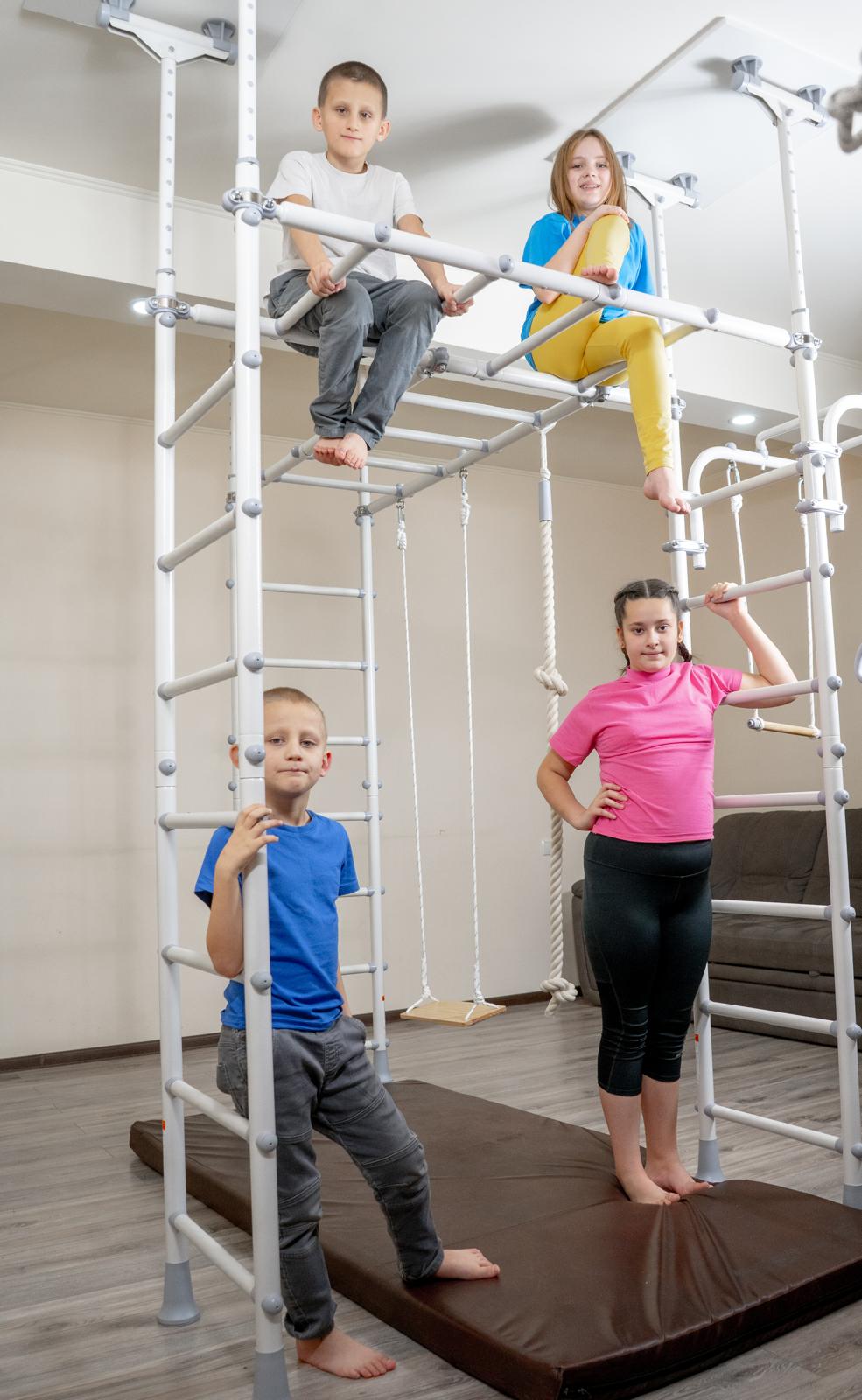
A Brainrich gym in a homeschool is not a toy that happens to be near the books. It is the recess replacement: the standing answer to "we finished the lesson, now what does the body get?" It works between subjects, before breakfast, and through every month the weather cancels. And it descends from the Swedish gymnastics tradition, the same wall-bars (Swedish ladder) lineage that equipped school gymnasiums across Europe for over a century, re-engineered in powder-coated steel for a family home. Our founder grew up on one in his childhood gym in Ukraine; your child gets the version with 250+ deliberate safety decisions built in.
The homeschool fit comes down to three things. Safety first: steel tested to double its 220 lb rating, a pressure-fit frame with no wobble, no splinters, no joints that loosen, and impact mats in the landing zones, because a structure used daily and often independently has to be engineered for exactly that. It teaches one student at a time: adjustable bar heights mean the same gym serves a cautious 3-year-old and a fearless 9-year-old on the same afternoon, with the challenge rising only when each child is ready (independent climbing is rated ages 3+). It holds attention for years: nets, rings, monkey bars, and swappable accessories rotate the "curriculum" so the structure your kindergartner masters is the same one your fifth-grader is still inventing routes on.


Which gym fits your homeschool? Take the 60-Second Quiz →
Sources
Ray, B.D. (2026). How many homeschool students are there in the United States? National Home Education Research Institute. · Johns Hopkins University School of Education, Homeschool Hub. Homeschool growth 2024–2025. · EdChoice. School Choice in America dashboard (Education Savings Account program counts and funding).
New: shopping for a homeschooler? See Homeschool Gift Ideas That Get Used Every Day, sorted by budget, room, and age.
Share: