

Updated August 2026 · 14-min read · by the Brainrich Kids team
Every August, thousands of families print a beautiful homeschool schedule, color-coded by subject, blocked to the quarter hour. By October, most of those schedules are dead. Not because the family lacked discipline, and not because the curriculum was wrong, but because the schedule was missing the one structural element every school on earth builds in and almost no homeschool template includes: engineered movement. Schools alternate desks with recess, PE, and hallway transitions because children's attention runs on a rhythm. At home, nobody rings the recess bell, so you have to design it in yourself. This guide shows you how.
The quick answer: a homeschool schedule that survives past October is built on alternating blocks: 20–45 minutes of focused work, then a real movement block, then back to focus. Total seat work is far less than a school day—roughly 1–2 hours for kindergarten, 2–4 hours for elementary—which is why the popular "4-hour homeschool schedule" works. Pick a chassis (block, loop, or year-round), anchor the day to a rhythm instead of clock times, and protect the movement blocks the way schools protect recess. Research associates activity breaks with better on-task behavior afterward, and pediatricians call the break itself necessary for cognition—so the movement is not a reward for finishing the schoolwork. It is what makes the schoolwork happen.
Jump to: Why schedules collapse · The movement block · Block vs. loop vs. year-round · 4 sample days · Build your own · Failure modes · FAQ
Why most homeschool schedules collapse by October
Talk to veteran homeschoolers about their first year and you will hear the same story: they rebuilt school at the kitchen table. A 8:30 start, six subjects in a row, a schedule that looked like a class timetable. It usually survives about six weeks.
Here is the piece that gets missed. A school day looks like six hours of instruction, but it is actually a long chain of interruptions: the walk to school, morning announcements, the transition between classrooms, recess, PE, lunch, lining up, packing up. The actual focused instruction inside a six-hour school day is a fraction of it—which is exactly why homeschoolers keep discovering they can cover the same material in a few hours. But when families cut the school day down to its academic core, they usually cut the movement out with it, and the movement was never filler. It was the machinery that made the focus possible.
The result is predictable: a child who did beautiful work at 9:00 is sliding off the chair by 10:15, the parent starts narrating ("sit up, focus, we're almost done"), the lesson stretches to fill the resistance, and by week six everyone dreads the table. The schedule gets blamed. The curriculum gets replaced. But the real problem was structural: focus was scheduled, and movement was not.
The American Academy of Pediatrics made this point about schools years ago in its recess policy statement, calling recess "a necessary break in the day" for a child's cognitive development—necessary, not optional, and the statement is explicit that the break should not be withheld to squeeze in more academics. If pediatricians defend recess that hard inside a building full of teachers, the version of school with one adult and no gymnasium needs it at least as much.
The movement block: the spine of a schedule that holds
So the first design decision of your homeschool schedule is not which curriculum goes at 9:00. It is this: after every focus block, where does the energy go?
A movement block is 15–30 minutes of genuinely physical activity between lessons: climbing, swinging, hanging, a walk to the park, a backyard obstacle course, a bike loop. Not a screen break, not "go play quietly"—actual large-muscle work that raises the heart rate and works the body hard enough to reset the mind. The research on what happens to attention afterward is one of the better-studied corners of education science:
In a study of 243 elementary students, researchers introduced short classroom activity breaks called Energizers and observed on-task behavior before and after. After the breaks were implemented, on-task behavior during academic time improved by about 8%—and the students who struggled most to stay on task improved by about 20%. The least focused kids gained the most from moving.
MAHAR ET AL., MEDICINE & SCIENCE IN SPORTS & EXERCISE, 2006 · READ THE STUDY
That study is not alone. A review by Donnelly and Lambourne reported that physically active academic lessons were associated with a 6% improvement on a standardized achievement test, while the control group slipped slightly. And a 2017 systematic review and meta-analysis of classroom-based physical activity interventions found the most consistent positive association was with on-task behavior—the exact thing homeschool parents fight for at the kitchen table every morning.
Two important cautions, because we promised you precision. First, this research is associational and school-based: it tells us activity breaks and better subsequent focus tend to travel together in classrooms, not that a gym session guarantees a compliant phonics lesson. Second, none of it says more academics per day is better. It says the alternation is the active ingredient. For scale, the CDC's guidance is that children 6–17 need at least 60 minutes of moderate-to-vigorous activity daily, and preschoolers should be active throughout the day. Three or four movement blocks gets a homeschooled child there without a single minute labeled "exercise."
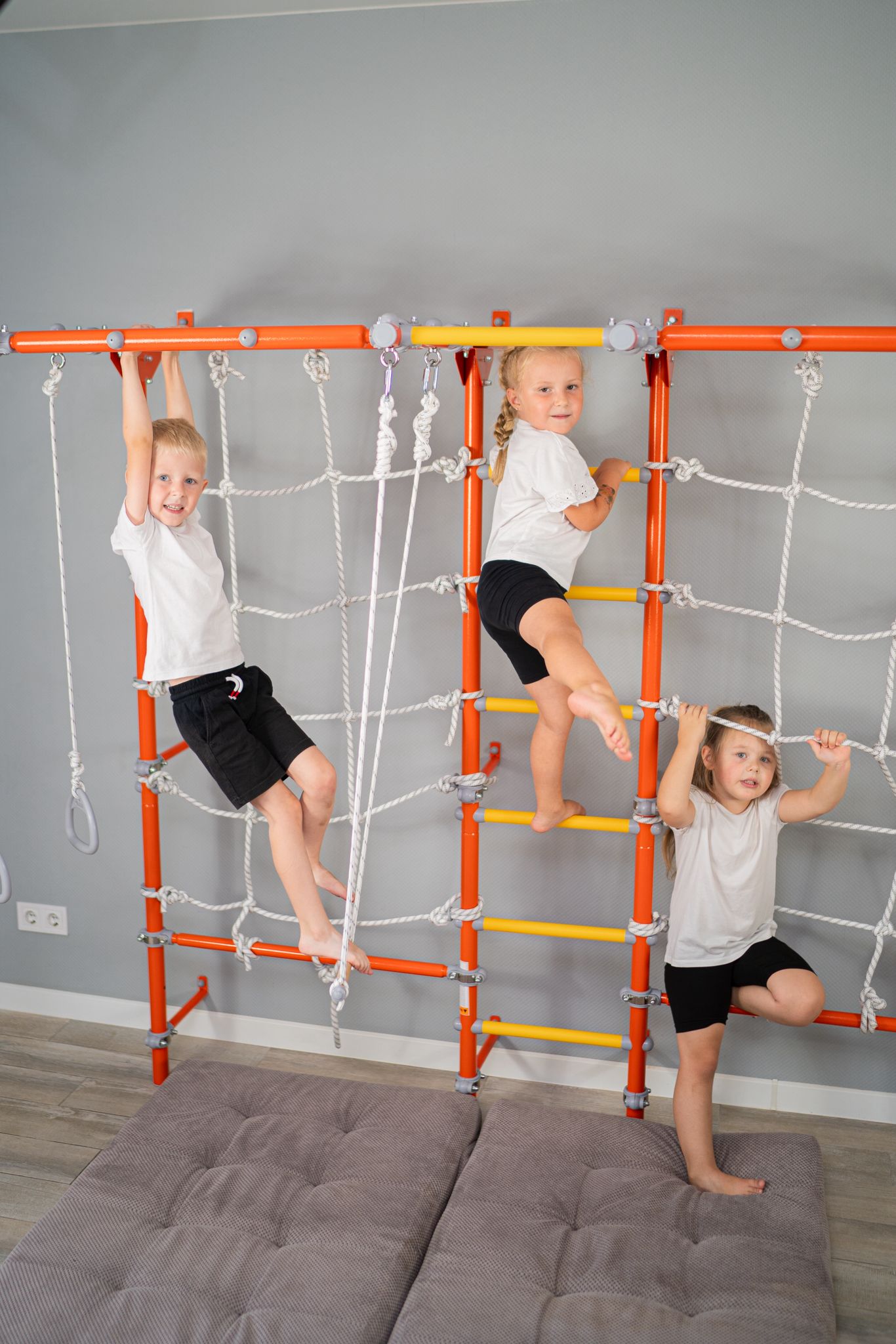
Where the movement happens is up to your house and your weather. Outdoors is wonderful and we will never argue against a park morning. But a schedule can only rely on what is available every single day at 10:15, in February, during a rain week, while the baby naps—which is why so many homeschool families anchor the movement block to an indoor gym, a pull-up bar, a sensory corner, or a hallway obstacle course. The point is not the equipment. The point is that the movement block has to be as reliable as the math block, or the schedule reverts to all-chairs by November.
Block, loop, or year-round: pick your chassis
With the focus-movement rhythm as your spine, you still need a chassis: the system that decides what gets taught when. Three dominate the homeschool world, and they solve different problems:
| Chassis | How it works | Best for | Watch out for |
|---|---|---|---|
| Block schedule | Fixed daily blocks: math and reading every day, other subjects in assigned slots. The classic daily homeschool schedule. | Kids who thrive on predictability; parents who want to know Tuesday looks like Tuesday. | Rigidity. One dentist appointment and the day feels "ruined." Build in one empty block as a shock absorber. |
| Loop schedule | Daily anchors (math, reading) stay fixed; everything else lives on a loop list (science → history → art → music). Do the next thing on the loop, however long it takes; pick up where you left off tomorrow. | Families who kept "falling behind" on Friday subjects; anyone who wants a flexible homeschool schedule without abandoning structure. | Loops hide drift. If science hasn't surfaced in two weeks, your loop is too long. |
| Year-round schedule | School in 6-week sprints with a full week off between (often called "sabbath schooling"), lighter summers instead of none. Roughly the same 36 weeks, redistributed. | Avoiding the summer slide and the September restart-from-zero; families whose energy runs in bursts. | Feels strange when the neighborhood kids are off. Decide your off-weeks a year ahead or they evaporate. |
These are not competing philosophies—plenty of families run a year-round calendar of 6-week sprints, with a block schedule for mornings and a loop for afternoons. The chassis question is simply: what does your family keep failing at? Falling behind on the "extra" subjects points to a loop. Chaos and negotiation every morning points to blocks. Burnout every November and a lost September points to year-round.
Four sample days you can steal
All four days below share the same skeleton—focus, move, focus, move—tuned to different families. Treat the times as a rhythm, not a contract: the order matters far more than the clock. (Looking for homeschool schedule ideas for a specific age? These scale up and down; the kindergarten version gets its own full guide with sample days here.)
1. Kindergarten (the short version)
| Rhythm | Block | Notes |
|---|---|---|
| ~9:00 | Morning movement (20–30 min) | Climb, swing, dance, park. Body first, letters second. |
| ~9:30 | Table time #1 (15–20 min) | Phonics or letters. Stop while it's still going well. |
| ~10:00 | Movement + snack | The recess you're not skipping. |
| ~10:45 | Table time #2 (15–20 min) | Numbers and counting, games over worksheets. |
| ~11:15 | Read-aloud on the couch | The academic heavyweight of kindergarten, disguised as snuggling. |
| Afternoon | Free play, outside time, rest | Done. Total seat work: 30–40 minutes, and that is genuinely enough at 5. |
2. Elementary (the 4-hour day)
| Rhythm | Block | Notes |
|---|---|---|
| 8:30 | Morning movement (30 min) | Bike, gym circuit, monkey-bar challenge. Front-load the wiggles. |
| 9:00 | Focus block #1: math (40 min) | Hardest subject first, while attention is freshest. |
| 9:40 | Movement block (20 min) | Timer on. Child picks: climb, swing, hang, obstacle course. |
| 10:00 | Focus block #2: language arts (40 min) | Reading, writing, spelling on rotation. |
| 10:40 | Movement + snack (30 min) | The big one. Outside when possible, gym when not. |
| 11:10 | Focus block #3: loop subject (40 min) | Science → history → geography → art, next on the loop. |
| 12:00 | Lunch + free play | Real break, no agenda. |
| 1:00 | Quiet block: reading or audiobook (30–45 min) | Everyone reads, including you. Then the school day is over. |
3. Multi-age (teaching multiple grades at once)
The trick with multiple grades is that you cannot be in two focus blocks at once—so you stagger them, and the movement block becomes your teaching slot: one child works their body while you work one-on-one with the other.
| Rhythm | Older child (grade 3+) | Younger child (K–1) |
|---|---|---|
| 9:00 | Morning basket together: read-aloud, memory work, calendar | Same—this is the one truly shared block |
| 9:30 | Independent math practice | Movement block (in sight, not underfoot) |
| 10:00 | Movement block | Table time with you (15–20 min) |
| 10:30 | Math lesson with you | Free play nearby |
| 11:00 | Both kids: movement + snack, then loop subject done together at each child's level | Science for a 9-year-old is science for a 6-year-old with different questions |
| 12:00 | Lunch, free afternoon; older child finishes independent work | Done for the day |
One warning about the swap system: it only works if the movement station holds attention without you. A basket of fidget toys will not buy you 20 minutes of one-on-one math. A climbing gym, a swing, or a serious obstacle course will—this is the single most common reason homeschool families of multiple kids tell us they bought one.
4. The working-parent schedule
Homeschooling while working—from home, part-time, or split-shift with a partner—means the schedule serves your calendar, not the other way around. The design rule: pin the focus blocks to the hours you are actually available, and make everything else independent-friendly.
| Rhythm | Block | Who's driving |
|---|---|---|
| 7:30 | Focus block #1: math with parent (30–40 min) | You, before work starts |
| 8:15 | Movement block | Child, solo—while you start your workday |
| 9:00 | Independent work: assigned reading, practice apps, copywork checklist | Child, with a visible checklist |
| 10:30 | Movement + snack | Child; you wave from the desk |
| 12:00 | Lunch together + focus block #2 (30 min) | You, on your lunch break |
| Afternoon | Audiobooks, documentaries, free play, outside time | Child; light-touch |
| Evening or Sat AM | Catch-up block: review the checklist, loop subject together | You or partner; year-round calendars help absorb busy work weeks |
Notice the load-bearing wall in that day: the child has to be able to burn energy safely without your hands-on supervision. That is a genuinely different requirement from a stay-at-home schedule, and it is worth solving with equipment engineered for solo use—rated structures, impact mats, challenges that a child can self-dose—rather than improvised couch-cushion parkour in the next room.
Build your own: the 5-step template
Rather than handing you a printable that fits nobody, here is the template process—the same one behind all four sample days:
1. COUNT YOUR REAL FOCUS BLOCKS
Kindergarten: two blocks of 15–20 min. Elementary: three blocks of 30–40. Middle school: four of 45. That's the whole academic day.
2. SLOT A MOVEMENT BLOCK AFTER EACH ONE
15–30 minutes, real exertion, zero screens. This is scheduled, named, and non-negotiable—exactly like the math it protects.
3. ANCHOR TO RHYTHM, NOT CLOCK
"Math after breakfast, reading after the mid-morning climb" survives a slow morning. "9:00 sharp" dies on contact with real life.
4. PICK YOUR CHASSIS
Blocks for predictability, a loop for the subjects you keep dropping, year-round sprints if every November burns you out.
5. RUN IT FOR 3 WEEKS, THEN EDIT
Change nothing for three weeks; note where friction repeats. Then adjust one variable at a time. A schedule is a draft, forever.
The five ways homeschool schedules die
| Failure mode | The fix |
|---|---|
| Recreating school. Six subjects daily, 8:30–3:00, desk-bound. Burnout for everyone by fall break. | Cut to the real focus-block count for the age (step 1 above). A 4-hour homeschool day is not a shortcut—it's the correct dose. |
| Movement as a reward. "Finish the worksheet, then you can climb." The kids who most need to move are the ones who never earn it. | Movement blocks are scheduled infrastructure, not currency. Recall the Mahar finding: the least on-task kids gained the most from moving. Withholding movement from a struggling child removes the one intervention associated with helping. |
| Stretching lessons to fill resistance. The 20-minute lesson takes 50 because the child melted down at minute 21. | End the block on time even mid-worksheet. Ending on a win beats finishing on a fight, and tomorrow's block starts warmer. |
| The February collapse. The schedule assumed the park, and then winter happened. Movement quietly became screens. | Design the indoor default before you need it: a gym, a swing, a hang bar, heavy-work stations. Outdoors when you can, engineered indoors when you can't. |
| Scheduling for the child you wish you had. Forty-minute blocks for a child whose real ceiling is twenty. | Time the actual child for a week and build from observed attention, not grade-level norms. (For high-energy and ADHD kids, shorter blocks and more frequent movement—we wrote a full movement-first ADHD guide.) |
Which gym fits your homeschool? Take the 60-Second Quiz →
The movement station your schedule keeps pointing at
Every sample day above has the same recurring block, and it needs somewhere reliable to happen—rated for daily use, safe enough for the independent stretches, engaging enough that a timer feels too short. That is the job we build for. One structure covers the morning wake-up climb, the between-blocks reset, the multi-age swap system, and the February problem, for every child in the house ages 3 and up. (Researchers also associate this kind of daily climbing and swinging with motor-skill and confidence gains that reach well beyond the schedule—we walk the evidence here. And if you're funding your homeschool through an ESA or similar program, see the grants and funding guide.)


Give the movement block a permanent address
Every gym assembles in an afternoon and is covered by a 30-day money-back guarantee.
Frequently asked questions
How many hours a day should homeschooling take? Far fewer than school hours, because a homeschool day is nearly all instruction while a school day is mostly logistics. A workable daily homeschool schedule runs 30–60 minutes of seat work for kindergarten, 2–3 hours for lower elementary, 3–4 for upper elementary, and 4–5 for middle school—split into short focus blocks with movement between them, never served as one sitting.
Is a 4-hour homeschool schedule really enough? For elementary, yes—and it is closer to standard practice than a shortcut. Four hours of one-on-one focused work exceeds the focused instruction most children receive in a full classroom day. The catch: the 4 hours only stay productive if they are broken up by real movement, which is the entire argument of this article.
What time should homeschool start each day? Whenever your family is actually functional, which is a genuine advantage—use it. Anchor the schedule to a sequence (movement, then math, then break) instead of a start time, and the day survives slow mornings, appointments, and a baby who was up at 4 a.m.
What is loop scheduling in homeschool? Daily anchor subjects (usually math and reading) happen every day, while everything else sits in an ordered loop—science, history, art, music. Each day you do the next loop subject, however far you get, and continue from there next time. Nothing is ever "behind"; everything simply comes around again. It is the easiest flexible homeschool schedule to actually maintain.
What is a year-round homeschool schedule? The same ~36 weeks of school redistributed across all 12 months, most commonly as six-week terms with a full week off between and a lighter summer. Families use it to avoid the summer slide, the brutal September restart, and the November burnout—and the off-weeks land in months when parks and museums are empty.
Can you homeschool with a full-time job? Many families do, and the schedule looks different rather than longer: focus blocks pinned to parent-available hours (early morning, lunch, evening), independent work and movement blocks holding the middle of the day, and a weekend catch-up block as the shock absorber. The prerequisite is a safe, engaging way for the child to burn energy without hands-on supervision—solve that first and the rest of the day gets dramatically easier.
How do I schedule homeschool for multiple grades? Stagger, don't duplicate: share one combined morning block (read-aloud, memory work), then swap—one child in a movement block while you teach the other one-on-one, then switch. Content subjects like science and history can be taught once to everyone, with output scaled by age. The swap only works if the movement station genuinely occupies a child solo.
Do homeschoolers need scheduled PE? Some states require documented physical education, and the CDC's activity recommendation for ages 6–17 is at least 60 minutes daily regardless of schooling. The movement-block structure meets that bar automatically—three or four blocks a day adds up past an hour without a single lesson labeled "PE." For requirements, logs, and a full K–6 program, see our Homeschool PE at Home guide.
📚 Keep reading in the Homeschool Hub
Kindergarten Homeschool Schedule: Sample Days That Fit a 5-Year-Old · Homeschool PE at Home · Homeschool Room Ideas · The Homeschool Hub
Sources
Mahar, M.T. et al. (2006). Effects of a classroom-based program on physical activity and on-task behavior. Medicine & Science in Sports & Exercise. · Donnelly, J.E. & Lambourne, K. (2011). Classroom-based physical activity, cognition, and academic achievement. Preventive Medicine. · Watson, A. et al. (2017). Effect of classroom-based physical activity interventions on academic and physical activity outcomes: a systematic review and meta-analysis. International Journal of Behavioral Nutrition and Physical Activity. · American Academy of Pediatrics, Council on School Health (2013). The Crucial Role of Recess in School. Pediatrics. · Centers for Disease Control and Prevention. Physical Activity Recommendations for Children and Teens.
Share: