

Updated August 2026 · 10-minute read · by the Brainrich Kids team
Homeschool families have quietly become the best-funded buyers of children's movement equipment in the country—not because anyone raised their income, but because three separate systems can now help pay: medical accounts (HSA/FSA), state education money (ESA), and disability waivers. The trouble is that each lane has its own money, its own logic, and its own paperwork, and mixing them up is the fastest way to a denied claim. This guide keeps the three lanes straight.
The quick answer: HSA and FSA are medical accounts—your own pre-tax dollars, spendable on equipment only when a licensed provider documents that it treats a specific diagnosed condition (a letter of medical necessity). An ESA is state education money—spendable on equipment only where your program's allowable-expense list has a PE or supplemental-materials category, justified educationally rather than medically. Disability waivers are a third lane—Medicaid-based services that can fund adaptive and sensory equipment through a child's service plan. One purchase runs through one lane; the skill is picking the lane where your family's facts are strongest.
This article is informational only—it is not tax, medical, or legal advice, and no funding route is ever guaranteed. Confirm the current rules with your plan administrator, program, or case manager before purchasing.
Jump to: Three pots of money · The medical lane (HSA/FSA) · The education lane (ESA) · The waiver lane · The comparison table · Picking your lane · FAQ
Three pots of money, three different questions
Every funding conversation about a play gym, sensory swing, or PE setup eventually comes down to a single question the reviewer is silently asking. The lanes differ because the question differs:
🩺 HSA / FSA ASKS
"Is this medical care for a diagnosed condition?" Movement being good for kids is not enough—the IRS standard is treatment or mitigation of a specific condition, documented by a provider.
🎓 ESA ASKS
"Is this education—does it appear on our allowable-expense list, tied to the student's learning?" A written PE curriculum does the work here that a diagnosis does in the medical lane.
🧩 WAIVERS ASK
"Is this in the child's service plan?" Waiver funding follows an assessed need written into a person-centered plan by a case manager—not a receipt you submit afterward.
Same product, three different justifications. Answer the wrong lane's question—a medical letter sent to an ESA, an education plan sent to an FSA administrator—and a fundable purchase gets denied on framing alone.
The medical lane: HSA and FSA
Both accounts hold your own pre-tax money for qualified medical expenses, but they behave differently. An HSA belongs to you: it requires a high-deductible health plan, the 2026 contribution limits are $4,400 for self-only and $8,750 for family coverage (plus $1,000 catch-up at 55+), balances roll over forever, and the account follows you between jobs. An FSA belongs to your employer's plan: you elect up to $3,400 for 2026, the election locks for the year, and unused money is forfeited beyond a small carryover (up to $680) or a short grace period—your plan offers one or the other, not both. The FSA's use-it-or-lose-it deadline is exactly why December sees so many eligible-expense questions.
What both accounts can buy is defined by the tax code's definition of medical care: expenses for the diagnosis, mitigation, treatment, or prevention of disease. Items that are "merely beneficial to general health" are excluded. Exercise and play equipment sits in the dual-purpose category—not eligible by default, but potentially eligible when it treats a specific diagnosed condition. The bridge is a letter of medical necessity (LMN): a licensed provider (often the child's occupational therapist or pediatrician) documents the diagnosis—autism, ADHD, sensory processing disorder, a motor delay—and states that the equipment is recommended to treat or mitigate it. Administrator eligibility lists say this plainly: "exercise equipment may be eligible for reimbursement with a Letter of Medical Necessity." Our LMN guide covers what a strong letter contains, and our play gym HSA/FSA eligibility guide walks the whole process end to end.
One warning belongs in bold. In 2024 the IRS publicly warned against companies selling mass-produced doctor's notes based on self-reported information, stating that such notes do not convert personal expenses into medical care—and that claims relying on them will be denied. A real LMN comes from a provider who actually treats your child and ties the equipment to a specific therapeutic goal. That is the version administrators approve, and the only version worth your time.
IRS ALERT IR-2024-65, MARCH 2024
Two limits to respect. First, approval is administrator-discretionary: your plan's administrator adjudicates each claim individually, and identical claims can be approved by one administrator and denied by another—ask yours before you buy, not after. Second, the dollars are finite: a $3,400 FSA election has to cover the whole family's medical year, so large equipment purchases are more often an HSA conversation than an FSA one.
The education lane: ESA
An education savings account flips every assumption of the medical lane. The money is the state's, not yours—deposited for your child's education under program rules. No diagnosis is needed (outside disability-specific programs), no LMN, no health plan. What's needed instead is an educational justification: the purchase must fit a category on your program's current allowable-expense list, and for equipment the strongest fit is a physical education or supplemental-materials category backed by a written PE plan.
How far that goes depends entirely on your state. Arizona's 2025–26 handbook names "physical education equipment" and "playground" as supplemental materials that are allowed with curriculum documentation; Florida's purchasing guides allow home playsets, swing sets, exercise equipment, and sensory swings; Arkansas caps PE spending at 25% of the award and requires written state preapproval for non-core purchases, so equipment approval there is unlikely; Utah and West Virginia exclude play equipment by rule; Iowa and Tennessee restrict their programs to private-school students entirely. The program-by-program detail—amounts, purchase mechanics, appeals—is the subject of our companion guide, Can You Buy PE and Play Equipment With ESA Funds?, and the wider funding landscape (grants, co-ops, charter stipends) lives in the state-by-state grants guide.
The ESA lane's distinctive risk is also worth naming: rules are re-issued every year and enforced by audit, so the allowable list you read last August may not be this August's list. Check your program's current allowable-expense list the week you buy—every time.
The third lane: disability waivers
For children with significant disabilities there is a lane many families discover late: Medicaid home and community-based services (HCBS) waivers. Every state and DC operates them, and many waive parental income when qualifying a child with a disability—which is why they reach families the other lanes miss. Waivers fund services and equipment written into a child's person-centered service plan, which can include adaptive and sensory equipment where the state's waiver defines those services. Whether sensory or therapy equipment is coverable, and how long the waitlist runs, varies enormously by state—a case manager can tell you what your state's waiver covers and how the equipment request process works. Our state disability waiver guide maps this lane in detail.
The master comparison
| Account | Whose money | Qualifying rationale | Typical process | Where equipment can fit |
|---|---|---|---|---|
| HSA | Yours (pre-tax; requires a high-deductible health plan; rolls over, portable) | Medical—treats a diagnosed condition | Obtain LMN from treating provider → buy → keep records; administrator or IRS may review | Dual-purpose exercise/sensory equipment with a condition-specific LMN; administrator-discretionary |
| FSA | Yours via employer plan ($3,400 election for 2026; use-it-or-lose-it beyond $680 carryover or grace) | Medical—same standard as HSA | LMN → claim to plan administrator → approval or denial before reimbursement | Same as HSA, but the smaller annual pool limits large purchases |
| ESA | The state's, directed by you (~$2,000–$10,000/yr depending on program) | Educational—fits the program's allowable-expense list, tied to a curriculum | Marketplace, direct pay to approved vendor, or receipt reimbursement; audits and appeals per program | PE/supplemental-materials categories where offered (Arizona with curriculum documentation, Florida explicitly; Arkansas capped and preapproval-only, so unlikely; several states exclude) |
| Disability waiver | Medicaid's, via the state (parental income often waived for the child) | Assessed need in the child's person-centered service plan | Case manager writes equipment/service into the plan; state approves; waitlists common | Adaptive and sensory equipment where the state's waiver covers it—state-dependent, never promised |
Picking your lane (and using more than one)
A single purchase goes through a single lane—you cannot reimburse the same receipt twice—but families are not limited to one lane across the year. A practical way to sort it:
Start with the ESA if your state has an equipment-friendly one. It is the state's money rather than your own, and in Arizona or Florida the equipment category is named (Arizona asks for curriculum documentation). Your medical dollars stay free for actual medical needs.
Go medical when the facts are medical. If your child has a diagnosis and a treating provider who already recommends vestibular or proprioceptive input—common for kids with autism, ADHD, or sensory processing differences—an LMN-backed HSA purchase matches the strongest justification to the purchase. This is also the only lane available in states with no ESA, no equipment category, or private-school-only programs.
Ask about a waiver when disability is central. If your child has or may qualify for Medicaid waiver services, ask the case manager whether sensory equipment fits the service plan before spending your own account dollars on it.
And split thoughtfully. A family in Florida's FES-UA might buy the gym through the ESA's PE category and reserve the HSA for therapy copays; a family in Iowa (no homeschool ESA) leans on the LMN route; a family in Arkansas, where the ESA needs written state preapproval and is unlikely to approve equipment, funds the structure another way. The lanes reward matching, not maximizing.
Which gym fits your family? Take the 60-Second Quiz →
If a lane opens for your family
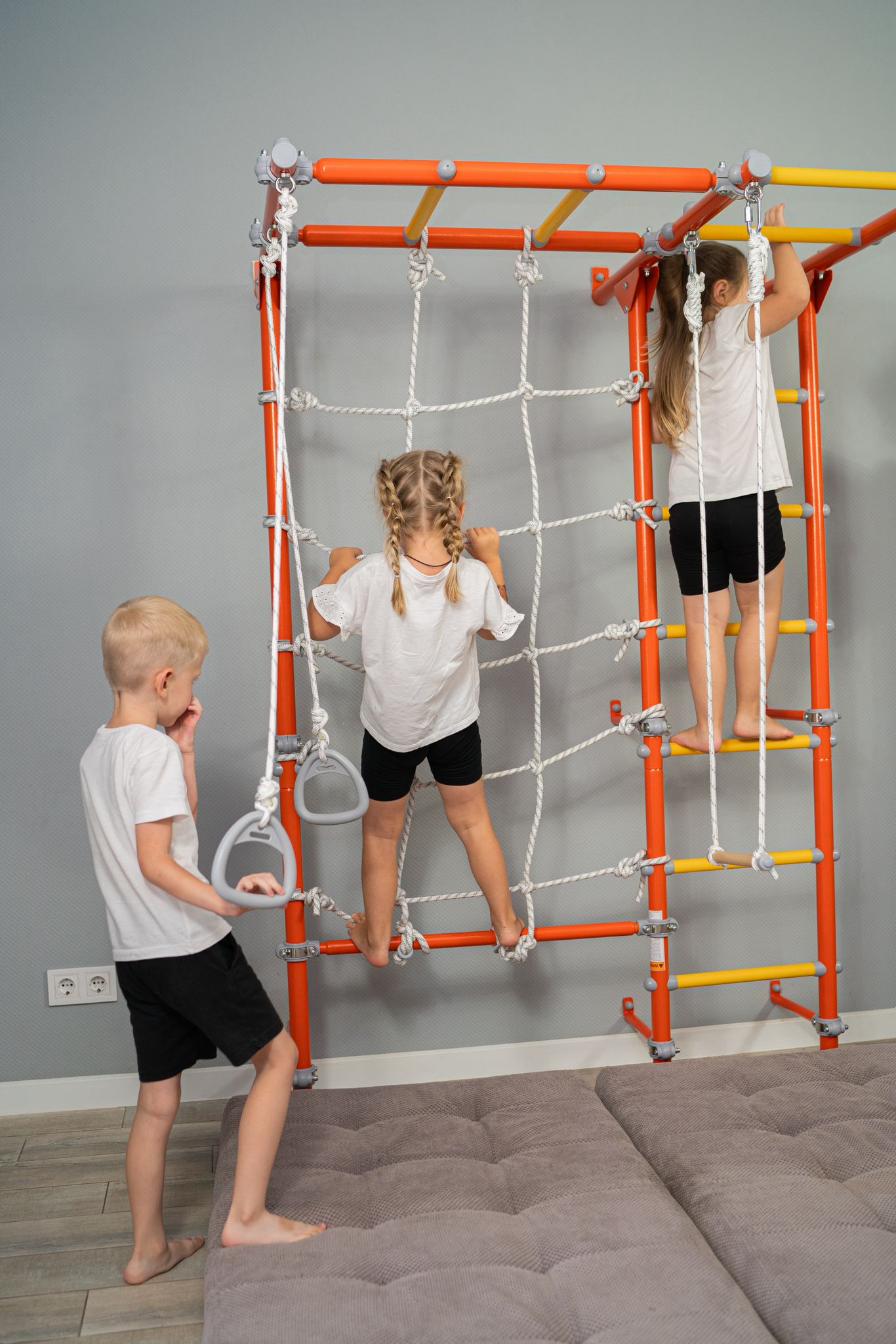
Whichever justification fits—an ESA PE category, a provider's LMN, or a waiver service plan—the equipment itself should be worth the paperwork. These are the three gyms we build, each engineered for daily indoor use from age 3 up:


Want the full funding map?
Our funding page collects every route in one place, and every gym is covered by a 30-day money-back guarantee.
Frequently asked questions
Can I use both an HSA and an ESA for the same purchase? No—one purchase, one funding source. Reimbursing the same receipt from two systems would misrepresent the expense to at least one of them. Families can absolutely use different lanes for different purchases in the same year, which is usually the smarter structure anyway.
Do I need a diagnosis to use HSA or FSA money on play equipment? Effectively yes. The IRS standard requires the expense to treat or mitigate a specific medical condition, documented in a letter of medical necessity from a licensed provider who treats your child. Without that, exercise and play equipment is a general-health expense, which these accounts cannot cover—and the IRS has explicitly warned against purchased boilerplate letters.
Do I need a diagnosis to use ESA funds? For most universal ESA programs, no—the justification is educational, typically a PE or supplemental-materials category plus a documented curriculum. Disability-specific programs like Florida's FES-UA do require a qualifying diagnosis, and in exchange tend to have the most generous equipment and sensory categories.
Which lane is fastest? Usually the ESA marketplace route, since catalog items are pre-vetted. LMN-backed HSA purchases move at the speed of your provider's paperwork and your administrator's review. Waivers are the slowest lane—service plans and waitlists—but reach families and dollar amounts the other lanes cannot.
What are the 2026 contribution limits? HSA: $4,400 self-only, $8,750 family, plus a $1,000 catch-up at 55 or older (IRS Rev. Proc. 2025-19). Health FSA: $3,400 salary-reduction limit with a $680 maximum carryover (Rev. Proc. 2025-32). ESAs have no contribution limit because the state funds them—awards in equipment-friendly programs run roughly $6,800–$10,000 a year, with Texas's homeschool tier at $2,000.
Is a play gym guaranteed to be covered by any of these? No, and be wary of anyone who says otherwise. Every lane runs on individual review: the plan administrator for HSA/FSA, the program's allowable list and auditors for ESA, the service plan for waivers. What you control is matching the purchase to the right lane and documenting it well—our guides on HSA/FSA eligibility and ESA equipment rules show exactly how.
📚 Keep reading in the Decision Guide
Can You Buy PE Equipment With ESA Funds? · Is a Play Gym HSA/FSA Eligible? · The Letter of Medical Necessity Guide · State Disability Waiver Programs · Homeschool PE at Home · The Homeschool Hub
Sources
Internal Revenue Service. Rev. Proc. 2025-19: 2026 HSA and HDHP inflation-adjusted amounts. · Internal Revenue Service. IR-2024-65: Beware of companies misrepresenting wellness expenses as medical care. · Internal Revenue Service. Publication 969: Health Savings Accounts and Other Tax-Favored Health Plans. · Newfront. 2026 health FSA limit increases to $3,400 (Rev. Proc. 2025-32). · FSA Store. Exercise equipment eligibility. · Arizona Department of Education. ESA Parent Handbook 2025–2026. · Step Up For Students. PEP Purchasing Guide. · EdChoice. What is an Education Savings Account? · Autism Speaks. Home and community-based services (HCBS) waivers.
Share: