

Updated August 2026 · 9-minute read · by the Brainrich Kids team
A four-year-old spins in circles until she falls over, laughs, gets up, and spins again. Her brother watches TV upside down, head hanging off the couch. At dinner both of them rock their chairs onto two legs. None of this is misbehavior, and none of it is random: all three kids are feeding the same sense, one most parents have never heard of. Here is what vestibular input is, why children chase it so relentlessly, and how to give it a proper home.
The quick answer: vestibular input is the sensation of head movement and head position, detected by tiny receptor organs in the inner ear. It tells the brain which way is up, how fast the body is moving, and whether it is falling, and it is the foundation balance is built on. Kids crave it because the system develops through use: every spin, swing, and upside-down dangle is a rep. The practical rule OTs teach is that slow, linear movement calms (rocking, gentle swinging) while fast or spinning movement alerts (save it for daytime). A swing is the classic delivery vehicle, which is why one hangs in nearly every OT clinic, and why the home question is really a mounting question: swings hang best from a free-standing frame, not a hole drilled in your ceiling.
Jump to: What the vestibular system is · The pedigree · Seekers and the motion-cautious · Activities by intensity · How OTs use swings · The home setup · FAQ
What is vestibular input, in parent language
Deep in the inner ear, right next to the hearing organ, sits a small cluster of fluid-filled structures: three looped canals and two little chambers lined with sensors. When the head turns, the fluid in the canals lags behind and bends microscopic hairs, and the brain reads the bend as rotation. When the head tilts or moves in a line, tiny crystals in the chambers shift against their sensors, and the brain reads that as gravity and speed. The National Institute on Deafness and Other Communication Disorders describes this system as central to knowing where you are in space, keeping your balance still or in motion, and holding your vision steady while your head moves.
That is the vestibular system. You never notice yours precisely because it works: it is the reason you can read a street sign while walking, or stand on one leg with your eyes closed for at least a moment.
OTs often call it one of the "hidden senses," alongside proprioception, the muscle-and-joint sense we covered in our heavy work guide. Taste, touch, sight, smell, and sound report on the world. Proprioception and the vestibular sense report on your own body, and a child's brain is still calibrating both. That calibration happens one way: through movement. Which is why a preschooler treats spinning the way a teenager treats snacks. The behavior that looks pointless to an adult, spinning until dizzy, rolling down the same hill nine times, dangling upside down until their face turns red, is a child self-administering exactly the input their balance system is asking for.
The pedigree: who taught us to see it this way
The vocabulary in this article did not come from marketing. It comes from a specific line of clinicians and authors that sensory-aware parents still read today:
A. Jean Ayres is the source. An occupational therapist and neuropsychologist working from the 1950s through the 1970s, Ayres built sensory integration theory, the framework that treats behavior as the visible output of how a brain organizes sensation. She put the vestibular system near the center of that framework, describing it as an organizer that other senses build on, and her 1979 parent classic Sensory Integration and the Child is still the book OTs hand to families first. The swinging and spinning equipment in every sensory clinic descends from her practice, and the terms "vestibular" and "proprioceptive" reached parents through her work.
Patricia Wilbarger, another occupational therapist in the Ayres lineage, coined the term "sensory diet": the idea that movement input works best scheduled through the day in regular doses, like meals, rather than binged once at the weekend playground trip. Every "movement break" your child's teacher runs traces back to this idea.
Carol Stock Kranowitz translated the clinic for the kitchen table. The Out-of-Sync Child gave a generation of parents the words for kids who are "sensory seekers" or "sensory avoiders," and her activity books made vestibular play, spinning, swinging, rolling, hanging, a household project rather than a clinical one.
Different decades, one throughline: movement is not a break from development, it is the raw material of it.
Two kids, one system: seekers and the motion-cautious
The same vestibular system can be tuned differently in different kids. OTs describe two broad patterns, and most children live somewhere between them:
THE SEEKER (under-responsive: the system registers less, so the child orders more)
✓ Spins in circles and barely seems to get dizzy
✓ Hangs upside down off the couch as a default position
✓ Rocks the chair, bounces the leg, is always in motion
✓ Would swing for an hour if you let them
✓ Loves being tossed, flipped, and turned upside down
THE MOTION-CAUTIOUS KID (over-responsive: the system registers more, so the child orders less)
✓ Avoids swings and merry-go-rounds, or tolerates only the gentlest push
✓ Gets carsick easily
✓ Dislikes the head tipping back, so hair washing is a battle
✓ Clings to the rail on stairs, avoids feet leaving the ground
✓ Prefers to keep both feet planted and watch other kids climb
This is a conversation starter, not a diagnosis. The useful shift for a parent is the one Ayres taught clinicians: read the behavior as information. The spinner is not being wild, they are hungry for input. The swing-avoider is not being difficult, the input arrives too loud. Seekers need generous, safe access so the need gets met on purpose instead of off the furniture. Motion-cautious kids need the volume turned down: slow, low, linear movement they control themselves, never a surprise push.
Vestibular activities for kids, sorted by intensity
Not all movement input is equal. The variables OTs grade in a clinic are direction and speed, and you can use the same dial at home:
| Intensity | Activities | Typical effect, and when to use it |
|---|---|---|
| Slow and linear | Rocking chair, gentle back-and-forth in a hammock swing, slow swaying in a blanket held by two adults, riding on a parent's back at walking pace. | Calming. This is the input parents discover by instinct when they rock a baby. Use before bed, after school, after a meltdown, and as the entry point for motion-cautious kids. |
| Moderate and rhythmic | Regular swinging, jumping on a mini trampoline, hopscotch, bike riding, wheelbarrow walking. | Organizing. Good default for the daily movement diet, and easy to pair with the heavy work that helps most kids settle. |
| Fast or rotary | Spinning in an office chair, twirling in place, rolling down a hill, somersaults, spinning in a hammock swing wound up and released. | Alerting, and the strongest input on the list. Great for a sluggish morning, wrong before bedtime. Let the child drive the speed and stop at the first sign of too much: pale face, glassy eyes, queasiness. |
| Upside down | Hanging off the couch, downward dog, hanging by the knees from a bar with a mat and a parent below, forward folds in a cocoon swing. | Intense and, for many seekers, the most satisfying input there is. Keep it self-directed and supervised: a child who climbs into the position themselves is showing you they can handle it. |
Two rules carry across every row. First, the child controls the motion: self-directed input is self-limiting in a way that being spun by a big sibling is not. Second, watch the response, not the clock: vestibular input is powerful, and a kid who has had enough will show you before they can tell you.
Why there is a swing in every OT clinic
Walk into a pediatric OT gym and the ceiling is the first thing you notice: hooks, straps, and half a dozen swings. Platform swings, cocoon swings, tire swings, hammocks. The swing is the clinic's precision instrument for vestibular input because it lets the therapist grade everything: direction (linear glide or full rotation), speed, duration, and how much of the child's body is supported while the input arrives. A wide-open platform swing challenges balance; a snug hammock wraps the child in deep pressure while delivering gentle motion, which is why it doubles as a calm-down corner.
Home use is simpler than clinic use, and it should be: equipment at home supports regulation and play, it does not treat a condition. What a home swing borrows from the clinic is the schedule. Wilbarger's sensory-diet insight, small doses spread across the day, is the single most practical idea a parent can steal: ten minutes of swinging after school beats an hour on Saturday. Our sensory swings guide walks through the swing types one by one.
The home setup: what the swing actually hangs from
Here is where most families stall. The swing itself costs little. The question is the attachment point, and drilling a heavy-duty eye bolt into a ceiling joist is where many parents reasonably stop: you need to find the joist, drill it dead center, trust your own installation with a moving load, and live with a permanent hole you cannot relocate when the room changes. The clinic answer, a hook set in structural ceiling, was engineered for a building, not a bedroom.
The home answer is a frame that brings its own structure:
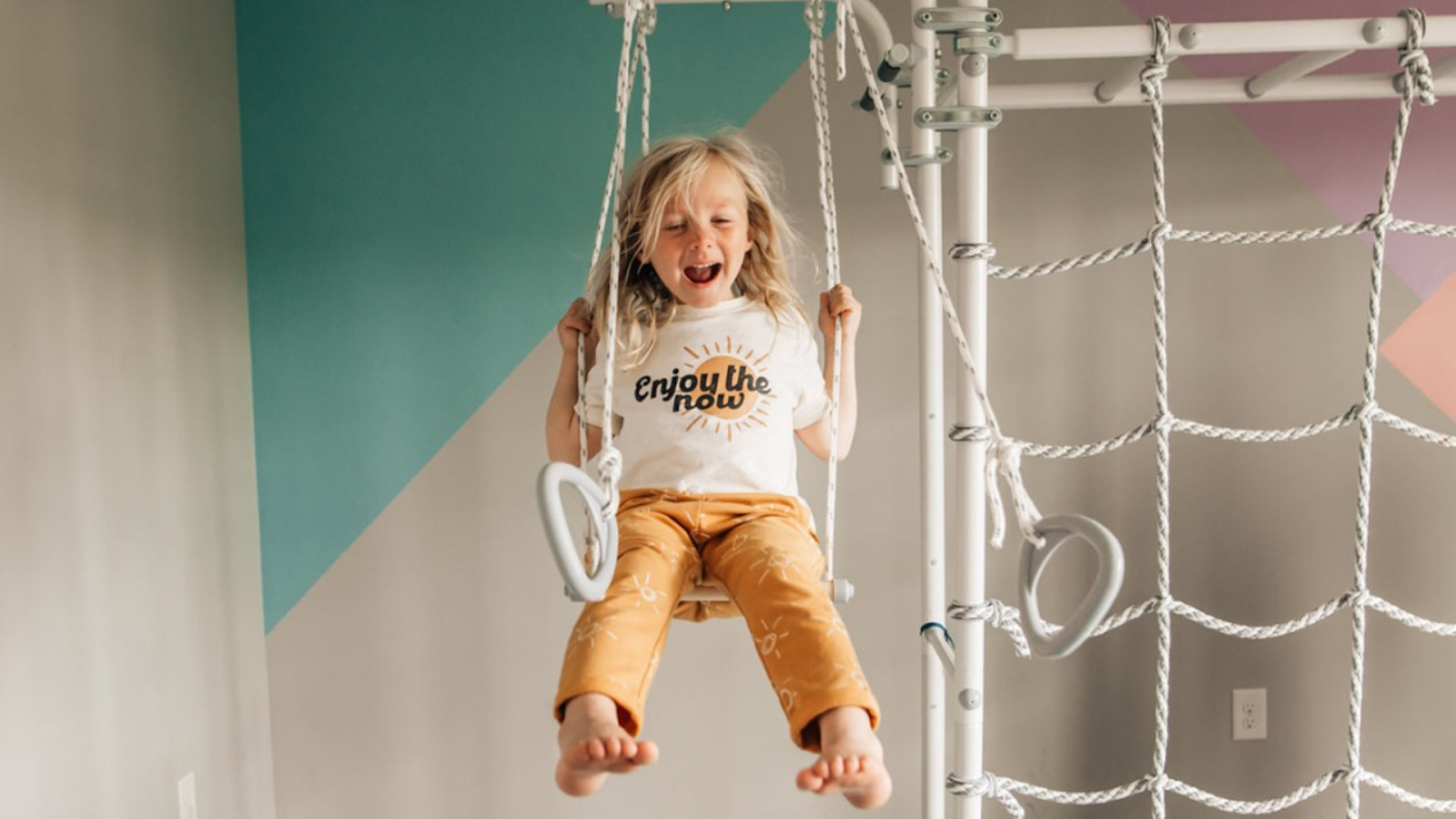
A floor-to-ceiling gym. Brainrich frames are steel, brace between floor and ceiling on telescopic poles with no drilling into joists, and are rated to 220 lb. A swing clipped to the monkey-bar span hangs in open space, which means 360-degree movement: linear gliding, full spinning, and nest-style swings all work, so the whole intensity table above is available in one corner of a room. The V3 span is about a foot longer than the previous generation with an added rung, so it fits wider swings and still leaves rungs free. Spider V3, Spider Max V3, and Mega Max V3 come with the span built in; owners of a Model T2 or T3 can add the Monkey Bars V3 attachment to an existing gym. The bars themselves are a vestibular device in their own right, swinging the head through arcs on every traverse, which is the subject of our indoor monkey bars guide.
A wall-mounted gym for small rooms. The steel Model W3 and W3 Max anchor to wall studs, protrude just 9 inches from the wall, and are certified to 220 lb. Wall proximity means linear swinging only: a small hammock swing glides front to back, which happens to be exactly the calming input from the top row of the table. No spinning and no nest swing, so if your seeker lives for rotation, choose the floor-to-ceiling frame. If your child is motion-cautious, a gentle linear hammock is precisely where an OT would start anyway.
The ground rules, whichever frame. Independent climbing and swinging suit ages 3 and up, younger siblings only with a parent's hands close by. A thick mat lives under the swing zone. And a parent stays in the same room: vestibular play is the good kind of intensity, and supervision is what keeps it that way. The full room plan, mats, zones, and what goes where, is in our home sensory gym guide.
When to talk to an OT: if motion fear keeps your child off playgrounds entirely, if seeking is so constant it crowds out eating and sleeping, or if daily regulation feels hard most days, that is a conversation for a pediatric occupational therapist who can see your child, and your pediatrician can refer you. Home equipment supports a child's regulation and play. It does not diagnose or treat anything, and this article is not medical advice.
FAQ
Why does my child spin in circles and never seem to get dizzy?
Kids OTs describe as vestibular seekers often register movement input less intensely, so it takes more spinning to produce the effect another child gets from one turn. The practical response is generous, safe, self-directed access to movement rather than trying to suppress it. If the seeking feels extreme or is disrupting daily life, that is worth raising with an OT.
Is hanging upside down bad for kids?
For healthy kids in play, brief, self-directed upside-down time is a normal and popular form of vestibular input. Keep it supervised with a mat below, let the child get into and out of the position themselves, and let them decide when they are done. A child with any medical condition affecting the head, neck, heart, or blood pressure should get positions like this cleared by their doctor first.
What is the difference between vestibular and proprioceptive input?
Vestibular input is head movement and head position, sensed in the inner ear: swinging, spinning, tipping upside down. Proprioceptive input is pressure and load through muscles and joints: pushing, pulling, carrying, hanging. Swinging is mostly vestibular, hanging from a bar is mostly proprioceptive, and monkey bars deliver both at once. The proprioceptive side has its own playbook in our heavy work guide.
Which swing should we start with at home?
A hammock or cocoon style swing is the most forgiving first swing: it delivers gentle linear motion, adds a calming wrap of pressure, and works for both seekers and cautious kids. Hang it from a frame rated for dynamic load, on a Brainrich gym that means the 220 lb certified steel span, and put a mat underneath. Our sensory swings guide compares every type.
Which gym fits your family? Take the 60-Second Quiz →
📚 Keep reading: Sensory Swings 101 · Indoor Monkey Bars: The Sensory Case · How to Build a Sensory Gym at Home
📚 Keep reading in the Decision Guide · Shop sensory gym equipment · Sensory Swings for ADHD
Proprioception Explained: The Partner Sense · What Is Stimming? A Parent’s Guide · Best Swings for Autistic Kids
Share: