

Updated October 2026 · 13-min read · by Yegor Nadvornyy, founder of Brainrich Kids
Kinesthetic means relating to the body's sense of its own movement, position, and muscle effort. In learning, kinesthetic means learning through movement and touch: a kinesthetic learner understands and remembers best by doing, building, and moving, not only by watching or listening.
Somewhere around the second week of homeschooling, most parents meet the same child: the one who cannot sit through a phonics page but can narrate the entire lesson while hanging upside down. The one who "wasn't listening" and then repeats every word back, mid-cartwheel. If that child lives in your house, someone has probably already told you they are a kinesthetic learner. That label is half right, half wrong, and the difference matters more than most parenting articles admit. This guide covers what kinesthetic learning actually means, what the research supports and what it doesn't, and how to use movement to teach a child who thinks with their whole body.
The quick answer: kinesthetic learning means learning through movement, touch, and hands-on experience—counting with jumps instead of a worksheet, tracing letters in the air, feeling a physics concept with the hands instead of reading about it. Two things are true at once. The popular "learning styles" theory—that each child has one fixed style and should be taught only through it—is not supported by research. But the finding that movement and hands-on activity help children learn, remember, and focus is supported, repeatedly, and it applies to all children, not a special kinesthetic few. Teach every child with their body as well as their eyes and ears, and the child who craves movement benefits most of all.
Jump to: The definition · What the research actually shows · Why movement helps every learner · Signs your child learns through movement · Strategies at home · By subject · FAQ
Kinesthetic learning, defined
The kinesthetic learning definition in one sentence: kinesthetic learning is learning that happens through physical movement, touch, and doing—rather than through watching or listening alone. The word comes from kinesthesia, the body's sense of its own movement and position. A child learning kinesthetically is recruiting muscles, hands, balance, and motion as part of the thinking itself.
Kinesthetic, meaning
Kinesthetic (adjective): relating to kinesthesia, the sense of the body's own movement, position, and muscular effort. From the Greek kinein, to move, and aisthesis, sensation. In everyday use a kinesthetic learner is a child who learns best by doing and moving, and a kinesthetic activity is one that teaches through physical action. Related terms: kinesthesia (the sense itself), tactile (learning through touch specifically), and proprioception (the body-position sense it overlaps with, explained in our proprioception guide).
Everyday kinesthetic learning examples look like this:
The term entered classrooms through the "learning styles" movement—most famously the VARK model developed by New Zealand educator Neil Fleming in the late 1980s, which sorted learners into Visual, Auditory, Reading/writing, and Kinesthetic types. The idea spread fast because it matches something every parent genuinely observes: children really do differ. Some sit and absorb; some need to touch everything; some narrate constantly. Those differences are real.
Where the theory went beyond the evidence is the next step it took: the claim that each child has one style, that the style can be diagnosed with a questionnaire, and that teaching to the diagnosed style is what makes learning work. That claim has now been tested. It is worth knowing what the tests found, because the version of "kinesthetic learner" most parents have been handed is not the version science supports—and the version science does support is considerably more useful.
What the research actually shows
In 2008, four cognitive psychologists—Harold Pashler, Mark McDaniel, Doug Rohrer, and Robert Bjork—were commissioned to review the entire evidence base for learning styles. Their report, published in Psychological Science in the Public Interest, remains the landmark. To count as evidence, a study had to show that students taught in their "matching" style outperformed students taught in a mismatched one—the so-called meshing hypothesis. The authors found that almost no studies had ever tested this properly, and among the few that had, most found no benefit to matching instruction to diagnosed style. Their conclusion: the widespread use of learning-style assessments in education had no adequate evidence base.
The finding has been repeated from several directions since:
NOT SUPPORTED
The matching hypothesis. Diagnosing a child's "style" and restricting instruction to that channel. When Rogowsky, Calhoun, and Tallal tested it directly in 2015—matching self-identified auditory and visual learners to audiobooks or e-text—matching produced no improvement in comprehension. A 2019 study of anatomy students found VARK-diagnosed styles didn't predict how students actually studied or how well they performed.
WELL SUPPORTED
Movement helps learning—for everyone. Hands-on physical experience is associated with deeper understanding of concepts. Gesturing while learning is linked to better retention. Activity breaks are linked to better attention and on-task behavior. None of these effects are restricted to children labeled "kinesthetic." They show up broadly, across learners.
Daniel Willingham and colleagues, in a 2015 review in Teaching of Psychology, put the state of the field plainly: people broadly believe learning-styles theory is accurate, but scientific support for it is lacking. Notice what is not being said. Nobody found that movement doesn't help children learn. Nobody found that all children are the same. What failed was the sorting exercise—the label, not the movement.
Here is the reframe that makes the whole debate useful for a parent: stop asking "is my child a kinesthetic learner?" and start asking "how do I use movement to teach my child?" The first question leads to a label the research can't back up—and to the risk of narrowing a child's education to one channel. The second leads to strategies that research links to better learning for essentially every child, and that a movement-hungry child will take to with particular joy.
This distinction is also why we would gently push back if anyone suggested a "kinesthetic" child should be excused from reading practice or listening skills. Every child needs all the channels. Movement is not a substitute for the others—it is an amplifier under all of them.
Why movement helps every learner
If the learning-styles version collapsed, why does teaching through the body work so well? Two research threads answer that, and both are on much firmer ground.
Thread one: thinking is partly physical
Cognitive scientists call it embodied cognition: the finding that concepts are processed not just in abstract language but in the brain's sensory and motor systems. When knowledge enters through the hands, there is more of the brain holding it.
The elegant demonstration comes from physics, of all places. In a 2015 study in Psychological Science, Kontra and colleagues had college students learn angular momentum either by watching a demonstration with spinning bicycle wheels or by holding the axle and feeling the forces themselves. The students who physically felt the concept scored higher on later quizzes, and brain imaging showed their sensorimotor regions activating when they merely thought about the concept afterward. The body had become part of the memory.
The same pattern shows up at homeschool-table scale:
✋ GESTURE AND MATH
Children required to gesture while learning a new math concept retained what they learned weeks later at higher rates than children who only spoke the idea aloud (Cook, Mitchell & Goldin-Meadow, 2008). Moving the hands helped the idea stick.
✏️ HANDWRITING AND READING
In preliterate children, printing letters by hand—but not typing or tracing them—activated the brain's reading circuit (James & Engelhardt, 2012). The motor act of forming the letter appears to be part of learning to read it.
🔢 MOVEMENT AND COUNTING
Preschoolers who learned numeracy through physically active lessons outperformed peers taught the same content sitting down, both immediately and weeks later (Mavilidi et al., 2018).
Thread two: movement restores the attention that learning runs on
The second thread is less about how knowledge is encoded and more about the engine underneath: attention. A 2017 systematic review and meta-analysis of classroom-based physical activity found the interventions were associated with improved on-task behavior and academic-related outcomes. A 2018 meta-analysis of 31 studies in children aged 6–12 linked physical activity to benefits across executive function, attention, and academic performance. And in one of the field's most cited single studies, the Energizers program of short classroom activity breaks was associated with a roughly 20% improvement in on-task behavior among the students who struggled most to stay on task (Mahar et al., 2006).
Read that last finding again from a homeschool chair: the children who benefited most from movement breaks were exactly the children who looked least able to sit still. The wiggling was not the obstacle to attention. The wiggling was the request for the thing that restores it. This is the same principle behind our guides to heavy work activities and homeschooling a child with ADHD—for some children, movement is not a nice-to-have between lessons. It is the thing that makes the lessons possible.
Put the two threads together and you get the research-backed replacement for the learning-styles story: movement deepens encoding and refuels attention, in all children. That is what "kinesthetic learning" is actually pointing at, and it survives every study that killed the questionnaire.
Signs your child learns well through movement
With the label retired, the observations behind it are still worth making. Some children have a stronger drive for movement and hands-on input than others, and teaching goes better when you work with that drive instead of against it. You are likely raising a movement-driven learner if several of these sound familiar:
| What you see | What it usually means |
|---|---|
| Listens better while moving—swinging, rocking, pacing, hanging upside down | Movement is helping regulate arousal so attention can settle; stillness costs them effort that then isn't available for the lesson |
| Touches everything; learns a new toy or tool by handling it, not by watching a demo | Strong preference for tactile, hands-on encoding—give the hands something to do in every lesson |
| Talks with their whole body; acts out stories; counts on fingers long after "they should have stopped" | Gesture is doing real cognitive work—the research says let it |
| Melts down or fidgets hard during long seated work, then focuses beautifully after active play | Classic movement-break profile—shorten seat time, insert whole-body resets, watch the afternoon change |
| Remembers what they did ("the day we built the volcano") far better than what they heard | Experience-linked memory is their strong suit—turn key lessons into things that happen, not things that are said |
One caution, said with care: a child who cannot attend without constant intense movement, who crashes into furniture, or who seems to need far more physical input than peers may be showing a sensory-seeking profile worth understanding on its own terms—our guide to building a sensory gym at home covers what that looks like and when an occupational therapist is worth consulting. "Loves to move" is a temperament. It is not a diagnosis, and it is not a box.
Kinesthetic learning strategies at home
Homeschooling families hold an advantage here that no classroom can match: you control the schedule, the room, and the rules. Nobody can make your child sit for six hours, and nothing stops math from happening mid-swing. Here is how to build movement into the school day, in ascending order of commitment:
1. Let the body be busy while the mind works
Reading aloud while your child swings, hangs, or walks in circles is not a compromise—for many children it is the highest-comprehension format available. Keep hands busy with putty or building blocks during listening work. Allow standing, kneeling, and lying-on-the-floor as legitimate desk postures. The test is output, not posture: if narration is sharp while the child dangles upside down, the dangling stays.
2. Turn recall into motion
Anything currently drilled with flashcards can be drilled with jumps, hops, throws, and climbs instead. Skip-count in stomps. Spell in squats. Answer-and-catch with a beanbag. Our companion piece, 35 kinesthetic learning activities for hands-on kids, is a full subject-by-subject menu of these—reading, math, spelling, and science.
3. Schedule movement breaks before they're needed
The classroom research above used short activity bursts roughly every lesson block, and that cadence transfers directly to homeschool: 10–20 minutes of focused work, then 3–5 minutes of real, whole-body movement—not a screen, not a snack. Climbing, hanging, swinging, and animal walks are ideal because they load the big muscle groups and the vestibular system, the combination associated with the calm-alert state that good attention rides on. The full scheduling logic lives in our homeschool PE guide.
4. Give the movement a permanent address
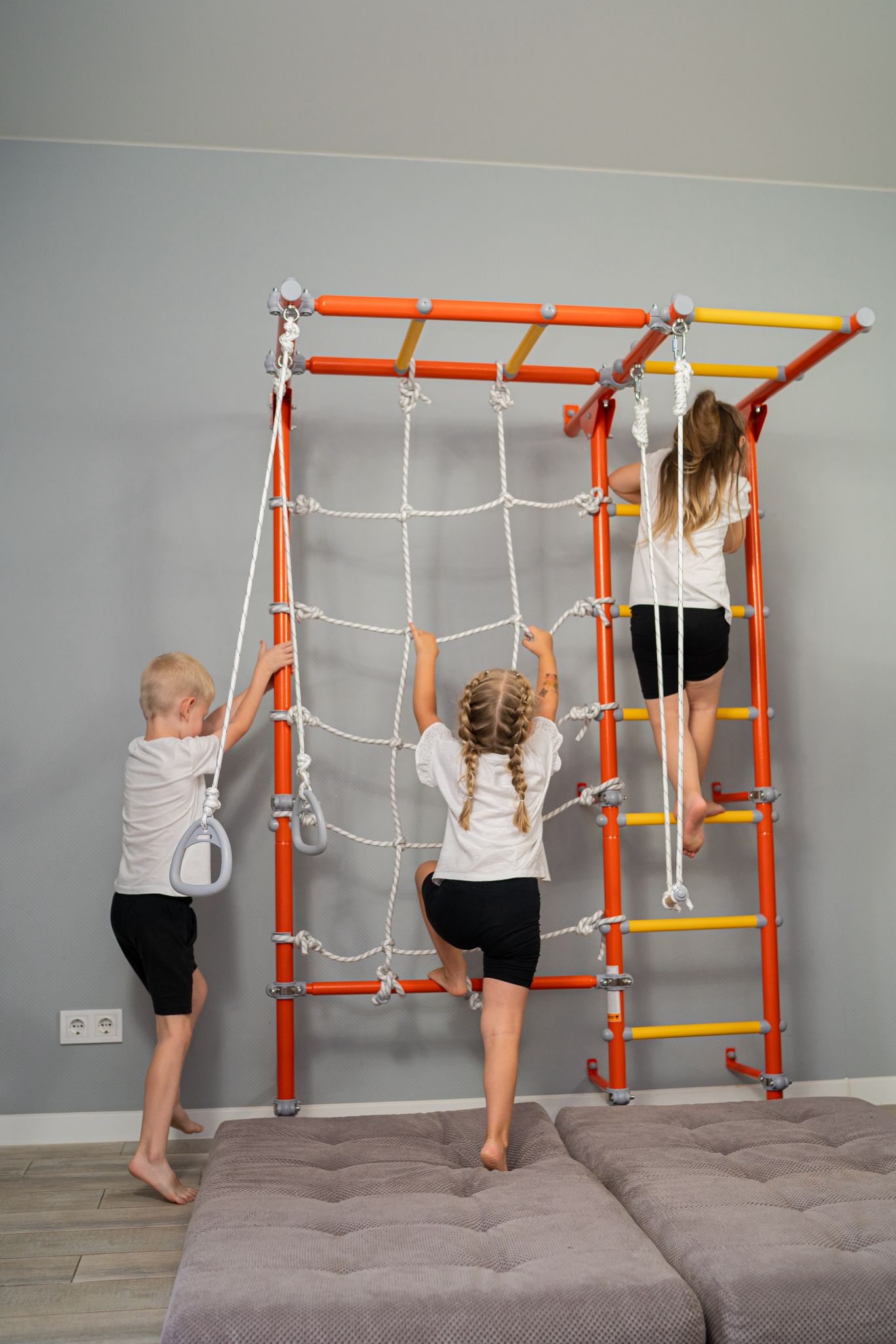
Strategies survive when the environment makes them effortless. A movement zone in the homeschool room—even a corner—means the break happens in thirty seconds instead of requiring shoes, weather, and a drive. This is the "movement zone first" principle from our homeschool room ideas guide, and it is where a home climbing gym earns its place in an education budget: it is the recess bell, the PE department, and the fidget outlet, standing eight feet from the math table, usable in January, in an apartment, in the rain. (None of which retires the park, the yard, or the trail—outdoor play is irreplaceable, and the gym is what keeps the movement diet intact on the days outside isn't happening.) For the evidence on what daily climbing does for developing bodies and brains, see does a home climbing gym actually help kids?
Which gym fits your space? Take the 60-Second Quiz →
Kinesthetic learning by subject
📐 Math
Math is the easiest subject to move, because quantity is physical before it is symbolic. Count real objects, then count jumps, then count rungs climbed. Skip-count in claps and stomps. Build place value with towers of blocks. Walk a masking-tape number line for addition and subtraction—the child is the cursor. Measure the room, the hallway, the dog. For fact fluency, pair each correct answer with a physical move (a monkey-bar rung per multiplication fact is a Brainrich-house favorite). The preschool numeracy research above found active math lessons outperforming seated ones—lean into it hardest at ages 3–7, when the abstraction is newest.
📖 Reading
Letter knowledge is a motor skill wearing a literacy costume: the handwriting research showed that physically forming letters is associated with activating the brain's reading circuitry. So write big and write physically—letters in the air with the whole arm, in sand and shaving cream with fingers, walked out on tape lines on the floor. Hop between phonics sounds. Act out stories scene by scene to build comprehension and retelling. And for the restless read-aloud kid: swing, rock, or hang while listening. Comprehension first, posture never.
🔬 Science
Science is the born kinesthetic subject—the entire discipline is "find out by doing." Become the solar system in the living room, with one child orbiting another. Act out states of matter: frozen-solid statues, flowing-liquid walks, bouncing-gas sprints. Do balance and lever experiments with the child's own body as the apparatus. The physics study above is the model: the students who felt the force understood the force. A six-year-old hanging from a bar is running her own gravity experiment daily—name the forces while she does.


Give the movement a permanent address
Every gym assembles in an afternoon and is covered by a 30-day money-back guarantee.
Frequently asked questions
What is kinesthetic learning? Kinesthetic learning is learning through physical movement, touch, and hands-on experience—counting with jumps, tracing letters in the air, understanding a science concept by physically feeling it rather than only reading about it. The term comes from kinesthesia, the body's sense of its own movement and position.
Is the kinesthetic learning style real? The observation is real: some children clearly prefer and seek movement and hands-on work. What research does not support is the stronger claim—that children have one fixed learning style and learn better only when instruction matches it. Major reviews (Pashler et al., 2008; Willingham et al., 2015) and direct tests (Rogowsky et al., 2015) found no reliable benefit to style-matched teaching. What is well supported: movement, gesture, and hands-on activity are linked to better learning and attention across children generally.
Have learning styles been debunked? The matching hypothesis—diagnose a style, teach only to it—lacks supporting evidence and is widely considered a myth among cognitive scientists. But "debunked" is often overread as "movement doesn't matter," which is the opposite of the evidence. Embodied cognition and physical activity research consistently associate movement with stronger encoding and better attention. The label failed; the movement didn't.
Should I teach my kinesthetic child only through movement? No. Every child needs practice reading, listening, and looking—those are skills, not styles, and school and life demand all of them. Use movement as an amplifier: keep the body involved while the eyes and ears do their work, and use whole-body breaks to refill attention between seated blocks.
What are examples of kinesthetic learning activities? Letter hopscotch, air-writing spelling words, skip-counting in stomps, acting out stories, building math problems with blocks, walking a tape number line, and climbing or hanging between lessons as movement breaks. We keep a full list in 35 kinesthetic learning activities, organized by subject.
Is needing to move the same as ADHD? No. A strong drive to move is a normal temperament, and movement-based teaching serves it well. ADHD is a clinical picture involving persistent attention and impulse-control differences across settings. That said, the movement strategies here overlap heavily with what helps ADHD learners—the research on activity breaks found the largest attention gains in the least on-task students. Our guide to homeschooling a child with ADHD goes deeper.
What ages does movement-based learning suit? The research spans preschool through college—the physics study above was done on university students. Practically, the strategies in this guide fit ages 3 and up, and the younger the child, the more physical the teaching should default to. On climbing equipment specifically, Brainrich gyms are rated for independent use at age 3+.
Does movement during a lesson distract from learning? The research suggests the opposite for most children: gesture during learning is linked to better retention, and doodling-scale movement rarely competes with the lesson. The practical test is output—if narration, answers, and recall are strong while the child moves, the movement is helping. If the activity fully captures their attention (a new toy, a screen), it has crossed from channel to competitor.
📚 Keep reading in the Decision Guide
35 Kinesthetic Learning Activities for Hands-On Kids · The Homeschool Hub · Controlled Risky Play: the Science
Sources
Pashler, H., McDaniel, M., Rohrer, D. & Bjork, R. (2008). Learning styles: concepts and evidence. Psychological Science in the Public Interest. · Willingham, D.T., Hughes, E.M. & Dobolyi, D.G. (2015). The scientific status of learning styles theories. Teaching of Psychology. · Rogowsky, B.A., Calhoun, B.M. & Tallal, P. (2015). Matching learning style to instructional method: effects on comprehension. Journal of Educational Psychology. · Husmann, P.R. & O'Loughlin, V.D. (2019). Another nail in the coffin for learning styles? Anatomical Sciences Education. · Kontra, C., Lyons, D.J., Fischer, S.M. & Beilock, S.L. (2015). Physical experience enhances science learning. Psychological Science. · Cook, S.W., Mitchell, Z. & Goldin-Meadow, S. (2008). Gesturing makes learning last. Cognition. · James, K.H. & Engelhardt, L. (2012). The effects of handwriting experience on functional brain development in pre-literate children. Trends in Neuroscience and Education. · Mavilidi, M.F. et al. (2018). Immediate and delayed effects of integrating physical activity into preschool children's learning of numeracy skills. Journal of Experimental Child Psychology. · Watson, A. et al. (2017). Effect of classroom-based physical activity interventions on academic and physical activity outcomes: a systematic review and meta-analysis. Int. Journal of Behavioral Nutrition and Physical Activity. · de Greeff, J.W. et al. (2018). Effects of physical activity on executive functions, attention and academic performance in preadolescent children: a meta-analysis. Journal of Science and Medicine in Sport. · Mahar, M.T. et al. (2006). Effects of a classroom-based program on physical activity and on-task behavior. Medicine & Science in Sports & Exercise.
Share: