

Updated August 2026 · 13-min read · by the Brainrich Kids team
Every homeschool parent has lived this afternoon: it's 2 p.m., the math is done, the weather is terrible, and a small human is orbiting the kitchen table at increasing speed. "Go play" isn't a PE program, and neither is one more YouTube workout nobody finishes. What actually works is a menu—a deep enough list of activities, sorted by age, that there's always an answer to "what should we do for PE today?" Here are 40 of them, organized by age band and by indoor versus outdoor, with the skill progressions that turn play into a program.
The quick answer: aim for the federal benchmark—about 3 hours of active play across the day for ages 3–5, and at least 60 minutes of moderate-to-vigorous activity daily for ages 6+, with muscle- and bone-strengthening activity at least 3 days a week. Then stop planning minutes and start planning a rotation: 2–3 indoor anchors your child can do daily without a car ride, 2–3 outdoor staples for good-weather days, and one skill they're progressing on (hang → swing → brachiate on the bars; climb → traverse on the net). The 40 activities below fill every slot. This piece is part of our complete homeschool PE guide.
Jump to: How to use this list · Skill progressions · Ages 3–5 · Ages 6–9 · Ages 10–13 · FAQ
How to use this list (especially in winter)
You'll notice the indoor lists below are deliberately longer than the outdoor ones. That's not a vote against the outdoors—on a good day, outside wins, and several outdoor activities here are the best thing on the page. It's arithmetic: a homeschool year runs straight through January, and the difference between families who keep PE going year-round and families whose program quietly dies in November is almost always what's available indoors at 8 a.m. on a sleeting Tuesday. Build your daily anchors from the indoor lists, treat outdoor days as the bonus they are, and no month of the calendar can cancel PE.
Two ground rules before the list. First, safety: floor mats under anything a child hangs or climbs on, equipment that doesn't wobble, and challenges kids reach by themselves—the research-backed distinction between removable hazards and worthwhile risks is the whole subject of our controlled risky play guide. Second, ages: bands are starting points, not fences. Brainrich equipment is rated for independent climbing at age 3+, and a capable 9-year-old should absolutely raid the 10–13 list.
The two progressions that turn play into PE
A PE program differs from recess in one way: skills go somewhere. You don't need a coach's manual—just two ladders, revisited every few weeks:
🐒 THE BAR LADDER: HANG → SWING → BRACHIATE
First a dead hang (grip and shoulders). Then a controlled swing while hanging (core and rhythm). Then brachiation—traveling hand-over-hand down the monkey bars—then skipping rungs. Each stage is measurable: seconds held, swings completed, rungs crossed.
🧗 THE CLIMB LADDER: CLIMB → TRAVERSE
First climbing up and down (legs push, arms guide). Then traversing—moving sideways across a net or ladder without touching the floor—which flips the challenge to route-planning, weight shifts, and endurance. Same equipment, brand-new sport.
Both ladders train what the federal activity guidelines call muscle- and bone-strengthening activity, and what researchers link to fewer injuries down the line—children with well-developed motor skills tend to have fewer injuries than children without them. Sprinkle the progression activities (marked below) through your week and let the rest of the list stay pure fun.
Ages 3–5: build the body's vocabulary
At this age, PE is play with names. The guideline is about 3 hours of active play spread across the day—not one heroic session—so think many 10–20 minute bursts.
INDOOR
1. 🐒 The morning hang
Start the bar ladder. Set a bar at chest height and let your child grip, lift their feet, and hang for a count—3 seconds is a triumph at three. Do it every morning before lessons and chart the seconds. Grip strength is the margin of safety for everything else on this list.
2. 🧗 Up-and-down ladder reps
Climbing up is instinct; climbing down is the skill. Practice slow descents on a gym ladder or net—eyes on feet, one limb moves at a time. The rule that keeps this safe forever: kids climb to heights they reached themselves, no boosting.
3. 🐻 Animal-walk relay
Bear crawl to the couch, crab walk back, frog-jump to the door, waddle like a penguin to finish. Animal walks are a full-body strength workout wearing a costume, and they need zero equipment and eight feet of floor.
4. 🎵 Freeze-and-move
Music on: dance, hop, spin. Music off: statue. The stopping is the secret curriculum—inhibition and balance control—and the game runs happily for twenty minutes on a rainy day.
5. 🧺 Little mover jobs
Carrying the laundry basket, pushing the chair in, hauling the watering can: proprioceptive "heavy work" that organizes little bodies and doubles as helpfulness. We keep a full menu in our heavy work activities guide.
6. 🌈 Balance-path builder
Tape a winding line on the floor, or lay a low balance beam, and walk it forward, backward, sideways, heel-to-toe, carrying a stuffed animal on a tray. Rebuild the path weekly so the challenge never goes stale.
7. 🪢 Swing-seat pilot lessons
On a hanging swing seat, teach pumping: legs out, legs in. Independent pumping usually clicks somewhere in this band, and it's a core-and-timing workout disguised as the best thing that ever happened. Gentle, child-controlled swinging also feeds the balance (vestibular) system.
8. 🎯 Beanbag skill ladder
Toss beanbags into a basket, then a smaller basket, then farther, then with the other hand. Throwing accuracy at this age is a developmental milestone you can watch improve week to week.
OUTDOOR
9. 🌳 Scavenger walks
A walk becomes PE when there's a mission: find something rough, something red, something that flies. Distance accumulates without a single "keep walking, please."
10. 🚲 Balance-bike loops
Laps around a driveway course of chalk arrows and cone gates. Balance bikes (or first pedal bikes) build the same vestibular and postural control the gym trains, at speed.
11. 🐸 Jump lines
Chalk a row of lily pads and jump between them—two feet, one foot, backward. Jumping is bone-strengthening activity in its purest form, and chalk makes it a game.
12. ⚽ First-touch soccer
One ball, two cones, no rules beyond "kick it through the gate." Dribbling around the yard teaches feet to do two things at once, which is most of early coordination.
13. 🪁 Windy-day chasers
Streamers, a kite, or just a leaf storm to chase. Sprinting in bursts is exactly how this age is built to run—no laps required.
Ages 6–9: the skill-hungry years
This band wants to be good at things. Feed that: time things, count things, chart things. From age 6, the benchmark becomes 60+ minutes of moderate-to-vigorous activity daily.
INDOOR
14. 🐒 Monkey-bar mileage
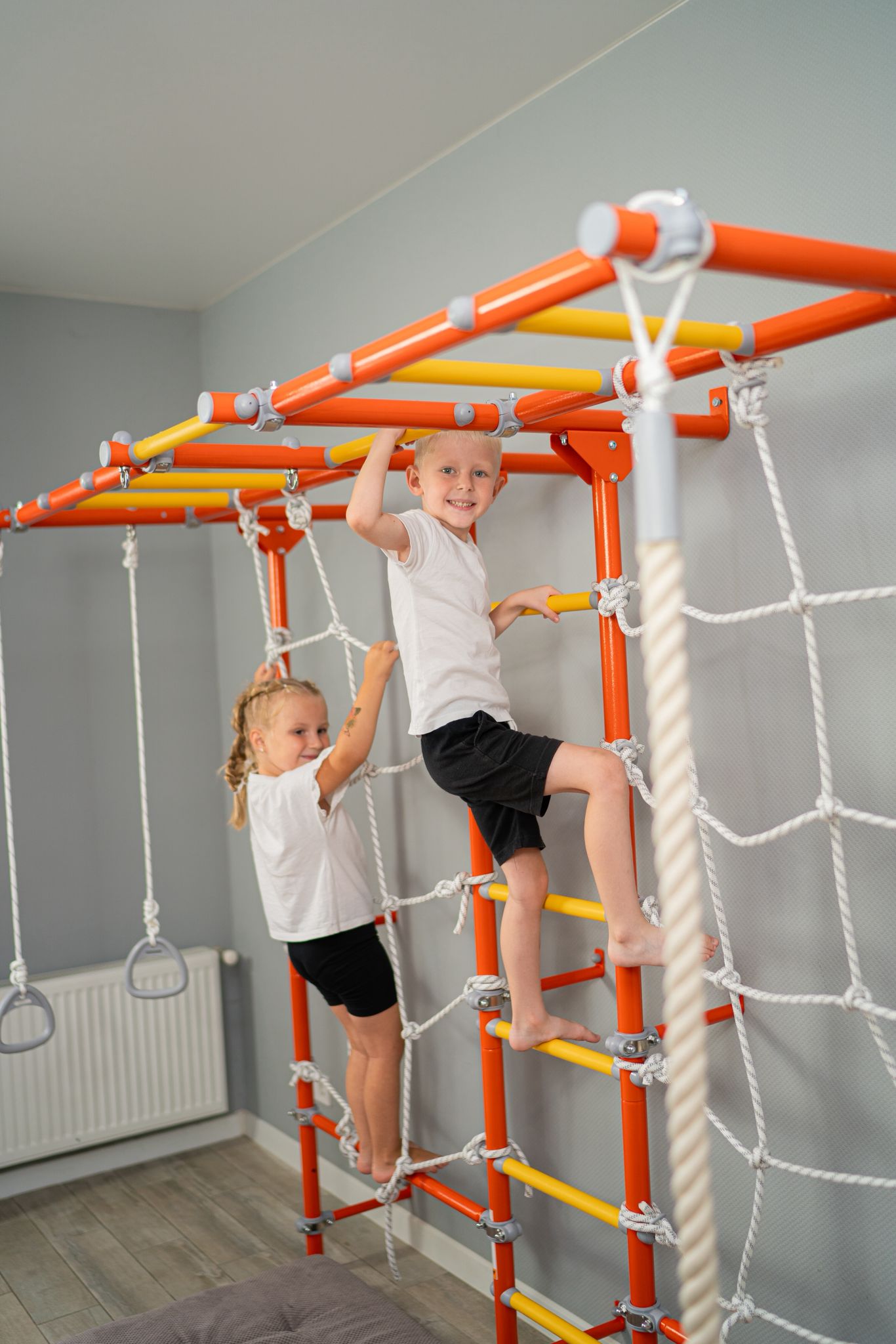
The brachiation stage of the bar ladder: hand-over-hand across the bars, first with feet ready to catch, then clean crossings, then counting rungs-per-week like a paper route. Few activities build upper body and confidence as visibly.
15. ⏱️ Net climb time trials
Same net, same route, stopwatch out. Beating your own Tuesday time is the purest motivation engine in childhood, and repeated routes build the movement mastery we describe in what a home climbing gym does for kids.
16. 🔄 Swing craft
Graduate from pumping to skills: swing standing (hands on ropes), swing seated no-hands for a count, stop the swing dead in three pumps. Child-controlled challenge on familiar equipment—the heart of controlled risky play.
17. 🏗️ Obstacle-course architect
The child designs the course—under the table, over the cushion line, up the net, down the ladder, ring the bell—then runs it, times it, and revises it. Design is planning; running it is PE; both are learning.
18. 🃏 Fitness deck
A card deck where each suit is an exercise (hearts = jumping jacks, spades = animal walks, clubs = squats, diamonds = a lap of the hallway) and the number is the reps. Draw ten cards and the workout writes itself, differently every day.
19. 🪢 Rope starts
Climbing rope or rope ladder basics: feet-lock first, three pulls up, then a controlled hand-under-hand descent (never a fast drop—that's how rope burns happen). Rope gives back exactly the effort put in—no shortcuts, no momentum—and it makes every other climb feel easy.
20. 🎶 Interval dance blocks
Two songs fast, one song slow, repeat. Twelve minutes of genuine cardio hiding inside a kitchen dance party, ideal for the deepest weeks of winter.
21. 🤸 Hold-it circus
Wall sits, planks, superman holds, tuck hangs from the bar—each held while someone recites a poem or spells a word. Strength work plus recall practice: very homeschool.
OUTDOOR
22. 🚴 Bike mileage ladder
A weekly ride with a distance chart on the fridge. One mile becomes three over a season, and the chart becomes the PE log almost by itself.
23. 🏃 Backyard track meet
Sprint, long jump, "javelin" (pool noodle), an obstacle lap. Record personal bests in a notebook and rerun the meet monthly—same events, same measuring tape, visible progress.
24. 🥾 Hike with a job
On trail days, give the child the map, the snack schedule, or the bird checklist. A named role turns three miles of "are we there yet" into three miles of leadership.
25. ⚾ Throw-catch progressions
Big ball, then tennis ball, then one-bounce catches, then grounders, then opposite hand. Ten minutes a day quietly produces the kid who's never picked last.
26. 🏰 Fort logistics
Hauling branches, stacking stones, dragging pallets: heavy work at expedition scale, plus engineering. The fort is the excuse; the loaded carries are the PE.
27. ❄️ All-weather recess
Rain gear and snow gear exist so PE can happen outside anyway—puddle stomps, snow-fort builds, sled hauls (hauling it back up is the workout). Not being anti-outdoors includes not being anti-weather; save the indoor list for the days that are truly unplayable.
Ages 10–13: train like it counts
Preteens need PE that respects them: real programming, real numbers, real autonomy. This is also where a home setup earns its keep socially—movement without an audience, on days when self-consciousness is loud.
INDOOR
28. 🧗 The traverse challenge
Top rung of the climb ladder: cross the net or ladder sideways without touching the floor, then do it low (harder), then add a backpack with a book in it. Traversing is strategy plus endurance—rock-gym thinking on home equipment.
29. 💪 Hang-time leaderboard
Timed dead hangs, then one-arm-assisted hangs, then knee raises, then L-sit attempts. Post the family leaderboard where guests can see it. Parents compete too; humility follows.
30. 🐒 Skip-a-rung bars
Brachiation, advanced class: skip every other rung, cross the bars backward, turn around mid-bar. When the standard crossing gets easy, the same eight feet of bars has three more years of challenge in it.
31. 🏋️ Bodyweight circuit builder
Teach the template—push (push-ups), pull (rows under a bar or rings), squat, carry, hang—and let them build their own 15-minute circuit. Writing the workout is the assignment; muscle-strengthening 3 days a week is the guideline being met.
32. 🎲 HIIT dice
Two dice: one picks the exercise, one picks the reps. Ten rounds, heart rate up, zero negotiation, done before the next lesson block. The randomness is the fun; the intervals are the fitness.
33. 🤸 Rings and bar routines
String together holds and controlled swings into a 30-second "routine," gymnastics-style, and film it monthly. Composing movement—sequence, timing, form—is a different intelligence than repeating it.
34. 🪢 Jump-rope progressions
Basic bounce → boxer step → crossovers → double-under attempts. A jump rope is the cheapest serious cardio equipment ever invented and fits behind a door.
35. 📓 The athlete's journal
Once a week, they log their own numbers—hang time, trial time, circuit rounds—and set one goal. This is PE's thinking half, and it plugs straight into the PE log system your state may want to see anyway.
OUTDOOR
36. 🏃 The 5K build
A run-walk plan, three sessions a week, eight-ish weeks, ending in a real (or family-staged) 5K. Finishing a distance you trained for is a life lesson wearing running shoes.
37. 🗺️ Orienteering runs
Print a map of the neighborhood or park, mark five checkpoints, add a time limit. Navigation under mild pressure is PE for the brain and legs at once.
38. 🏀 Driveway sport ladder
Pick one sport per season and run a family ladder—HORSE, one-v-one, around-the-world. Ranked games give competitive kids a sanctioned outlet and teach losing as a renewable resource.
39. 🛶 Seasonal adventure day
Once a month, PE is an outing: paddling, skating, snowshoeing, a long ride. One adventurous day anchors the habit of being a person who does things outside—the actual goal behind all forty of these.
40. 🌟 The family field day
Season finale: your preteen designs and referees a field day for younger siblings—events, scorecards, medals. Organizing sport is the graduate level of PE, and it hands your program its best day of the year.
Notice what the indoor anchors in every band have in common: hanging, climbing, swinging, traversing. That's not coincidence—it's the short list of movements researchers consistently associate with the play children seek out on their own, with height and speed at the top of the list, and it's the list a home climbing gym was built to serve daily, in any weather, between any two lessons.


Which gym fits your family? Take the 60-Second Quiz →
Frequently asked questions
How many of these should we do per day? Two or three, in short blocks. A morning anchor (a hang, a climb, a swing session), a between-lessons burst (animal walks, fitness deck, HIIT dice), and one longer block (a course, a ride, a trail). That pattern comfortably clears 60 minutes for school-age kids without ever feeling like a class period.
What counts as "moderate-to-vigorous" activity? The practical test: breathing noticeably harder, warm, hard to sing. Climbing, brachiating, dancing intervals, biking, and running all qualify; a stroll or light stretching mostly doesn't. Hanging, climbing, and jumping also cover the muscle- and bone-strengthening activity the federal guidelines call for at least 3 days a week.
Do these activities satisfy state PE requirements? A planned rotation of activities like these, documented, is a program of physical education in every state we've reviewed—no purchased curriculum required. Log what you do (our PE log guide has a ready-made system), and if you'd rather have structure handed to you, see the curriculum comparison.
What about kids younger than 3? Toddlers join the movement day with hands-on supervision—floor play, cushion crawls, assisted swinging in a toddler seat. Independent climbing on gym equipment starts at age 3+; before that, the younger sibling's job is watching the show and growing into it.
Is indoor equipment really necessary? Necessary, no—several families run great programs from lists 3, 9, 18, and 36 alone. What daily-available equipment changes is consistency: the hang-swing-brachiate and climb-traverse ladders need frequent, repeated practice on the same structure, and weather-proof repetition is the one thing a park trip can't schedule. That daily-mastery case is laid out in does a home climbing gym actually help kids?
My child resists anything labeled "exercise." Now what? Stop labeling it. Time trials, dice games, courses they design, leaderboards they might win—every activity above is structured so the child chases the game while the exercise happens to them. Research on active play consistently associates child-led, challenge-seeking play with more activity, not less; the less it resembles a lesson, the more minutes you'll log.
📚 Keep reading in the Decision Guide
Homeschool PE at Home: The Complete Guide · Homeschool PE Curriculum: Options Compared · The Homeschool PE Log · The Homeschool Hub · Heavy Work Activities for Kids
Sources
U.S. Department of Health and Human Services. Physical activity guidelines for children (CDC overview). · Sandseter, E.B.H. (2007). Categorising risky play: how can we identify risk-taking in children's play? European Early Childhood Education Research Journal. · Brussoni, M. et al. (2015). What is the relationship between risky outdoor play and health in children? A systematic review. Int. Journal of Environmental Research and Public Health. · Review of motor skill development and childhood injury patterns. PMC. · Beaulieu, E. & Beno, S. (2024). Healthy childhood development through outdoor risky play. Canadian Paediatric Society position statement.
Share: