

Updated August 2026 · 13-min read · by the Brainrich Kids team
Most homeschool room tours show you the same things: the bookshelf, the world map, the alphabet garland, the little desks. What they never show you is the room from the nervous system's point of view: the flickering bulb overhead, the six competing wall displays, the dishwasher drone, the chair that offers a wiggly body nothing to push against. For a lot of kids, and for nearly every autistic or ADHD child, the room is not the backdrop of the school day. It is the loudest voice in it. This guide is about making that voice a calm one.
The quick answer: a sensory-friendly homeschool room manages three inputs and adds one output. The inputs: lighting (kill the flicker and glare, favor daylight and warm lamps), sound (soften the echo, name the hum), and visual clutter (one display where the eyes work, closed storage everywhere else). The output: a regulation station, a small movement zone with a swing, a crash mat, and something to climb, so a dysregulated child has somewhere to go before the meltdown instead of after it. Zone the room so seekers can move without invading the quiet corner avoiders need, then check your setup against the OT-informed checklist below.
Jump to: Why the room comes first · Lighting, sound, visual clutter · The regulation station · Seekers vs. avoiders · The OT-informed checklist · FAQ
Why the room comes first (before curriculum, before schedule)
Here is the ordering most families discover the hard way: curriculum problems are often regulation problems, and regulation problems are often environment problems. The child who "can't focus on phonics" at a table under a buzzing light, facing a wall of visual noise, in a chair that gives their body nothing, does not have a phonics problem. They are spending their attention budget on filtering the room, and phonics gets the leftovers.
Teachers cannot rebuild a classroom around one child's nervous system. You can, and it is arguably the single biggest structural advantage homeschooling gives a sensory-sensitive child: total control of the environment. Our guides to homeschooling an autistic child and homeschooling a child with ADHD both land on the same first move for the same reason: build the environment, then schedule into it, then pick curriculum last.
Two grounding notes before the practical part. First, on language: occupational therapists work with sensory-based strategies every day, and pediatric guidance (including the American Academy of Pediatrics) describes sensory-based approaches as a reasonable component of a broader plan while noting the research on formal sensory integration therapy is still limited. So nothing in this room "fixes" a child, and this article stays out of therapy's lane. Second, on scope: you do not need a diagnosis to benefit from any of this. Every nervous system in the house, the parent's included, does better in a room with good light, soft sound, and somewhere to move.
The three inputs: lighting, sound, and visual clutter
Work through these in order. Each one is a single afternoon of changes, and each is essentially free.
💡 LIGHTING
The enemy is flicker and glare, not brightness. Retire aging fluorescent tubes and cheap buzzing LEDs; many kids register the flicker adults tune out. Put the desk beside a window rather than facing it (backlight glare) or facing away (screen reflections). Layer two or three warm lamps instead of one overhead blast, and you get a bonus dimmer switch for the whole room's energy.
🔉 SOUND
Hard floors + bare walls = echo box. A rug, curtains, and one soft surface (the crash mat earns double duty here) tame most of it. Hunt the hums: dishwasher, dryer, and robot vacuum run after school hours. Keep over-ear headphones in a known spot the child can reach without asking, and treat reaching for them as regulation, not rudeness.
🗂️ VISUAL CLUTTER
Classroom walls are decorated for inspection day, not for attention. Pick one display surface for current work and leave the wall the child faces during lessons close to bare. Closed bins beat open cubbies: what the eyes can't see, the brain doesn't have to filter. If it isn't part of this week's learning, it lives behind a door.
A useful test for all three: sit in your child's school chair for five minutes at lesson time, and do nothing. What you start noticing at minute three (the bulb, the pile, the dryer) is what your child has been filtering all along. The room should pass the five-minute sit before you spend another dollar on curriculum.
The regulation station: swing, crash mat, something to climb
Managing inputs is half the room. The other half is giving the nervous system an output: a permanent, three-steps-away place where a child can get the movement their body is asking for, at the moment it asks. We call it the regulation station, and its minimum viable version is three pieces:
| Piece | What it feeds | In practice |
|---|---|---|
| A swing | The vestibular system: the inner-ear balance sense that gentle rhythmic motion helps organize. Our vestibular input guide covers the science. | Linear back-and-forth for calming; spinning sparingly and only child-controlled. Pod and platform styles compared in our sensory swings guide and indoor swing roundup. |
| A crash mat | Deep pressure: the firm, whole-body input many kids seek by crashing into couches anyway. | Doubles as the impact mat under the climbing zone and the soft landing that makes "crash safely here" a rule you can actually offer instead of "stop jumping on the couch." |
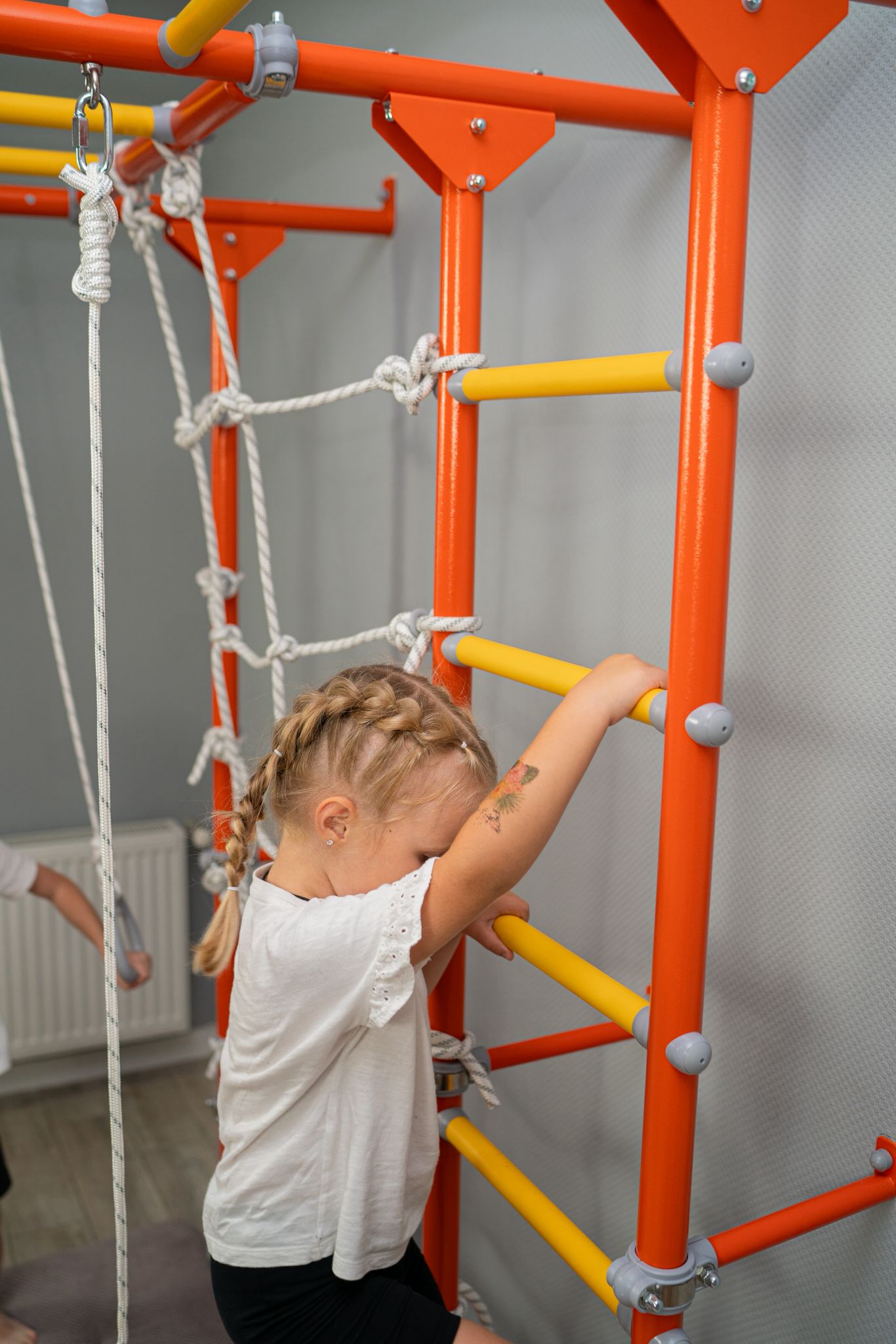
| Something to climb and hang from | Proprioception: joint and muscle feedback from pulling, pushing, and bearing weight, the calming workhorse behind heavy work. | A ladder, net, rings, or bar rated for daily use and ages 3+. Climbing before a writing block is the cheapest focus tool in the room. |
You can assemble the station from separate pieces, but this is exactly the job a compact home gym was built to consolidate: one pressure-fit or wall-mounted steel frame carries the swing, the rings, the net, and the ladder, with the crash mat underneath, in about the footprint of an armchair. The full logic, layouts, and equipment list live in our sensory gym at home guide; the short version is that permanence is the feature. A station that must be set up will be skipped on exactly the days it was needed most.
Does a movement station belong in the school room? The classroom research says yes with numbers: short physical activity built into the school day is associated with more on-task behavior afterward, with the biggest gains in the least focused students (Mahar 2006; Watson 2017). The station is not a distraction placed next to the desk. It is the reason the desk works.
"The best sensory equipment is the piece your child walks past a hundred times a day. Availability beats intensity: thirty seconds of hanging, twenty swings, one climb, taken the moment the body asks, does more for a school morning than an hour-long session scheduled for Saturday."
– YEGOR NADVORNYY, FOUNDER OF BRAINRICH KIDS
Zoning for seekers and avoiders (often in the same family)
Sensory profiles run in two broad directions, and most families with more than one child are running both at once. The room has to serve them simultaneously, which is a zoning problem, not a compromise problem:
THE SEEKER
Craves input: crashes, spins, climbs, chews, hums, touches everything. Under-input, this child gets louder and wilder. The room's job is a legal supply: the regulation station, a wobble cushion or standing option at the desk, and heavy-work chores with real weight. Movement zone placed away from the quiet corner, with the crash mat marking its border.
THE AVOIDER
Overwhelmed by input: covers ears, squints at bright light, avoids messy hands, retreats from busy rooms. Over-input, this child gets quieter, then gone. The room's job is a reliable retreat: a small den (a pop-up tent, a curtained corner, a bottom bunk) with dim light, headphones, and a weighted lap pad, that is never used as a time-out spot. The den only works if it stays voluntary.
Three zoning rules make one room hold both kids. Rule one: the zones face away from each other. The quiet den should not have a sight line to the swing, or the avoider watches instead of resting and the seeker performs instead of regulating. Rule two: the desk is its own zone, visually calm, belonging to neither. Rule three: both zones are always available and never earned. The moment the swing becomes a reward or the den becomes a consequence, they stop being regulation tools and start being currency. (Worth saying: many kids are seekers in one sense and avoiders in another, a spinning-loving child who hates tags is completely ordinary. Zone for behaviors you observe, not for a label.)
Small-room and shared-space layouts, including how to fit a movement zone into an apartment, are covered in our homeschool room ideas pillar.
The OT-informed setup checklist
Occupational therapists who consult on home setups tend to probe the same dozen points. Walk the room with this card; every line is observable in five minutes:
✅ THE SENSORY-FRIENDLY ROOM CHECK
Light · No flickering or buzzing bulbs anywhere in the room · Desk sits beside the window, not facing toward or directly away from it · At least one warm lamp alternative to the overhead light
Sound · Rug or soft flooring under the work area · Noisy appliances scheduled outside school hours · Headphones within the child's reach, no permission needed
Sight · The wall the child faces during lessons is calm · One display surface, refreshed weekly, everything else in closed storage · Materials for this week visible, everything else behind doors
Body · Seating gives feet a surface to press into (floor, footrest, or wobble option) · A standing or lying-down work option exists and is allowed · Regulation station reachable in under ten steps from the desk · Crash mat under every climbing and swinging zone
Rules · Movement zone and quiet den both always available, never earned, never a punishment · The child can get to either without asking · You have done the five-minute sit in their chair this month
Score it with your own eyes on a Tuesday morning, not on setup day. Rooms drift: displays multiply, bins migrate to countertops, the crash mat becomes a laundry shelf. A monthly walk of this card keeps the room doing its quiet work.
Which gym fits your family? Take the 60-Second Quiz →
The anchor piece: one frame, every input
If the regulation station is the room's output valve, the gym is its anchor: swing, rings, ladder, net, and bar on one steel frame, ages 3+, with the crash mat underneath. Pick by room size and headcount:


Ready to anchor the regulation station?
Every gym ships in 5–7 days, assembles in an afternoon, and is covered by a 30-day money-back guarantee, even assembled, even used.
Frequently asked questions
What makes a homeschool room "sensory-friendly"? Three managed inputs and one built-in output. Inputs: lighting without flicker or glare, sound without echo or background hum, and visual calm on the surfaces the child faces during lessons. Output: a regulation station (swing, crash mat, something to climb) within a few steps of the desk, so movement needs get met before they become behavior. No single product makes a room sensory-friendly; the arrangement does.
Do I need a diagnosis or an OT to set this up? No. Everything in this guide is ordinary environmental design that benefits any child, and none of it requires or replaces professional input. If your child is working with an occupational therapist, bring the checklist to a session; therapists are usually glad to tune a home setup to a specific child, and their guidance outranks any article, including this one.
How much space does a regulation station need? Roughly an armchair's footprint plus mat clearance: a compact gym frame carries swing, rings, and climbing in about 3x3 feet of floor, with the crash mat in front. In apartments, a doorway bar plus a folded crash mat is a workable minimum. What matters is permanence: equipment that has to be set up gets skipped on the hardest days, which are exactly the days it earns its keep.
My child is a seeker and their sibling is an avoider. One room? Yes, with zoning: movement zone and quiet den at opposite ends, no direct sight line between them, and the desk as a neutral third zone. Both stay always-available and never become rewards or punishments. Most such rooms fail on sight lines, not square footage, so fix the geometry before concluding the room is too small.
Is swinging during the school day a distraction from learning? The classroom evidence points the other way: studies of short movement built into the school day associate it with more on-task behavior afterward, with the largest gains among the least focused students. Ten minutes of swinging or climbing between lesson blocks is not stolen learning time; it is what makes the next block usable. See our vestibular input guide for the mechanism.
What age can kids use the regulation station independently? Brainrich gyms are rated 3+ for independent climbing, with younger siblings joining under hands-on supervision using toddler attachments like a swing seat. Keep the crash mat under all climbing and swinging zones, teach "one climber on the ladder at a time" early, and stay within arm's reach for children under 3.
This article is for general information only and is not medical advice or occupational therapy. Decisions about sensory processing evaluation and therapy belong with your child's pediatrician or occupational therapist. A well-designed room complements professional care; it does not replace it.
📚 Keep reading in the Decision Guide
How to Build a Sensory Gym at Home · Homeschooling an Autistic Child: Building the Environment First · Homeschool Room Ideas: Spaces That Actually Get Used
Sources
Zimmer, M. & Desch, L., American Academy of Pediatrics (2012). Sensory integration therapies for children with developmental and behavioral disorders. Pediatrics. · Mahar, M.T. et al. (2006). Effects of a classroom-based program on physical activity and on-task behavior. Medicine & Science in Sports & Exercise. · Watson, A. et al. (2017). Effect of classroom-based physical activity interventions on academic and physical activity outcomes: a systematic review and meta-analysis. International Journal of Behavioral Nutrition and Physical Activity.
Share: