

Updated August 2026 · 9-min read · by the Brainrich Kids team
Here is the strange thing about the homeschool PE log: the families who keep one almost never started because the law made them. They started because a log is the difference between "we're pretty active, I think" and knowing—knowing the minutes happened, knowing the skills moved, and having something to hand an evaluator without a single night of reconstructing the semester from memory. This guide covers both halves: what states actually require, and a tracking system simple enough to survive a real homeschool week.
The quick answer: PE requirements vary sharply by state. Some states list physical education by name as a required homeschool subject (Pennsylvania does at every level; New York requires it in all grades and expects 2 credits in high school), while others, like Texas, don't require PE at all. Check your own state on HSLDA's state-law pages—the canonical source. Wherever you land legally, the working system is the same: a one-line-per-day log (date, activity, minutes, occasional skill note) kept somewhere you already look, totaled once a week against the 60-minutes-a-day benchmark. Ten seconds a day; audit-ready forever.
Jump to: What states require · What a good log captures · The sample log · The weekly system · What counts as PE · FAQ
📥 Free download: The Homeschool Movement Kit
Skip the blank spreadsheet: the free 5-page PE Kit answers the requirements, lists movement milestones by age to check off, and turns tracking into a connect-the-dots progress graph kids chart themselves—plus an ADHD crash course and the 2026 state-by-state funding cheat sheet.
Get the free kit →Homeschool PE requirements: what states actually ask for
There is no federal homeschool PE rule—this is state law, and the spread is wide. Three verified examples show the range:
PENNSYLVANIA
Physical education is a standalone required subject at both the elementary and secondary level, alongside health and safety education, per HSLDA's Pennsylvania compliance guide. Pennsylvania homeschoolers also keep a portfolio—exactly where a PE log lives.
NEW YORK
PE appears in the required-subject lists for every grade band: listed for grades 1–6, required "on a regular basis" in grades 7–8, and worth 2 credits in grades 9–12, per HSLDA's New York guide. New York's quarterly reports make a running log close to mandatory in practice.
TEXAS
The other end of the spectrum: required subjects are math, reading, spelling and grammar, and good citizenship—PE isn't on the list, per HSLDA's Texas guide. Texans log for their own reasons, not the state's.
A note for the high-school years, because that's where the log stops being optional in practice: where a state expects PE credits (New York's 2 credits are the clearest example), a common homeschool convention is to translate logged hours into credit—many families and evaluators treat roughly 120–150 hours of documented activity as one credit, though the convention varies and your state's own guidance governs. Either way, the arithmetic only works if the hours were written down as they happened. A ninth grader's log is a transcript ingredient; nobody wants to invent one retroactively in twelfth grade.
Most states fall somewhere between these poles: some name PE outright, some fold it into "health," some require "equivalent instruction" broad enough to include it, and some ask nothing. Two rules of thumb keep you safe. First, read your own state's page on HSLDA—laws get amended, and a blog post (including this one) is a map, not the territory. Second, notice what even the strictest states are actually asking for: no state we've reviewed requires a purchased PE curriculum, a certified instructor, or a gymnasium. They require instruction in physical education—a planned program of activity—and, in portfolio and reporting states, evidence it happened. A log is that evidence.
If you do want structure on top of the log, we compare every real option—paid, free, and build-your-own—in the homeschool PE curriculum guide, and the whole program design lives in our flagship Homeschool PE at Home guide.
What a good log captures (and what it can skip)
A PE log has exactly two audiences: a possible evaluator, and future-you. Both want the same four things, and neither wants a spreadsheet with fourteen columns:
Teal: the fields that matter. Lilac: the fields that kill logs by October.
The skill note is the one non-obvious field, and it's optional-but-golden: once a week or so, jot the concrete marker—"first clean monkey-bar crossing," "held a 20-second hang," "biked 3 miles." Minutes prove the program existed. Skill notes prove it worked, and they're the entries you'll actually enjoy rereading in June. (They're also the backbone of a high-school PE credit narrative, if your state expects one.)
The sample log: one week, one glance
Here's the entire system on one table—a real-shaped week for a 7-year-old, including the imperfect days, because a believable log has them:
| Day | Activity | Minutes | Skill note |
|---|---|---|---|
| Mon | Gym time (net climbs, monkey bars) + bike loops | 35 + 30 | Crossed 4 rungs hand-over-hand |
| Tue | Obstacle course (self-designed) + freeze dance | 40 + 15 | |
| Wed | YMCA homeschool PE class | 90 | First full swim lap |
| Thu | Rainy day: gym time + fitness card deck | 45 + 20 | Hang time 14 sec (was 10) |
| Fri | Family trail walk + playground | 75 | |
| Sat | Free play, gym + yard (kid-led) | ~60 | |
| Sun | Rest day (travel) | — | |
| Week | Total · vs. ~60 min/day benchmark | 410 | ✓ On track |
Notes on the shape of it: multiple short entries per day are normal—homeschool movement happens in bursts, and the log should mirror that instead of fighting it. Estimates are fine ("~60" is a legitimate entry; nobody stopwatches free play). And the weekly total row is the whole reason the system works, which brings us to the routine.
The 10-second system that survives a real semester
Every abandoned PE log we've ever heard about died the same death: it lived in a special binder, required sentences, and depended on remembering. The fix is three habits, none longer than a coffee sip:
1. One line, once a day, at a fixed trigger. Attach the entry to something that already happens—lunch, or closing the school day. Date, activity, minutes. If you missed a day, reconstruct it tomorrow and move on; a log with occasional patched days is a log that survives.
2. One total, once a week. Friday afternoon, add the minutes and eyeball them against the benchmark from the federal activity guidelines—about 60 minutes a day of moderate-to-vigorous activity for ages 6–17 (with muscle- and bone-strengthening activity at least 3 days a week), and roughly 3 hours of spread-out active play for ages 3–5. Under target? Next week's rotation gets one more anchor block. That single feedback loop is your entire program management.
3. One skill note, once a week. Ask at dinner: "what could you do this week that you couldn't do last month?" Write down whatever comes back. Twenty-six of these and you have a year-end PE narrative that writes itself.
Where should it live? Wherever you already are: the back page of the lesson planner, a notes app, a shared spreadsheet. The medium is irrelevant; the trigger is everything. A printable version of our log sheet is in the works—the same table above, formatted for a clipboard—and it will land in this article when it's ready.
What counts as PE (more than you think)
Parents consistently under-log because they're picturing a gym class. The guidelines are activity-based, not ceremony-based—if the body worked, it counts:
LOG IT
Climbing-gym sessions (climbing, hanging, swinging, monkey bars—muscle- and bone-strengthening in the guidelines' own terms) · bike rides and hikes · swim lessons and sports practices · obstacle courses and active games · dance · heavy work like hauling, digging, and shoveling snow · energetic free play, indoors or out.
DON'T STRETCH IT
Screen time about sports, a car ride to the trailhead, or ten minutes of wandering the yard. An evaluator's trust in the whole log rests on the entries being believable—log generously, but log real movement.
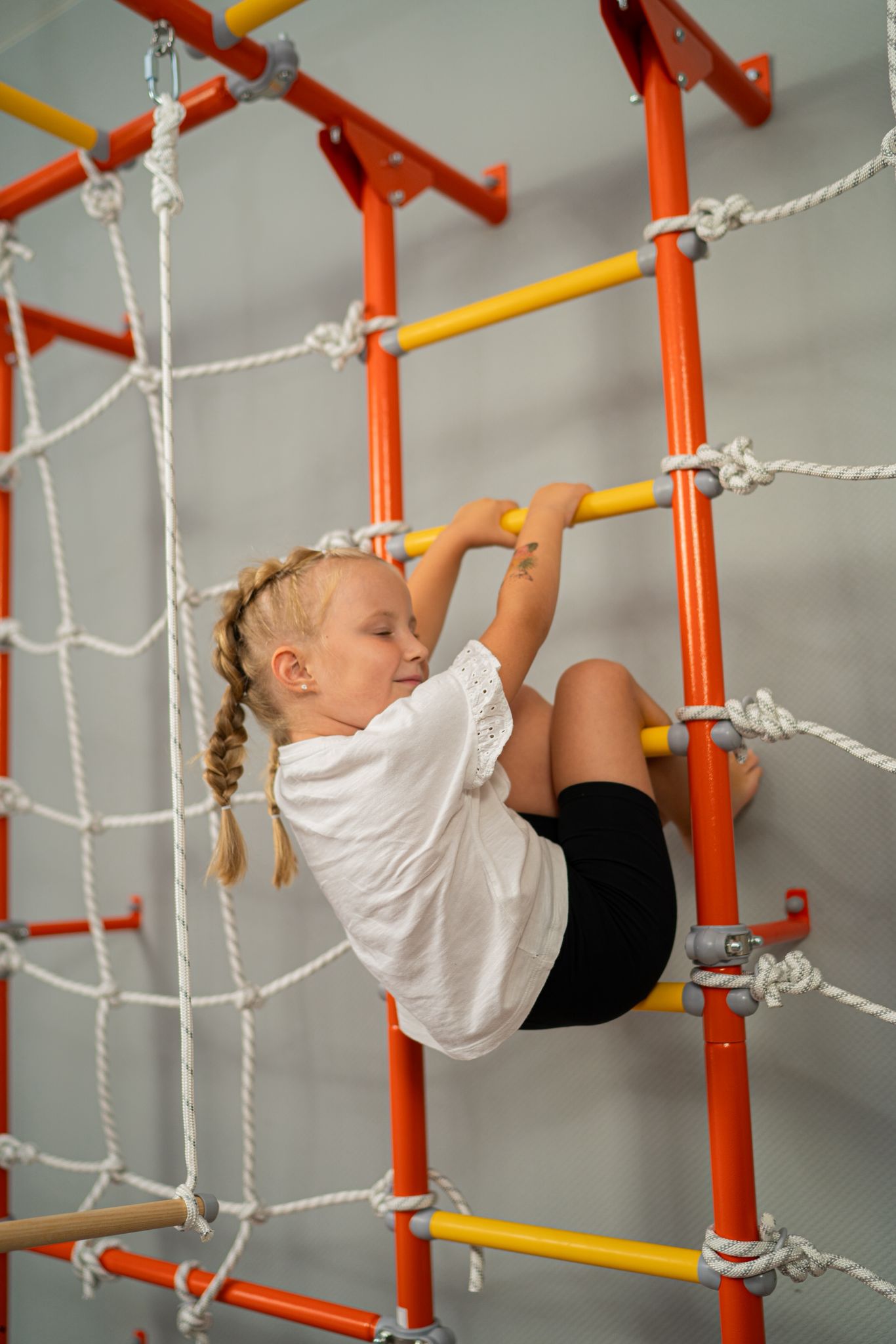
This is also where daily-available equipment quietly changes the paperwork: a child who climbs and swings at home most days generates loggable, skill-progressing PE minutes as a side effect of living there—between lessons, before breakfast, deep into February. The developmental case is in does a home climbing gym help kids?, the safety framing in controlled risky play, and if you're weighing equipment (in several states, ESA funds can help—see the funding guide), start here:
Which gym fits your family? Take the 60-Second Quiz →
Frequently asked questions
Do homeschoolers have to do PE? It depends on the state. Pennsylvania and New York, for example, list physical education among required homeschool subjects (New York expects 2 high-school credits), while Texas requires only math, reading, spelling and grammar, and good citizenship. Check your state's current law on HSLDA's state pages before relying on any summary, including this one.
Do I need a special printable to keep a PE log? No—a notebook line or spreadsheet row with date, activity, and minutes is a complete log. A printable just lowers friction. Ours is coming; until then, copy the sample table above into whatever you already use daily.
How many PE minutes should I be logging? The most-used benchmark is the federal guideline: at least 60 minutes of moderate-to-vigorous activity daily for ages 6–17, and about 3 hours of active play across the day for ages 3–5. Few states specify homeschool PE minutes; where a number matters (New York's high-school credits, for instance), your state's own documents govern.
Does free play count, or only structured lessons? Active free play counts—the guidelines measure movement, not instruction format, and researchers consistently associate child-led active play with the outcomes PE exists for. A strong log usually shows a mix: some structured entries (a class, a skill progression, a course) among the free-play ones.
What does an evaluator actually want to see? A pattern, not perfection: regular entries across the year, reasonable weekly volume, and some evidence of progression—which is exactly what the skill-note column provides. A log with a missing week and real skill notes reads far better than a suspiciously flawless grid.
What should the PE program behind the log look like? Pick from our 40 PE activities by age, or adopt a full curriculum from the options comparison. The complete blueprint—equipment, rotation, and this log—is in Homeschool PE at Home.
📚 Keep reading in the Decision Guide
Homeschool PE at Home: The Complete Guide · 40 Homeschool PE Ideas by Age · Homeschool PE Curriculum: Options Compared · The Homeschool Hub · Homeschool Grants & Funding
Sources
Home School Legal Defense Association. Homeschool laws by state. · HSLDA. How to comply with Pennsylvania's homeschool law. · HSLDA. How to comply with New York's homeschool law. · HSLDA. How to comply with Texas's homeschool law. · U.S. Department of Health and Human Services. Physical activity guidelines for children (CDC overview). · Brussoni, M. et al. (2015). What is the relationship between risky outdoor play and health in children? A systematic review. Int. Journal of Environmental Research and Public Health.
Share: