

Updated September 2026 · 12-minute read · by the Brainrich Kids team
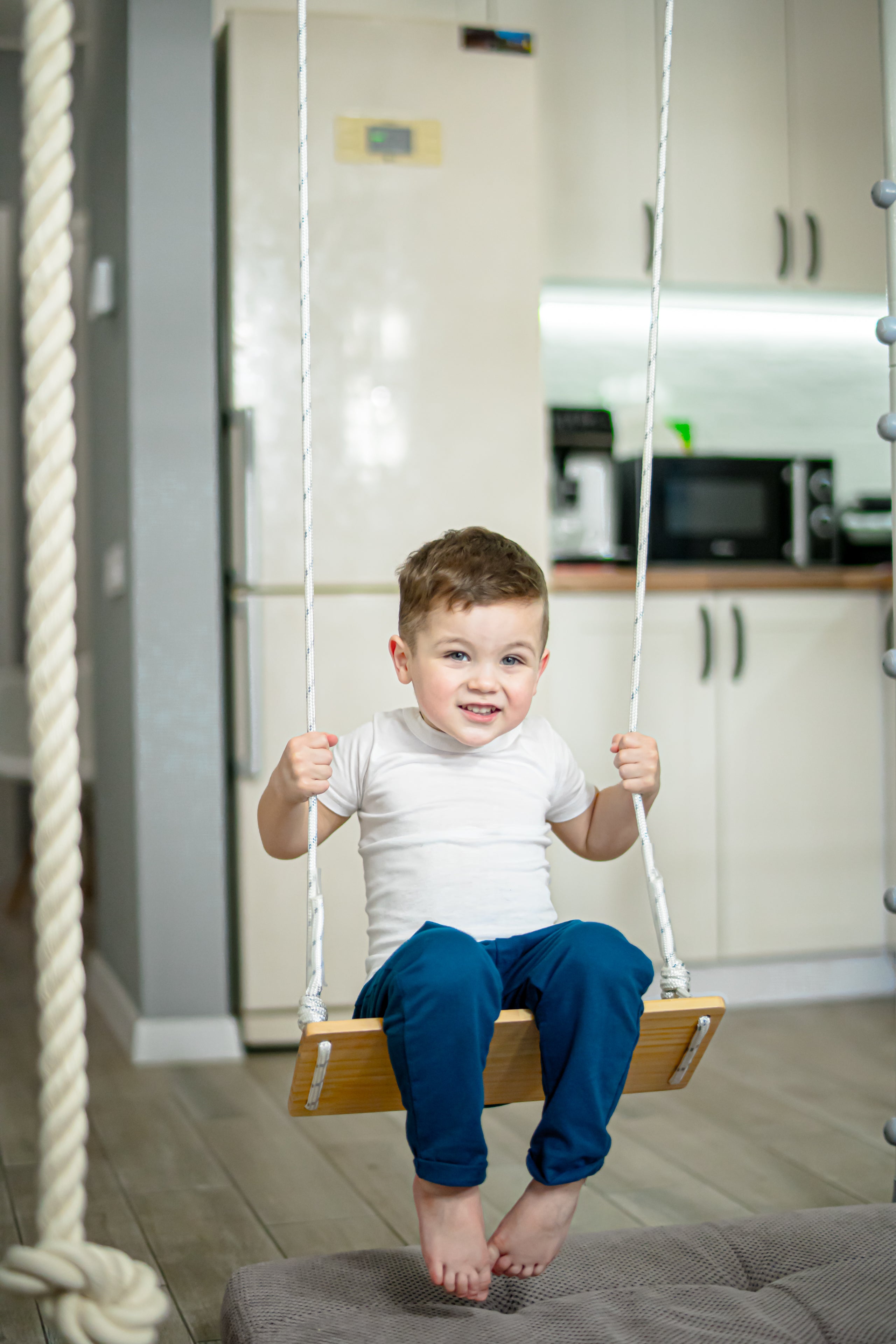
Some children ask for a snack. Yours asks to be turned upside down, spun in the desk chair "again, again," and rocked until the couch cushions migrate across the room. That is not misbehavior. It is a request from the movement sense in your child's inner ear, and a sensory swing is the equipment built to answer it. This guide covers all six types, real weight limits, and, the part most articles skip, how to hang one indoors without gambling on your ceiling.
The quick answer: a sensory swing is any swing chosen for the type of movement input it gives a child: calming linear glides, alerting rotary spins, or full-body deep pressure. The six common types are platform, pod (cocoon), hammock, disc, trapeze, and classic sling swings, and most are rated by their makers for roughly 100 to 250 lb depending on design, so always read the tag on yours. The three legitimate ways to hang one indoors, ranked by how much can go wrong: a freestanding play gym frame (no drilling, a published tested capacity: Brainrich steel frames are rated for 220 lb of active load and safety-tested to 440 lb), rated hardware bolted into a ceiling joist, and, a distant third, a doorway bar. Drywall anchors and unrated decorative hooks are never on the list.
Jump to: Why kids crave swinging · The six types · What a swing does · Weight limits · How to hang one · The do-not list · How long, how fast · FAQ
Why children crave swinging: the vestibular system in parent language
Inside each of your child's inner ears sits a cluster of fluid-filled canals and gravity sensors called the vestibular system: the body's motion and balance sense, reporting which way is up and how fast the head is moving. Occupational therapists working in the tradition of Dr. A. Jean Ayres, who developed sensory integration theory in the 1970s, describe vestibular input as foundational to balance, posture, and body confidence, and the STAR Institute for Sensory Processing lists it among the eight senses every child is working to organize.
Here is the piece most parents are never told: not all swinging is the same input. The direction of movement changes what it does.
LINEAR MOVEMENT
Back-and-forth or side-to-side gliding, the way a hammock or platform swing moves. OTs generally describe slow, rhythmic linear input as calming and organizing: the "settle down before dinner" direction, and the reason rocking has soothed babies forever.
ROTARY MOVEMENT
Spinning, the way a disc or pod swing twirls on a single point. Rotary input is powerful and alerting, and it keeps working on the nervous system after the spinning stops: the strong stuff, dosed carefully rather than poured.
Because rotary input is strong, every parent hanging a swing should know the signs of "enough," the cues occupational therapists teach families to watch for during spinning play: a suddenly pale or flushed face, sweating, glassy eyes, nausea or hiccups, yawning, unusual drowsiness, or the opposite, a child who comes off wired, giddy, and unable to land. Any of these means stop, sit together, and let the system settle. The child asking to spin forever is not always the best judge of when to stop. That part is your job.
The six types of sensory swings, compared
Brainrich makes six swing styles, and they map neatly onto the categories OTs use. Each hangs from one or two points on a frame or ceiling mount, and each delivers a different mix of movement and pressure:
| Swing type | Sensory input it gives | Best age fit | Typical weight limit* |
|---|---|---|---|
| Platform swing | Gentle linear glide with a stable base. Kids lie, kneel, or sit, which adds balance and core work. The best first swing. | 3+ | 150–200 lb |
| Pod / cocoon swing | Slow linear or rotary movement plus deep, even pressure from the fabric wrapping the whole body. The calm-down champion. | 3+ | 100–150 lb |
| Hammock swing | Cradled linear rocking with light compression. Reading nook, wind-down spot, and screen-free lounging in one. | 3+ | 120–180 lb |
| Disc swing | Strong rotary input plus a serious balance challenge: one rope, one seat, active grip the whole ride. Alerting, not calming. | 4+ | 150–220 lb |
| Trapeze bar & rings | Hanging, swinging, and inverting: heavy proprioceptive (muscle-and-joint) input plus grip and shoulder strength. | 4+ | 150–220 lb |
| Classic sling swing | Rhythmic self-propelled linear swinging: the playground feeling, plus timing, leg pumping, and posture work. | 3+ | 150–250 lb |
*Typical manufacturer ratings across each category, ours included. The number that governs your swing is on its label, and the hanging point has its own rating too (more below).
Which one first? A child who mostly needs help settling (bedtime battles, after-school meltdowns) starts with a pod or hammock. A child who mostly needs to move (the couch is a trampoline, the floor is lava) starts with a platform or classic swing, adding the disc once they are steady. Most families end up rotating several: our Accessories Set 2 bundles swing attachments with rings and a trapeze so the same hanging points serve a calming morning and a wild afternoon.
What a swing actually does for a child
Swinging looks like pure recreation, which is exactly why it works: the child chases the feeling, and the development comes along free. Swings have been core equipment in sensory integration therapy since Ayres built the first therapy gyms, and peer-reviewed reviews of the approach (Schaaf and Miller, 2005; Case-Smith and colleagues, 2015) describe movement-based sensory work as promising and actively studied rather than settled. Here is what families and therapists consistently associate with regular swing time:
Regulation
Slow rhythmic swinging is the classic reset: many families build it into the after-school and pre-bed routine on purpose.
Balance & core
Staying upright on a moving seat is a continuous, self-adjusting balance workout no exercise sheet can match.
Body awareness
Gripping, leaning, pumping, and hanging feed the muscle-and-joint sense that tells a child where their body is.
Focus readiness
A movement break before homework is a strategy OTs suggest constantly: input first, then the worksheet.
Indoor outlet
On the days weather wins, the movement need doesn't pause. An indoor swing keeps the outlet open year-round.
Two clarifications. Sensory swings are not only for children with diagnosed sensory needs: every developing nervous system uses movement input, which is why every playground on earth has swings. Parents who want the deeper picture usually start with two books: Ayres' own parent-facing classic, Sensory Integration and the Child, and Carol Stock Kranowitz's The Out-of-Sync Child, the book that carried sensory processing into everyday parent language. And none of this replaces the park; it covers the childhood hours that happen at home, including winter and the fourth rainy day in a row.
Weight limits: the number on the tag is only half the story
Every reputable swing carries a weight rating, and the ranges in the table above are typical. But a hanging swing is a chain: seat, ropes, carabiner, hanging point, and the structure behind it, and the chain is only as strong as its most optimistic link. The tag on the fabric says nothing about the hook in your ceiling.
The tag also can't show dynamic load. A swinging, bouncing child briefly pulls on the hanging point with a force well above their body weight, which is why hardware makers rate swing hardware far beyond the rider's weight. It is also why we publish two numbers for Brainrich frames: every gym is rated for 220 lb of active, moving load and safety-tested to 440 lb, double the rating, per our engineering spec. The margin is not marketing; it is the part doing the work at the top of every arc.
The rule that keeps everyone out of trouble: rate the whole chain, then obey the smallest number. A 200 lb swing on a 220 lb frame hung with rated carabiners is a 200 lb system. The same swing on an unrated decorative hook is whatever that hook feels like today; nobody tested it, so nobody knows.
How to hang a sensory swing indoors, ranked by how much can go wrong
There are three legitimate answers and a long list of illegitimate ones, ranked from fewest failure points to most:
1. A FREESTANDING PLAY GYM FRAME
A steel frame like the Spider V3 gives the swing an engineered structure with a published, tested capacity: no drilling, no hunting for joists, no guessing what your ceiling was built from, and it moves when you move. Hanging points sit at child height, and the same frame carries the net, rings, and monkey bars the swing rotates with. Every link in this chain has a number on a spec sheet.
2. RATED HARDWARE IN A CEILING JOIST
Done right, this is solid: locate a solid wood joist (stud finder, then confirm), drill a pilot hole into its center, and install a swing-rated eye bolt or hanger with a published working load. The catches: engineered I-joists and open-web trusses may need blocking or a pro's sign-off, older ceilings hide surprises, and the hole is forever. If any of that felt fuzzy, hire a pro for an hour or use option 1.
3. A DOORWAY BAR
Tension or bracket-mounted bars can hold a swing, but they rank last: many are rated for pull-ups (a static, straight-down load), not the swinging loads a moving child creates, clearance is tight, and a tension bar's grip depends on friction and correct installation every single time. If you use one, choose a bracket-mounted bar with a published dynamic rating, and treat the doorframe as part of the chain.
Whichever route you choose, finish the same way: rated carabiners with stamped ratings (not keychain clips), daily-glance checks of rope, stitching, and connectors, a clear arc of empty space in every direction the swing travels, and an impact mat under the ride, the same surfacing-and-clearance logic the CPSC's Public Playground Safety Handbook applies under public swings.
The do-not list
Every item below has appeared in a real "swing fell" story somewhere online. None are hanging points:
NEVER HANG A SWING FROM:
✗ Drywall anchors of any kind, including "heavy duty" toggle bolts: drywall is a finish material, and dynamic load rips anchors through it · ✗ Unrated decorative hooks, plant hooks, or closet rods · ✗ A joist you have not actually confirmed ("it felt solid" is not a rating) · ✗ Ceiling fans, light fixtures, or electrical boxes · ✗ Pull-up bars without a published dynamic rating · ✗ Frayed rope, cracked plastic, or bent carabiners: retire hardware early · ✗ Anything, when the rider exceeds the smallest rating in the chain
One placement rule that costs nothing: keep the travel path clear of walls, furniture, and windows, and put the mat where dismounts happen, usually a foot or two beyond the seat.
How long, how fast: the dosing guidelines OTs commonly suggest
There is no universal prescription, and any article that gives you one exact number is improvising. But the guidelines pediatric occupational therapists commonly share with families are consistent enough to pass along, attributed as exactly that: common clinical guidance, not settled research doses.
| Situation | What OTs commonly suggest |
|---|---|
| Everyday linear swinging | Sessions of roughly 10–15 minutes with breaks, following the child's lead. Slow and rhythmic to settle; faster and bouncier to wake up a sluggish morning. |
| Spinning (rotary input) | Short bursts: around ten rotations one direction, pause, then the other direction, watching the child's face between rounds. Rotary input keeps working after the spin stops, so under-do it. |
| Any sign of overload | Pale or flushed face, glassy eyes, nausea, yawning, sudden drowsiness or wild revving: stop, sit, water, quiet. Resume another day at a lower dose. |
| A child in OT | Ask the therapist which swing and movement direction supports the home program; a home swing extends the plan, it doesn't replace it. |
The meta-rule underneath all of it: the child propels, the child chooses, the adult watches the face. Self-directed movement is mostly self-dosing; the exceptions are spinning, and an adult pushing harder than the child would.
Which gym fits your family? Take the 60-Second Quiz →
One frame, all six swings, zero holes in the ceiling
Here is the quiet economics of the swing decision. Ceiling mounting done properly buys you one hanging point, in one fixed spot, for one swing at a time. A steel play gym frame costs more and delivers the rest of the childhood: multiple hanging points at child height, a 220 lb rating tested to double, and the climbing net, rings, trapeze, and monkey bars that turn a swing corner into a complete movement diet. Many families also cover the frame with pre-tax HSA/FSA dollars; the full eligibility picture is in our guide to whether a play gym is HSA/FSA eligible.


Ready to give the swinging a home?
Every gym assembles in an afternoon and is covered by a 30-day money-back guarantee.
Frequently asked questions
What is a sensory swing? A sensory swing is any swing chosen for the movement input it delivers to a child's vestibular (motion and balance) and proprioceptive (muscle and joint) senses. The main types are platform, pod or cocoon, hammock, disc, trapeze, and classic sling swings, each delivering a different mix of linear gliding, rotary spinning, and deep pressure. Every developing nervous system uses movement input, not only children with diagnosed sensory needs.
How do I hang a sensory swing indoors without drilling into the ceiling? Use a freestanding play gym frame. A steel frame like the Brainrich Spider V3 provides engineered hanging points with a published, tested capacity (rated for 220 lb of active load and safety-tested to 440 lb per our engineering spec), and requires no drilling or joist-hunting. It is the only mounting option where every link in the chain has a number on a spec sheet.
What is a typical sensory swing weight limit? Most manufacturer ratings fall between roughly 100 and 250 lb depending on the type: pod and hammock swings commonly sit near 100–180 lb, while platform, disc, trapeze, and classic swings commonly reach 150–250 lb. Check the label on yours, and remember the system's real limit is the smallest rating anywhere in the chain: seat, rope, carabiner, and hanging point.
Can I hang a swing from drywall with anchors? No. Drywall is a finish material, not a structure, and a swinging child creates dynamic loads that pull anchors, toggle bolts included, straight through it. Hang a swing only from rated hardware in a confirmed ceiling joist, a bracket-mounted bar with a published dynamic rating, or a freestanding frame with a tested capacity.
How long should a child use a sensory swing? Pediatric occupational therapists commonly suggest sessions of about 10 to 15 minutes with breaks for everyday swinging, and short bursts for spinning, often framed as around ten rotations in one direction, then a pause. This is common clinical guidance rather than a fixed research dose. Stop at any sign of overload: pale or flushed skin, glassy eyes, nausea, yawning, or a child who comes off wired instead of settled.
Which sensory swing is best for a beginner? A platform swing for movers, a pod or hammock for kids who need help settling. The platform's wide, stable base is the easiest first ride and adds balance and core work; the pod adds calming deep pressure. Strong rotary swings like the disc are best added around age 4 and up, once a child is steady on gentler equipment.
Are sensory swings only for children with autism or sensory processing differences? No. OTs use swings extensively in therapy, but the vestibular system is standard equipment in every child, which is why every playground on earth has swings. A home sensory swing serves any child's daily movement needs, with the type and dose adjusted to the kid.
What are saucer, skateboard, and yoga swings? They are alternate or legacy names families arrive with, and each maps onto one of the six types above. A saucer swing is the disc-style spinning platform, closest to the disc swing and its rotary input. A skateboard swing is a standing board swing used for balance work, the same job a platform swing does once a child rides it standing. A yoga swing, also sold as a stretchy or therapy swing, belongs to the pod and hammock family: wrapping, stretchy fabric that adds calming deep pressure. Whatever the name on the listing, find the matching row in the table above for its input type, age fit, and typical weight limit.
Is a sensory swing a good gift for a child? One of the best, because it stays in daily use long after the wrapping paper is gone. Match the type to the child: a pod or hammock for a kid who needs help settling, a platform or classic sling for a nonstop mover, a disc for a confident spinner age 4 and up. Check that the weight limit leaves room to grow, and confirm the family has a rated place to hang it. If they don't, pair the swing with a freestanding frame, or gift the frame itself and let the swings rotate on it for years.
Can I pay for a swing setup with HSA/FSA funds? Often, yes, for the play gym frame: Brainrich gyms are HSA/FSA eligible through our funding partner. See our funding page and the Decision Guide article on HSA/FSA eligibility for the current process and documentation.
📚 Keep reading in the Decision Guide
Is a Play Gym HSA/FSA Eligible? · Are Climbing Gyms Safe for Kids? The Science of Controlled Risky Play · Indoor Monkey Bars Are Sensory Equipment · The Best Swings for Autistic Kids · What Is Stimming? · Shop sensory gym equipment · Sensory Swings for ADHD
New: not sure where the swing should hang? Read Indoor Swing for Kids: Ceiling, Frame, Doorway, or Play Gym?, with pod swing notes and weight limits.
New: need a swing rated for a bigger kid, teen, or adult? See Heavy-Duty Sensory Swing That Supports 150 lb.
Sources
Ayres, A.J. (2005). Sensory Integration and the Child: 25th Anniversary Edition. Western Psychological Services. · STAR Institute for Sensory Processing. Your 8 Senses. · American Occupational Therapy Association (AOTA), sensory integration practice resources. · Schaaf, R.C. & Miller, L.J. (2005). Occupational therapy using a sensory integrative approach for children with developmental disabilities. Mental Retardation and Developmental Disabilities Research Reviews. · Case-Smith, J., Weaver, L.L. & Fristad, M.A. (2015). A systematic review of sensory processing interventions for children with autism spectrum disorders. Autism. · U.S. Consumer Product Safety Commission. Public Playground Safety Handbook. · Brainrich Kids engineering specification: frame working load 220 lb, safety-tested to 440 lb.
Share: