

Updated August 2026 · 12-minute read · by the Brainrich Kids team
Every August, thousands of families build a beautiful homeschool room. By October, most are doing math at the kitchen table anyway. The rooms fail for the same reason: they were designed like offices for seven-year-olds—a desk, a chair, a motivational poster—when a child's school day needs three different kinds of space. This guide collects 25 homeschool room ideas, and the framework that decides which ones your room actually needs.
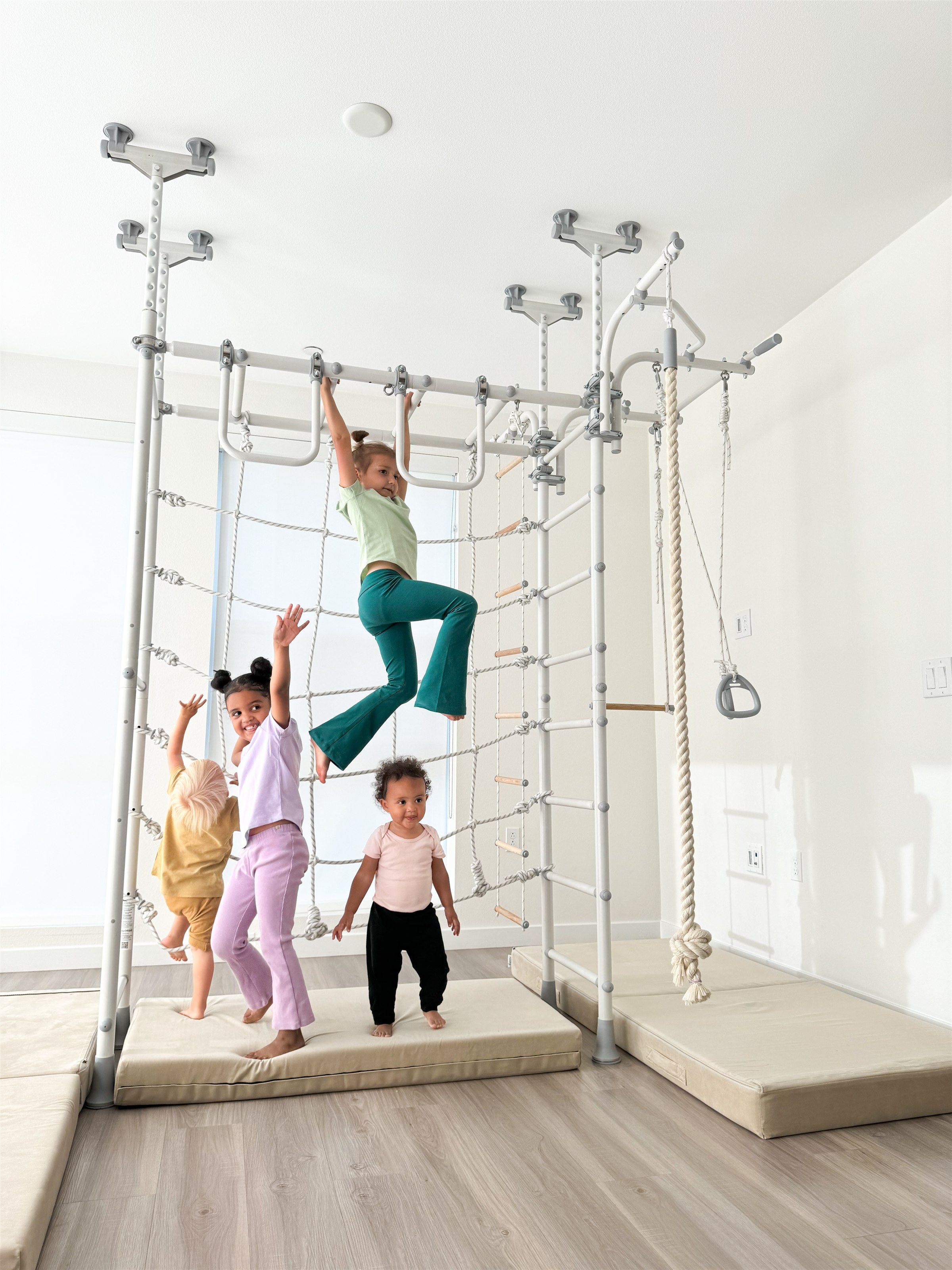
The quick answer: design your homeschool room in three zones—a table zone for seat work, a floor zone for reading and building, and a movement zone for climbing, hanging, and swinging between lessons. Most rooms only build the first zone, which is why they stop working by mid-fall. The movement zone is the one everyone forgets—and the one that makes the other two usable, because researchers link short bouts of physical activity to better on-task behavior in the lessons that follow.
Jump to: The 3-zone framework · Ideas 1–8: table + storage · Ideas 9–14: floor + quiet · Ideas 15–21: movement · Ideas 22–25: small spaces · Common mistakes · FAQ
The 3-zone framework: why most homeschool rooms fail by October
Walk through any homeschool room tour online and you will see the same room: a desk against the wall, a bookshelf, a rug, bunting. It photographs beautifully. Then the school year starts, and the room meets an actual child—a person whose attention runs in 20–30 minute cycles and who physically cannot sit at that desk for a four-hour block. The fix is not more decor. It is zoning. A working homeschool room does three jobs, and each job needs its own territory:
🪑 TABLE ZONE
Handwriting, math, art, anything with a pencil or a mess. Needs a wipeable surface, storage within a child's reach, and good light. This is the zone every room already has.
📚 FLOOR ZONE
Read-alouds, independent reading, blocks, maps, puzzles. Needs softness, low book storage, and a boundary (a rug does it). This is where half of real homeschooling happens.
🧗 MOVEMENT ZONE
Climbing, hanging, swinging—the reset button between lessons. Needs vertical space and mats. The zone almost nobody plans, and the one this article argues for hardest.
Why fight for the third zone? Because the research keeps pointing the same direction. A 2017 systematic review found classroom-based physical activity was associated with improved on-task behavior, and Donnelly and Lambourne's review in Preventive Medicine linked physically active lessons to gains in attention and achievement. Homeschoolers hold an advantage no classroom has: the movement can be ten feet from the math book, used the moment it is needed. Our companion guide, Homeschool PE at Home, covers the curriculum—this article covers the room. And note: the three zones are not three rooms. In most homes they are three corners of one room; the zones are a way of thinking, not a floor plan.
Ideas 1–8: the table + storage zone
Seat work is the smallest part of a young child's day, so the table zone should be the cheapest zone in the room. Budget and IKEA-hack ideas live here on purpose—save the real money for the zone that gets used hardest.
1. 🛒 Start with a rolling cart, not a desk
The single highest-value purchase in homeschooling is a three-tier rolling cart (roughly $30). Load it with the week's workbooks, pencils, and manipulatives, and the "homeschool room" can travel to the kitchen table, the couch, or the porch. Many veteran families discover the cart is the table zone—and the room's square footage is better spent on floor and movement space.
2. 🪑 One big shared table beats individual desks
Rows of small desks recreate the part of school most homeschoolers left on purpose. A single large table—secondhand dining tables work perfectly—seats every child plus the parent, hosts big art projects, and doubles as a puzzle station after hours. Choose a wipeable finish over a precious one; this table is going to earn its scars.
3. 📚 The IKEA hack wall: KALLAX + TROFAST
The classic IKEA homeschool combination: a KALLAX cube unit on its side gives every child their own cubes at their own reach, and a TROFAST frame with shallow bins sorts manipulatives, art supplies, and science kits by category. One safety rule that outranks aesthetics: anchor every shelf taller than the child to the wall with the anti-tip hardware. In a room where climbing is welcomed, furniture must never be the thing that gets climbed.
4. 🧰 Go vertical with a pegboard + rail system
Walls are free real estate. A pegboard over the table holds scissors, tape, rulers, and headphones at eye level, and a wire rail with hanging cups swallows the pencil chaos. Every item that moves from tabletop to wall is surface area returned to actual work—and a clear table is one a child settles into faster.
5. 🧺 The one-bin-per-subject budget system
The best on-a-budget homeschool room idea costs almost nothing: one labeled bin per subject on a single shelf. Math bin, reading bin, science bin. The child pulls one bin, works, returns it—cleanup is built into the system instead of being a separate battle. If budget is the constraint shaping your whole room, read our guide to homeschool grants and funding programs—many families are surprised what their state's education funds cover.
6. 🖼️ Hang a display rail instead of decorating the walls
Skip the mass-printed alphabet posters. A wire with clips (or a picture-ledge rail) displays the children's current work—this week's map, this week's watercolor—and rotates weekly. Children take real pride in a wall that shows what they made rather than what a poster company printed.
7. 🗓️ Build a command center on one strip of wall
One wall calendar, one weekly checklist per child, one clock with a visible face. Children who can see the day's plan argue less about the day's plan, and a checklist a child marks off themselves quietly transfers ownership of the school day from parent to student—which is half the point of homeschooling.
8. 💡 Light the zones separately
Overhead lighting flattens a room into one box. Give the table zone a bright task lamp, the floor zone a warm floor lamp, and let the movement zone take the window. Different light in different corners makes one room feel like three distinct places—which, under the 3-zone framework, is exactly what it is.
Ideas 9–14: the floor + quiet zone
Read-alouds, buddy reading, block engineering, map work—the floor carries more of homeschooling than the table does. This zone needs softness, low storage, and a clear boundary.
9. 🛋️ A reading nook with front-facing book storage
A corner, a floor cushion or small couch, and a front-facing book rail at child height. Front-facing matters: spines-out shelving is for adults who already know what they want; covers-out display is an invitation. Rotate the featured shelf weekly, and keep the nook clear of the movement zone so the reader is never in a swing path.
10. 🧩 Define the building space with one big rug
A low-pile rug is a boundary a three-year-old understands: blocks live on the rug, and the project still standing at dinnertime is safe on the rug. This one purchase ends the "someone stepped on my castle" wars and marks the floor zone as clearly as walls would.
11. 🎧 Build a calm-down corner before you need it
A small tent, a beanbag, noise-reducing headphones, two or three fidget tools. For many children—especially those whose attention runs hot and fast—the day goes better with a sanctioned place to be done for ten minutes. Families often find the calm corner and the movement zone are the two most-used spots in the room; our guide to homeschooling a child with ADHD covers how the two work together.
12. 🔄 Rotate materials on one open shelf
A single low shelf holding six to eight trays of current activities, everything else stored out of sight and rotated in monthly. Less out means more used: a shelf a child can scan in three seconds gets engaged with; a packed wall of everything gets ignored. The cheapest attention upgrade in this article.
13. 🪟 Put an observation station at the window
A small table at the best window: magnifying glass, nature journal, colored pencils, whatever came in from the last walk. Homeschooling gives children more outdoor hours than almost any schooling model—the observation station is where outside gets drawn and labeled. The room is not a replacement for the outdoors; it is the outdoors' filing cabinet.
14. 🎨 Set up a listening + handwork table
An audiobook player with a headphone splitter next to a basket of hands-busy work: modeling clay, lacing cards, embroidery for older kids. Hands occupied, ears learning—many children absorb a novel better while their fingers are busy. This station also buys the parent a 30-minute block with the other child, which every multi-kid homeschool knows is worth gold.
Ideas 15–21: the movement zone
Here is the zone that separates rooms that survive the year from rooms that quietly die. Children's attention is refilled by movement—hanging, climbing, swinging—and a room with nowhere to move sends that need to the furniture, the stairs, and the sibling. The ideas below run from a $25 bar to a full gym, and all share one design rule: the movement zone works because it is in the room—ten feet from the math book, usable in the 90 seconds between lessons.
15. 🚦 Give movement real square footage—on purpose
Before buying anything, commit the space: a clear area roughly the size of a large rug, away from the reading nook, with nothing breakable in swing range. Zone it deliberately, and put an impact mat down even before equipment arrives—the mat marks the territory the way the rug marks the floor zone, and the floor is part of the safety system from day one.
16. 🪜 Use the wall you forgot: a Swedish ladder
The Swedish ladder (wall bars) comes out of the Swedish gymnastics tradition and solves the movement zone's biggest objection—"we have no room"—by using almost none. Mounted flat against a wall, it occupies about a foot of depth while giving a child climbing, hanging, and stretching on demand. A homeschool room has four walls; most rooms use zero of them for the body.
17. 🐒 Monkey bars: the between-lessons reset button
Hanging and swinging from bars is classic heavy work—the deep push-and-pull muscle input occupational therapists reach for when a child needs to settle. A round of monkey bars between handwriting and math takes two minutes, loads the shoulders and grip, and returns a different child to the table. Owner families describe the same pattern: lesson, bars, lesson, bars, all morning.
18. 🌀 Hang a swing—the most-requested seat in the room
A swing indoors sounds indulgent until you watch how it gets used: reading spot, regulation tool, and a reward that costs nothing. Swinging feeds the vestibular system—the balance sense—and for many kids ten minutes of it is the difference between a squirmy read-aloud and a still one. Mount only from a properly rated anchor (a gym frame or a correctly installed ceiling mount, never a bare drywall hook); our roundup of the best indoor swings for kids sorts the options by age.
19. 💪 The $25 doorway pull-up bar test
Not sure your family will use a movement zone? Run the cheapest experiment in this article: a doorway pull-up bar at child height in the school room's doorway. If it gets grabbed every time someone passes under it—and in our experience it will—you have your answer about investing in the real thing. Check the mounting and weight rating carefully, and skip it if your trim will not support it.
20. 🏗️ Climbing wall vs. freestanding gym: pick by wall, floor, and budget
The movement zone's core decision. A wall-mounted option is cheaper and nearly flat, but it is permanent, drilled into studs, and offers one activity per wall. A freestanding steel gym costs more and claims real floor space, but a pressure-fit frame braced between floor and ceiling installs without drilling, moves with you, and stacks climbing, bars, rings, rope, and swing into one footprint. The whole zone by footprint and price band:
| Movement-zone option | Footprint | Price band | Best for |
|---|---|---|---|
| Doorway pull-up bar | A doorframe | $20–$40 | Testing whether movement breaks stick |
| Wall-mounted Swedish ladder or climbing holds | One wall, about a foot deep | $150–$600 | Narrow rooms with a free stud wall you can drill |
| Compact freestanding steel gym (Model T3) | A corner, no drilling | $899 | Climb, swing, and hang in one small movement zone |
| Full jungle gym (Spider Max V3 / Mega Max V3) | A dedicated movement zone | $1,899–$2,399 | Multiple kids, nets, monkey bars, rings, and swing on one frame |
Whichever you choose, the logic of controlled risky play applies: mats under the landing zones, challenges that start low and rise as the child is ready, and equipment rated for independent climbing at ages 3 and up—younger siblings join only hands-on, never solo.
21. 🧘 Make the floor part of the equipment
Impact mats under everything a child can fall from—non-negotiable, and also an opportunity. Folding gymnastics mats stack into a "crash corner" for jumping and rolling, become balance-beam lines laid flat, and disappear against a wall when the room needs floor. In a movement zone, the mat is not an accessory to the equipment. It is equipment.
"Homeschool families were the first to teach us how a gym really gets used. Not as a toy after school—as part of school. Monkey bars between handwriting and math, a swing during the read-aloud, the net while a sibling finishes a lesson. The gym is not competing with the curriculum. It is what makes the curriculum land."
– YEGOR NADVORNYY, FOUNDER OF BRAINRICH KIDS
If a freestanding gym is where your movement zone is headed, these are the three we build, from the corner-sized to the whole-wall:


Which gym fits your room? Take the 60-Second Quiz →
Ideas 22–25: small-space and shared-space solutions
No dedicated room? Neither do most homeschoolers. The 3-zone framework was built for exactly this: zones are corners, not rooms, and every idea above shrinks.
22. 🏙️ The apartment plan: one zone per room
In an apartment, stop looking for one school room and distribute the zones: table zone at the kitchen table (the rolling cart from idea #1 holds everything), floor zone in a bedroom corner with the rug and book rail, movement zone on the living room's one clear wall. A pressure-fit gym frame is the apartment family's cheat code—it braces between floor and ceiling without drilling, so the movement zone survives both the lease and the eventual move.
23. 🚪 The closet conversion study nook
Remove a closet's doors, add a desktop at child height, one shelf, a task light, and a corkboard. The alcove gives an easily distracted child something an open room cannot: two walls between them and everything interesting. It is the classic small-spaces DIY homeschool room idea because it manufactures a "room" out of wasted space for the cost of a board and brackets—anchored into the closet's framing, not just drywall.
24. 🛋️ The living-room corner that disappears at 5 p.m.
Shared-space homeschooling lives or dies on teardown speed. Build the corner from things that close: a cabinet (not open shelves) for materials, the rolling cart parked inside it, a folding mat standing against the wall. School packs away in five minutes and the living room returns to the adults each evening—for many families, the difference between a spouse who tolerates homeschooling and one who champions it.
25. 🎪 The playroom-homeschool combo room
If the kids already have a playroom, do not build a second room—merge them. The playroom's toy zones and the school's floor zone are the same zone; the train table moonlights as a project table; the play gym anchoring the movement corner works both shifts, recess and PE. The one addition that makes the merge work is a closed cabinet for school materials, so "school is done" is a visible, physical state. We covered the play side in our kids playroom ideas guide—the two articles are designed to be used together.
Common mistakes (that this framework prevents)
Buying desks first
The desk is the least-used surface in the room and the first thing most families buy. Start with the cart, the rug, and the movement zone; add a desk only if the year proves you need one.
Using zero vertical space
Four walls and a ceiling, all ignored. Pegboards, rails, a Swedish ladder, a pressure-fit frame—the room's biggest capacity is the part most plans never touch.
Decorating over function
A room designed for the photo fails the Tuesday-in-October test. Every purchase should answer "which zone does this serve?"—if the answer is "it looks nice," it goes last on the list.
Skipping the movement zone
The default mistake. A room with nowhere to climb sends the climbing to the bookshelf and the couch arm. Plan the outlet, or the furniture becomes the outlet—unpadded and unchosen.
Storing at adult height
If a child cannot reach it, a child cannot start it—or put it away. Every material a child uses independently belongs below their shoulder line; anchored shelves, always.
Overlapping the zones
The reading nook inside the swing arc, the block rug under the monkey bars. Zones need clearance from each other—spacing is a safety feature, not a luxury.
Frequently asked questions
What do I actually need to start a homeschool room? Far less than the room tours suggest: a work surface (any table), a rolling cart or one bin per subject, a rug with a low bookshelf, and a designated place to move. That last item is the one most starter lists omit, and it can begin as cheaply as a doorway bar and a folding mat. Add everything else only after real school days reveal what is missing.
How do I set up a homeschool room in a small space or apartment? Distribute the three zones instead of hunting for one big room: table zone at the kitchen table with a rolling cart, floor zone in a bedroom corner, movement zone on the one clear wall. Pressure-fit equipment that braces between floor and ceiling gives renters a full climbing setup without drilling a single hole.
What is a realistic homeschool room budget? The table and floor zones can be built for under $200 with a secondhand table, a cart, bins, and a rug. The movement zone is the widest range: $25 for a doorway bar, a few hundred for wall bars, $899–$2,399 for a freestanding steel gym. Before assuming it is all out of pocket, check your state's education funds and grant programs; several reimburse PE equipment.
Can a playroom and homeschool room share one space? They should—the floor zone and the toy zone are the same zone, and a play gym covers both recess and PE. The one rule that makes the combo work: school materials live in a cabinet that closes, so the room has a visible "school open" and "school closed" state. Without that boundary, neither school nor play ever fully starts or ends.
Is climbing equipment safe inside a school room? With the same controls as any movement space: impact mats under every landing zone, clearance from the reading and table areas, wall-anchored furniture everywhere else, and equipment rated for independent use at ages 3 and up. Researchers who study children's physical play—Brussoni's 2015 systematic review is the landmark—associate this kind of challenge in a managed environment with gains in physical activity, social behavior, and resilience.
Sources
Watson, A. et al. (2017). Effect of classroom-based physical activity interventions on academic and physical activity outcomes: a systematic review and meta-analysis. International Journal of Behavioral Nutrition and Physical Activity. · Donnelly, J.E. & Lambourne, K. (2011). Classroom-based physical activity, cognition, and academic achievement. Preventive Medicine. · Brussoni, M. et al. (2015). What is the relationship between risky outdoor play and health in children? A systematic review. Int. Journal of Environmental Research and Public Health. · Sandseter, E.B.H. (2007). Categorising risky play: how can we identify risk-taking in children's play? European Early Childhood Education Research Journal. · Beaulieu, E. & Beno, S. (2024). Healthy childhood development through outdoor risky play. Canadian Paediatric Society position statement.
📚 Keep reading in the Decision Guide
Homeschool PE at Home: A Complete Plan · Controlled Risky Play: Why Climbing Makes Kids Safer · The Best Indoor Swings for Kids
Share: