

Updated August 2026 · 13-min read · by the Brainrich Kids team
There is no recess bell in a homeschool. No gym teacher with a whistle, no line for the climbing rope, no schedule that forces everyone outside at 10:15 whether the math lesson is finished or not. That freedom is why you homeschool, and it is also why, in every homeschool group we talk to, the same confession comes up: PE is the subject that slips first. Reading gets its hour. Math gets its curriculum. Movement gets "they ran around outside, that counts, right?" This guide exists to answer that question properly: what actually counts, how much your kids actually need, and how to run a PE program at home that takes less planning than a spelling list.
The quick answer: homeschool PE is any planned, regular physical activity that builds your child's fitness and motor skills, and yes, free play, climbing, biking, swimming, and family hikes all count. The benchmark to aim for comes from the CDC: children ages 6–17 need 60 minutes or more of moderate-to-vigorous activity every day, including muscle-strengthening and bone-strengthening activity (think climbing, hanging, jumping) at least 3 days a week. Preschoolers ages 3–5 should simply be active throughout the day, with about 3 hours of active play as a reasonable target. You do not need a gym membership or a certification to deliver that. You need a plan, a place to move on indoor days, and a log.
Jump to: What counts as PE · How much kids need · Weekly plan · 40 activities by age · The indoor movement zone · The PE log · Curriculum options · FAQ
📥 Free download: The Homeschool Movement Kit
This guide's printable companion is free: a 5-page PE Kit with the requirements answered, movement milestones by age, a chin-up ladder from first hang to first rep, a connect-the-dots progress graph kids chart themselves, and Family Movement Bingo—plus an ADHD crash course and the 2026 funding cheat sheet.
Get the free kit →What counts as PE in a homeschool
Start with the reassuring part: homeschool physical education does not have to look like school PE. There is no rule that says fitness must involve a parachute, a dodgeball, or twenty-five kids in matching shirts. In a homeschool, PE is simply the physical-development strand of your child's education: planned movement that builds strength, endurance, coordination, balance, and motor skills over time.
You are also in very large company. Homeschooling in the US is not a fringe arrangement anymore:
~3.4M
US students were homeschooled in 2024–25, per the National Home Education Research Institute.
6.3%
of the entire K–12 population, roughly one child in sixteen, learns at home.
+5.4%
annual growth in homeschooling, per Johns Hopkins' Homeschool Hub tracking of 2024–25 state data.
What about the law? Homeschool requirements are set state by state, and they vary enormously. The general pattern: some states publish a list of required subjects, and physical education or health appears on some of those lists; other states require instruction in broad terms or name no subjects at all. A few states also ask families to keep records, portfolios, or logs of instruction. Because the details differ so much, do not take a blog's word for it, including ours: check your state's actual homeschool statute, summarized state by state at HSLDA's legal pages.
Whatever your statute says, here is the practical standard that serves every family: if the activity is planned, recurring, and physically challenging for your child, it counts. A Tuesday climbing session counts. Swim lessons count. A family hike with a trail map counts. A rainy-week obstacle course in the living room counts. The bar is regularity and intention, not equipment or uniforms.
How much movement kids actually need
The most useful numbers in this entire subject come from the CDC's physical activity guidelines for children and adolescents, which summarize the federal Physical Activity Guidelines for Americans. They give a homeschool parent a concrete target for every age you are teaching:
AGES 3–5
Active throughout the day. Caregivers should encourage active play of any intensity, with about 3 hours per day of movement as a reasonable target. At this age, structure matters far less than opportunity.
AGES 6–17
60+ minutes of moderate-to-vigorous activity daily. Within the week, that should include vigorous activity, muscle-strengthening (climbing, hanging, gymnastics-style work), and bone-strengthening (running, jumping), each on at least 3 days.
Read that second card again, because it quietly settles a question homeschool parents ask us constantly. The CDC does not define muscle-strengthening for children as dumbbells and gym machines. For kids, the classic muscle-strengthening activities are climbing and hanging: playground-style movement where a child hauls, holds, and swings their own body weight. Bone-strengthening is impact: running, hopping, jumping down and landing. A child who climbs a net, traverses monkey bars, and jumps to the mat has just checked both boxes without either of you saying the word "exercise."
For the "am I doing enough?" worriers, here is the benchmark schools are held to. SHAPE America, the national association of physical educators, recommends schools provide 150 minutes of instructional PE per week for elementary students and 225 minutes for middle and high schoolers. That is 30–45 minutes a day of actual instruction, a bar many schools miss and a homeschool can clear with one daily movement block and a bike ride.
SHAPE AMERICA, NATIONAL PE GUIDELINES · SEE THE GUIDELINES
Two clarifications keep these numbers from becoming a source of guilt. First, the 60 minutes is total daily movement, not a single continuous workout, and it does not all have to be "PE class." Recess-style free play, a walk to the library, and twenty minutes of tag all accumulate. Second, the minutes can be split any way your day allows: three 20-minute bursts work as well as one hour, which is exactly how children prefer to move anyway.
A simple weekly PE plan
The plan below is deliberately boring, because boring is what survives a real homeschool week. It assumes one anchor block of 30–45 minutes on weekdays, rotating the focus so that across the week you hit the CDC's aerobic, muscle-strengthening, and bone-strengthening categories, plus the free play your kids were going to do anyway.
| Day | Focus | Sample anchor block (30–45 min) |
|---|---|---|
| Monday | Climbing & upper body (muscle-strengthening) | Climbing circuit: net laps, monkey-bar traverses, ring hangs, rope climb attempts. Count reps, chase last week's number. |
| Tuesday | Aerobic endurance | Bike ride, brisk trail walk, or a jump-rope-and-jog interval session if the weather traps you inside. |
| Wednesday | Skills & coordination | Ball skills, balance-beam lines on the floor, hopscotch, throwing and catching progressions, kid yoga. |
| Thursday | Jumping & games (bone-strengthening) | Obstacle course with jumps and landings, freeze tag, relay races, jump-rope challenges. |
| Friday | Child's choice | They pick: swimming, a playground trip, a hike, a dance-along, a climbing challenge they invent. Choice is what keeps the program alive in February. |
Weekends need no plan: family bike rides, playgrounds, yard play, and sports practices carry themselves. The anchor block is small on purpose. A 30-minute block you actually run every weekday beats a 90-minute program you quit by October, and five anchor blocks already put you past SHAPE America's elementary benchmark before you count a single minute of free play.
40 PE activities by age
A quick note on the indoor/outdoor mix before the lists: this is not an either/or. Outdoor play is irreplaceable, and nothing below is meant to substitute for a good trail or a public playground. But every homeschool family also knows the days when outside is not happening: January ice, August heat advisories, a week of rain, a napping baby you cannot leave. Indoor equipment exists for those days, so the movement continues no matter what the sky is doing. Mix freely.
AGES 3–5 · 13 activities
Indoor: animal walks (bear crawl, crab walk, frog jumps) · painter's-tape balance lines and hopscotch · couch-cushion obstacle courses · freeze dance · balloon volleyball · bean-bag toss into laundry baskets · ladder-rung climbing at the lowest heights (from age 3, with you nearby) · five-second "monkey holds" hanging from rings or a low bar.
Outdoor: nature walks with a scavenger list · balance-bike or tricycle loops · playground trips · chalk obstacle trails · puddle-jumping and leaf-pile landings.
AGES 6–9 · 14 activities
Indoor: monkey-bar traverses (brachiating is one of the best whole-upper-body movements a child can do) · timed climbing-net laps · jump-rope intervals · kid yoga or animal-flow videos · dance-alongs · Swedish-ladder circuits (up, across, over, down) · rope-climb progressions · hallway "crab soccer" with a soft ball.
Outdoor: bike rides with a destination · freeze tag and its hundred variants · wall-ball and soccer drills against a fence · swim lessons · family hikes with a loaded backpack, a classic form of heavy work · seasonal specials like sledding or raking-and-jumping.
AGES 10–12 · 13 activities
Indoor: bodyweight strength circuits (squats, push-ups, planks) · dead-hang and pull-up progressions on rings or a bar, logged weekly · jump-rope interval workouts · stretching and mobility routines · rock-climbing gym sessions.
Outdoor: a beginner running plan (build to a continuous mile) · basketball or soccer drills · skateboarding or rollerblading · rec-league or YMCA homeschool sports · martial arts · orienteering and geocaching · yard work scored as training · family fitness challenges with a shared scoreboard.
One pattern worth noticing across all three lists: the activities kids return to voluntarily are the ones with swinging, hanging, climbing, and spinning in them. That is not an accident; that kind of movement feeds the vestibular system, the balance sense that children instinctively seek out and that underpins coordination everywhere else. Build your program around the movement your child already craves and the compliance problem mostly solves itself.
The indoor movement zone: the homeschool's gym
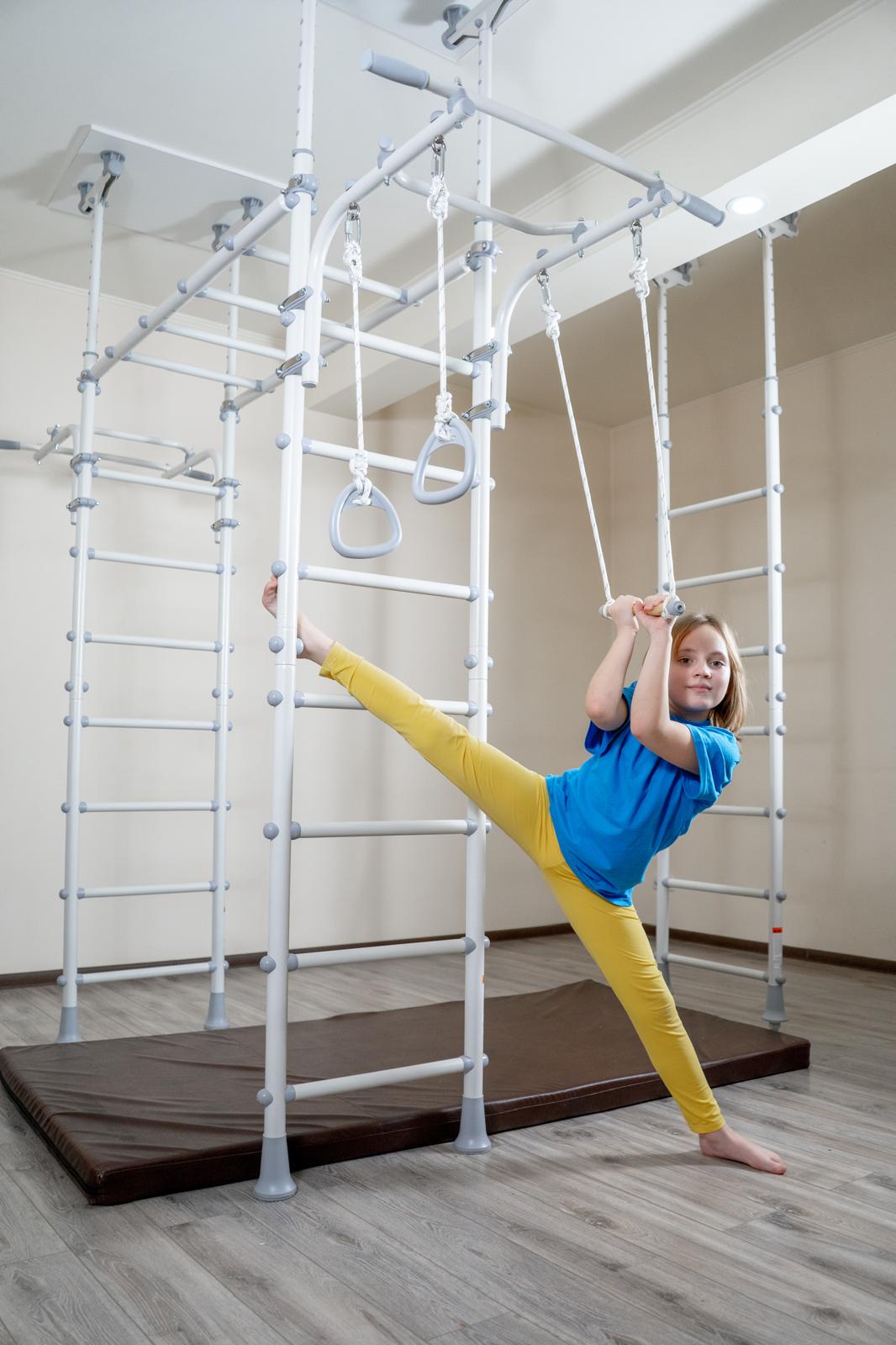
Every school has a gymnasium for a reason: weather is not allowed to cancel PE. A homeschool deserves the same insurance policy, scaled to a corner of a room. We call it the indoor movement zone: one dedicated spot where climbing, hanging, and swinging are always available, no setup, no driving, no "maybe after lunch."
This is, we admit plainly, the part of the subject where we have a product to sell, so let us argue it on the merits. A Swedish-ladder-based climbing gym earns its floor space in a homeschool three ways:
It covers the hardest CDC categories automatically. Aerobic minutes are easy to find; a child can run anywhere. The muscle-strengthening and bone-strengthening minutes are the ones that quietly go missing, and they are exactly what a climbing structure produces: hauling body weight up a net, brachiating across monkey bars, hanging from rings, jumping to the mat. Three sessions a week on the gym and those boxes are checked without a single formal "workout."
It converts the between-lessons fidget into the PE program. Homeschool days have seams: the ten minutes between math and reading, the restless late afternoon. A movement zone turns those seams into training volume. Families of wiggly learners tell us the gym became the thing that made desk work possible; if that is your household, our guide to homeschooling a child with ADHD goes deep on the movement-then-focus rhythm.
It teaches judgment, not just fitness. Climbing at height, on a structure engineered to remove hazards while keeping the challenge, is the textbook case of controlled risky play: the child chooses how high, the equipment guarantees no wobble and no surprises, the mats handle the landings. PE that builds a careful, capable mover is worth more than PE that only burns minutes.
All three of our gyms are built on the same bones: powder-coated steel, a pressure-fit frame braced between floor and ceiling, adjustable bar heights so the challenge grows with the child, and a 3+ age rating for independent climbing. They ship in multiple boxes and go together like a giant Lego set, and one afternoon of assembly buys you a gymnasium that is open 365 days a year:


Two practical notes for homeschool budgets. First, families with an HSA or FSA often ask whether a play gym qualifies; the answer has nuance, and we wrote it up in our HSA/FSA eligibility guide. Second, if your state offers education savings accounts or microgrants, PE equipment is a category worth investigating; our homeschool grants and funding guide maps what exists.
Which gym fits your space? Take the 60-Second Quiz →
Tracking it all: the homeschool PE log
The log is the least glamorous and most valuable habit in this guide, for three reasons. It satisfies the states that ask for records. It builds the paper trail you will want later for high school credit. And it quietly answers the guilt question, because a month of filled-in lines is proof the program is real.
A useful homeschool physical education log needs only four columns:
Date
One line per day. Blank days are information too.
Activity
"Climbing circuit," "bike ride," "swim lesson." Two words is plenty.
Minutes
The column that becomes hours, and hours become credits.
Milestones
"First full monkey-bar traverse." The line your child will ask you to read back.
Log the anchor block every day it happens, plus anything organized (lessons, practices, hikes). You do not need to log every minute of backyard play; the log is a floor, not a surveillance program. Once a month, total the minutes and compare against the CDC's 60-a-day and SHAPE America's weekly instruction benchmarks. If the anchor blocks alone are landing four or five days a week, your program is already healthier than the average school schedule. We are building a printable one-page PE log designed around exactly these columns; it will be linked here when it goes live.
Curriculum options: structured, activity-based, or outsourced
Do you need a formal homeschool physical education curriculum? Need, no. Some families want one anyway, for the same reason they buy a math curriculum: the sequencing is done for you. Here is the neutral map of the three approaches, which mix well:
| Approach | What it looks like | Best for |
|---|---|---|
| Structured curriculum | A purchased scope-and-sequence with lesson plans, skill progressions, and assessments, often video-led. You follow the schedule. | Families who want PE to look like their other subjects, or who need documentation-ready lesson plans for their state. |
| Activity-based | The approach in this guide: a weekly rotation of real activities (climbing, biking, swimming, games) plus a log. You are the curriculum. | Most families, most of the time. Cheapest, most flexible, and easiest to sustain, provided the log actually gets kept. |
| Outsourced classes | YMCA homeschool PE classes, co-op gym days, rec leagues, swim teams, martial arts, gymnastics. Someone else teaches; you drive. | Team-sport exposure, social time, and skills a parent cannot easily coach. Many YMCAs run daytime homeschool sessions; ask your local branch. |
The strongest programs we see blend all three: an outsourced class or league for the social and skill layer, activity-based weeks at home for the daily minutes, and a curriculum only if the family genuinely enjoys following one. The daily minutes are the non-negotiable layer, and they are the layer that happens at home, which is why the movement zone and the log matter more than the curriculum choice.
Frequently asked questions
How do I homeschool PE? Pick a daily 30–45 minute anchor block, rotate the focus across the week (climbing and strength, aerobic, skills, jumping and games, child's choice), let free play and outings fill the rest of the CDC's 60 daily minutes, and write one line per day in a log. That is the entire system. Add outsourced classes for team sports and a formal curriculum only if you want one.
What counts as PE for high school credit? Conventions vary, so check your state law and any umbrella school first. The common homeschool convention treats roughly 120–180 logged hours of work as one full credit, which means a half-credit of PE, a typical transcript entry, is on the order of 60–90 hours: about 30 minutes a day across a school year. Organized sports, strength training, swim team, martial arts, and documented independent fitness programs are all commonly transcripted. This is exactly why the minutes column in your log matters.
How many hours of PE does a homeschooler need? Few states prescribe PE hours for homeschoolers specifically, so the health guidelines are your real target: the CDC recommends 60+ minutes of moderate-to-vigorous activity daily for ages 6–17, and about 3 active hours a day for ages 3–5. For the instructional slice, SHAPE America's school benchmarks (150 minutes a week elementary, 225 secondary) are a sensible bar that a daily anchor block clears comfortably.
Does climbing count as PE? Yes, and it is one of the most efficient entries you can put in the log. Climbing and hanging are the CDC's textbook examples of muscle-strengthening activity for children, jumping down to a mat adds bone-strengthening impact, and sustained climbing games raise the heart rate into aerobic territory. Add the balance and motor-planning demands, which research links to broader coordination and physical confidence, and a 30-minute climbing session touches every category a PE program is supposed to cover.
Is PE legally required for homeschoolers? It depends entirely on your state. Some states list required subjects that include physical education or health, others require none. Check your state's statute at HSLDA before assuming either way, and if your state asks for records, a simple dated log is usually the cleanest way to satisfy it.
What if my child hates "exercise"? Then stop selling it as exercise. Children reliably move for play: tag, climbing challenges, dance-alongs, obstacle courses, scavenger hikes. Build the program out of the movement your child already chases, keep the anchor block short, and let them design Friday. The log does not care whether the minutes felt like PE.
Sources
CDC. Child Activity: An Overview—physical activity guidelines for children and adolescents. · SHAPE America. Guidelines on instructional physical education minutes. · National Home Education Research Institute (2025). How many homeschool students are there in the United States? · Johns Hopkins School of Education, Homeschool Hub. Homeschool growth, 2024–2025. · HSLDA. Homeschool laws by state.
📚 Keep reading in the Decision Guide
Homeschool Room Ideas That Include Movement · Homeschooling a Child With ADHD · Homeschool Grants & Funding: What's Available
New: shopping for a homeschooler? See Homeschool Gift Ideas That Get Used Every Day, sorted by budget, room, and age.
Share: