

Updated September 2026 · 9-minute read · by the Brainrich Kids team
Homeschool families get the strangest gift requests. Not "a toy," but "something for the 2 p.m. slump," or "anything that gets him off the couch between math and reading." That is because a homeschooled child spends the whole day in the same rooms where they eat and sleep, with no bell, no recess, and no gym class arriving on a schedule. The gifts that get used in those houses are the ones that solve that problem. This guide is our list of them, sorted by budget and by the size of the room, with the reasoning and the caveats attached.
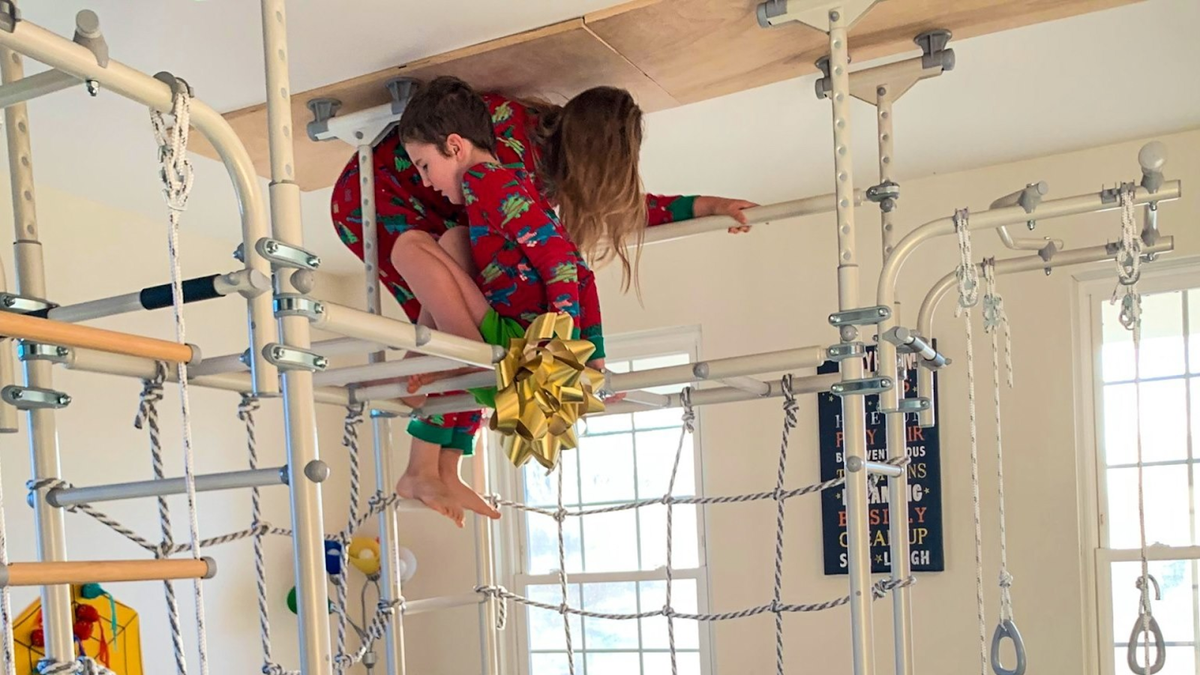
The quick answer: the best homeschool gifts are movement gifts, because movement is the thing a home classroom is missing. A homeschooler has no built-in recess, so a gift that lets a child climb, hang, swing, or balance for five minutes between lessons gets used every school day, not just on the day it is opened. Under $50: a climbing rope, a rope ladder, or a wooden swing seat for a frame the family already owns. Under $200: a balance board or a set of stepping stones. The big one: a steel indoor play gym (from $850), which turns any spare wall or corner into the recess the schedule does not have. Whatever the budget, pick the gift that fits the room they actually school in.
Jump to: Why movement gifts · The three-question test · Gifts by budget · Gifts by room · Gifts by age · How families pay · What to skip · FAQ
Why the best homeschool gifts are movement gifts
A school day has movement built into it whether anyone plans it or not: the walk to the bus, the hallway between classes, recess, PE, the playground after the bell. Take a child out of that building and every one of those disappears. The lessons get shorter and better, which is the point of homeschooling, but the body's schedule empties out.
Homeschool parents notice this by about November of the first year, usually as a behavior problem that is not one: a child who cannot sit for the second lesson, who fidgets through read-aloud, who melts down at 2 p.m. The fix most families land on is a movement break, and the research supports the instinct. The American Academy of Pediatrics' 2018 report on play describes active, self-directed play as associated with executive function and self-regulation, the CDC asks for 60 minutes of daily activity from age 6 including muscle-strengthening movement 3 days a week, a 2020 meta-analysis in Frontiers in Public Health found a modest positive association between children's physical activity and academic performance, a 2023 systematic review in Sustainability concluded that physical activity produces changes in the brain that support cognitive performance and academic achievement in school-age children, and a 2025 narrative review in Brain Sciences gathered the evidence linking physical activity to executive functions in children.
A gift that makes the movement break happen without a parent organizing it is a gift to the parent as much as the child. That is the whole logic of this list. The full argument, with a schedule you can copy, is in movement breaks for kids.
The three-question test for any homeschool gift
1. Will it get used on a Tuesday in February? Not on Christmas morning. On a grey weekday, between lessons, with no adult running it. Gifts that need setup, batteries, or a parent to referee fail this test.
2. Does it fit the room they school in? A homeschool happens at a kitchen table, in a converted dining room, or in a corner of the living room. The gift has to live there too, or it will not be reached for.
3. Will it still fit the child in three years? Homeschool families buy for the long run. A gift sized to a 5-year-old is a gift for one year; a gift that adjusts is a gift for the whole education.
Our steel frames pass all three, which is why we sell them. More than 10,000 families have set one up, occupational and physical therapists in our owner community recommend them for the daily movement work described above, and the same frame serves a household from the toddler years (with a parent's hands close by) through the teens, with adults using the pull-up bar. But a $37 rope ladder and a $27 swing seat pass the test too, if the family already owns something to hang them from. Read the list with the test in mind.
Homeschool gift ideas by budget
| Budget | Gift | Why it works for a homeschooler | The catch |
|---|---|---|---|
| Under $50 | Climbing rope ($45), rope ladder ($37), wooden swing seat ($27) | Adds a new route to a frame the family already owns; a two-minute rope climb is a complete movement break | Only for families who own a Brainrich frame or another rated hanging point |
| Under $50 | Jump rope, a set of wooden stepping stones, a small kids' broom and dustpan | Cheap, storable, usable in a hallway; real chores count as movement in Montessori homes | Novelty fades fast unless it is on a schedule |
| $50 to $200 | Balance board, pull-up bar add-on ($175) for an existing frame, a folding gymnastics mat | A balance board under the desk is a movement break that happens during the lesson; a pull-up bar grows with a 10-year-old | The pull-up bar attaches to a Brainrich frame, not to a doorway |
| $200 to $400 | Play mats sized to the frame, a hammock or pod swing to hang under a monkey-bar span | The mat is the part of a climbing corner most families skip; the hammock is the calm-down tool for the child who reads best upside down | Both need a frame to go with |
| $850 to $1,899 | Model W3 wall-mounted ($850), Model T3 ($899), Spider V3 with monkey bars ($1,499), Spider Max V3 ($1,899) | Recess, PE, and the sensory break in one corner, used 180 school days a year plus weekends; every bar adjusts as the child grows | Needs a flat ceiling between 6 ft 9 in and 10 ft 6 in (floor models) or wall studs (W3); ages 3+ with a parent in the room |
Prices are ours as of September 2026 and do not move; we do not run sales, so the price a grandparent sees in October is the price in December. The bigger gift is usually a pooled one. How to organize that, and how to word the ask, is in non-toy gifts for kids.
Gifts by the room they school in
The kitchen table homeschool. Nowhere to put anything, and the family knows it. The right gifts are small and storable: a balance board that slides under a bench, a jump rope, stepping stones in a basket. If there is one free wall with studs anywhere in the house, the Model W3 stands 9 inches off it and is the only full climbing frame that fits a home with no spare floor. The rest of that playbook is in homeschooling in a small space.
The converted dining room or spare bedroom. A corner is available. A Model T3 takes about 5 ft 6 in by 2 ft 6 in of floor and gives a child a ladder to climb, a rope, rings, and a swing point, which is more movement than most recesses. Add a mat, and the "school room" has a gym.
The dedicated homeschool room or basement. This is where the full frames live. A Spider V3 comes with the monkey bars built in and stands in about 8 ft 6 in by 4 ft 7 in; the Spider Max adds a second span and a second net for siblings. Layouts, ceiling heights, and where the desk goes relative to the frame are in homeschool room setup and the playroom-homeschool combo.
One design note for gift-givers: monkey bars are never a stand-alone gift. A span needs two supports, so the Spider V3 comes with them built in, and the Monkey Bars V3 add-on ($699) is only for a family that already owns a Brainrich frame such as the T3. Ask which they have before you buy.
Gifts by age
Ages 3 to 5
The first real frame, a swing seat, stepping stones, a rope ladder. Independent climbing starts at 3, with a parent in the same room. Under 3, a Pikler triangle is the right gift instead.
Ages 6 to 9
Monkey bars (most kids cross somewhere between 5 and 7), a climbing rope, a balance board for the desk, a hammock for read-aloud time.
Ages 10 to 14
A pull-up bar, gymnastic rings, a jump rope, and a printable PE log so the movement counts toward their credit. The same frame they climbed at 5 becomes their gym.
The broader by-age lists, with toys we do not sell, are in gifts for active kids and Montessori gifts by age. For a child with sensory needs, start with gifts for autistic kids.
How homeschool families pay for the big gift
A play gym is the kind of gift that often gets bought with money that is not the giver's own, and homeschoolers have more of those routes than most.
Education savings accounts. In states with ESA or education-freedom programs, PE equipment can sometimes be an allowable expense, usually with a curriculum tie-in and receipts. The rules differ by state and change often; our state-by-state pages and the ESA equipment guide lay out what each program has actually approved. Keep claims conservative and ask the program administrator first.
HSA and FSA funds. For a child with a qualifying diagnosis, a play gym may be eligible with a Letter of Medical Necessity; the plan administrator decides, and most FSA balances expire December 31.
Grants and co-op funds. Some homeschool grants and charter-style programs fund PE equipment. The current list is in homeschool grants and funding.
The pooled family gift. The most common route of all. Two sets of grandparents and an aunt cover a Spider V3 without anyone buying a single toy that gets forgotten by February. If a program needs an itemized invoice, email us your full name, address, and the model, and we will send one with shipping and tax.
What to skip
Anything with a screen. Homeschool days already fight for attention; a screen gift adds a negotiation to every transition.
Movement gifts that need a yard. A trampoline or backyard set is wonderful in June. The homeschool problem is a Tuesday in February, when it is dark by 5 and the yard is a sheet of ice or a cloud of mosquitoes, depending on the state.
Equipment sized to the child today. A frame or climber a 5-year-old will outgrow at 7 is two years of use for the same money as twelve.
Anything without a load rating. If a child will hang from it, the seller should publish a working load in pounds. Ours: 220 lb working load, safety-tested to 440 lb, on every frame.


The recess a homeschool does not have
Steel indoor play gyms for ages 3 to 12+. Every bar adjusts, 220 lb working load tested to 440, no drilling, 30-day money-back guarantee.
Frequently asked questions
What are the best gifts for homeschoolers? Movement gifts, because a home classroom has no built-in recess or PE. Under $50, a climbing rope, rope ladder, or swing seat for a frame the family owns; under $200, a balance board or pull-up bar add-on; and for the big gift, a steel indoor play gym from $850 that gives a child somewhere to climb, hang, and swing between lessons every school day.
Why do homeschoolers need movement gifts more than other kids? A school building supplies movement by accident: hallways, recess, PE, the walk to the bus. A homeschooled child loses all of it and spends the day in the same rooms. Pediatric guidance asks for 60 minutes of daily activity from age 6, and physical activity is associated with better attention and self-regulation, so a gift that creates a movement break gets used every day.
Can I give monkey bars as a homeschool gift? Only to a family that already owns a frame. Monkey bars are never a stand-alone unit because the span needs two supports. The Brainrich Spider V3 ($1,499) comes with the monkey bars built in, and the Monkey Bars V3 add-on ($699) is for families that already own a Brainrich frame such as the Model T3.
What homeschool gift works in a small apartment? A wall-mounted frame such as the Model W3, which stands about 9 inches off a wall with studs and needs no floor space, or storable items like a balance board, stepping stones, and a jump rope. A single-ladder-pair floor frame like the Model T3 takes a corner about 5 ft 6 in by 2 ft 6 in.
Can homeschool funds pay for a play gym? Sometimes. Some state ESA programs allow PE equipment with a curriculum tie-in and receipts, a play gym may be HSA/FSA eligible for a child with a qualifying diagnosis and a Letter of Medical Necessity, and some homeschool grants fund PE equipment. Rules differ by state and program, so confirm with the administrator before buying.
What age is a play gym gift for? Independent climbing starts at about age 3 with a parent in the same room, and a well-built steel frame stays useful past age 12 as a pull-up and rings station. For a child under 3, a Pikler triangle is the right gift instead.
📚 Keep reading in the Decision Guide
The Homeschool Hub · Non-Toy Gifts for Kids · Gifts for Active Kids · Christmas Gifts for Kids Who Climb · Homeschool PE at Home · The Homeschool PE Log
Sources
Yogman, M. et al. (2018). The Power of Play: A Pediatric Role in Enhancing Development in Young Children. Pediatrics, American Academy of Pediatrics clinical report. · CDC. Physical Activity Guidelines for Children and Adolescents. · Sember, V., Jurak, G., Kovač, M., Morrison, S. A., & Starc, G. (2020). Children's Physical Activity, Academic Performance, and Cognitive Functioning: A Systematic Review and Meta-Analysis. Frontiers in Public Health, 8, 307. · Latino, F., & Tafuri, F. (2023). Physical Activity and Academic Performance in School-Age Children: A Systematic Review. Sustainability, 15(8), 6616. · Guzmán-Muñoz, E. et al. (2025). Physical Activity and Its Effects on Executive Functions and Brain Outcomes in Children: A Narrative Review. Brain Sciences, 15(11), 1238. · Brainrich prices from brainrichkids.com on the publication date. · Brainrich Kids engineering specification: frame working load 220 lb, safety-tested to 440 lb; footprints and ceiling-height versions per product documentation.
Share: