

Updated August 2026 · 12-min read · by the Brainrich Kids team
Here is the question that eventually finds every homeschool family: if we are not tied to a school building, why are we still tied to the school calendar? The 180 days in a row, the ten-week summer, the exhausted sprint to June: all of it was designed for institutions, not for your kitchen table. Year-round homeschooling redistributes the exact same school days across all twelve months, and families who switch rarely switch back.
The quick answer: a year-round homeschool schedule keeps the same number of school days (usually 180) but spreads them across the whole year with short, frequent breaks instead of one giant summer. The three classic patterns are 6-weeks-on-1-off ("sabbath schooling"), 9-weeks-on-3-off, and 4-day weeks all year. The payoff: less material forgotten over long breaks, less burnout for the parent, and off-weeks that fall when everyone else is in school. The one thing every version needs is a daily movement plan that works in every season, because "recess" now happens in January and in August heat.
Jump to: Why families switch · The three patterns · Sabbath schooling · 9-on-3-off · 4-day weeks · Movement by season · Switching mid-year · State laws · FAQ
Why families go year-round
This article is a spoke of our flagship guide, The Homeschool Schedule That Works, which covers how to structure a single day. This one zooms out to the whole year, because the yearly rhythm is where most schedule pain actually starts. Two problems push families toward year-round schooling.
Problem one: the long summer erases work you already did. Researchers have studied summer learning loss (parents know it as the "summer slide") for decades. The classic meta-analysis by Harold Cooper and colleagues, covering 39 studies, found that achievement test scores decline over summer vacation, with the steepest losses in math computation and spelling, on the order of about one month of instruction lost on a grade-level equivalent scale. Every September, schools spend weeks reteaching. When you homeschool on the same calendar, so do you. Shorter, more frequent breaks mean the review tax shrinks: after one week off, kids pick up nearly where they left, and you spend September teaching new material instead of re-teaching June's.
Problem two: the 36-week grind burns out the teacher. In a traditional calendar, you teach for months at a stretch with only scattered holidays. By February, most homeschool parents we talk to are running on fumes, and the curriculum guilt spiral starts. Year-round patterns build recovery into the architecture: a real off-week is always at most a few weeks away, which changes how the hard weeks feel. If you are already deep in that hole, our guide to homeschool burnout is the companion read.
There are quieter perks too: vacations in September when parks are empty and prices drop, grandparent visits that do not have to cluster in July, and a household rhythm that no longer swings between "school mode" and "feral summer mode."
The three classic patterns at a glance
All three patterns below deliver roughly a 180-day school year. They differ in how long you sprint and how often you rest.
| Pattern | Rhythm | Best for | Watch out for |
|---|---|---|---|
| Sabbath schooling | 6 weeks on, 1 week off, repeated all year | Families who burn out on long stretches; parents who need regular planning weeks | Off-weeks arrive whether or not you "earned" them; requires trusting the system |
| 9-on-3-off | Four 9-week quarters, each followed by 3 weeks off | Families who travel; kids who thrive on longer immersion in a topic | Three weeks is long enough for some forgetting; week 8 of a quarter can drag |
| 4-day weeks, year-round | School Monday to Thursday, every week, with light seasonal breaks | Working homeschool parents; co-op families whose Fridays are already spoken for | Needs ~45 weeks of the year "on"; the fifth day fills up fast if you let it |
Sabbath schooling: 6 weeks on, 1 week off
The term comes from the idea of a sabbath rest applied to the school year, and the math is tidy: six terms of six weeks each gives you 36 school weeks, the standard 180 days. Add the six off-weeks and you have accounted for 42 weeks, leaving roughly ten flexible weeks to spend on a longer December break, a summer buffer, or extra off-weeks wherever your family sags.
| Term | Roughly when | Then |
|---|---|---|
| Term 1 · weeks 1–6 | Early August to mid September | 1 week off |
| Term 2 · weeks 1–6 | Late September to early November | 1 week off |
| Term 3 · weeks 1–6 | Mid November to just before Christmas | 2–3 weeks off (holidays) |
| Term 4 · weeks 1–6 | Mid January to late February | 1 week off |
| Term 5 · weeks 1–6 | Early March to mid April | 1 week off |
| Term 6 · weeks 1–6 | Late April to early June | 4–6 week summer buffer |
Two rules make sabbath schooling work. First, the off-week is not a catch-up week. If you spend it finishing the math chapter you fell behind on, you have quietly cancelled the rest that makes the next six weeks possible. Behind is fine; the schedule absorbs it. Second, protect the off-week from becoming an errand week. Many families give it a shape: a project week, a grandparents week, a library-and-park week. The kids still move, read, and build things. Nobody prints a worksheet.
Parents consistently report the same surprise: the biggest beneficiary is not the child, it is the teacher. Knowing that week seven is always coming changes how week five feels.
9 weeks on, 3 weeks off
This is the classic year-round calendar many public districts use (there it is often called 45-15, counting days instead of weeks). Four 9-week quarters give you 36 school weeks; four 3-week breaks give you 12 off-weeks, and the remaining four weeks land as holidays and buffer.
| Quarter | Roughly when | Then |
|---|---|---|
| Q1 · 9 weeks | Early August to early October | 3 weeks off (fall trip season) |
| Q2 · 9 weeks | Late October to just before Christmas | 3 weeks off (holidays) |
| Q3 · 9 weeks | Mid January to mid March | 3 weeks off (spring) |
| Q4 · 9 weeks | Early April to early June | 3 weeks off + summer buffer |
The three-week break is this pattern's superpower and its weakness in one. It is long enough for real travel, a full unit of nothing, or an off-season vacation while the crowds are in school. It is also long enough that some skills (math facts, early reading fluency) get rusty. The fix most families use: keep two tiny anchors alive during breaks, ten minutes of reading and a daily dose of hard physical play, and drop everything else guilt-free.
The 4-day week, all year
Instead of restructuring the calendar into terms, this pattern restructures the week: school runs Monday to Thursday, every week, roughly 45 weeks a year (45 weeks × 4 days = 180 days), leaving about seven off-weeks to place around holidays and a short summer break. Friday becomes the standing day for co-op, field trips, appointments, nature days, or a working parent's overlap day.
| Day | What it looks like |
|---|---|
| Monday–Thursday | Core lessons in the morning, movement blocks between subjects, afternoons for interest-led work |
| Friday | Co-op, field trips, library, park day, catch-up only if a child asks for it |
| Off-weeks (~7/yr) | Placed around holidays, family travel, and one deliberate mid-winter rest week |
Because the "on" season is so long, the 4-day pattern lives or dies on the quality of an ordinary Tuesday. Four focused days beat five distracted ones, but only if the focused days include real physical outlets; with only light seasonal breaks, there is no long vacation for kids to burn off a semester of accumulated wiggle. The daily movement block is not optional here. It is the pressure valve.
Movement blocks by season: the part most plans skip
Here is what nobody tells you before you go year-round: you have just signed up to run recess in every month of the year. A traditional September-to-June calendar quietly outsources the worst weather to summer vacation. A year-round schedule does not. You will be schooling through January ice and through August heat advisories, and health authorities recommend school-age kids get 60 minutes of moderate-to-vigorous activity every single day, including those.
The practical answer is to plan movement like you plan curriculum, seasonally, with an indoor default that never depends on the weather:
| Season | Outdoor blocks | Indoor zone carries |
|---|---|---|
| Fall / spring | The easy season: park days, bikes, nature walks between lessons | Rainy-day backup; first-thing wake-up climb before seat work |
| Winter | Short bundled-up bursts when conditions allow | Nearly everything: climbing, swinging, and hanging between every lesson block, weeks at a stretch |
| Summer (year-round schoolers school here!) | Early morning and evening only in hot states; August afternoons are indoor territory | The 10am-to-5pm window: heat-safe recess in air conditioning |
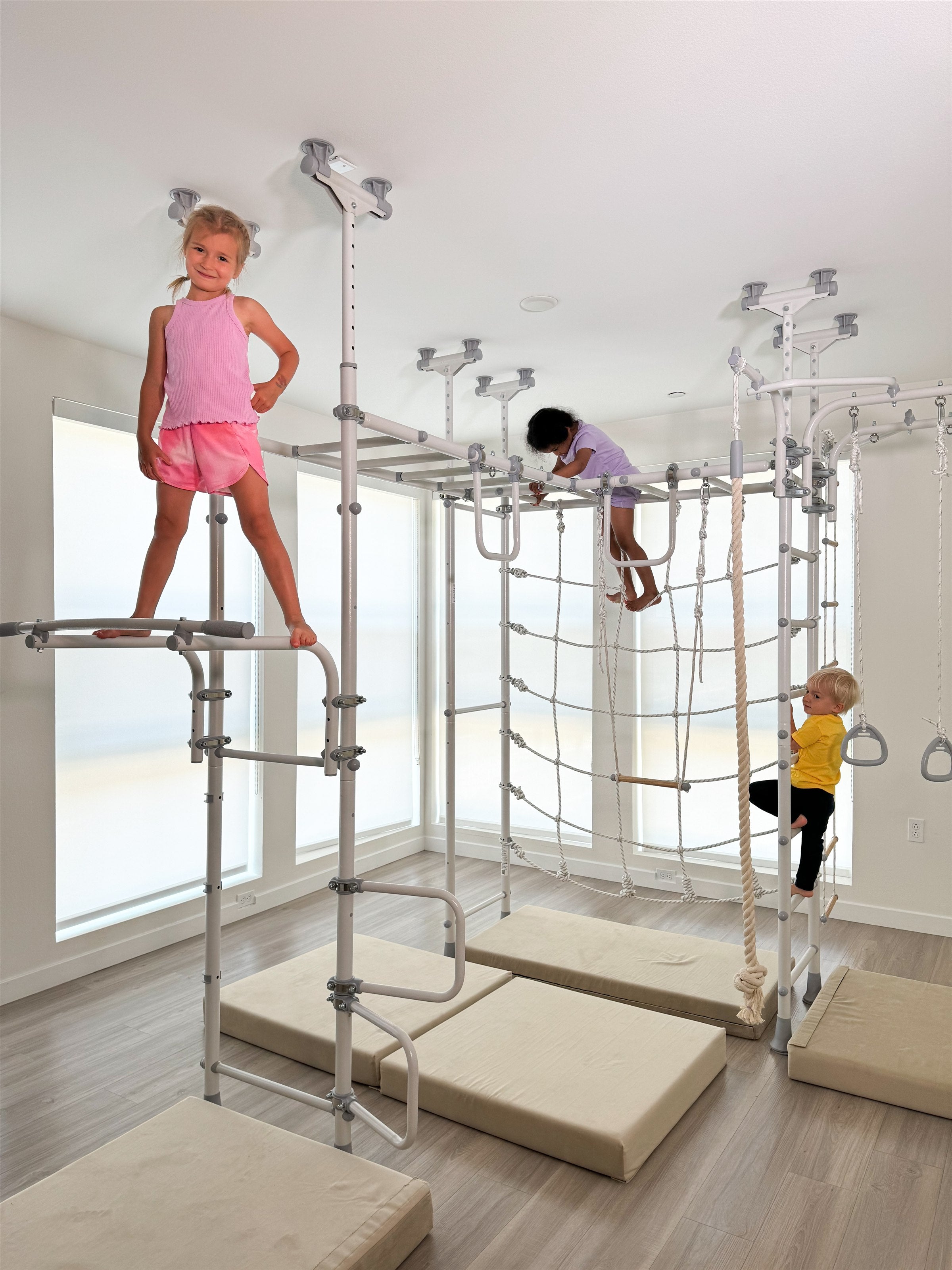
We are the opposite of anti-outdoors: when the weather is good, go out, every time. The point is what happens on the other 100+ days a year when it is not good. Families with a dedicated indoor movement zone (a climbing gym, mats, a swing) do not lose those days; the between-lesson body break happens on schedule in February exactly as it did in October. That consistency is worth more to a year-round schedule than any planner. It is the difference between a calendar that works on paper and one that works in your actual house. Our homeschool PE guide turns that daily hour into an actual K-6 program, gym or no gym.
Which gym fits your homeschool room? Take the 60-Second Quiz →
Switching mid-year (yes, you can start in January)
You do not have to wait for August. Because year-round patterns are modular, you can convert any time by counting what you have already done. Say you schooled a traditional fall and want to switch after the holidays: you have roughly 80–90 days banked, so you need about 90–100 more. That is five sabbath terms starting mid January, or two and a half 9-week quarters, finishing in early summer with off-weeks intact. The steps:
1 · COUNT BACKWARD
Tally days completed so far, subtract from your state's requirement, and divide the remainder into terms.
2 · START WITH AN OFF-WEEK
Counterintuitive but effective: open the new system with its reward, then run your first six-week term.
3 · TELL THE KIDS THE RULES
Post the term calendar where they can see it. Kids pace themselves beautifully when the next break has a date.
Mid-year switching is also, quietly, the rescue move for a fall semester that went sideways. January is the second-biggest month for new homeschoolers, and a year-round calendar means starting in January is not "half a year behind." It is simply week one.
One legal note before you print your calendar
Homeschool law is state law, and states count very differently: some require a specific number of instruction days or hours, some require subjects but no day count, and some require assessments on a fixed schedule. A year-round calendar satisfies day-count requirements just as well as a traditional one, but how you log attendance across a July term can matter in states where the "school year" has a defined start and end for reporting. Before you commit, check your state's current requirements on HSLDA's state law pages, and if you file paperwork through an umbrella school or charter, ask how they want year-round attendance recorded. Ten minutes of checking beats an awkward letter in October.


Building the recess that runs all year?
Every gym assembles in an afternoon and is covered by a 30-day money-back guarantee.
Frequently asked questions
What is a year-round homeschool schedule? A calendar that spreads the standard school year (usually 180 days) across all twelve months, using short frequent breaks instead of one long summer. The three most common patterns are 6-weeks-on-1-off (sabbath schooling), 9-weeks-on-3-off, and 4-day school weeks running most of the year.
What is sabbath schooling? A year-round pattern of six weeks of school followed by one full week off, repeated through the year. Six terms of six weeks produce 36 school weeks, and the built-in seventh-week rest is the feature: the parent-teacher recovers before burnout compounds, and kids return sharp after a short break instead of rusty after a long one.
Do year-round homeschoolers still get a summer break? Almost always, just a shorter one. Most families keep a four-to-six week summer buffer in June or July for camps, travel, and pure rest, which is easy to afford when the other breaks are distributed through the year.
Is year-round homeschooling legal? Homeschooling is legal in all 50 states, and no state requires that your school days fall between September and June. What varies is how days, hours, subjects, and assessments must be counted and reported, so check your state's current rules on HSLDA before finalizing a calendar, especially if you report through an umbrella school or charter program.
How do kids keep active when school runs through winter and August? Deliberately. Year-round schooling means your recess plan has to survive both January and a heat wave, which is why so many year-round families anchor the day with an indoor movement zone: climbing, swinging, and hanging between lesson blocks regardless of the forecast, with outdoor time layered on whenever weather allows. Brainrich gyms are rated for independent climbing at ages 3+, which covers the entire K-6 stretch where the wiggles fight the worksheets hardest.
Can I switch to a year-round schedule in the middle of the year? Yes. Count the school days you have already completed, subtract from your state's requirement, and arrange the remainder into terms. Many families switch in January and find it is the easiest schedule change they ever made, because the next break is always close enough to see.
Does year-round schooling actually reduce summer learning loss? The research on summer loss is clear that long breaks cost measurable ground, with math hit hardest. Shortening the longest break shrinks the amount there is to forget, and homeschoolers have an advantage no district has: you can keep ten minutes of daily reading and daily physical play alive during off-weeks at zero cost to the rest.
📚 Keep reading in the Decision Guide
The Homeschool Schedule That Works · Homeschool Burnout: The Physical-Outlet Fix · Kindergarten Homeschool Schedule · Homeschool PE at Home
Sources
Cooper, H. et al. (1996). The effects of summer vacation on achievement test scores: a narrative and meta-analytic review. Review of Educational Research. · HSLDA. Homeschool laws by state. · CDC. Physical activity guidelines for children and adolescents (60 minutes daily).
Share: