

Updated August 2026 · 12-minute read · by the Brainrich Kids team
Every family that owns a climbing gym eventually asks about the tall vertical ladder on the side: the one that looks like a section of wall made entirely of rungs. That piece has a name. Several, actually. It is a Swedish ladder, also called stall bars, a Swedish wall, or gymnastic wall bars, and it is quietly one of the oldest pieces of exercise equipment still in daily use anywhere: invented in Sweden in the early 1800s, adopted by gyms across Europe, reinvented for compact family apartments, and now standing in American living rooms. Here is what it is, where it came from, what it does for a growing body, and how to choose one for your kids.
The quick answer: a Swedish ladder (stall bars) is a vertical frame of evenly spaced horizontal rungs that children climb, hang from, and stretch against. It was developed within Per Henrik Ling's Swedish gymnastics system in the early 19th century, spread through European school gyms and therapy clinics, and became the backbone of the apartment-sized steel home-gym tradition that modern indoor play gyms, including ours, descend from. For kids, it supports climbing skill, grip strength, shoulder and core strength, flexibility, and postural control, which is why pediatric therapists still keep stall bars in their clinics. When buying, check four things: rung coating, weight rating, mounting method (wall studs or floor-to-ceiling tension), and rung spacing. Brainrich gyms include a full-height steel gym ladder rated to 220 lb and safety-tested to 440 lb, climbable independently from age 3.
Jump to: What it is · The 200-year history · Benefits for kids · Skills by age · Buying guide · The Brainrich gym ladder · FAQ
What is a Swedish ladder? (One apparatus, five names)
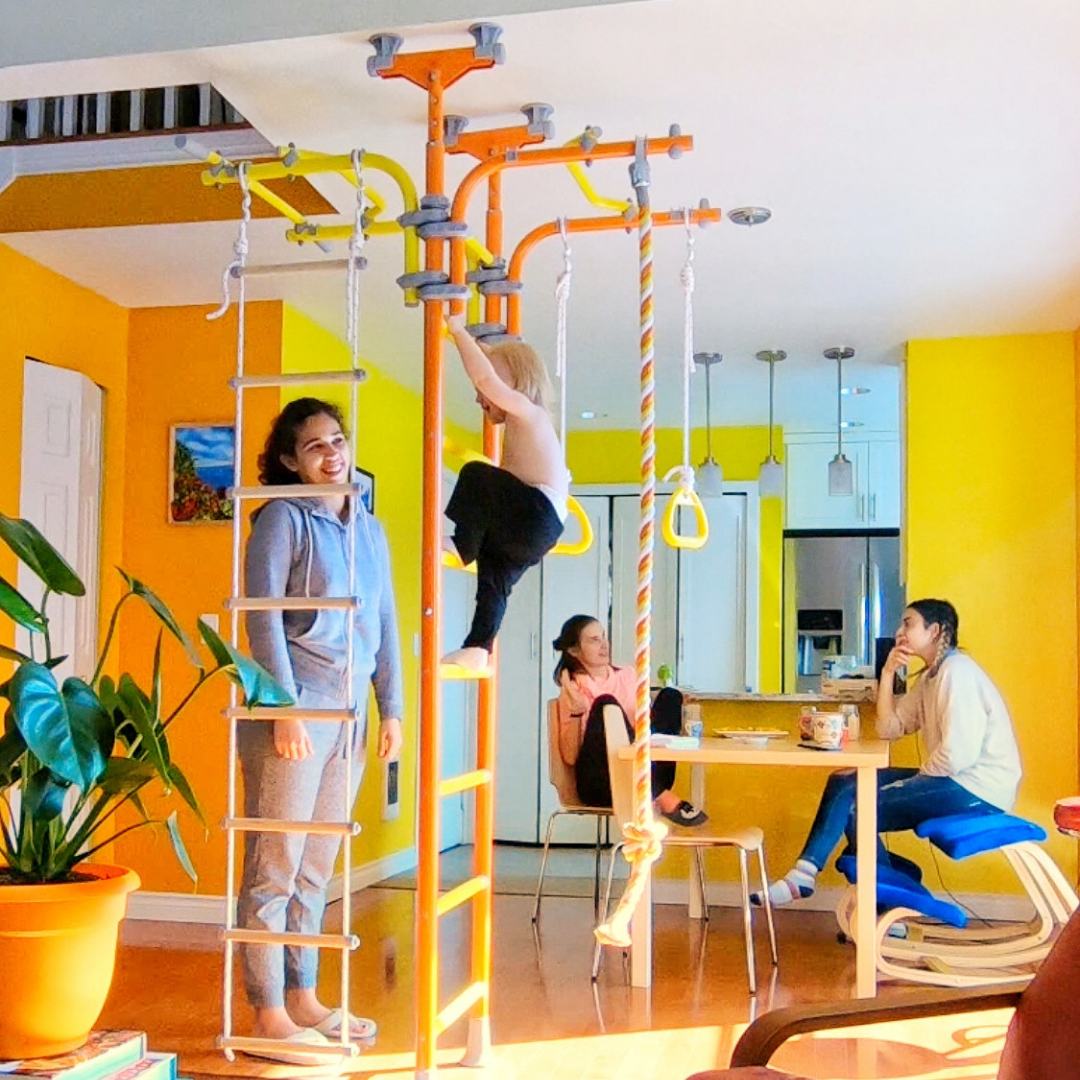
Picture a ladder built into a wall: two vertical rails, a column of round horizontal rungs spaced a few inches apart, running from near the floor to above an adult's head. That is the whole apparatus, and the simplicity is the point. A child can climb it, hang from it, swing a leg over a rung to stretch, press their back against it to practice standing tall, or use the bottom rung as a foothold for a hundred invented games.
Because it spread through so many countries over two centuries, the same object collected a stack of names, and they all refer to the same thing:
All five names describe the same vertical rung ladder. "Swedish" points to the country that invented it; "stall bars" is the traditional English gym term.
The English term stall bars traces back to the original Swedish name, ribbstol, and to the stall-like bays the ladders formed when a whole gymnasium wall was lined with them. In Ukraine, where our founder grew up, the apparatus is simply called the Swedish wall, a name so standard that generations of families never learned any other word for it. That name matters to this story more than you might expect, because the second half of this apparatus's history happened not in gymnasiums but in family apartments, and that is the branch of the family tree that leads directly to the modern steel home play gym.
A 200-year history: from a Swedish poet's sore arm to your living room
The Swedish ladder begins with Per Henrik Ling (1776–1839), a Swedish poet and fencing master who noticed that daily exercise appeared to ease the arthritis in his arm. Ling turned that observation into a system: with royal backing he founded the Royal Gymnastic Central Institute in Stockholm in 1813 and built what became known as Swedish gymnastics, a method of precise, progressive exercises for education, therapy, and posture. The apparatus his school made famous was the ribbstol, the wall of rungs, refined within the Ling tradition into the standardized stall bars that soon lined gymnasium walls across Sweden.
Through the 19th century the Swedish system traveled: to school gymnasiums across Europe, to physical-therapy practice (Ling's institute trained the world's first physiotherapists), and eventually across the Atlantic with European immigrants. If you have ever seen a black-and-white photograph of a turn-of-the-century school gym, the ladders on the wall are Ling's legacy: the same rungs served a seven-year-old learning to climb, a gymnast stretching, and a patient rebuilding a shoulder.
Then comes the chapter most English-language histories skip. Nowhere did the Swedish wall put down deeper roots than in Eastern Europe, where it became standard equipment in school gyms, sports halls, and therapy clinics, and where, in the 1970s and 80s, engineers and educators took it one radical step further: into the apartment. They designed compact floor-to-ceiling home sports complexes that packed a Swedish wall, rings, a rope, and a trapeze into a few square meters of ordinary living space: a steel gym in the corner of the family room, used daily, all year, regardless of weather. Whole generations of children, including Brainrich's founder, grew up climbing one before breakfast.
This is personal for us. Brainrich founder Yegor Nadvornyy grew up on one of those steel home sports complexes in Ukraine. It was bolted up before he could walk, it survived his entire childhood of climbing, hanging, and flipping, and it is still standing in the same spot roughly 35 years later. Brainrich gyms are that tradition, re-engineered for American homes: the same floor-to-ceiling steel, the same Swedish ladder at the core, the same conviction that daily movement belongs inside the home, not just at the playground.
So when you buy a modern indoor play gym with a vertical ladder on the side, you are not buying a toy trend. You are buying the current model year of a 200-year lineage: Ling's therapy apparatus → the European school gym → the apartment home sports complex → the modern steel home play gym. Few pieces of children's equipment on earth have been field-tested by more generations.
What a Swedish ladder does for a growing body
There is a reason pediatric occupational and physical therapy clinics still install stall bars a full two centuries after Ling: one simple apparatus exercises an unusually wide slice of child development. Researchers who study climbing and active play link this kind of vertical, whole-body movement to benefits across strength, coordination, and confidence, and the ladder serves four of them especially well:
🧗 CLIMBING & GRIP
Every trip up the rungs works the hands, forearms, shoulders, and core together. Grip strength is the unglamorous foundation under almost every physical skill a child builds later, from monkey bars to handwriting endurance.
🐒 HANGING
Hanging from a high rung loads the shoulders and lengthens the whole chain from fingers to hips. Therapists often use supported hanging to build shoulder stability and body awareness, and kids seek it out on their own because it simply feels good.
🤸 FLEXIBILITY
The classic stall-bar move: a heel hooked over a rung at exactly the right height, a slow fold forward. The graded rungs act like a built-in stretching partner that grows with the child, which is why dancers and gymnasts never stopped using them.
🧍 POSTURE
Ling designed the ribbstol partly as a posture tool, and it still works that way: back against the rungs for alignment practice, hanging to counter a day of sitting, climbing to strengthen the muscles that hold a spine tall.
Underneath all four runs the same developmental engine we describe across our Decision Guide: vertical play trains proprioception (knowing where your limbs are), the vestibular system (balance), and motor planning (sequencing hands and feet). A ladder teaches all three unusually well because it is perfectly predictable: identical rungs, identical spacing, hundreds of repetitions, available every day in every season. None of this replaces outdoor play, and it is not meant to. It fills the enormous stretch of childhood hours that happen indoors.
Vertical-ladder skills by age
One of the quiet advantages of a Swedish ladder is that it never expires. The same rungs serve a toddler and a ten-year-old; only the games change. Here is the progression we see across thousands of owner families:
| Age | What the ladder looks like to them |
|---|---|
| 1–2 years | A pull-to-stand rail and a first rung or two, always with an adult's hands on. This is watching-and-cruising territory, not independent climbing. |
| 3–4 years | Independent climbing begins (Brainrich gyms are rated for solo climbing from age 3). Expect slow, deliberate ascents, endless up-and-downs, and enormous pride at each new highest rung. |
| 5–7 years | Speed climbs, sideways traverses, hanging from the top rung, skipping rungs on the way up, transitioning from the ladder to nets and monkey bars mid-route. |
| 8+ years | The ladder turns into training equipment: hanging leg raises, stretching drills, pull-up practice on the top rungs, timed obstacle circuits they invent themselves. |
The rule that keeps the whole progression safe is the one from our risky-play guide: let children climb to their own height. A child who reached a rung by themselves has demonstrated the skill to be there. A child lifted to a rung has not. Stay close and quiet for the under-3s, keep an impact mat at the base, and let the ladder do what it has done for two centuries: hand out challenge in perfectly graded, rung-sized doses.
Buying guide: how to choose a Swedish ladder for kids
Swedish ladders come in two big families, and the right one depends mostly on your walls, your ceiling, and how much gym you want around the ladder.
WALL-MOUNTED
Bolts directly into wall studs. Smallest footprint, sits flat against the wall, works under any ceiling height. The classic stall-bar format. Must be anchored into studs or masonry, never drywall alone.
TENSION-MOUNTED (FLOOR TO CEILING)
Braces between floor and ceiling with no drilling, the direct descendant of the apartment home sports complex. Renter-friendly, movable, and usually part of a larger gym with nets, rings, and monkey bars around the ladder.
On materials, the market splits into wood and steel. Wooden stall bars are the traditional gymnasium format and look beautiful; their long-term job is fighting wear, since wooden rungs and joints are the parts that age. Steel ladders hold their geometry for decades (the 35-year-old gym from Yegor's childhood is the standing proof), and modern coatings solve old steel's cold-and-slippery problem. We build in steel for exactly that reason, and we wrote a full comparison in Steel vs. Wood Climbing Gyms. Whichever family you choose, run every candidate through this checklist:
The 5-point Swedish ladder checklist
1. Rung coating. Bare metal is cold and slick under small hands. Look for a grippy, non-toxic rubber or powder coating on the rungs, and ask what is in it: coatings and any plastic parts should be phthalate-free, because hands and mouths will be all over them.
2. Weight rating, with a test number behind it. A kids' ladder should carry an adult, because an adult will climb it (to spot, to stretch, to prove a point). Look for a stated working load and a higher tested load, not just a marketing number.
3. Mounting you can trust. Wall-mounted: into studs or masonry, with the hardware included and the stud spacing documented. Tension-mounted: measure your ceiling first, and check the model's supported ceiling range before you fall in love with it.
4. Rung spacing and diameter. Rungs sized for children's hands (roughly broomstick diameter) and spaced so a preschooler can reach the next one without lunging. Uniform spacing top to bottom is what lets the body build its map of the ladder.
5. Room to grow. The best value is a ladder that is part of a system: one that accepts rings, a swing, monkey bars, or an extension later, so the apparatus expands as the child does instead of being outgrown.
How the Brainrich gym ladder extends the concept
Every Brainrich play gym is built around a full-height steel Swedish ladder, and it is worth explaining its anatomy, because the design solves the one problem Ling never had to think about: American ceilings come in every height.
The Brainrich gym ladder is a three-part telescoping column: a bottom section, a middle section, and a telescopic top section that extends to press against the ceiling and lock the whole gym in place. The bottom section comes in two lengths, Short and Standard (identical across V2 and V3 gyms): the Short bottom simply has one fewer rung, making it about 10 inches shorter for lower ceilings. Between the two bottoms and the telescoping top, the same gym fits ceilings from 6'9" to 9'1" (Short), 7'8" to 9'11" (Standard), or 9'4" to 10'6" (Tall). And for vaulted rooms, a dedicated extension ladder adds roughly 53 cm (about 21 inches) of extra reach. In other words: measure your ceiling, and there is a configuration for it.
The rest is the checklist from the last section, answered in full: powder-coated steel with non-toxic rubber-coated rungs and phthalate-free plastics, a working load of 220 lb with every gym safety-tested to 440 lb (double the rating), independent climbing from age 3, and a tension-mounted frame that needs no drilling. Around the ladder, the gym adds what a bare stall bar cannot: nets, rings, a rope, a trapeze, and monkey bars, so the ladder becomes the trunk of a whole climbing tree. Everything ships the way a big Lego set does, in multiple clearly marked boxes that arrive together and assemble in an afternoon.
Three more practical notes. Brainrich gyms are HSA/FSA eligible with a Letter of Medical Necessity, which can effectively save families up to about 30%. Every gym carries a 30-day money-back guarantee. And if you want to see a few thousand of these ladders in real homes first, our 12,500-member owner community posts them daily. We design and support everything from our home base in Boca Raton, Florida. If you prefer the classic against-the-wall stall bar format, our wall-mounted W3 line starts at $850; the tension-mounted gyms below are the full home-sports-complex experience.


Two centuries of design. One corner of your home.
From the Spider V3 at $1,499 to the Mega Max V3, every gym is built around the same steel Swedish ladder, covered by a 30-day money-back guarantee.
Frequently asked questions
What is a Swedish ladder? A Swedish ladder is a vertical frame of evenly spaced horizontal rungs, either bolted to a wall or braced between floor and ceiling, used for climbing, hanging, stretching, and posture exercises. It comes from the Swedish gymnastics system founded by Per Henrik Ling in the early 1800s and is also known as stall bars, a Swedish wall, or gymnastic wall bars.
What is the difference between a Swedish ladder and stall bars? There is no difference in the apparatus itself: "stall bars" is the traditional English gymnasium term, "Swedish ladder" and "Swedish wall" credit the country of origin, and "wall bars" is common in Europe. All describe the same wall of rungs. In practice, "stall bars" often implies the classic wooden wall-mounted format, while "Swedish ladder" is used more broadly, including for ladders built into freestanding play gyms.
What age can kids start using a Swedish ladder? On Brainrich gyms, independent climbing is rated from age 3. Younger toddlers can use the bottom rungs for supported standing and first climbs with an adult's hands on. There is no upper age: the same ladder serves stretching, hanging, and strength work for older kids, teens, and adults, which is exactly how it was used in Ling's original gymnasiums.
How much weight can a Swedish ladder hold? It varies widely by build, which is why the rating matters when you shop. Brainrich gym ladders have a working load of 220 lb and every gym is safety-tested to 440 lb, double the rating, so parents can climb, spot, and stretch alongside their kids.
Should I get a wall-mounted or freestanding (tension-mounted) Swedish ladder? Wall-mounted ladders take the least space and suit any ceiling height, but they must be anchored into wall studs or masonry and they stay where you bolt them. Tension-mounted ladders brace between floor and ceiling with no drilling, can move with you, and usually anchor a larger gym with nets, rings, and monkey bars. Renters and families who want a full play gym usually choose tension-mounted; families who want a minimal footprint against one wall choose wall-mounted.
Is a Swedish ladder safe for kids indoors? Used with the same rules as any climbing equipment, yes: an impact mat at the base, close supervision under age 3, and the golden rule of letting children climb only to heights they reached themselves. Check that rungs are coated and grippy, that the frame carries a real tested weight rating, and that mounting follows the manufacturer's instructions exactly.
Why is it called a Swedish wall? Because the apparatus spread across Europe from Per Henrik Ling's Royal Gymnastic Central Institute in Stockholm, other countries named it after its origin. In many places, including Ukraine, "Swedish wall" is the standard everyday name for it, and it was there that the apparatus later evolved into the apartment-sized home sports complex that inspired modern steel home play gyms.
📚 Keep reading in the Decision Guide
Steel vs. Wood Climbing Gyms for Kids · Controlled Risky Play: Why Climbing Makes Kids Safer · DIY vs. Buying an Indoor Play Gym · Shop Swedish Ladders & Stall Bars · Children's Climbing Ladders Compared
Sources
Encyclopaedia Britannica. Per Henrik Ling, Swedish physical educator. · Wikipedia. Wall bars. · Brussoni, M. et al. (2015). What is the relationship between risky outdoor play and health in children? A systematic review. Int. Journal of Environmental Research and Public Health.
Share: