

Updated August 2026 · 14-min read · by the Brainrich Kids team
Most guides to homeschooling an autistic child start with curriculum: which program, which method, which planner. Then week two arrives, the beautifully chosen curriculum sits untouched, and the morning is spent recovering from a meltdown that had nothing to do with phonics. Here is the reframe that experienced autism homeschoolers eventually land on, usually the hard way: the environment is the curriculum's landlord. If the environment doesn't work, nothing that happens inside it does. So this guide starts where the successful families start: with the room, the rhythm, and the regulation, and only then with the books.
The quick answer: before you choose a single workbook, build the environment: a predictable structure to the day (research links unpredictability to anxiety in autistic children), a sensory setup matched to your child (calm zones, controlled lighting and sound, regulating input on demand), and movement access all day long, because studies associate physical activity and vestibular/proprioceptive input with better regulation, attention, and behavior. Curriculum comes last, and almost any curriculum works better inside an environment that keeps your child regulated. This is the one advantage no school building can match: you control every variable.
Jump to: Why families choose it · Environment before curriculum · The sensory-first room · Movement & regulation · Sample daily rhythms · Co-regulation & breaks · Curriculum notes · FAQ
This article is general information for families, not medical or therapeutic advice. Every autistic child is different; build your setup with your child's occupational therapist or care team, who know your specific child.
Why so many families of autistic kids choose homeschooling
Homeschooling is the fastest-growing education segment in the country, with roughly 3.4 million homeschooled students in 2025–26, and families of autistic children are heavily represented in that growth. That is not a coincidence of demographics. With the CDC now identifying autism in about 1 in 31 eight-year-olds, an enormous number of families are discovering the same mismatch: a school building is, by design, a one-size-fits-most sensory and social environment, and their child is not most.
The research on these families is small but consistent. In a qualitative study of parents homeschooling autistic children, Hurlbutt (2011) found parents chose home education because they felt schools were unwilling or unable to provide effective programming, and that once home, they used the flexibility to do exactly what this article describes: accommodate the environment for sensory needs, build flexible schedules, and weave the child's interests into the work. In other words, the families who made the leap didn't primarily buy a better curriculum. They built a better environment.
The everyday reasons parents give tend to cluster into four:
🔊 SENSORY OVERLOAD
Fluorescent hum, cafeteria echo, 25 bodies in motion. A school day can be a seven-hour sensory marathon before a single lesson lands.
⏰ PACE MISMATCH
Spiky profiles are the norm in autism: a child reading years ahead and writing years behind. Classrooms teach to the middle; home teaches to the child.
🔁 RECOVERY TIME
Many parents describe after-school restraint collapse: a child who held it together all day and falls apart at pickup. Homeschool days can be built so nothing needs holding in.
🤝 SUPPORT GAPS
IEP meetings, waitlists, and one aide across a full classroom. At home, the adult-to-child ratio is a number no school can offer.
None of this is an argument that school is wrong for every autistic child; plenty of autistic kids thrive in classrooms with the right supports. It is an argument that if school is not working for your child, you are not imagining the mismatch, and the thing you get to change at home is not just the teaching. It is everything around the teaching.
Environment before curriculum: the ordering that changes everything
Here is the principle underneath this whole article. A dysregulated nervous system cannot learn. Not "learns less", not "learns slower": the parts of the brain doing phonics and fractions are simply not driving the bus while the body is in alarm. Every experienced special-ed teacher and OT knows this sequence, and it is worth pinning to your wall: regulated first, connected second, learning third. Curriculum is the third floor of a building. The environment is the foundation and the frame.
For autistic children specifically, two environmental variables carry most of the weight:
1. Predictability. Research on anxiety in autistic children keeps arriving at the same construct: intolerance of uncertainty, the distress that comes from not knowing what happens next. Boulter and colleagues (2014) found that intolerance of uncertainty helps explain the strong association between autism and anxiety in children and adolescents. Flip that finding around and it becomes a design instruction: every piece of uncertainty you remove from the day is anxiety your child doesn't have to spend the morning managing. Same start time, same sequence, visual schedule on the wall, warnings before transitions. (We wrote a whole companion guide on this: Autism Homeschool Schedules & Visual Routines.)
2. Sensory fit. A meta-analysis of 14 studies by Ben-Sasson and colleagues found that sensory differences, both over-responsivity (sounds too loud, tags unbearable) and under-responsivity (craving crashing, spinning, squeezing), are dramatically more frequent in autistic children than in their peers, with the biggest differences in exactly the 6–9 age band most homeschoolers teach. Sensory processing differences are now part of the diagnostic criteria for autism itself. Which means a homeschool room designed without a sensory plan is a homeschool room designed without the child in it.
CURRICULUM-FIRST HOMESCHOOL
Buys the boxed program, sets up a desk, starts Monday. By Thursday the desk is a battleground, the program is "not working", and the family is shopping for the next one. The variable that failed was never the curriculum.
ENVIRONMENT-FIRST HOMESCHOOL
Spends week one on the room, the rhythm, and the regulation tools, with short, easy academic wins layered in. By the time real curriculum arrives, it lands on a child whose day already works. Almost anything teaches well in that room.
The sensory-first room: three zones, one rule
You do not need a dedicated schoolroom, a Pinterest budget, or a finished basement. You need three zones, and they can live in one corner of a living room. We covered the general version in our homeschool room ideas guide and the deep sensory version in how to build a sensory gym at home; here is the autism-homeschool cut of it.
| Zone | What it's for | What goes in it |
|---|---|---|
| Work zone | Focused table work, short blocks | A clear desk facing away from visual clutter, the visual schedule at eye level, headphones within reach, fidget basket, natural light where possible |
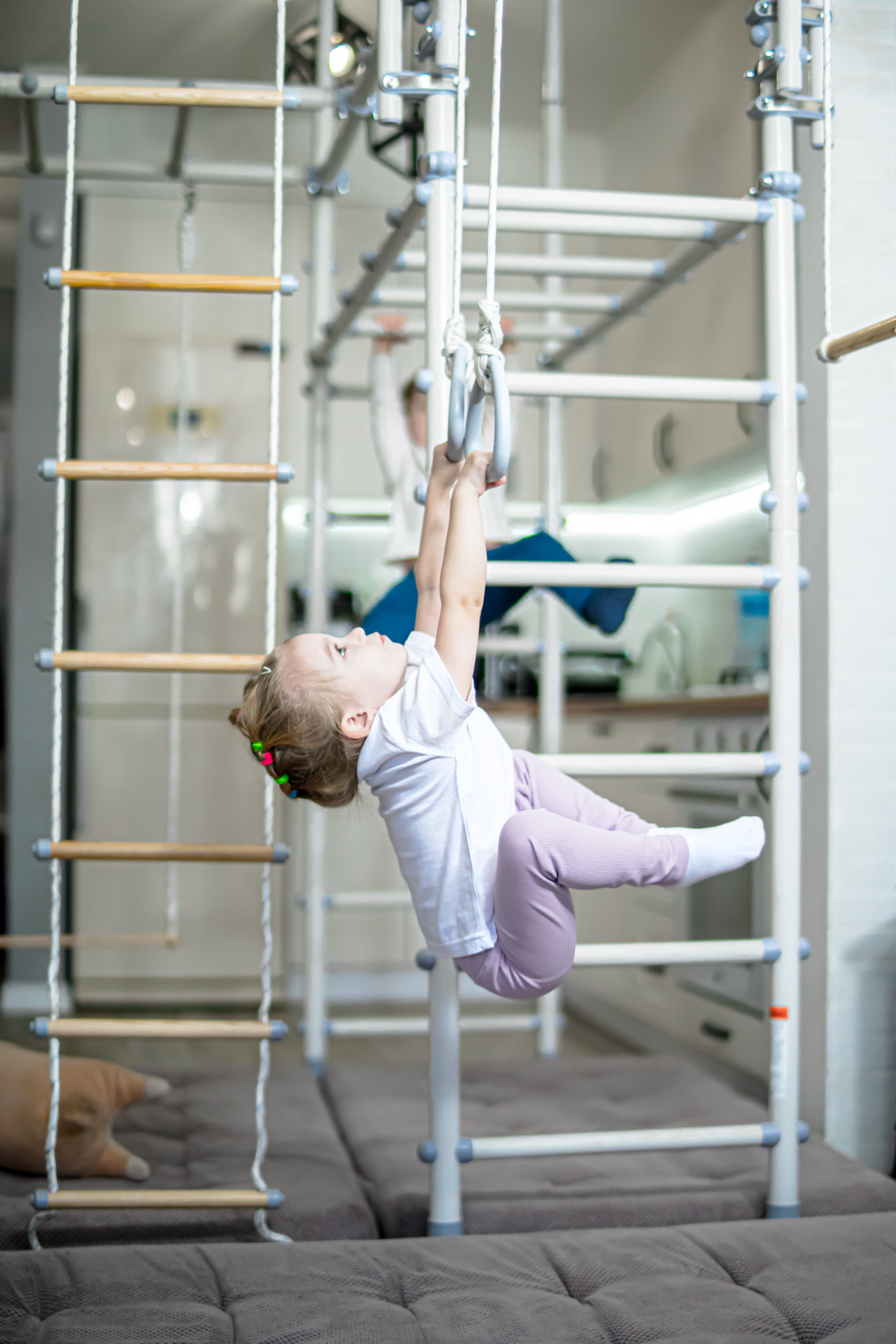
| Movement zone | Regulation on demand, all day | Climbing, hanging, and swinging equipment with impact mats; this is the recess bell your homeschool doesn't have, permanently rung |
| Calm zone | Downshifting, retreat, recovery | A tent, teepee, or corner with cushions, dim light, a weighted lap pad, ear defenders, a bin of the child's comfort objects; entered by choice, never as punishment |
The one rule that makes the three zones work: each zone means one thing. The desk is never where meltdowns are processed; the calm corner is never where demands are made; the movement zone is never taken away as a consequence. Autistic kids read environments faster than they read faces, and a room whose zones keep their promises is itself a form of predictability.
Sensory specifics worth auditing before day one: lighting (many autistic children are bothered by fluorescent flicker; use lamps or daylight), sound (a quiet house is a real advantage over school, protect it, and keep headphones normalized), clothing (one of homeschooling's underrated perks: seams, tags, and uniforms stop being a battle), and visual clutter (open shelving full of bright bins reads as noise to many kids; doors and curtains are cheap fixes). Your child's occupational therapist can help you map whether your child mostly seeks input, mostly avoids it, or, most commonly, both at once in different channels, and tune the room accordingly. If swings are part of your plan, our sensory swings guide walks the types.
Movement is regulation: the vestibular and proprioceptive levers
Ask an occupational therapist what they reach for when an autistic child is climbing out of their skin, and the answer is rarely a worksheet about feelings. It is movement, and two sensory channels in particular:
⚖️ VESTIBULAR INPUT
The inner-ear sense of motion and gravity: swinging, spinning, hanging upside down, rocking. Many autistic kids seek it in huge doses or avoid it fiercely; either way it is a primary regulation channel. Full explainer: vestibular input for kids.
💪 PROPRIOCEPTIVE INPUT
The sense from muscles and joints under load: climbing, hanging, pushing, carrying, squeezing. OTs call it "heavy work" and it is the closest thing sensory integration has to a universal calmer. Ideas list: heavy work activities.
The research here is genuinely encouraging, with the usual scientific caveats. A systematic review by Bremer and colleagues (2016) of 13 exercise-intervention studies in autistic children and youth reported positive behavioral outcomes across activities from jogging to swimming to martial arts. An earlier meta-analysis by Sowa and Meulenbroek (2012) across 16 studies associated structured physical exercise with improvements in both motor and social skills. And in a randomized trial by Schaaf and colleagues (2014), autistic children ages 4–8 who received occupational therapy using sensory integration principles, therapy built around exactly this kind of swinging, climbing, and heavy-work equipment, made significantly greater progress on individualized goals and self-care than children receiving usual care.
Read those findings the way the researchers do: associations and promising trials, not guarantees, and not a substitute for your child's therapy plan. But notice what the interventions have in common. They are all scheduled doses of the input autistic kids were seeking anyway, the spinning, crashing, climbing, and squeezing that gets labeled "sensory-seeking behavior" at school and is, at home, simply Tuesday.
Here is the structural advantage nobody tells new homeschoolers about: a homeschooled child has no recess bell. No gym class, no playground at 10 a.m., no walk between buildings. Every drop of movement in the day has to be built in on purpose, and for an autistic child whose regulation runs on movement, that is not a nice-to-have. It is the load-bearing wall of the schedule. This is why so many autism homeschool rooms are anchored not by the desk but by the climbing gym: the gym is the recess, sixty seconds away, in any weather, every single day.
Outdoor time still matters, and none of this replaces the park, the trampoline place, or the hiking trail. The indoor movement zone exists for the other twenty-two hours: the January mornings, the too-hot afternoons, the ten minutes between math and reading when the wiggles arrive and the playground is a car ride away.
"Their most used toy by FAR, like by a landslide. They use it every day for hours."
– LEISA L., MOM OF 3, BRAINRICH OWNER
Sample daily rhythms (steal these, then bend them)
Autism homeschool veterans talk about rhythm rather than schedule: a predictable sequence of anchors rather than a clock-locked timetable. The sequence stays fixed, which feeds the need for predictability; the durations flex, which respects the fact that no autistic child regulates on a bell system. Two starting points:
| Anchor | Ages 3–6 (rhythm day) | Ages 7–11 (block day) |
|---|---|---|
| Morning movement | 20–30 min on the gym before any demands: climb, swing, hang. Input first, everything else after. | Movement circuit the child helped design: rings, monkey bars, net climbs. Then breakfast debrief and the visual schedule review. |
| Work block 1 | One short table activity (10–15 min) on the hardest-for-them subject, while the tank is full. | 25–40 min on the priority subject. First-then board visible: first math, then rings. |
| Movement break | Free play in the movement zone, as long as needed. | 10 min of chosen input: swing, hang, heavy work. Non-negotiable, never withheld. |
| Work block 2 | Interest-led: the dinosaur books, the number games, the thing they'd choose anyway, with you narrating the learning inside it. | Second subject, often interest-adjacent (reading about their special interest counts double: skill practice plus motivation for free). |
| Afternoon | Outside time, errands as life-skills practice, calm-zone rest, sibling play. | Project time, therapy appointments, co-op or park meetups, and a real recess outdoors whenever weather allows. |
Three notes from families who live this. First, front-load movement: the single highest-leverage change most families report is putting big input before the first demand of the day instead of using it to mop up afterward. Second, keep work blocks shorter than you think, then let a good day run long rather than forcing a bad day to term. Third, the rhythm itself belongs on the wall as a visual schedule your child can see and touch; that is a big enough topic that it has its own companion article, Autism Homeschool Schedules & Visual Routines, with printable-style layouts, first-then boards, and transition strategies.
Co-regulation, breaks, and the myth of the independent learner
A quiet trap in homeschool culture is the image of the child working independently at a tidy desk while the parent sips coffee nearby. For many autistic children, especially early on, that picture is years away, and chasing it too soon burns both of you out. The developmental reality is that self-regulation is learned through co-regulation: a calm adult nervous system lending its steadiness until the child's own can take over. You are not a distraction from your child's independence. For now, you are the scaffolding of it.
What co-regulation looks like on an ordinary Tuesday:
Breaks deserve their own rules, because for autistic kids a break is not a reward, it is maintenance. Three that matter: breaks are scheduled (they appear on the visual schedule before behavior demands them), breaks are never revoked (taking away the movement break for a hard morning is like taking away insulin for high blood sugar), and breaks have a menu (swing, hang, calm corner, water, outside) so "take a break" is a choice, not another demand. Watch for your child's early signals, the pacing, the pitch change, the script that speeds up, and cue the break at the signal, not at the meltdown. Every family's list of signals is different; this is exactly the map an OT can help you draw.
And one more break that nobody schedules: yours. Homeschooling an autistic child is a marathon of presence. A parent running on fumes cannot lend a nervous system to anyone. The calm corner works for adults too; so does the gym, a quiet coffee, and the co-op afternoon where another adult takes point.
Curriculum notes (the short section, on purpose)
Now, and only now, the books. This section is short not because curriculum doesn't matter but because no curriculum choice matters as much as the environment it lands in, and because curriculum is where your child's individual profile should drive, not a blog's opinion. A few neutral principles that hold across programs:
Match the format to the sensory profile, not the grade level. A child who can't sit doesn't need an easier workbook; they need a format that doesn't require sitting: audiobooks on the swing, math facts recited on the monkey bars, spelling traced in a sand tray. Expect a spiky profile and buy accordingly: it is completely normal to run one subject two grades up and another two grades down, which is a reason to prefer subject-by-subject purchases over all-in-one boxes at first. Lean into special interests, the most powerful engine in autism education; a train-obsessed child can learn reading, math, geography, and history without ever leaving the rails. And use structure your child can see: whatever program you choose, wrap it in visual supports, which the National Clearinghouse on Autism Evidence and Practice (2020) lists among the practices with the strongest evidence base across more than a hundred studies.
If your child also has an ADHD profile, as many autistic kids do, our movement-first ADHD homeschool guide is the sibling to this article, and homeschool PE at home covers the formal-PE side of the movement day.
Two money notes before you buy anything. Depending on your state, ESA and homeschool grant funds can often cover curriculum, equipment, and therapy; the state-by-state picture is in our homeschool grants and funding guide. And for sensory equipment specifically, some families use HSA/FSA funds with a letter of medical necessity from their provider; see whether a play gym is HSA/FSA eligible and our letter of medical necessity guide.
Which gym fits your child's sensory needs? Take the 60-Second Quiz →
Building the movement zone: what belongs in it
If the movement zone is the recess your homeschool doesn't otherwise have, it earns real equipment: something that serves both sensory channels (vestibular swinging and hanging, proprioceptive climbing and gripping), holds up to daily use for years, and lives safely indoors with impact mats underneath. That is precisely the job a floor-to-ceiling play gym was designed for, and all three of ours are rated for independent climbing at ages 3 and up, with adjustable bars so the challenge starts low and grows with your child:


Ready to build the room around the child?
Every gym assembles in an afternoon and is covered by a 30-day money-back guarantee.
Frequently asked questions
How do I start homeschooling my autistic child? In this order: check your state's homeschool notification requirements (a quick step in most states), then spend your first weeks on environment rather than academics: set up work, movement, and calm zones; establish a predictable daily rhythm with a visual schedule; and learn your child's sensory profile with your OT's help. Layer in short, low-pressure academic blocks once the days feel stable, and choose full curriculum last. Many families call the first month "deschooling" and treat it as setup, not lost time.
Is homeschooling good for autistic children? It depends on the child and the family, and anyone who gives a blanket answer is overselling. What the research does describe is why families choose it and what they do with it: parents in Hurlbutt's study reported schools couldn't accommodate their child effectively and used homeschooling's flexibility to fit the environment, schedule, and content to the child. Homeschooling's structural advantages for autistic kids, total control of the sensory environment, one-on-one pacing, and movement on demand, are real; so is the demand it places on parents.
What curriculum should I use for an autistic homeschooler? There is no autism curriculum, and that is fine: the environment, not the program, is usually the deciding variable. Choose subject-by-subject to fit a spiky profile, prefer formats that match your child's sensory needs (movement-friendly, visual, hands-on), wrap any program in visual supports, and route it through your child's interests. Expect to adjust after a month, and treat that as tuning, not failure.
How much time does homeschooling an autistic child take per day? Far less seat time than school: many families do 1–3 hours of focused academics across short blocks, embedded in a full day of rhythm, movement, therapy, and interest-led learning. One-on-one instruction is dramatically more efficient than classroom instruction, which is what makes the short blocks viable.
Does swinging and climbing really help autistic kids regulate? Research is encouraging and appropriately cautious: reviews of exercise interventions report positive behavioral and social outcomes, and a randomized trial of sensory-integration occupational therapy, which uses swinging and climbing equipment as core tools, found greater progress on individualized goals than usual care. Families and OTs widely report vestibular and proprioceptive input as their most reliable regulation levers. None of this makes equipment a therapy or a treatment; it makes movement access a sensible, low-risk part of the environment, planned with your child's care team.
What about socialization? The classroom is not the only social venue, and for many autistic kids it is a uniquely hard one: 25 same-age peers, constant noise, unstructured hallways. Homeschoolers build socialization deliberately: co-ops, homeschool park days, therapy groups, special-interest clubs, and sibling play, in doses and settings the child can succeed in. Quality and fit over quantity.
Can I homeschool an autistic child and still work with our OT and other therapists? Yes, and you should: homeschooling typically makes therapy easier, not harder, because appointments no longer fight the school calendar and therapists' recommendations can be implemented at home the same afternoon. Share your daily rhythm with your child's team and ask them to help tune the sensory setup; that collaboration is the closest thing this field has to a cheat code.
📚 Keep reading in the Decision Guide
Autism Homeschool Schedules & Visual Routines · The Homeschool Hub · Homeschooling a Child With ADHD · How to Build a Sensory Gym at Home · Exercise and Autism: Research and a Home Program · Sensory Diet 101
Sources
Hurlbutt, K.S. (2011). Experiences of parents who homeschool their children with autism spectrum disorders. Focus on Autism and Other Developmental Disabilities. · CDC (2025). Data and statistics on autism spectrum disorder (ADDM Network, 2022 surveillance year). · National Home Education Research Institute (2026). How many homeschool students are there in the United States? · Ben-Sasson, A. et al. (2009). A meta-analysis of sensory modulation symptoms in individuals with autism spectrum disorders. Journal of Autism and Developmental Disorders. · Boulter, C. et al. (2014). Intolerance of uncertainty as a framework for understanding anxiety in children and adolescents with autism spectrum disorders. Journal of Autism and Developmental Disorders. · Schaaf, R.C. et al. (2014). An intervention for sensory difficulties in children with autism: a randomized trial. Journal of Autism and Developmental Disorders. · Bremer, E. et al. (2016). A systematic review of the behavioural outcomes following exercise interventions for children and youth with autism spectrum disorder. Autism. · Sowa, M. & Meulenbroek, R. (2012). Effects of physical exercise on autism spectrum disorders: a meta-analysis. Research in Autism Spectrum Disorders. · Steinbrenner, J.R. et al. (2020). Evidence-based practices for children, youth, and young adults with autism. UNC Frank Porter Graham Child Development Institute, NCAEP.
Share: