

Updated September 2026 · 10-minute read · by Yegor Nadvornyy, founder of Brainrich Kids
You turned around for eleven seconds and your toddler is on the kitchen counter. Again. You've moved the chairs, stacked the cushions, said "get down" four hundred times, and searched "how to stop toddler climbing furniture" at 11 p.m. — and found nothing but forum threads of parents as tired as you. So let's give this question the real answer it deserves, from the child-development research, not the comment section.
The quick answer: you can't switch the climbing off, because it isn't a behavior problem — it's a developmental drive. Climbing is a CDC milestone by 18 months, and it feeds two sensory systems (balance and body awareness) that your toddler's brain is actively wiring right now. The plan that works has two parts, in this order: 1) anchor your furniture today, because tip-overs send a child to the ER every 53 minutes in the U.S., and 2) redirect the climbing to a "yes" space instead of trying to suppress it. Suppression fails because the drive stays. Redirection works because the drive gets somewhere to go.
Jump to: It's a milestone · Why they climb · Why "stop it" fails · Anchor today · The redirect method · Build a yes space · FAQ
First, the reframe: your toddler is on schedule
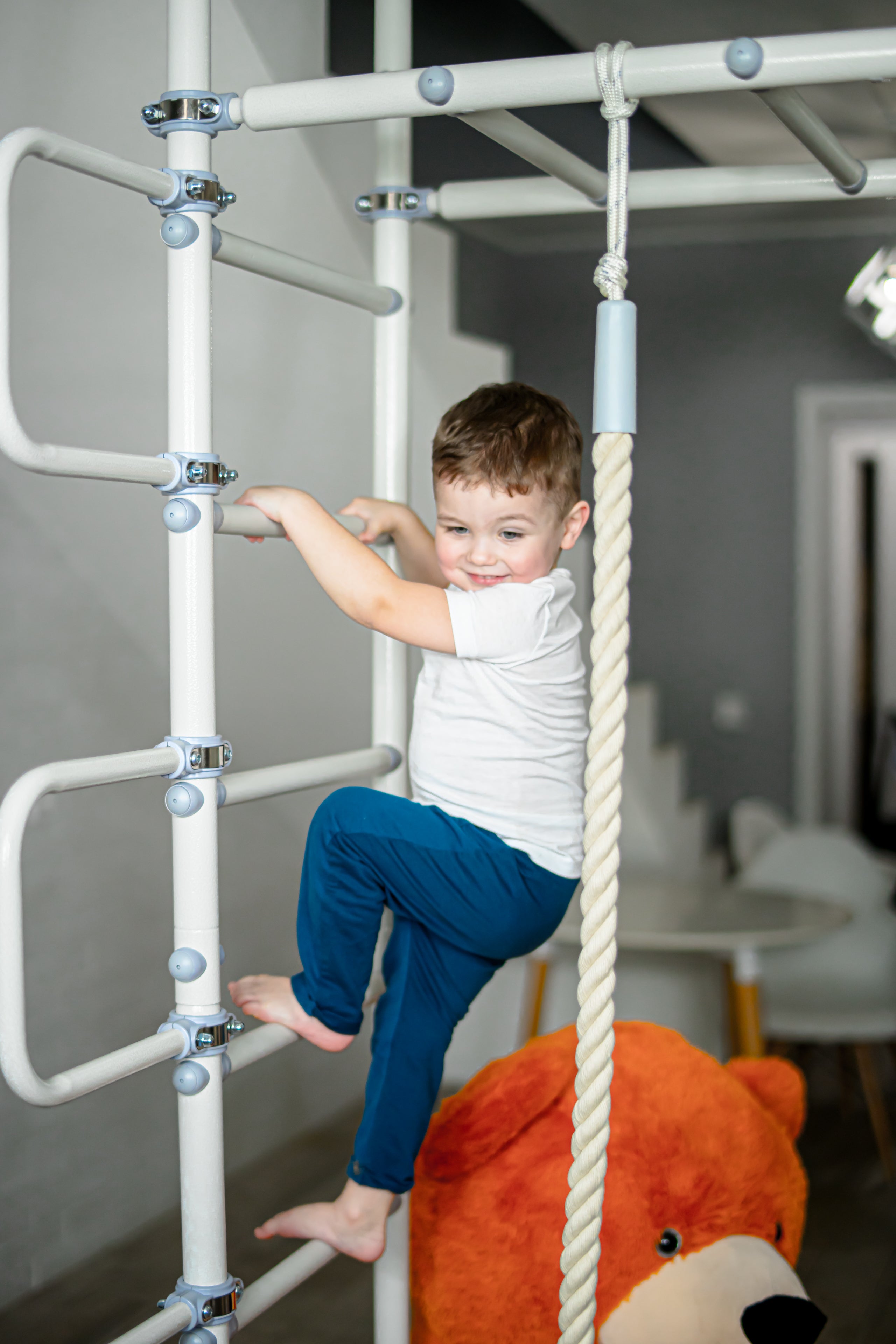
Here is the sentence that changes how this feels: "climbs on and off a couch or chair without help" is an official CDC developmental milestone at 18 months. It sits on the same checklist as first words and self-feeding. Pediatricians don't just expect climbing at this age — they check for it, and its absence is the thing that would worry them.
So when your 20-month-old summits the back of the sofa, they aren't testing you. They're passing a test. The climbing that's driving you up the wall (sometimes literally) is the same climbing a developmental screening wants to see.
None of this would have surprised the field's founders. Maria Montessori built her method on the observation that movement and learning are inseparable, and Hungarian pediatrician Emmi Pikler, the namesake of the Pikler triangle, made self-directed movement the center of her philosophy: to both of them, a toddler's urge to climb is development asking for practice, not defiance asking for correction.
That doesn't make the kitchen counter safe. It means the question isn't "how do I stop this?" It's "how do I keep them safe while this necessary thing runs its course?" Those are different problems with different solutions, and the second one is much more solvable.
What's actually driving the climbing
Ask a toddler why they climb and you'll get nothing useful. Ask a developmental scientist and you get a precise answer: climbing is how young children feed two "hidden" sensory systems that most of us never learned in school.
⚖️ THE VESTIBULAR SYSTEM
The balance sense, housed in the inner ear. It detects height changes, tilts, and motion — and it develops through use. Climbing, swinging, and hanging upside down are its food. Research shows it keeps maturing until roughly age 15, with postural control taking about 18 years to fully develop.
🧭 PROPRIOCEPTION
The body-position sense, from receptors in muscles and joints. It's trained by pushing, pulling, hanging, and climbing — anything that loads the muscles. It's what will one day let your child write, pour milk, and cross a room without crashing into things.
Both systems share a feature that explains your whole week: they only develop through movement. A toddler can't strengthen their balance sense by sitting still any more than they can learn words without hearing them. Reviews of vestibular development are blunt about the flip side, too: reduced gross-motor activity means reduced vestibular stimulation, which during key developmental periods can delay motor milestones and impair postural control.
Your toddler doesn't know any of this. What they have is an urge — a genuine, physical pull toward height, tilt, and effort — installed by the systems doing the wiring. The bookshelf isn't the goal. The bookshelf is just the tallest thing in the room when the urge arrives.
There's one more layer. The foundational research on children's play, from Norwegian professor Ellen Beate Hansen Sandseter, catalogued the kinds of "risky play" children everywhere seek out on their own. Category one on the list: play with great heights. Not because children are careless — because a hundred thousand years of development built them to practice exactly this. We covered that research in depth in our controlled risky play guide; the short version is that height-seeking is universal, purposeful, and linked to confidence, judgment, and lower anxiety later on.
Why "stop climbing!" doesn't work (and what it costs)
Every parent tries suppression first. Here's why it keeps failing, in three parts.
1. The drive doesn't have an off switch. You can remove the chair, but you can't remove the vestibular system. Block one route and the urge simply reroutes — to the drawers, the toilet lid, the dog. Parents in every forum thread report the same pattern: the climbing didn't stop, it moved. That's the drive doing its job.
2. Suppression selects for sneakiness. A toddler who learns climbing brings a scolding doesn't conclude "climbing is bad." They conclude "climb when nobody's watching." That trade is strictly worse: the same climbing, minus the supervision, on furniture you never got to check. The riskiest climbing in a home is the unsupervised kind — and "no" is how climbing goes underground.
3. Blocked challenge carries its own cost. Sandseter and psychologist Leif Kennair published a landmark 2011 paper describing risky play as nature's own exposure therapy: children approach feared things like height in small, self-chosen doses, master them, and the fear resolves on schedule. Their warning runs the other way too — children denied age-appropriate physical challenge may carry more anxiety forward, not less. A 2015 systematic review led by Dr. Mariana Brussoni reached a matching conclusion: risky play is associated with better physical, social, and emotional outcomes — and, counterintuitively, not with higher serious-injury rates.
So the suppression plan fails on its own terms: it doesn't stop the climbing, it degrades the supervision, and it withholds practice your child's development is asking for. Which leaves the plan that actually works. It starts with a screwdriver.
Step one: anchor the furniture. Today.
Redirection takes two to three weeks of consistency. Gravity doesn't wait that long, so the safety work comes first — and the numbers here deserve your full attention.
U.S. emergency rooms treat a child for a furniture, TV, or appliance tip-over injury about every 53 minutes. Between 2000 and 2022, the Consumer Product Safety Commission counted 199 children killed by clothing-storage tip-overs alone — dressers, chests, wardrobes — with children making up 71% of all tip-over deaths. The risk was severe enough that Congress passed the STURDY Act in 2022, forcing a mandatory stability standard for new dressers.
SOURCE: CPSC / ANCHORIT.GOV · READ THE CPSC STANDARD
The STURDY standard only covers dressers manufactured after 2023. Everything already in your house is on you — and the fix costs about $15 and one afternoon:
- Strap every dresser, bookcase, and TV stand to a wall stud with anti-tip straps or L-brackets. Kits run $10–20 and install in about 15 minutes per piece.
- Mount TVs to the wall, or strap them to anchored furniture. Never on a dresser a child can climb.
- Load heavy items into bottom drawers and keep drawers closed — open drawers are a staircase.
- Clear the summit. Remove remotes, snacks, and toys from the tops of furniture. A toddler climbs a dresser for something more often than not; take away the prize and you take away the route.
- Move launch pads. Slide chairs, stools, and toy boxes away from counters, windows, and shelves. Toddlers are excellent engineers; don't leave materials on site.
Do this even if your child has never touched the dresser. The CDC milestone means every toddler is a climber-in-training, and anchored furniture turns your home's worst-case scenario from a tragedy into a telling-off.
Step two: the redirect method
With the hazards bolted down, you can work on the behavior — by working with the drive instead of against it. The method has four moves, and none of them is a punishment.
1. Name the need, not the crime. Swap "get down!" for "you want to climb!" This isn't soft parenting — it's accuracy. You're teaching your child a word for the urge, which is the first step toward them managing it. Save the sharp "down, now" voice for genuine emergencies, so it still means something.
2. Move the body, keep the verb. Lift them off the counter and carry them straight to the place where climbing is allowed: "Climbing happens here." No lecture in between. A toddler's brain links the two events only if they're seconds apart.
3. Make the yes-place better than the no-place. This is where most redirect attempts die. If the "yes" option is a foam wedge in the corner and the "no" option is the glorious, forbidden kitchen counter, the counter wins every time. The yes-place has to offer real height, real challenge, and ideally you — join the first few minutes of climbing and your toddler's favorite thing (your attention) relocates with them.
4. Repeat, boringly. Expect two to three weeks of calm, identical repetitions. Consistency is the entire trick: same words, same relocation, same yes-place, every single time, from every caregiver. The forums are full of "we tried redirecting and it didn't work" — and almost always, "tried" means four days. Milestones don't negotiate on that timeline.
To make step two faster in the moment, it helps to know that what they climb tells you what they're seeking:
| What they climb | What they're seeking | Redirect to |
|---|---|---|
| Couch arms and backrests | Height + safe-ish falling practice | Cushion pile on the floor, climbing net, low slide |
| Bookshelves and dressers | Vertical rung-style climbing — shelves are a ladder | An actual ladder: climbing triangle (under 3) or gym rungs (3+). Anchor the shelf regardless |
| Counters, via drawers and stools | Goal-directed problem solving — climbing as a tool | "Climbing jobs": a learning tower at the counter, fetch tasks that involve legal climbing |
| Out of the crib | Escape-grade strength and coordination — a graduation notice | Floor-bed or toddler-bed transition, plus a big climbing session before bedtime |
| Stairs, endlessly | Repetition of the climbing pattern itself | Supervised stair time (it's genuinely great practice), ramps, low rungs |
| You | Rough-and-tumble play + deep-pressure input to muscles and joints | Scheduled wrestling, piggyback rides, hanging from a low bar |
One warning as you build the routine: never lift your toddler onto anything they can't climb themselves — not the yes-place, not the playground structure. A child who reached a height on their own strength has the skills to be at that height. A boosted child doesn't. That single rule, standard across risky-play research, prevents more falls than any amount of hovering.
Step three: build a yes-space worth choosing
The redirect method lives or dies on the quality of the destination. Here's what that looks like by age.
Under 18 months: floor freedom is most of the answer. Cushion piles, a mattress on the floor, sturdy low furniture they're allowed to conquer, and supervised stair practice. The World Health Organization's guidance for this age is interactive floor-based play, several times a day — "more is better."
18 months to 3 years: this is climbing-triangle season — a small wooden climber gives the rung practice their hands are asking for at a height that matches their skills. It's also the age where the WHO's target jumps to at least 180 minutes of physical activity a day. If a triangle is already in your living room, you know how much work it does. If your child is nearing the top of it — literally — we wrote a full guide to what comes after the Pikler triangle.
Age 3 and up: the drive doesn't fade at three — it scales. WHO guidance for ages 3–4 wants 60 of those 180 daily minutes to be energetic play, and the CDC explicitly lists climbing as a muscle-strengthening activity for children. This is the age our gyms are built for: a steel structure with climbing nets, rungs, rings, and monkey bars that gives the height-seeking a permanent, engineered home. It installs by tension between floor and ceiling — no drilling — and it's rated to 220 lb and tested to double that, so it will still be the yes-place when your toddler is ten.
"We stopped fighting the climbing the day it got its own address. He still climbs everything — but now 'everything' is the gym, and I drink my coffee while he does it."
– THE PATTERN WE HEAR MOST FROM BRAINRICH FAMILIES
Which gym fits your space? Take the 60-Second Quiz →


A permanent address for the climbing
Installs without drilling, 30-day money-back guarantee. Many families cover it with pre-tax HSA/FSA dollars.
Frequently asked questions
Why does my toddler climb on everything? Because their development requires it. Climbing on and off furniture without help is a CDC milestone at 18 months, and climbing feeds the vestibular (balance) and proprioceptive (body-awareness) systems that a toddler's brain is actively wiring. The urge is installed by the systems doing the building — the furniture just happens to be what's available.
How do I stop my toddler from climbing on furniture? You can't remove the drive, so the working plan is anchor-and-redirect: strap furniture and TVs to the wall first, then consistently move the climbing to a place where it's allowed, using the same calm words every time. Expect two to three weeks of repetition before it sticks. Suppression alone tends to produce sneakier, unsupervised climbing — the most dangerous kind.
At what age do toddlers start climbing? Many start attempting furniture around 12–15 months, and the CDC expects climbing on and off a couch without help by 18 months. Stairs, playground ladders, and everything else follow over the next two years. It typically peaks in intensity between 18 months and 3 years — and then, rather than fading, it scales up to bigger challenges.
Is constant climbing a sign of ADHD or a sensory problem? On its own, no — intense climbing is typical toddler development, and the CDC checklist treats it as expected behavior. Some children do seek movement more intensely than others, which is a normal range. If climbing comes with other developmental concerns, or your instincts are telling you something is off, bring it to your pediatrician — that's what milestone checklists are for.
Should I punish climbing? The research points the other way. Climbing is a milestone, not misbehavior, and punishing it teaches children to climb out of sight rather than not at all. Save firm commands for real emergencies, and spend your energy on anchored furniture and a genuinely appealing legal place to climb.
What can my toddler safely climb indoors? Under 3: cushion piles, floor mattresses, supervised stairs, and a climbing triangle sized to their reach — with you within arm's length. From age 3: a properly engineered climbing gym with impact mats, which gives the drive a permanent home. Whatever they climb, apply the golden rule: they go up on their own power, never boosted.
Why does the climbing get worse in winter? Because the outlet shrinks while the drive doesn't. Cold, dark, and rainy stretches cut outdoor movement time, so the same balance-and-body hunger gets fed on whatever is indoors, which usually means your furniture. Families consistently report climbing spikes during long indoor seasons. The fix is the same anchor-and-redirect plan with the indoor yes-space doing more of the work, plus scheduled heavy-work play (wrestling, cushion forts, hanging from a low bar) on the worst-weather days.
When is a child ready for a full climbing gym? Brainrich gyms are rated for independent climbing at age 3+. Younger siblings join earlier with hands-on supervision and toddler accessories like a swing seat. Adjustable bar heights let every challenge start low and rise only as skills grow — which is the same graded-challenge principle the risky-play research recommends.
📚 Keep reading in the Decision Guide
Why Autistic Kids Climb Everything · Sensory Seekers · Best Climbing Toys by Age · Climbing Gyms for Babies and Toddlers · Indoor Activities for High-Energy Kids: Winter Survival Guide
Ready to shop? Browse the toddler climbing gym collection: steel gyms built for ages 3 and up, with low-start and low-ceiling options.
New: deciding between a wooden climbing set and a steel frame for a toddler? Read Pikler Climbing Set vs Steel Play Gym, with 2026 prices and the age-5 question answered.
Sources
CDC. Important Milestones: Your Baby by Eighteen Months. Learn the Signs. Act Early. · U.S. Consumer Product Safety Commission. Final Safety Standard to Prevent Tip-overs of Dressers and Other Clothing Storage Units (STURDY). 2023, with tip-over data via AnchorIt.gov. · Sandseter, E.B.H. (2007). Categorising risky play: how can we identify risk-taking in children's play? European Early Childhood Education Research Journal. · Sandseter, E.B.H. & Kennair, L.E.O. (2011). Children's risky play from an evolutionary perspective: the anti-phobic effects of thrilling experiences. Evolutionary Psychology. · Brussoni, M. et al. (2015). What is the relationship between risky outdoor play and health in children? A systematic review. Int. Journal of Environmental Research and Public Health. · Review of pediatric vestibular development. Children (Basel), PMC10814320. · WHO (2019). Guidelines on physical activity, sedentary behaviour and sleep for children under 5 years of age.
Share: