

Updated July 2026 · 11-minute read · by the Brainrich Kids team
Let's name the fear precisely, because it deserves precision. You are not afraid of a climbing gym. You are afraid of one specific moment: your child climbs up, and your child falls. We build climbing gyms for a living, and we will not open this article by telling you that moment is impossible. It isn't, and any brand that promises you zero risk is selling you a story. What we can show you is what forty years of child-development research says about that fear, and why the answer surprised us too.
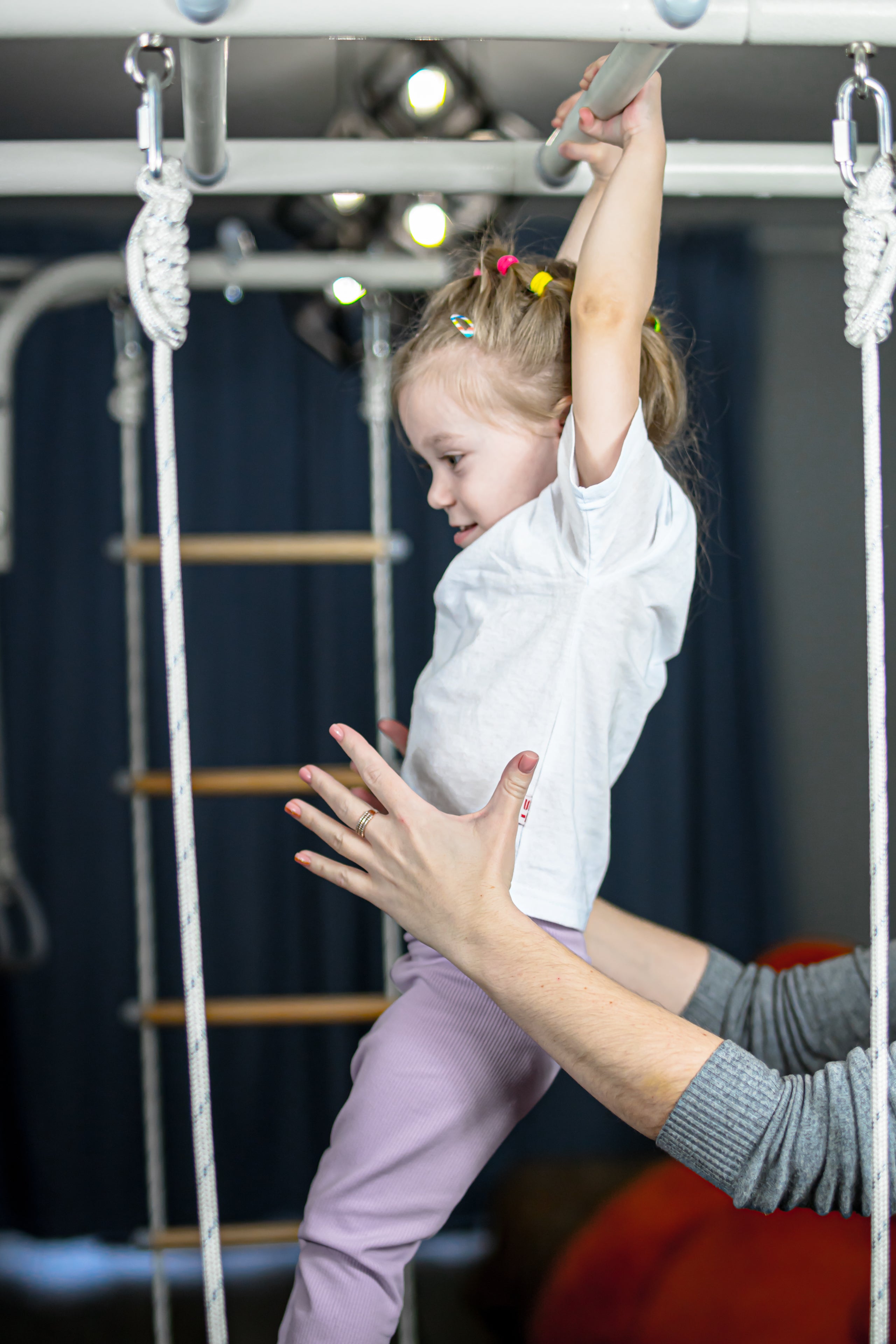
The quick answer: children do not become safe by avoiding risk. They become safe by practicing it in a controlled environment. A child who climbs the same structure every day builds the balance, grip strength, spatial awareness, and judgment that prevent bad falls, and researchers link this kind of play to confidence, self-reliance, problem-solving, creativity, and lower anxiety. Our job is not to remove the risk. Our job is to remove the hazards (wobble, loose joints, splinters, surprises) and hand your child the risk in graded, climbable doses. That is controlled risky play, and a home gym happens to be the best environment ever invented for it.
Jump to: The real fear · What risky play is · The research · Mastery · The body's own safety systems · What "controlled" means · How to do it at home · FAQ
"What if they climb up and fall?" is the right question
We talk to hundreds of parents a year, and when a family hesitates about a climbing gym, it is almost never about price, space, or looks. It is this: a picture of their child at the top of the net, and then not at the top of the net. If that picture is in your head right now, good. It means you take your child's safety seriously, and this article was written for you, not around you.
There are two possible responses to that picture. The first is to remove the climbing: no gym, no height, no risk. The second is to build the climber: give the child so much practice, skill, and body awareness that the fall stops happening. The first response feels safer. The research says the second one actually is, and the first response quietly carries risks of its own: children who are blocked from age-appropriate physical challenge miss out on the confidence, judgment, and body competence that protect them everywhere else, on the school playground, at a friend's house, on equipment they have never seen before.
Here is the uncomfortable truth nobody in the toy aisle says out loud: your child is going to climb something. Kids are wired for it. The only real decision you get to make is where they learn: on a structure you chose, engineered for the job, with mats underneath and you nearby, or on whatever they find when the urge arrives.
What risky play actually is (and what it is not)
"Risky play" is not a parenting trend. It is a formal research field, and its foundational work comes from Norwegian professor Ellen Beate Hansen Sandseter, who in 2007 observed preschoolers at play and identified six categories of risky play that children everywhere seek out on their own:
Teal: the categories a home climbing gym serves (climbing high, swinging fast, wrestling around the frame). Lilac: the categories it doesn't need to.
Notice what tops the list. Play with great heights, with the possibility of falling, is category one. Children do not climb to defy you. They climb because a hundred thousand years of development built them to seek exactly this practice. When your toddler scales the bookshelf, that is not disobedience. That is a developmental program running on the wrong equipment.
Just as important is what risky play is not. In 2024, the Canadian Paediatric Society published a position statement endorsing risky play for healthy child development, and it draws a line that every parent should have: the difference between a risk and a hazard.
A RISK
A challenge the child can see, size up, and choose. "How high do I go on this net?" The child is the one deciding, matching the challenge to their own skill. Risk builds judgment.
A HAZARD
A danger the child cannot see or manage: a joint that has worked loose, a frame that wobbles mid-swing, a splintering rung, a rope worn thin. The child never got a vote. Hazards just injure.
This one distinction reorganizes the entire safety conversation. Good equipment does not remove risk from the child. It removes hazards from the equipment. The height stays, because the height is doing developmental work. The wobble goes, because the wobble was never part of the lesson. The Canadian Paediatric Society's own framing is the best sentence in the field: keep children "as safe as necessary, not as safe as possible."
What children actually get out of risky play
In 2015, Dr. Mariana Brussoni of the University of British Columbia led a systematic review of the research on risky outdoor play, grading 21 studies for quality. The conclusion: risky play showed overall positive effects on health, physical activity, social behavior, creativity, and resilience, and environments that allowed children to take risks promoted more play, more social interaction, and more inventiveness. This is the study that moved risky play from parenting philosophy to public-health recommendation.
Here is what the research, taken together, credits to children who get regular, age-appropriate risky play:
Confidence
"I got to the top myself" is not a feeling a parent can gift. It has to be earned at height.
Self-reliance
Getting stuck halfway and solving it alone teaches "I can handle this" at the muscle level.
Problem-solving
Every route up a net is a physics puzzle solved with the whole body, not a worksheet.
Cause & effect
Grip loosely, slip a little. Lean too far, wobble. Physical play is the most direct teacher a child ever meets.
And then there is the finding that stopped us cold. Sandseter, together with psychologist Leif Kennair, published a landmark 2011 paper on the anti-phobic effect of risky play. The theory: children are born with natural fears (heights, strangers, deep water) that protect them while they are too young to cope. Risky play is nature's built-in exposure therapy: the child approaches the feared thing in thrilling, self-dosed increments, masters it, and the fear resolves on schedule. Block the play, and the fear has nowhere to go. The authors warn that children deprived of age-appropriate risky play may carry more anxiety, not less, into later life.
The most counterintuitive data point in the field comes from the famous Dunedin longitudinal study, which followed roughly a thousand people from birth. Researchers checked whether childhood falls produced adults who fear heights. The relationship ran the other way: people who had injurious falls between ages 5 and 9 were less likely to fear heights at 18 than people who never fell. The children who climbed, slipped, and got back up were not being damaged. They were being inoculated.
POULTON ET AL., BEHAVIOUR RESEARCH AND THERAPY, 1998 · READ THE STUDY
To be clear about what that finding means and does not mean: nobody is prescribing falls. The point is that a childhood spent carefully avoiding all physical challenge does not produce a safer adult. It produces a more fearful one, with none of the body skills that actual safety is made of. Which brings us to the part of this story that belongs to the gym.
Mastery: the safety feature nobody puts on the box
Every conversation about climbing safety obsesses over the equipment. Almost nobody talks about the variable that dwarfs it: how well the child knows the structure.
Think about where children usually meet climbing equipment: a playground, visited maybe once a week, often a different one each time, always crowded, always novel. Novelty is wonderful for fun, but novelty is precisely the condition under which misjudgments happen: unfamiliar spacing, unfamiliar grip, other kids' momentum, a structure their hands have never memorized.
Now run the same child on a gym that lives at home. It is available 24 hours a day, 7 days a week: before breakfast, between homeschool blocks, during the witching hour, at 8 p.m. in January. The repetition math is not even close:
CLIMBING SESSIONS PER YEAR, SAME STRUCTURE
Home gym, climbed daily (owners report multiple sessions a day)
Weekly playground trip (and often different equipment each time)
Hundreds of repetitions on the same bars, the same net, the same spacing, do something no safety label can: they produce mastery. Owners in our community joke that their kids could navigate the gym with their eyes closed, and the joke is more literal than they realize: after enough repetitions, a child's motor system holds a complete map of the structure. Their hands know the diameter of the rungs. Their feet know the spacing without looking. Their body knows exactly how much swing the rings allow. A child who knows every rung is a child who does not take bad falls, because the two ingredients of a bad fall, surprise and misjudgment, have both been trained away.
This is why familiarity, not padding, is the first real safety feature of a home gym. The structure never changes, never surprises, and never gets swapped for a different model mid-week. Your child is not a visitor on it. They are the resident expert.
"Their most used toy by FAR, like by a landslide. They use it every day for hours."
– LEISA L., MOM OF 3, BRAINRICH OWNER
Daily, for hours. That sentence describes fun from the parent's side of the room. From the child's side, it describes training volume, and training volume is where safety actually comes from.
Their body is building its own safety equipment
Here is the second thing daily climbing does, and it is the one that protects your child off the gym too. Climbing is not one skill. It is a daily workout for the exact four systems whose job is preventing falls:
🧭 SPATIAL AWARENESS
Proprioception: knowing where every limb is without looking. It is the difference between a foot that finds the rung and a foot that finds air.
⚖️ BALANCE
The vestibular system, trained by swinging, hanging, and being upside down. A trained balance system corrects a wobble before it becomes a fall.
🧠 COORDINATION
Motor planning: sequencing hands and feet three moves ahead. Planning a route up the net is rehearsal for every physical judgment call childhood will throw at them.
💪 GRIP STRENGTH
The literal margin of safety. A slip with a strong grip is a story at dinner. Hanging, swinging, and monkey bars build it every single day.
The research backs the loop this creates. Reviews of childhood injury data note that young children with well-developed motor skills have fewer injuries than children with underdeveloped ones, and that children given free, adventurous play under adult oversight become skilled risk assessors with surprisingly few accidents. Skill is not the reward for surviving risk. Skill is the thing that was preventing the injuries all along, and daily play is how skill compounds:
More play → more skill → safer play → bolder play → more skill
The flywheel only spins if the gym is close enough to be used daily. That is the entire argument for putting it in your home instead of a fifteen-minute drive away.
So when we say "the more they play, the safer they get," it is not a slogan. It is a description of motor development doing its job on a daily schedule. The gym is not just the place where risk happens. It is the machine that continuously manufactures the child who can handle it.
"Controlled" is our half of the bargain
Controlled risky play has two halves. Your child brings the courage, the curiosity, and the decision about how high to go today. The environment supplies the control. Here is exactly what that means on a Brainrich gym, and notice that every single item is about removing hazards, never about removing the challenge:
| What the child controls | What we control |
|---|---|
| How high to climb today | Steel tested to double its 220 lb rating, so the structure is never the question |
| Which route up the net | A pressure-fit frame braced between floor and ceiling: no wobble, even mid-swing |
| When to try the monkey bars | Adjustable bar heights, so every challenge starts low and rises only when they are ready |
| Whether today is a brave day or a careful day | 250+ deliberate safety decisions in the design: smooth powder-coated steel, no splinters, no joints that loosen |
| How it feels to hang upside down | Impact mats in the landing zones, because "controlled" includes the floor |
Look back at the hazard list from the pediatricians: the loose joint, the mid-swing wobble, the splintering rung, the worn rope. Every one of them is an equipment failure, not a child failure, and every one of them is exactly what steel engineering exists to eliminate. On a wooden climber, those hazards arrive with age as finishes wear and joints work loose. On a properly engineered steel frame, the structure your child memorized in month one is the identical structure in year five, which is what makes the mastery permanent.
The adjustable bars deserve one more sentence, because they are the control knob of the whole system. Risky play research is unanimous that challenge should be graded: matched to the child, raised in increments, chosen rather than imposed. Fixed equipment cannot do that. Bars that move can: monkey bars at chest height for a cautious 3-year-old become monkey bars at full height for a fearless 8-year-old, on the same gym, in minutes. The challenge grows exactly as fast as the child does, and never faster.
"We will never promise a child cannot fall, because that promise would shortchange the child. What we promise is the environment: steel that never surprises them, challenges that start low and grow with them, and soft landings while they learn. Kids bring the courage. We bring the margins."
– YEGOR NADVORNYY, FOUNDER OF BRAINRICH KIDS
How to run controlled risky play at home
The gym is half the environment. You are the other half, and the research on how adults help (or accidentally hinder) is refreshingly practical:
| Do | Skip |
|---|---|
| Let them climb to their own height. The golden rule of risky play: a child who got somewhere by themselves has the skill to be there. | Lifting them to heights they didn't climb. A boosted child is at a height their skills didn't earn. That is where falls come from. |
| Stay close and quiet, especially under age 3. Eyes on, hands off, within reach. Presence without steering. | Narrating every move with "be careful!" It interrupts their concentration exactly when they need it. Try "notice where your foot goes next." |
| Let them get stuck. A minute of frustrated problem-solving mid-net is the actual lesson. Talk them through it before you touch them. | Rescuing at the first whimper. Every rescue teaches "you can't do this without me." Usually, they can. |
| Start every new accessory at the lowest setting. Mastery first, height second. The bars adjust for exactly this reason. | Racing them up the difficulty curve. The child sets the pace. The research is emphatic that self-dosed challenge is the effective kind. |
| Put impact mats under the landing zones, and climb barefoot or in grippy socks for the best hold. | Blankets, pillows, or slippery socks as makeshift padding. Loose fabric slides; mats don't. |
And expect scrapes. We would be lying if we said otherwise, and the researchers say it plainly: the injuries typical of risky play are minor ones, bruises and scrapes, the tuition of a competent body. The serious injuries parents actually fear cluster around hazards (equipment failures, unfamiliar structures, unsupervised heights that were never earned), which is precisely the list controlled risky play is designed to erase.
Which gym fits your family? Take the 60-Second Quiz →
The cost of the bubble
One last reckoning, because a fair safety article has to count the risks on both sides of the ledger. Declining to buy climbing equipment does not set your child's risk to zero. It moves the risk, and it adds new ones:
The climbing happens anyway, on bookshelves, counters, fences, and playground equipment their body has never mapped, without mats, without engineering, without you. The fears stay unresolved: Sandseter and Kennair's warning is that children denied risky play carry the anxiety forward, and the Dunedin data shows avoidance does not produce fearless adults. And the body skills never compound: the balance, grip, and spatial judgment that daily climbing builds are exactly what your child will be missing at recess on equipment you never got to choose.
Pediatric occupational therapist Angela Hanscom makes the same case from the clinic side: her book Balanced and Barefoot argues that modern children get far less climbing, hanging, and vigorous movement than their development asks for, and that the urgent problem is the shortage of challenge, not the presence of it.
"No gym" is not the safe option. It is just the option where the risky play happens somewhere you didn't engineer. The question was never whether your child will climb. It is whether their thousand hours of practice happen on a structure built, tested, and padded for the job.


Ready to give the climbing a home?
Every gym assembles in an afternoon and is covered by a 30-day money-back guarantee.
Frequently asked questions
What is risky play? Researchers define it as thrilling, exciting free play with uncertain outcomes and the possibility of physical injury: climbing high, swinging fast, rough-and-tumble. Ellen Sandseter's foundational 2007 research identified six categories, with play at height, the kind a climbing gym provides, at the top of the list. It is a normal, necessary part of child development, endorsed by pediatric bodies including the Canadian Paediatric Society.
Is risky play the same as dangerous play? No, and the distinction is the whole point. A risk is a challenge the child can see and choose ("how high do I go?"). A hazard is a danger the child cannot detect or manage (a loose joint, a wobbly frame, a worn rope). Controlled risky play keeps the risk and eliminates the hazards.
Will my child get hurt on a home climbing gym? We will not promise zero injuries, and you should distrust anyone who does. Expect the minor scrapes and bruises the research describes as typical of risky play. What changes the picture on serious injuries is the combination this article describes: a hazard-free structure, graded challenge via adjustable bars, impact mats in the landing zones, and the mastery that comes from daily repetition on the same familiar equipment.
Does climbing actually make kids safer? That is what the evidence indicates: children with well-developed motor skills have fewer injuries than children with underdeveloped ones, and daily climbing trains exactly the systems that prevent falls: spatial awareness, balance, coordination, and grip strength. A home gym compounds this because the same structure is available every day, turning hundreds of repetitions into mastery.
Why is a familiar home gym safer than the playground? Misjudgments happen on unfamiliar equipment: unknown spacing, unknown grip, other children's momentum. A home gym never changes, so a child logs hundreds of sessions on the identical structure until their body holds a complete map of it. Owners joke their kids could navigate it with their eyes closed. That familiarity is precisely what playground visits, however fun, cannot build.
What age can children start controlled risky play on a gym? Brainrich gyms are rated 3+ for independent climbing. Younger siblings join earlier with hands-on supervision and toddler attachments like a swing seat, growing up alongside the gym years before their first solo climb. The adjustable bars let every challenge start low and rise only as the child is ready.
Should I catch my child every time they wobble? Stay close, especially under age 3, but let the wobble finish. Correcting a wobble is exactly the skill their balance system is trying to learn, and constant rescuing teaches dependence instead. The golden rule: never lift a child to a height they didn't climb themselves. A child who got there on their own has the skill to be there.
Does risky play really reduce anxiety? Sandseter and Kennair's 2011 research describes risky play as nature's exposure therapy: children approach feared things like heights in thrilling, self-chosen doses and master them, and the fear resolves. The Dunedin longitudinal study found people who had falls in childhood were less likely to fear heights at 18. Researchers warn the reverse too: block the play, and the anxiety may persist.
📚 Keep reading in the Decision Guide
Is a Climber Bad for Kids? · Steel vs. Wood Climbing Gyms for Kids · DIY vs. Buying an Indoor Play Gym · Indoor Climbing Wall for Kids · Do Boys Really Move More Than Girls?
Sources
Sandseter, E.B.H. (2007). Categorising risky play: how can we identify risk-taking in children's play? European Early Childhood Education Research Journal. · Brussoni, M. et al. (2015). What is the relationship between risky outdoor play and health in children? A systematic review. Int. Journal of Environmental Research and Public Health. · Sandseter, E.B.H. & Kennair, L.E.O. (2011). Children's risky play from an evolutionary perspective: the anti-phobic effects of thrilling experiences. Evolutionary Psychology. · Beaulieu, E. & Beno, S. (2024). Healthy childhood development through outdoor risky play. Canadian Paediatric Society position statement. · Poulton, R. et al. (1998). Evidence for a non-associative model of the acquisition of a fear of heights. Behaviour Research and Therapy.
Share: