

Published September 2026 · 12-minute read · by Yegor Nadvornyy, founder of Brainrich Kids
Every climbing toy has a shelf life, and the shelf life is the whole problem. The foam block set is thrilling at 14 months and furniture by 20. The triangle that ruled the living room at two is a coat rack by four. Parents end up buying climbing equipment three or four times before the kid turns eight. This guide is organized to stop that: what is safe and satisfying at each age, what gets outgrown in a season, and where the buying curve finally flattens. We sell steel play gyms for ages 3 and up, so the last half of this guide is our lane and we say so; the first half is not our product at all, and we have opinions there too.
The quick answer: at 1 to 2, low and soft wins: foam climbers, a Pikler-style triangle, cushion mountains, always with a parent within arm's reach. At 3 to 4, children are ready for real vertical climbing on a rated frame, and this is the age where a full steel play gym starts paying back daily. At 5 to 6, the signature skill is the monkey-bar traverse, plus ropes and rings. At 7 to 8, the climb becomes training: pull-ups, rope climbs, and challenge courses. The one purchase that spans ages 3 through 12 without replacement is a modular frame you add to; everything before it is a season.
Jump to: Safety by age · Ages 1 to 2 · Ages 3 to 4 · Ages 5 to 6 · Ages 7 to 8 · What to look for · FAQ
Safety by age: the one table to read first
| Age | What the body can do | Safe height and supervision |
|---|---|---|
| 1 to 2 | Crawls up, steps up, pulls to stand; cannot yet judge a drop | Knee to waist height, soft landings, parent within arm's reach at all times |
| 3 to 4 | Alternating feet on rungs, hangs briefly, climbs down feet-first when taught | Full-height rated frames with a mat below; independent climbing begins at 3+, parent in the same room |
| 5 to 6 | Hand-over-hand traverses, sustained hangs, first rope pulls | Monkey bars, rings, trapeze; mats under every dismount point |
| 7 to 8 | Full rope climbs, pull-up attempts, inversions, courses | Adult-rated equipment: a frame that holds a 12-year-old plus a friend plus momentum |
Two facts anchor everything below. The CDC's activity guidelines name climbing as a muscle-strengthening activity and call for it at least 3 days a week from age 6, inside the 60 daily minutes. And the research on challenging play, summarized in our guide to controlled risky play, associates height and climbing with better risk judgment, not worse. The job of a climbing toy is to be exactly as hard as the child, no more, and to be replaced by something harder the moment it isn't.
Climbing toys for 1 and 2 year olds
This is the age most parents are searching for, and the age where the toy industry sells the most plastic that gets outgrown fastest. What toddlers actually need is low, soft, and endlessly rearrangeable, because the developmental work at this age is not height. It is the mechanics: transferring weight, lifting a knee, gripping, and, most important, learning to come down.
- Foam climbing blocks and ramps. The best first climbing toy by a wide margin. Wedges, steps, and cylinders in dense foam let a 12-month-old crawl over a mountain and an 18-month-old build one. They fall over without consequence, and they double as crash pads for years.
- A Pikler-style triangle. The classic for a reason: rungs at toddler spacing, a low apex, and a design meant to let the child self-limit. Our full take on the triangle years, and what replaces them, is in What Comes After the Pikler Triangle.
- Cushion mountains and sofa forts. Free, daily, and exactly the right height. A toddler summiting the couch cushions is doing the same motor work as any purchased toy.
- A low balance beam or stepping stones for the 2-year-old who has mastered up and needs sideways.
What not to buy at this age: a full-height frame "to grow into." Our own gyms are rated for independent climbing at age 3 and up, and we tell 2-year-old parents the same thing every week: a younger sibling can join a gym early only with a parent's hands close by, and the useful early accessory is a swing seat, not the ladder. Buy the foam now; buy the frame at three.
Climbing toys for 3 and 4 year olds (the graduation year)
Around the third birthday two things arrive together: alternating feet on rungs, and the ability to follow "feet first, one rung at a time" on the way down. That combination is the green light for real vertical climbing on a rated frame, and it is the point where the buying curve can finally flatten, because a properly built frame is not a toy for this age. It is equipment for the next nine years.
- A first full climbing gym. Our Model T3 is built for exactly this year: two steel ladders braced floor to ceiling with no drilling, a rope, rings or a swing on the crossbar, rated for a 220 lb working load and safety-tested to 440, and modular, so it becomes a Spider V3 later by adding a Cross Bar set rather than being replaced. Preschoolers climb it at 3 and pull up on it at 12.
- A classic swing seat on the frame. The most-used accessory at this age, and the calm-down tool after the climbing burst. Our Classic Wood Swing is $27.
- A thick mat underneath. Non-negotiable from the first day of vertical climbing.
- Outdoors: the playground, a climbing dome, a low tree. We love outdoor play; the indoor frame is for the January afternoons and the rain.
If a child is still hesitant at three, that is information, not a problem. The full progression logic, including how to teach the descent, is in our guide to toddlers who climb everything.
Climbing toys for 5 and 6 year olds
The monkey-bar years. Hand-over-hand traversing is the signature skill of this age, and it is the single most-used feature in our owner community for ages 6 to 12. The other arrivals: sustained hangs, the first real rope pulls, and the ability to run a course.
- Monkey bars, stated precisely. Monkey bars are not a stand-alone unit; a complete span needs two ladder sets and a crossbar set. The clean path for a family starting fresh is the Spider V3, which comes with the monkey bars built in; the Monkey Bars V3 add-on is for families that already own a Brainrich frame and want to add the span.
- Rings and a trapeze. Grip, shoulders, and the first inversions. Rings clip on and off the V3 pull-up bars with carabiners, so the rotation takes seconds.
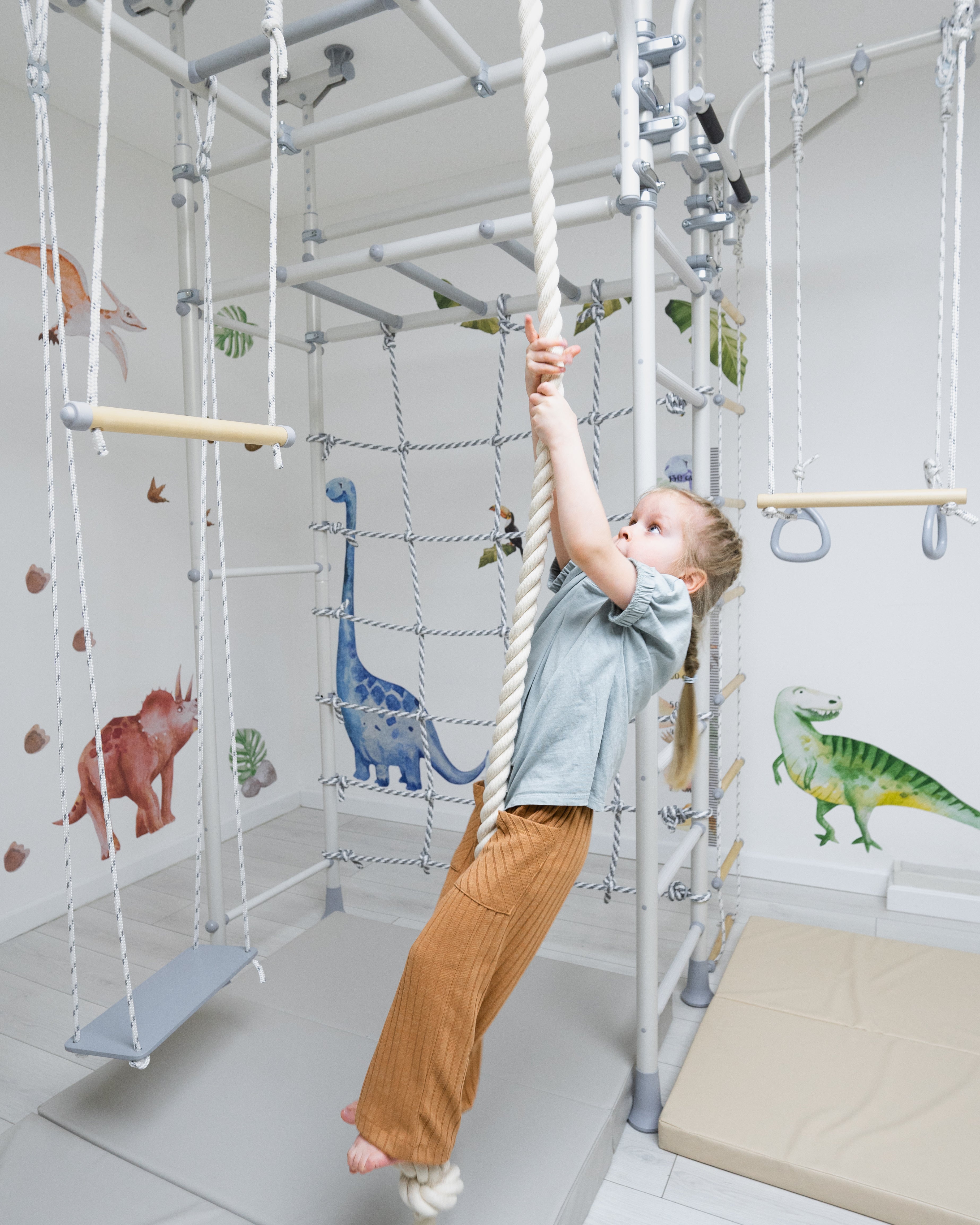
- A climbing rope. The rope is the hardest climb in the house at five and the favorite by six; the girl in the photo at the top of this page is doing the version of it that every kid eventually invents.
- A rope ladder. The wobbly climb. Where the rigid ladder trains strength, the rope ladder trains balance and planning, which is why occupational therapists like it.
Climbing toys for 7 and 8 year olds (and the years after)
By seven the word "toy" stops fitting. Kids this age start training like athletes: pull-up attempts, full rope climbs to the ceiling, timed traverses, upside-down hangs by the knees. The equipment that survives this stage is the equipment that was built for adults.
- A frame that holds a real load. Two 8-year-olds racing across monkey bars generate forces a toddler toy was never designed for. Our frames carry a 220 lb working rating, tested to 440, which is the difference between equipment and a toy.
- More stations, not more height. The Spider Max V3 adds climbing nets and routes so siblings each get their own way up; the Mega Max V3 is the full home jungle gym for the family that has turned a room over to it.
- A pull-up bar era begins. The same bar the rings hung from at five becomes strength training at eight and stays relevant through the teens.
- Challenge rotation. Swap accessories seasonally: rings out, rope in; trapeze out, net in. Boredom is the only thing that retires a climbing frame.
What to look for in any climbing toy, at any age
⚖️ A published load rating
If the maker will not print a number, assume the number is low. Ours: 220 lb working, tested to 440.
🧱 Stability you can feel
Push the top of it. A frame that sways teaches a child to distrust their own body; a rigid one lets them commit.
🧪 Materials you can read
Non-toxic coatings, rubber-coated rungs small hands can grip, plastics free of phthalates and other substances prohibited by child safety standards.
🔁 A path to grow
The only climbing purchase that is not a season is one you can add to. Modularity is the whole trick.


The last climbing toy you buy
Steel frames for ages 3 to 12+ that grow by adding, not replacing. No drilling, 30-day money-back guarantee.
Frequently asked questions
What are the best climbing toys for a 1 year old? Low and soft: foam climbing blocks and ramps, a Pikler-style triangle, and cushion mountains, always with a parent within arm's reach. The developmental work at one is the mechanics of stepping up, gripping, and coming down, not height. Full-height frames are for age 3 and up.
What climbing toys are good for a 2 year old? The same low equipment with more challenge: a triangle with a ramp or slide-board, foam block courses the child builds, a low balance beam, and daily playground time. Two-year-olds can join an older sibling's frame only with a parent's hands close by, and the useful early accessory is a swing seat, not the ladder.
What are the best climbing toys for preschoolers? Preschool (3 to 5) is the graduation year to real vertical climbing on a rated frame: a steel play gym with ladders, a rope, rings, and a swing, with a mat underneath. Independent climbing begins at 3+ with a parent in the room; by 5, monkey bars and a climbing rope become the favorite pieces.
What are good indoor climbing toys for a 5 year old? Monkey bars (as part of a frame like the Spider V3, since a monkey-bar span is not a stand-alone unit), gymnastic rings, a trapeze, a climbing rope, and a rope ladder for balance. Five is the age when hand-over-hand traversing arrives, and it stays the most-used skill through age 12.
At what age can kids use a climbing gym? Brainrich frames are rated for independent climbing at age 3 and up, with a parent in the same room. Younger siblings can use a swing seat on the frame with a parent's hands close by, but the ladders and monkey bars wait for three.
How do I make climbing toys safe at home? A thick mat under every dismount point, anti-tip anchoring for any furniture nearby, a published load rating on the equipment itself, teaching the descent (feet first, one rung at a time) as deliberately as the climb, and a parent in the room for new skills. Climbing is one of the highest-value activities a child can do; the equipment and the landing zone are what make yes possible.
📚 Keep reading in the Decision Guide
What Comes After the Pikler Triangle? · My Toddler Climbs Everything · The Science of Controlled Risky Play · Indoor Climbing Wall for Kids
Ready to shop? Browse the toddler climbing gym collection: steel gyms built for ages 3 and up, with low-start and low-ceiling options.
New: deciding between a wooden climbing set and a steel frame for a toddler? Read Pikler Climbing Set vs Steel Play Gym, with 2026 prices and the age-5 question answered.
New: wondering what fits a 1-to-5-year-old? See Best Indoor Play Gym for Kids Under 5.
Sources
CDC. Physical Activity Guidelines for Children and Adolescents. · Hanscom, A. (2016). Balanced and Barefoot. New Harbinger. · Sandseter, E.B.H. & Kennair, L.E.O. (2011). Children's risky play from an evolutionary perspective. Evolutionary Psychology. · Brainrich Kids engineering specification: frame working load 220 lb, safety-tested to 440 lb.
Share: