

Published September 2026 · 11-minute read · by Yegor Nadvornyy, founder of Brainrich Kids
Every January the same search spikes: "indoor activities for kids." Behind it is a parent at 3:40 p.m. on the eleventh gray day in a row, with a child who has been bouncing off the walls since lunch and a playground under six inches of slush. Craft ideas do not fix this. The problem is not boredom; it is a body that needs to move and a house that was not built for it. This guide is about that problem specifically: how to burn real energy indoors, every day, from November to March, without losing your mind or your furniture.
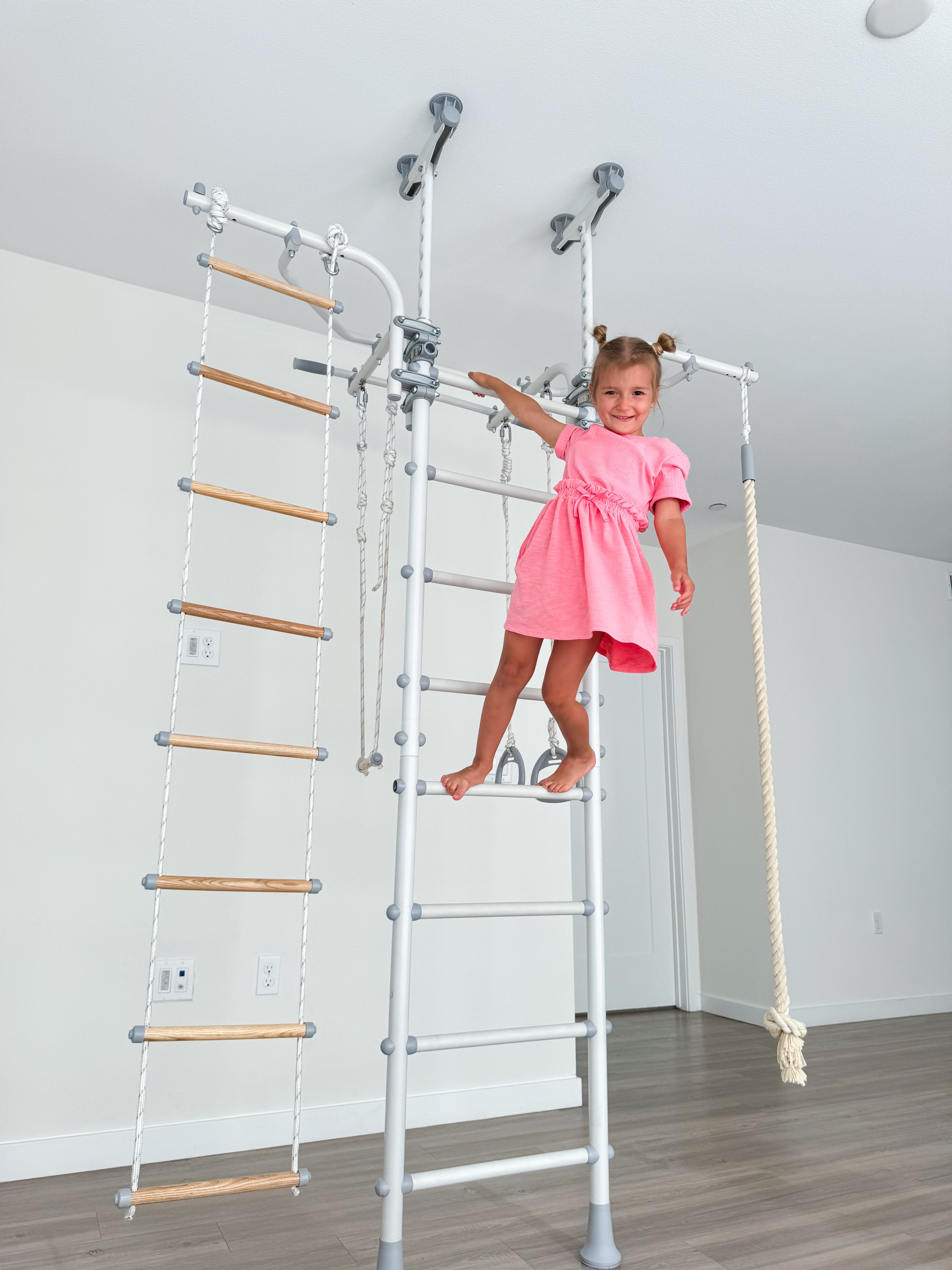
The quick answer: high-energy kids need whole-body movement indoors, not entertainment: climbing, hanging, jumping, crashing, and heavy work, in short doses several times a day. The CDC's 60 daily minutes does not pause for winter. Build the day in four blocks (a morning burst, a midday heavy-work job, the after-school big dose, a wind-down before bed), use the free menu below, and give the movement a permanent address so it happens without a project. A climbing frame in a corner is the single highest-leverage winter purchase for a family with a mover, because it turns "go burn some energy" into a thirty-second walk across the room.
Jump to: Why winter is harder · The free menu · By age · The four-block winter day · A permanent address for movement · FAQ
Why winter is harder than it should be
Kids do not need less movement in winter; they get less. The outdoor hours that quietly delivered most of a child's daily activity in June disappear in December, and nothing indoors replaces them by default. The result is the pattern every parent recognizes: the furniture becomes a climbing wall, siblings turn into wrestling partners, and bedtime moves later because the body never spent what it had. Our guide to toddlers who climb everything explains the mechanism: the need does not go away, it re-routes. Winter is when it re-routes into the couch.
The fix has a shape. Occupational therapists call it a sensory diet: scheduled doses of real movement, delivered before the day needs calm rather than after the meltdown. The two most valuable inputs are the ones winter removes most completely: heavy work (muscles and joints pushing against resistance, which calms and organizes) and vestibular input (swinging, spinning, climbing, which alerts and settles depending on dose). The list below is organized around them.
The free menu: 20 ways to burn energy indoors today
Heavy work (calming)
- Couch-cushion mountain: build it, climb it, crash it, rebuild it
- Wheelbarrow walks to the bathtub
- Laundry-basket hauling (add books for weight)
- Wall push-ups, 10 before every screen turn
- Blanket burrito with a firm squeeze
- Animal walks down the hallway: bear, crab, frog
- Kneading bread dough for real
- Moving every dining chair to the other room and back
Vestibular and cardio (alerting, then settling)
- Masking-tape obstacle course on the floor
- Freeze dance, three songs, no exceptions
- Pillow-path balance beam
- Sock-skating on the kitchen floor
- Stair races (one step at a time, hand on the rail)
- Spinning in an office chair, then a slow rock to settle
- Balloon volleyball over a couch net
- Indoor scavenger hunt with running between clues
The four that beat everything else, if you have the equipment: climbing (the densest input per minute a child can get), hanging from a bar or rings, swinging (slow for calm, big for the pre-dinner burst), and crashing onto a mat from a height they chose. These are the reason our owner community's winters look different from everyone else's, and the reason the last section of this guide exists.
Indoor energy burners by age
| Age | Free and daily | With a frame |
|---|---|---|
| 3 to 4 | Cushion mountains, animal walks, freeze dance, tape courses | Low-rung climbs, the swing seat, first hangs with a parent close |
| 5 to 7 | Obstacle courses they design, wall push-ups, stair races, balloon volleyball | Monkey-bar traverses, rope climbs, rings, timed courses up one ladder and down the rope ladder |
| 8 to 12 | Workout videos they pick, jump rope in the garage, chores with real weight | Pull-up progressions, hang-for-the-count, skin-the-cat with a spotter, course records on a whiteboard |
For the sensory seeker specifically, the child who needs three times the input of a sibling, our sensory seeker guide is the winter manual, and the heavy work list is the full 40-item menu.
The four-block winter day
- Morning burst (5 minutes): before breakfast or before the school run. Ten wall push-ups and a cushion crash, or three climbs to the top of the frame and a hang. It buys a calmer car.
- Midday heavy-work job (10 minutes): a real task with weight in it: carrying, pushing the vacuum, moving the recycling, kneading. Heavy work is the input that calms without revving.
- The after-school big dose (20 to 30 minutes): the non-negotiable meal of the winter day. Course, climb, swing, crash, repeat, until the edge is gone. This is the block a playground used to cover; indoors it needs a place.
- Wind-down (10 minutes, an hour before bed): slow swinging or rocking, a blanket squeeze, a warm bath. Alerting input (spinning, screens, roughhousing) moves bedtime later; slow pressure and rhythm move it earlier.
Homeschooling? The same four blocks slot between subjects; our movement breaks guide has the research on why a 3-minute burst every 20 minutes improves the next 20.
Give the movement a permanent address
Every strategy above works better when the equipment is three steps from the homework table instead of a drive away. That is the design brief behind a home climbing frame, and it is why the families in our community describe winter differently: the after-school dose happens at 4 p.m. in socks, the 7 a.m. burst happens before anyone finds shoes, and the couch goes back to being a couch. A frame braces floor to ceiling in a corner with no drilling, holds a 220 lb working load (tested to 440) so siblings pile on together, and carries the four inputs that matter most: climbing, hanging, swinging, and a mat to crash onto. We love outdoor play and would never replace it; the frame is what keeps the movement diet intact on the days outside is not an option, which in most of the country is about a third of the year. Sizing and models are in the indoor jungle gym buyer's guide; small apartments and shared rooms are covered in small-space setups.


Winter-proof the movement diet
Steel frames for ages 3 to 12+, in a corner, no drilling. Backed by a 30-day money-back guarantee.
Frequently asked questions
How do I burn my kid's energy indoors? With whole-body movement in short scheduled doses rather than entertainment: climbing, hanging, jumping, crashing onto cushions or a mat, and heavy work like carrying and pushing. Aim for a morning burst, a midday heavy-work job, a 20 to 30 minute after-school session, and a slow wind-down before bed.
What are good indoor activities for high-energy kids? Free: cushion-mountain crashing, animal walks, wheelbarrow walks, masking-tape obstacle courses, freeze dance, stair races, balloon volleyball, laundry-basket hauling. With equipment: climbing, monkey bars, rope climbs, rings, swinging, and crash mats, which deliver the most input per minute.
How much exercise do kids need in winter? The same as any other season: the CDC guideline is 60 minutes of daily activity for ages 6 to 17, including muscle-strengthening play like climbing at least 3 days a week, and active play throughout the day for younger children. Winter removes the outdoor hours that used to deliver it, so the indoor plan has to replace them on purpose.
Why does my child bounce off the walls in winter? Because the movement need does not shrink when the playground closes; it re-routes into the furniture. Kids who seem wilder in winter are usually kids who are under-exercised, and the fix is supply: real physical input built into the day, especially the after-school block.
Is an indoor climbing gym worth it for winter? For a family with a high-energy child, it is the highest-leverage winter purchase, because it makes the daily dose automatic: no shoes, no drive, no weather. A steel frame braces in a corner with no drilling, holds siblings at once, and stays useful from age 3 to 12 and beyond.
📚 Keep reading in the Decision Guide
Heavy Work Activities for Kids · Sensory Seekers: The Signs and the Science · The Indoor Jungle Gym Buyer's Guide · Basement Play Gym Ideas
Sources
CDC. Physical Activity Guidelines for Children and Adolescents. · Wilbarger, P. (1984). Planning an adequate sensory diet. Zero to Three. · Hanscom, A. (2016). Balanced and Barefoot. New Harbinger. · Brainrich Kids engineering specification: frame working load 220 lb, safety-tested to 440 lb.
Share: