

Published September 2026 · 9-minute read · by Yegor Nadvornyy, founder of Brainrich Kids
"Infant jungle gym" and "climbing gym for toddlers" are two of the most-searched phrases in our category, and they lead to some of the worst purchases in it, because the words mean three different products depending on who typed them. This guide sorts them out by age, says plainly what a child's body can do at 6 months, 1, 2, and 3, and tells you when a real climbing frame becomes the right buy. We sell steel play gyms rated for ages 3 and up, which means the first two-thirds of this guide is about things we do not sell, and we would rather you buy the right thing than ours.
The quick answer: under 12 months, an "infant gym" means a play mat with a toy arch, for reaching and tummy time; there is no climbing. From about 12 to 24 months, climbing means low, soft, and supervised: foam climbers, a Pikler-style triangle, cushion mountains, always within arm's reach. From 2 to 3, the same equipment with more challenge, plus the playground. At 3, with alternating feet on rungs and a learned feet-first descent, a child is ready for independent climbing on a rated frame with a parent in the room, and that frame lasts to twelve. A younger sibling can join an older child's frame early only on a swing seat with a parent's hands close by, never on the ladders.
Jump to: What the search terms mean · Under 12 months · 12 to 24 months · 2 to 3 years · The age-3 green light · Younger siblings on a big frame · FAQ
What "infant jungle gym" and "toddler climbing gym" actually mean
| The phrase | What it usually means | Age |
|---|---|---|
| Infant gym / baby gym | A padded mat with an arch of dangling toys; reaching, kicking, tummy time | 0 to about 9 months |
| Toddler climber / toddler climbing gym | Foam blocks, a Pikler-style triangle, a low plastic climber with a short slide | About 1 to 3 |
| Indoor climbing gym / play gym / jungle gym | A full-height rated frame: ladders, monkey bars, rings, rope, swing | 3 to 12+ |
The confusion is expensive in one direction: families buy the full-height frame for an 18-month-old "to grow into," and then own equipment their child cannot safely use for eighteen months. The honest sequence is mat, then low climber, then frame at three, and the frame is the last purchase.
Under 12 months: no climbing, lots of floor
Babies do not climb; they build the parts that will. Tummy time strengthens the neck and shoulders, crawling wires the cross-body coordination that later becomes hand-over-hand on monkey bars, and pulling to stand is the first vertical work. The equipment for this year is a play mat, an arch of toys to reach for, and as much floor as your house allows. The American Academy of Pediatrics' guidance on infant activity is essentially supervised floor play, several times a day, and that is the whole prescription. What to skip: anything that holds a baby upright before they can do it themselves.
12 to 24 months: low, soft, supervised
Walking arrives and climbing follows within weeks; the couch is the first summit. The developmental job now is the mechanics, not the height: transferring weight, lifting a knee, gripping, and, the part every parent underrates, learning to come down.
- Foam climbing blocks and ramps. The best first climbing toy: dense foam wedges and steps that fall over without consequence and double as crash pads for years.
- A Pikler-style triangle. Rungs at toddler spacing, a low apex, a design that lets the child self-limit. What replaces it later is in what comes after the Pikler triangle.
- Cushion mountains. Free, daily, and exactly the right height.
The rule at this age: a parent within arm's reach, every climb. Not in the room. Within reach. A one-year-old has no drop judgment at all, and the whole point of low equipment is that the parent's hands are the safety system.
2 to 3 years: more challenge, same equipment
Two-year-olds want the next thing, and the next thing is still low: a triangle with a ramp, foam courses they build themselves, a low balance beam, the playground several times a week. This is also the year to start teaching the descent deliberately, feet first, one step at a time, because that skill is the ticket to the frame at three. Our by-age guide, climbing toys by age, has the full menu for this stretch, and our guide to toddlers who climb everything explains the furniture problem and what to do about it.
The age-3 green light
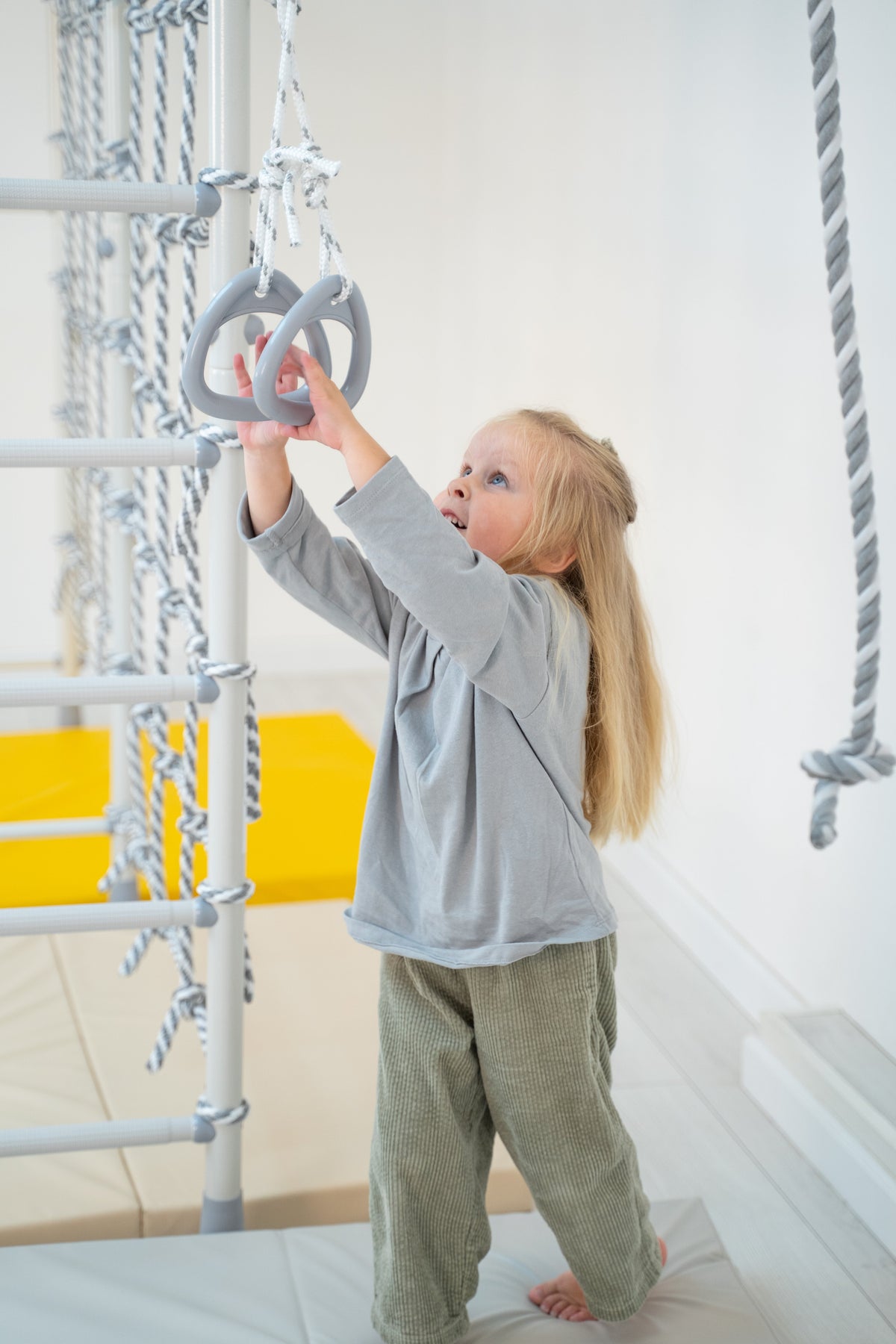
Around the third birthday two skills usually arrive together: alternating feet on rungs, and following "feet first, one rung at a time" on the way down. That combination is the readiness test for a rated frame, and it is why our gyms are designed for independent climbing at age 3 and up, with a parent in the same room. If a particular three-year-old is not there yet, wait; the frame is not going anywhere, and it is the same frame at twelve.
What a first frame should look like: a published load rating (ours is 220 lb working, tested to 440, which is not for the three-year-old, it is for the twelve-year-old the same frame will meet), rigid bracing so it does not sway, rubber-coated rungs small hands can grip, non-toxic materials, a thick mat underneath, and a growth path. Our Model T3 is built for exactly this year and becomes a Spider V3 later by adding a Cross Bar set. The lowest rungs and a classic swing seat are where three-year-olds live for the first months; the monkey bars and rope arrive at five.
Younger siblings on a big frame
The most common question from families with a 4-year-old and an 18-month-old: can the little one use the gym? The answer we give every week: on a swing seat, with a parent's hands close by, yes. On the ladders, no. Swinging is wonderful vestibular input at every age, and a parent pushing a toddler gently on a seat while the older child climbs is a daily scene in our owner community. The ladders, monkey bars, and rings wait for three. Keep a mat under everything, anchor any furniture nearby, and let the toddler's foam climber live next to the frame so both kids have a right-sized summit.


Ready at three, still climbing at twelve
Steel frames rated for independent climbing at age 3 and up. No drilling, 30-day money-back guarantee.
Frequently asked questions
Is there such a thing as an infant jungle gym? Not in the climbing sense. An "infant gym" or "baby gym" is a padded play mat with an arch of dangling toys for reaching, kicking, and tummy time, used from birth to about 9 months. Babies do not climb; they build the neck, shoulder, and cross-body coordination that climbing will use later, mostly through floor play.
What is the best climbing gym for a 1 year old? Low and soft, always within a parent's arm's reach: foam climbing blocks and ramps, a Pikler-style triangle, and cushion mountains. The work at one is the mechanics of stepping up, gripping, and coming down. Full-height frames are for age 3 and up.
Can a 2 year old use a climbing gym? A toddler climber, yes; a full-height rated frame, not yet. Two-year-olds are still building drop judgment and a reliable feet-first descent. Keep the equipment low and supervised, use the playground often, and teach the descent deliberately; most children are ready for a rated frame around three.
At what age can a child use a Brainrich play gym? Independent climbing from age 3 and up, with a parent in the same room. A younger sibling can use a classic swing seat on the frame with a parent's hands close by, but the ladders, monkey bars, and rings wait for three.
How do I know my child is ready for a real climbing frame? Two skills arriving together: alternating feet on rungs, and following "feet first, one rung at a time" on the way down. If either is missing, wait a few months; the frame is the same frame at twelve, so there is no reason to rush the start.
📚 Keep reading in the Decision Guide
Best Climbing Toys by Age · What Comes After the Pikler Triangle? · My Toddler Climbs Everything · What Is a Montessori Play Gym?
Ready to shop? Browse the toddler climbing gym collection: steel gyms built for ages 3 and up, with low-start and low-ceiling options.
New: deciding between a wooden climbing set and a steel frame for a toddler? Read Pikler Climbing Set vs Steel Play Gym, with 2026 prices and the age-5 question answered.
New: wondering what fits a 1-to-5-year-old? See Best Indoor Play Gym for Kids Under 5.
New: buying for a 2-to-4-year-old? Read Safest Monkey Bars for Toddlers first.
Sources
American Academy of Pediatrics, HealthyChildren.org: physical activity and tummy time guidance for infants and toddlers. · WHO (2019). Guidelines on physical activity, sedentary behaviour and sleep for children under 5 years of age. · Hanscom, A. (2016). Balanced and Barefoot. New Harbinger. · Brainrich Kids engineering specification: frame working load 220 lb, safety-tested to 440 lb; independent climbing rated from age 3.
Share: