

Published September 2026 · 15-minute read · by Yegor Nadvornyy, founder of Brainrich Kids
"Jungle gym" started as one man's trademark for one steel cube in one Illinois schoolyard. A hundred years later the words cover rope pyramids in Berlin, cedar forts in Ohio backyards, padded mazes at the mall, and the steel frame in my own living room. This guide maps all of it: the real history, every type, sizes by age and by room, the safety standards, upkeep by material, what each kind costs, and a router at the end that points to the deep guide for your situation.
The quick answer: a jungle gym is a rigid structure of bars, and sometimes ropes or platforms, that children climb through in every direction. It was invented in Winnetka, Illinois, in 1920. Today there are seven main types: the classic steel lattice, the geodesic dome, the rope-net pyramid, the post-and-platform playground structure, the backyard wooden playset, the soft contained indoor playground, and the indoor home frame (floor-to-ceiling or wall-mounted). Choose by where it will live, how many days a year it will be used, and the age range it has to serve. In the United States, public equipment follows ASTM F1487 and home equipment follows ASTM F1148, and the CPSC handbooks explain both in plain English. Expect about $200 for a backyard dome, $850 to $2,399 for an indoor steel frame, and $15,000 and up for anything commercial.
Jump to: History · Names worldwide · The seven types · Sizes by age · Sizes by space · Safety standards · Maintenance · Cost ranges · Which jungle gym is right for you · FAQ
History: a dinner party, a tesseract, and a schoolyard
The short version of the jungle gym story (Sebastian Hinton, patent filed 1920) is in What Is a Jungle Gym?. The long version is better.
It begins with a mathematician. Charles Howard Hinton, the British mathematician who coined the word "tesseract" for a four-dimensional cube, was teaching in Japan in the 1880s and wanted his children to feel three-dimensional space in their bodies. He built a lattice of bamboo poles in the yard, labeled the junctions with coordinates, and called out positions for the children to climb to. The math lesson did not stick. The climbing did.
It continues at a dinner party. In 1920 his son Sebastian, by then a patent lawyer near Chicago, described that bamboo frame at a dinner hosted by Winnetka school board member Edward Yeomans. At the table were two of the most progressive educators in America: Carleton Washburne, Winnetka's school superintendent, and Perry Dunlap Smith, headmaster of North Shore Country Day School. The three sketched a version in iron pipe. A prototype went up at North Shore Country Day, the children swarmed it, the designers adjusted it, and the first permanent jungle gym was installed at Winnetka's Horace Mann School. When that school was demolished in 1940, the structure moved to Crow Island School, where children climbed it for decades more. It is now in the care of the Winnetka Historical Society.
Hinton filed U.S. Patent 1,471,465 on July 22, 1920, and followed it with three more. He trademarked the name as one word: Junglegym. The first permanent one was climbed by children for more than nine decades, which is the most convincing durability test any play structure has ever passed.
WINNETKA, ILLINOIS · 1920
Then it spread, and changed shape. The steel cube filled American schoolyards through the 1950s, usually over asphalt. In Germany in the 1970s, architect Conrad Roland replaced the bars with tensioned rope and created the net pyramid now found in parks around the world. The CPSC published its first playground safety handbook in 1981, surfacing replaced asphalt, and manufacturers moved to the post-and-platform structures most parks have today. Indoors, a separate tradition had been running the whole time: the Swedish gymnastics wall bars of Per Henrik Ling, which European families turned into steel home gyms braced between floor and ceiling. I grew up on one in Ukraine, and it is still standing about 35 years later.
What the world calls it
In the United States it is a jungle gym. In the UK and Ireland it is a climbing frame. Germans say Klettergerüst (climbing scaffold) and Swedes say klätterställning (climbing stand). The French have the best one: cage à écureuil, the squirrel cage. Japan borrowed the English directly, as janguru jimu, and in South Africa "jungle gym" means nearly any playground structure at all. Indoors, American parents also search for a play gym, a climbing gym, or a Swedish ladder.
The seven types of jungle gym
| Type | Where | Best ages | Strength | Limit |
|---|---|---|---|---|
| 1. Classic steel lattice | Older schoolyards, some backyards | 5 to 12 | Hinton's original; endless routes; nearly indestructible | Interior bars to fall onto, which is why new public versions are rare |
| 2. Geodesic dome | Backyards, parks | 3 to 8 | Freestanding, inexpensive, climbable inside and out | Needs a 10-foot circle plus clearance; little true hanging; kids age out early |
| 3. Rope-net pyramid | City parks | 5 to 12+ | Height with a net below you at every step; balance and planning | Commercial only; large footprint and budget |
| 4. Post-and-platform structure | Parks, schools, childcare | 2 to 5 and 5 to 12, built separately | Decks, climbers, overhead ladders, and slides in one composite; built to ASTM F1487 | A five-figure purchase; the park is only open when the weather is |
| 5. Backyard wooden playset | Home yards | 3 to 10 | A fort, swings, and a slide; a place to be as much as a thing to climb | Yearly sealing, splinters, a big surfaced zone, idle in bad weather |
| 6. Soft contained indoor playground | Malls, restaurants, play cafes | 2 to 10 | Padded tunnels and nets; weatherproof; has its own standard, ASTM F1918 | Crawling more than climbing; an outing, not a daily habit (see home vs commercial) |
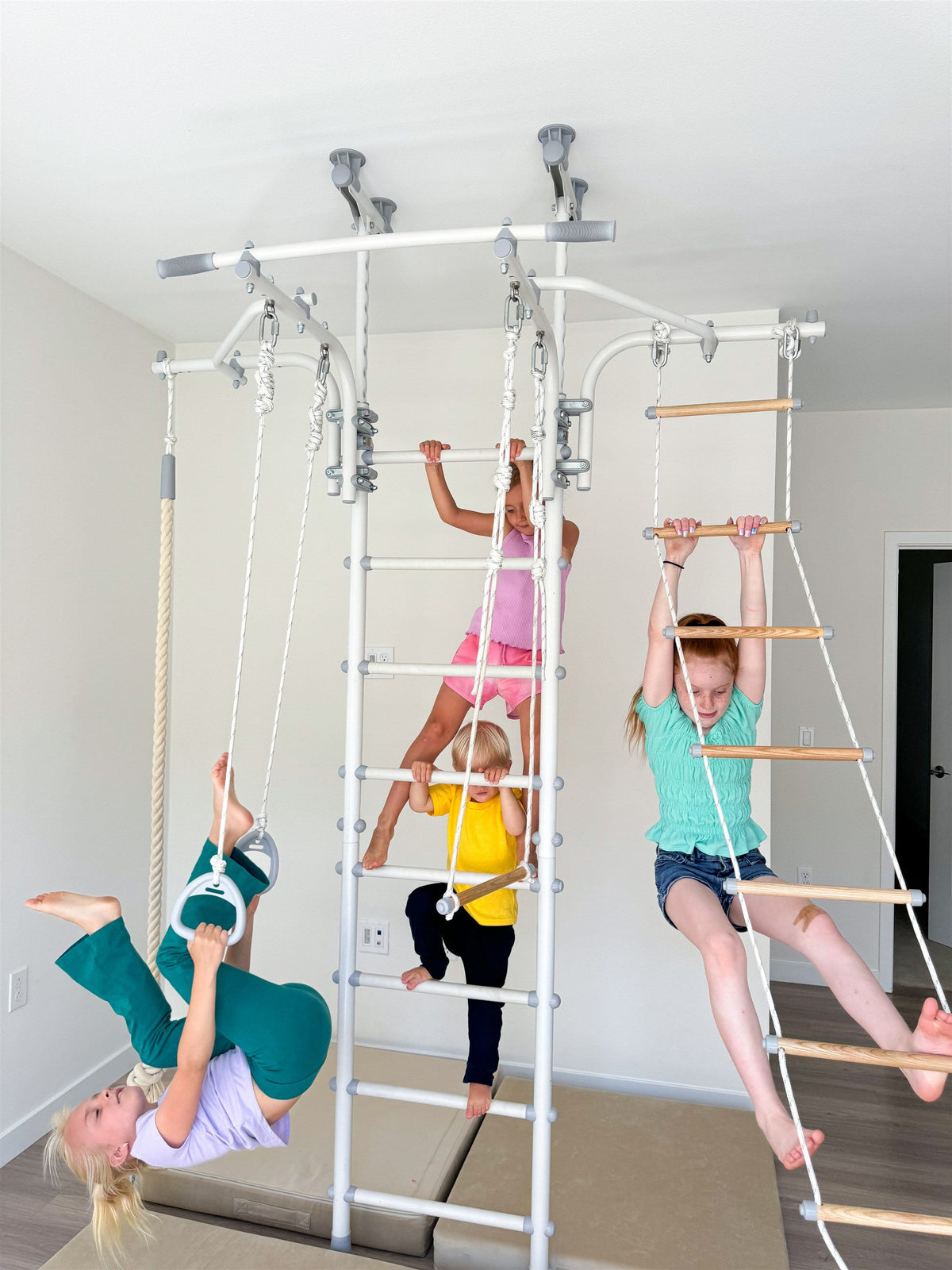
| 7. Indoor home frame (floor-to-ceiling or wall-mounted steel) | Bedrooms, living rooms, basements | 3 to 12+, adults on the pull-up bar | Ladders, monkey bars, net, rings, rope, and swing on one frame; used 365 days a year; no drilling on tension-mounted models | Needs a flat, solid ceiling from 6 ft 9 in to 10 ft 6 in, or wall studs |
Before any of these come the toddler climbers: foam blocks, then a Pikler triangle, named for the Hungarian pediatrician Emmi Pikler, whose work on self-directed movement still shapes how early-years teachers think about climbing. They are the on-ramp, and the path from one to the other is in Pikler climbing set vs play gym. After all of them comes the adult calisthenics rig, which is a jungle gym that stopped pretending (see jungle gym for adults).
Types 1 through 5 live outside, and we love them for the hours they get used. The indoor frame exists for the hours the park cannot cover: the heat advisory, the ice, the week of rain, mosquito season at dusk, and the dark at 4:30 on a December afternoon.
Sizes by age: how high, how wide, how far apart
The CPSC's Public Playground Safety Handbook sorts children into three groups and scales everything to them. These are public-playground numbers, but they are the best age-to-size reference anyone has published, and they translate well to home decisions.
| Age group | Typical height | What the CPSC handbook allows | Falls from platforms | What it means at home |
|---|---|---|---|---|
|
Toddler 6 to 23 months |
26 to 34 in | Climbing equipment under 32 inches high; ramps, stairs, full bucket swings. No overhead equipment | Barriers on almost everything | Foam climbers and a low Pikler triangle, with a parent's hands close by. Not a jungle gym yet |
|
Preschool 2 to 5 years |
34 to 45 in | Certain climbers, rung ladders; horizontal ladders up to 60 inches high for ages 4 and 5 only | Guardrails above 20 inches, full barriers above 30 | A real frame from age 3: lower rungs, a rope, a swing, a low bar to hang from. Parent in the same room |
|
School-age 5 to 12 years |
43 to 62 in | Arch and flexible climbers, overhead ladders up to 84 inches, rings, track rides, sliding poles | Guardrails above 30 inches, full barriers above 48 | The whole frame: monkey bars, net to the ceiling, rope climbs, rings, then pull-ups |
Source: CPSC Public Playground Safety Handbook, Table 1 and sections 5.1.3 and 5.3.2. Typical heights rounded from CDC growth charts.
3.5 to 9 inches
The head-entrapment range. A closed opening between those two sizes can admit a child's body and trap the head. Bars should be closer than 3.5 or wider than 9.
0.95 to 1.55 inches
The rung diameter range for anything gripped by a hand. Rungs should be round and must not rotate.
6 feet
The use zone: surfaced, empty ground in every direction around outdoor climbing equipment.
Age 3+
Our floor for independent climbing on a home frame, always with a parent in the same room. Never lift a child to a height they did not climb to.
One thing the chart hides: a good home frame is not sized to the child. The ladders are the same for a 3-year-old and a 12-year-old. What changes is which rungs they use and where you set the adjustable bars. That is why one frame can serve a family for a decade, and why the by-age accessory map lives in climbing toys by age and best indoor play gym for kids under 5. The bar-height chart for hanging is in our monkey bars guide.
Sizes by space: what each type really takes
The equipment footprint is never the real number. The real number is the footprint plus the zone you must keep clear and surfaced around it.
| Jungle gym | Equipment footprint | Space to plan for | Height |
|---|---|---|---|
| Backyard dome | About a 10 ft circle | About a 22 ft circle of surfaced ground | About 5 ft |
| Backyard wooden playset | Commonly 12 by 15 ft and up | About 24 by 27 ft, more in front of and behind swings | 8 to 12 ft |
| Model W3 (wall-mounted) | 9 inches of depth off the wall | A mat in front; works under slanted and very tall ceilings | Fixed; bolts to studs |
| Model T3 | About 5 ft 6 in by 2 ft 6 in | A corner the size of a dresser, plus a mat and swing clearance | Ceilings 6 ft 9 in to 9 ft 11 in |
| Spider V3 | About 8 ft 6 in by 4 ft 7 in | Add about 12 inches behind and a mat under the whole monkey-bar span | Ceilings 6 ft 9 in to 10 ft 6 in |
| Spider Max V3 (fort layout) | About 6 ft 2 in by 6 ft 7 in | Two spans, so two swing bays; also builds as an L or a long line | Ceilings 6 ft 9 in to 10 ft 6 in |
| Mega Max V3 | About 10 ft 9 in by 6 ft 7 in | A dedicated playroom or basement bay | Ceilings 6 ft 9 in to 10 ft 6 in |
Outdoor figures are typical, not universal; check the maker's plan. Brainrich footprints are read from our dimensional drawings for the standard layout. Ceiling versions: Short 6 ft 9 in to 9 ft 1 in, Standard 7 ft 8 in to 9 ft 11 in, Tall 9 ft 4 in to 10 ft 6 in (the T3 has no Tall version; an extension ladder adds about 21 inches).
Placement matters as much as size. Put an indoor frame where the family already spends its hours, leave about a foot behind it, never beside a bed, and never where a swing arc meets a wall. Room-by-room layouts are in the playroom jungle gym guide and basement play gym ideas.
Safety standards: which one applies to which jungle gym
Parents meet these as a string of letters on a product page. Here is what each one covers.
| Document | Applies to | What it covers |
|---|---|---|
| CPSC Public Playground Safety Handbook (Publication 325) | Parks, schools, childcare, apartment complexes, restaurants | Free plain-English guidance: age groups, heights, entrapment, surfacing, maintenance. Not a law by itself, though many states and districts adopt it |
| CPSC Outdoor Home Playground Safety Handbook (Publication 324) | Backyards | The family version: siting, anchoring, surfacing depth, and a seasonal maintenance checklist |
| ASTM F1487 | Public-use equipment, ages 2 through 12 | The technical specification commercial makers build and test to, and that certified inspectors audit against |
| ASTM F1148 | Home playground equipment, ages over 18 months through 10 years | Entrapment openings, protrusions, sharp edges, stability, fall height and surfacing, and slide geometry |
| ASTM F1292 | The ground | The impact test behind every "critical fall height" rating on tiles, mats, and engineered wood fiber |
| ASTM F1918 | Soft contained play equipment | The padded tube-and-net mazes at malls and restaurants |
The idea that runs through all of them is fall height. Every rule about surfacing, guardrails, and age groups is a rule about how far a child can fall and onto what. The CPSC counts more than 200,000 emergency-room-treated playground injuries a year, and in its most recent review of incident reports, falls were the most common hazard pattern at 44 percent, with equipment failures such as breakage, tip-over, and poor assembly next at 23 percent. So two questions sort any jungle gym, of any type, from any maker:
1. What is the fall height, and what is under it? Outdoors, 9 inches of wood chips or 6 inches of shredded rubber is rated to a 10-foot fall; 9 inches of sand is rated to only 4 feet; grass and dirt are not protective surfacing at all. Indoors, keep hanging feet a few inches above a firm mat and put a mat under every dismount point. A rug is not surfacing.
2. What load was it tested to, in pounds? A maker who publishes a working load and a test load has done the engineering. Every Brainrich frame carries a 220 lb working load and is safety-tested to 440 lb, and we print both numbers because two school-age kids plus momentum is the load a frame really meets.
One consequence of the home standard: ASTM F1148 specifies slides in detail, including side walls, an exit region, and clear floor beyond it. We designed a slide to that specification, measured the roughly 6 feet of clear floor it demanded, and did not ship it. No Brainrich gym has a slide. If you attach a third-party slide to any indoor frame, check the side walls, the exit region, and the clear zone yourself.
None of this makes climbing risk-free, and it should not. The aim is no hidden hazards, so that the visible risk, height, is the one a child learns to judge. The research is in the science of controlled risky play. Maria Montessori made the same argument a century ago: movement is not a break from learning, it is how young children do it.
Maintenance by material
What you maintain depends on what it is made of. The full trade-off is in metal vs plastic vs wood jungle gyms; this is the upkeep calendar.
| Material | Monthly | Yearly | Replace when |
|---|---|---|---|
| Outdoor wood | Run a hand along rails for splinters; tighten bolts, which loosen as wood shrinks and swells | Clean and reseal or stain; probe posts at ground level for soft spots | Any structural member is cracked through or soft at the base |
| Outdoor metal | Check anchors and hardware; touch-test surfaces on hot days | Sand and repaint chips before rust spreads; inspect welds | Rust has pitted a load-bearing tube or a weld has cracked |
| Ropes and nets (any setting) | Check knots, clamps, and connection points | Inspect the full length for fraying and sun damage | Any strand is cut or the core shows |
| Loose-fill surfacing | Rake back under swings and exits, where it gets kicked out | Top up; it compresses at least 25 percent over time, so 9 inches means filling to 12 | Depth markers show less than the rated depth |
| Indoor powder-coated steel | Hand-check bolts and connectors; push the top of the frame; re-check ceiling pressure on tension-mounted models | Raise the bars to the child's new reach; wipe rubber-coated rungs with mild soap | A part is bent or a thread is stripped. Replace the part; the frame carries on |
No weather means almost no decay, which is why indoor steel frames last long enough to be resold or handed down.
What a jungle gym costs: outdoor, indoor, and commercial
Outdoor and commercial ranges below are approximate U.S. figures as of September 2026, from public listings and manufacturer budgeting guides. Brainrich prices are exact, and they do not move, because we do not run sales.
| Category | Typical price | Usually not included | Years of use |
|---|---|---|---|
| Backyard geodesic dome | About $150 to $500 | Surfacing for a 22 ft circle | About 3 to 8 |
| Backyard wooden playset | About $500 to $6,000; premium installed sets run well past $10,000 | Installation, site leveling, surfacing, yearly sealing | About 3 to 10 |
| Indoor wall-mounted steel | Model W3 $850 · W3 Max $1,099 | A mat; mounting into studs | 3 to adult |
| Indoor tension-mounted steel | Model T3 $899 · Spider V3 $1,499 · Spider Max V3 $1,899 · Mega Max V3 $2,399 | A mat. Tall-ceiling versions cost more. No drilling, no installer | 3 to 12+, then pull-ups |
| Commercial park or school structure | About $15,000 to $50,000 for equipment; a common budgeting rule is $1,000 per child served at one time | Installation (often 20 to 40 percent of the project) and surfacing (about $5 to $20 per square foot) | 15 to 25 with inspections |
Two things change the math at home. Modularity: a Model T3 bought at 3 becomes a Spider V3 at 5 by adding the Monkey Bars V3 add-on ($699). That add-on is an attachment for families who already own a Brainrich frame, not a stand-alone unit; families starting fresh get the same result from the Spider V3, which comes with the monkey bars built in. Days of use: a playset used 100 days a year and a frame used 300 are different purchases even at the same price. The line-by-line buying math, including how families pay with HSA/FSA funds or homeschool ESA dollars, is in the indoor jungle gym buyer's guide.
Which jungle gym is right for you?
Find your sentence. Follow the link.
"I just want the definition and the basics." → What Is a Jungle Gym?
"I am ready to buy an indoor one and want a checklist." → The Indoor Jungle Gym Buyer's Guide
"Steel, wood, or plastic?" → Metal vs Plastic vs Wood Jungle Gyms
"We are looking at a dome." → Climbing Dome for Kids vs Indoor Climbing Gym
"My child is under 5." → Best Indoor Play Gym for Kids Under 5 and Pikler Climbing Set vs Play Gym
"Is a slide-and-climber playset the same thing?" → Indoor Playset vs Indoor Play Gym
"Would memberships to an indoor playground be smarter?" → Home vs Commercial Indoor Playground
"It is going in the playroom or the basement." → Playroom Jungle Gym Guide and Basement Play Gym Ideas
"The monkey bars are the point." → Monkey Bars: The Complete Guide
"I have one wall and no floor." → The Swedish Ladder for Kids
"Can I use it too?" → Jungle Gym for Adults
"Spider V3 or Spider Max V3?" → the model comparison, with footprints and placement rules


Hinton's idea, sized for a living room
Steel indoor jungle gyms for ages 3 to 12+. 220 lb working load tested to 440, no drilling, 30-day money-back guarantee.
Frequently asked questions
What is a jungle gym? A jungle gym is a rigid play structure of bars, and sometimes ropes or platforms, that children climb through in every direction. The main types are the classic steel lattice, the geodesic dome, the rope-net pyramid, the post-and-platform playground structure, the backyard wooden playset, the soft contained indoor playground, and the indoor home frame that mounts floor to ceiling or to a wall.
Who invented the jungle gym, and where? Sebastian Hinton, a patent lawyer, in Winnetka, Illinois. He filed U.S. Patent 1,471,465 on July 22, 1920, after sketching the design with educators Carleton Washburne and Perry Dunlap Smith. The idea came from a bamboo climbing lattice his father, the mathematician Charles Howard Hinton, had built to teach three-dimensional space. A prototype went up at North Shore Country Day School and the first permanent one at Horace Mann School.
What size jungle gym do I need? Size it to the space first. A backyard dome needs about a 22-foot surfaced circle and a wooden playset about 24 by 27 feet. Indoors, a wall-mounted frame needs 9 inches of depth, a Model T3 about 5 ft 6 in by 2 ft 6 in, a Spider V3 about 8 ft 6 in by 4 ft 7 in, and a Mega Max V3 about 10 ft 9 in by 6 ft 7 in, with flat ceilings from 6 ft 9 in to 10 ft 6 in depending on version.
What safety standards apply to jungle gyms? In the United States, ASTM F1487 covers public playground equipment for ages 2 through 12, and ASTM F1148 covers home playground equipment for ages over 18 months through 10 years. ASTM F1292 is the impact test for surfacing, and ASTM F1918 covers soft contained play equipment. The CPSC's Public Playground Safety Handbook and Outdoor Home Playground Safety Handbook explain the guidance in plain English.
How much does a jungle gym cost? As of September 2026, a backyard dome runs about $150 to $500, a wooden playset about $500 to $6,000 before installation and surfacing, and a commercial structure about $15,000 to $50,000 for equipment alone. Brainrich indoor steel frames are $850 for the wall-mounted Model W3, $899 for the Model T3, $1,499 for the Spider V3, $1,899 for the Spider Max V3, and $2,399 for the Mega Max V3.
📚 Keep reading in the Decision Guide
What Is a Jungle Gym? · Indoor Jungle Gym Buyer's Guide · Metal vs Plastic vs Wood · Jungle Gym for Adults · Monkey Bars: The Complete Guide
Sources
Hinton, S. (1923). Climbing structure. U.S. Patent 1,471,465, filed July 22, 1920. · Winnetka Historical Society. Jungle Gym Turns 100. · NPR (2023). The jungle gym turns 100 years old. · U.S. Consumer Product Safety Commission. Public Playground Safety Handbook (Publication 325): section 1.7 (injury data), Table 1 (age-appropriate equipment), Table 2 (surfacing), section 3.3 (entrapment), section 5.1.3 (guardrails and barriers), section 5.3.2 (climbers); and Outdoor Home Playground Safety Handbook (Publication 324). · ASTM International. ASTM F1487 (public use); ASTM F1148 (home); ASTM F1292 (surfacing impact attenuation); ASTM F1918 (soft contained play equipment). · CDC. Growth charts (typical stature by age). · Commercial budgeting figures: manufacturer budgeting guides reviewed September 2026. Retail price ranges: public U.S. listings reviewed September 2026; Brainrich prices from brainrichkids.com on the publication date. · Brainrich Kids engineering specification: frame working load 220 lb, safety-tested to 440 lb; footprints and ceiling-height versions per product documentation.
Share: