

Updated September 2026 · 18-minute read · by the Brainrich Kids team
Every tension-mounted Brainrich gym is built from the same parts: steel gym ladders, monkey-bar spans, pull-up bars, nets, and the accessories that hang from them. The four models are simply four amounts of that kit, and the question most families ask us, "Spider or Spider Max?", is really two questions in disguise: how many separate places to play do your kids need, and where in the house will the gym live? This guide answers both, with the footprint of each model, the community's own placement lessons, and the reason the Spider Max V3 became our most-ordered gym.
The quick answer: all four tension-mounted models (Model T3, Spider V3, Spider Max V3, Mega Max V3) are modular and fully adjustable, and any of them can expand later by adding a Monkey Bars V3 set. Pick by play zones, not by price: one child in a modest room does well with the Spider V3; two or more kids, or one child with a sensory need for a calm swing spot, are better served by the Spider Max V3, whose two monkey-bar spans create two wide swing bays and unlock the fort, L-shaped, and long-line layouts. Then place the gym where your kids already spend their hours, ideally a foot off the wall rather than jammed into a corner, and never beside a bed. And if your answer to every room question is "we have no space," the Model T3 fits literally anywhere with a flat ceiling.
Jump to: One system, four sizes · Play zones · Swings and monkey bars · Comparison table · Basement, Standard, Tall · Why families size up · Placement · Which room · FAQ
One system, four sizes: what "modular" really means
Start with the fact that reorganizes every other decision. A Brainrich gym is not four products. It is one modular steel system sold in four starting quantities. A gym ladder is a gym ladder whether it arrived in a Model T3 box or a Mega Max box. A monkey-bar span bridges any two ladders. The rings, trapeze, climbing rope, and rope ladder clip to any bar and move in seconds. Every bar is height-adjustable, so a span sits at chest height for a cautious three-year-old and rises to full height for a fearless eight-year-old on the same frame.
Modular also means the gym is never finished unless you want it to be. Add one Monkey Bars V3 set (one ladder plus one span) to a Model T3 and you own a Spider V3. Add another and you own a Spider Max V3. Add a third and you own a Mega Max V3. No model is a dead end. The family that buys small in a two-bedroom apartment and moves to a house with a basement three years later keeps every part they already paid for.
Model T3 → + monkey bars = Spider V3 → + monkey bars = Spider Max V3 → + monkey bars = Mega Max V3
Every arrow is one Monkey Bars V3 add-on ($699), which is not a stand-alone unit: it supplies one ladder and one span and uses the gym you already own as the other support.
One more thing about how we price. Each model costs what its materials cost: more ladders and more spans, more steel, higher price. But function does not scale in a straight line with steel. Adding one span to a T3 does not make it one span better. It creates the first place a wide swing can hang, the first stretch of monkey bars to cross, and the first structure a child can climb on top of. Adding a second span does it again: a second swing bay, a second net, and, for the first time, a frame that can close into a fort or turn a corner. Every added element unlocks new configurations rather than just more of the same, which is why each step up the ladder buys disproportionately more play than it costs. That is the whole argument for sizing up, and the rest of this article shows it in detail.
Play zones: the real reason to count spans, not dollars
Ask an owner what changed the day the gym went up and the answer is rarely "my kid climbs more." It is "my kids stopped fighting over the same three square feet." Siblings share toys badly and share space worse. A gym solves that when it has separate play zones: a net one child can climb while another swings, a span one child can cross while another sits in a hammock underneath.
Here is how zones scale across the lineup. A Model T3 is one ladder with two pull-up bars: one climbing face and two narrow hanging points, which is one zone, and the answer for the family that has no room for anything wider. A Spider V3 adds a second ladder, a monkey-bar span between them, and a rope net: now there is a net to climb, bars to cross, and a wide bay underneath for a swing. Two zones, three on a good day. A Spider Max V3 adds a third ladder, a second span, and a second net: two nets, two spans, two wide swing bays, and the ability to close the frame into a fort. Three to four zones. A Mega Max V3 with four ladders, three spans, and three nets runs to five or more.
1 zone
Model T3. One climbing face, rings and trapeze from the pull-up bars. The no-space answer: a flat ceiling is all it needs.
2-3 zones
Spider V3. A net, a span to cross, one wide swing bay. One or two kids who take turns well.
3-4 zones
Spider Max V3. Two nets, two spans, two swing bays, a fort on top. Two or more kids, or one child plus a calm-down spot.
5+ zones
Mega Max V3. Three nets, three spans, three swing bays. Three or more kids, a daycare, a dedicated playroom.
The rule that falls out of this is simple: the more kids who will use the gym at the same time, the more spans it needs. In our owners' group, the question that comes up before nearly every purchase is some version of the one Kait S. asked while shopping for her three swing-loving little ones: what setup allows at least one monkey-bar set and two spots for swings? The answer is always the same: two spans, which means the Spider Max V3.
Swings hang best under the monkey bars, so more spans means more swings
Here is a detail we wish every buyer knew before ordering. A gym has two kinds of hanging points, and they are not equal. The pull-up bars are about 2 feet long. They are perfect for rings, a trapeze, a climbing rope, or a narrow single-point swing, but a hammock or a nest swing needs more width than that. The monkey-bar span is 4 feet 7 inches wide, more than double. That width is what lets a family hang a hammock, a pod swing, a nest swing, or a platform swing and let it move freely without the ropes rubbing on a ladder.
Because of this, the best spot for almost every swing is directly underneath a monkey-bar span. Count the spans and you have counted the swing bays: one on the Spider V3, two on the Spider Max V3, three on the Mega Max V3. On the T3, with no span, swinging is limited to what a 2-foot bar allows. This is why the first span is the single biggest usability jump in the lineup, and why the step from one span to two is the next: it is the difference between one swing and two swings hanging at the same time.

A swing bay next to a climbing net: two kids, two zones, zero waiting.
Swings are also where the therapy and neurodivergent story lives. In the owner community, the sensory swing is the most-used feature across every age group, and the fort and hammock come right behind it. Sharon C. told the group the nest was the favorite for her elementary and middle schoolers. A hammock is not the most developmental piece on the gym. Climbing, hanging, and crossing bars build strength and coordination; a hammock mostly does one thing. But that one thing matters enormously for some children: slow, linear, rhythmic swinging is the kind of vestibular input that occupational therapists commonly reach for to help a child settle, a principle that traces back to A. Jean Ayres's sensory integration work and shows up in every sensory diet a therapist writes. On a bigger gym, that hammock gets its own bay. It stays hung, it stays available, and the child who needs it does not have to wait for a sibling to finish on the rings. On a smaller gym, it competes for the only wide spot. We cover swing types and hanging in the indoor swings guide and the science of why kids crave it in the vestibular input article.
The four tension-mounted models, side by side
Most families are choosing between the middle two columns, and the decision box under the table is written for them. The T3 is here for the family with no space at all, and the Mega Max for the family with a whole room. Footprints below are the standard configuration from each model's dimensional drawing. Add a mat-covered landing zone around the frame, and (as explained further down) leave about a foot behind it.
| Model T3 | Spider V3 | Spider Max V3 ★ | Mega Max V3 | |
|---|---|---|---|---|
| Price | $899 | $1,499 | $1,899 | $2,399 |
| Gym ladders / spans / nets | 1 / 0 / 0 | 2 / 1 / 1 | 3 / 2 / 2 | 4 / 3 / 3 |
| Pull-up bar sets (2 ft) | 2 | 2 | 1 | 1 |
| Wide swing bays (4 ft 7 in) | 0 | 1 | 2 | 3 |
| Separate play zones | 1 | 2-3 | 3-4 | 5+ |
| Footprint (standard layout) | about 5 ft 6 in × 2 ft 6 in | about 8 ft 6 in × 4 ft 7 in | about 6 ft 2 in × 6 ft 7 in (fort) | about 10 ft 9 in × 6 ft 7 in |
| Layouts | Single ladder | Straight run | Fort, L-shape, or long straight run | Fort plus a wing, long L, or framed zone |
| Ceiling versions | Short, Standard | Short, Standard, Tall | Short, Standard, Tall | Short, Standard, Tall |
| Best fit | No space at all: one child, any room with a flat ceiling, or the seed of a bigger gym | One or two kids along one wall | Two or more kids; sensory swing plus climbing; most rooms | Three or more kids; playroom, basement, daycare |
Shared by all four: powder-coated steel, 220 lb rating safety-tested to 440, ages 3+ for independent climbing, height-adjustable bars, tension-mounted with no drilling, rings, climbing rope, trapeze, and rope ladder included, 30-day money-back guarantee, HSA/FSA eligible with a Letter of Medical Necessity. Budget variants exist too: the Spider V3 Light (US only) ($1,245) and Spider Max V3 Light (US only) ($1,820) trim the accessory set, and the Spider V3 no Net ($1,420) drops the rope net.

Model T3: the footprint of a bookshelf. If the ceiling is flat, it fits.

Spider V3: one span, one wide swing bay, one wall.

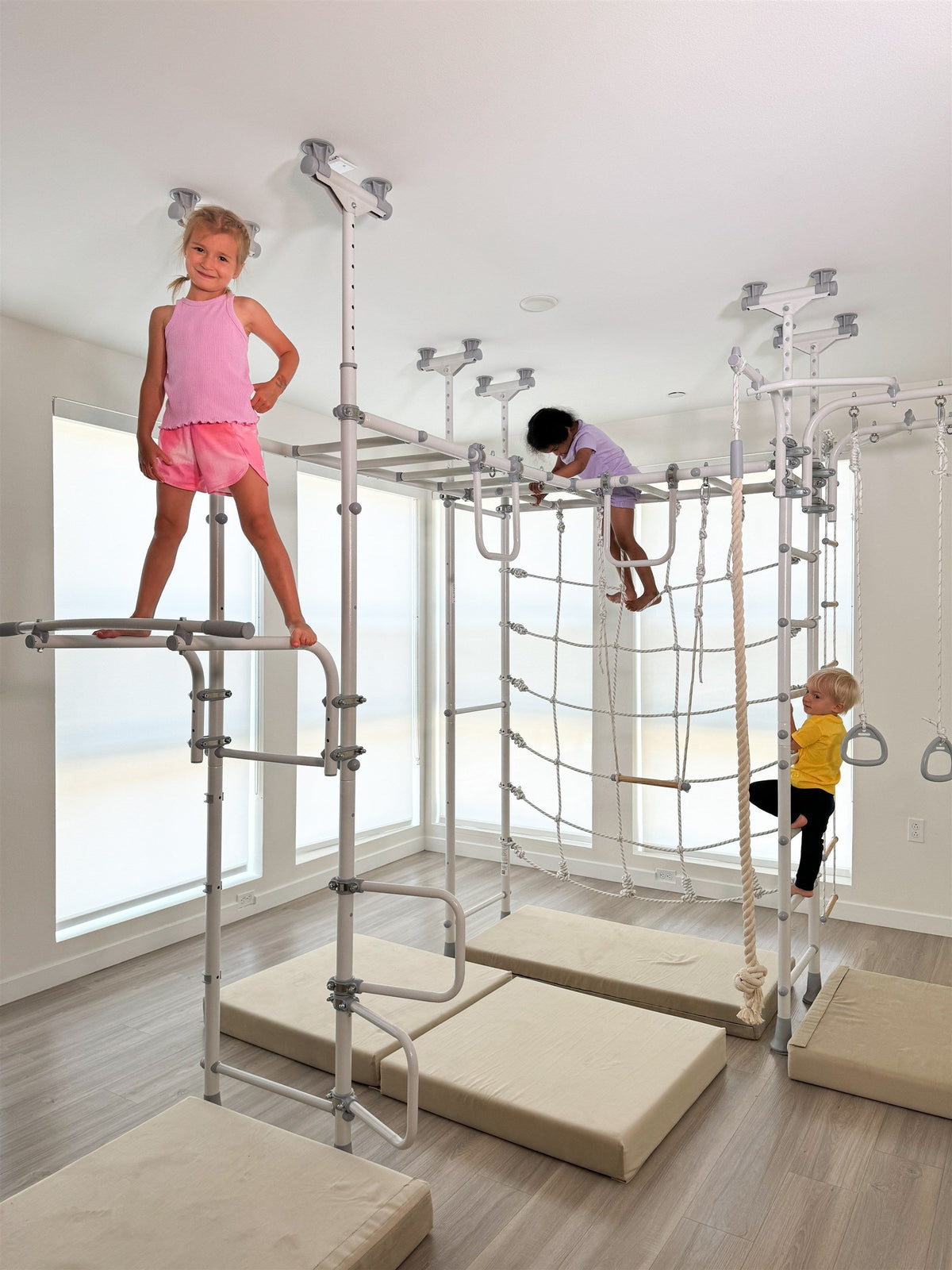
Spider Max V3 in the fort layout: two spans close into a platform on top.

Mega Max V3: the fort plus a third span running off one side.
Spider V3 or Spider Max V3? The $400 question, answered
Choose the Spider V3 if: one child will use it most of the time, the gym has to run along a single wall, or the budget is fixed today and the upgrade can wait. You get a net, a span to cross, and one wide swing bay.
Choose the Spider Max V3 if: two or more kids will climb at once, you want a hammock or sensory swing hanging permanently while another swing stays free, you want the fort, or the room lets you turn a corner. The extra $400 buys a third ladder, a second span, a second net, a second swing bay, and every layout the Spider V3 cannot make.
Why the Spider Max V3 is our most popular model. Look at the layouts row. With one span, the Spider V3 can only be a straight line. With two, the Spider Max V3 can be a fort (two spans closed into a square with a net platform on top, the playhouse every owner says gets used more than expected), an L that wraps a corner, or a long straight run of monkey bars down a basement wall. It is the first model where you choose the shape of the gym instead of accepting it, and the first with two wide swing bays. Sean W. put it up in the fort configuration with an extra set of pull-up bars for his 4- and 7-year-old and posted the playroom the same week. That combination, two spans for the price of a $400 step up from the Spider V3, is why more families land there than anywhere else in the lineup. Every layout is detailed in the Spider configurations guide.
Not sure which size? Take the 60-Second Quiz →
Basement, Standard, and Tall: the same gym, three ceiling ranges
Every ladder on a Brainrich gym has three parts: a bottom section, a middle section, and a telescopic pole at the top that braces against the ceiling. The three height versions change only the ends of that stack. The Short (basement) version fits ceilings from 6 ft 9 in to 9 ft 1 in and differs only in the bottom section, which has one fewer rung and is about 10 inches shorter. The Standard version fits 7 ft 8 in to 9 ft 11 in and is the one most homes order. The Tall version fits 9 ft 4 in to 10 ft 6 in for great rooms and newer builds. The middle section, the spans, the nets, and every accessory are identical across all three, so a basement gym is not a lesser gym. It is the same gym on a shorter stilt.
⬇️ SHORT (BASEMENT)
6 ft 9 in to 9 ft 1 in. Finished basements, older homes, split levels. The most-requested version in our owners' group every fall.
↕️ STANDARD
7 ft 8 in to 9 ft 11 in. Living rooms, playrooms, bedrooms in most houses built after 1970.
⬆️ TALL
9 ft 4 in to 10 ft 6 in. Great rooms, converted garages, new construction. Puts the monkey bars high enough for teens and parents.
Two practical notes. If your ceiling sits in the overlap between two ranges, both versions fit; pick Standard if you might move somewhere taller and Short if you might move somewhere lower. And if you move from one range to another, an Extension Ladder ($75) inserts between the bottom and middle sections and adds about 21 inches, which is how one owner in the group took her basement Spider Max to a new home with 9-foot ceilings. Slanted or vaulted ceilings, where a telescopic pole has nothing flat to brace against, are the one case where we point families to the wall-mounted Model W3 instead.
Why so many families wish they had sized up
Read our owners' group for a week and you will notice a pattern in the questions. Before the purchase: "Debating between the Spider V3 and the Spider Max V3, it will be the sole focus of our 11-by-11 playroom, which would you recommend?" (Kacie L.). A home daycare owner with six 2- to 4-year-olds plus a 6-, 10-, and 12-year-old: "Should I just get the largest one, or a smaller one with add-ons?" And then, a year or two later, from the families who bought small: "Our son is now 8 and is begging for more to climb on, what can I add to make this much larger?" (Jayme M., who started with the wall-mounted model), or "We have a basement T2 and want to expand it" (Jenna L.).
Nobody in those threads regrets the gym. What they regret is the second installation. And that is the part of the math that is easy to miss on the product page:
BUY THE SIZE YOU WILL GROW INTO
One delivery, one afternoon of assembly, one time tensioning the poles and checking the ceiling. The gym is complete on day one and stays complete as the second and third child reach climbing age. The V3 generation made this the easy path: fewer, unified bolts, clearly marked parts, and boxes labeled by section.
BUY SMALL AND EXPAND LATER
Perfectly valid when the room or the budget says so, and every part carries forward. The cost is a second delivery and a second build, usually with a child underfoot who wants the new span up now. Owners who took this route tell us to warn you: it is fine, it is just not free.
So the rule we give families who ask is this: if the room can hold the Spider Max V3, start there. If the room cannot, start with the Spider V3 knowing the upgrade path is real. And if you have three kids, a daycare, or a whole room to give, the Mega Max V3 is cheaper on day one than a Spider Max plus a Monkey Bars set added later.
"Their most used toy by FAR, like by a landslide. They use it every day for hours. Especially when other kids are playing with them. It entertains all of them endlessly."
– LEISA L., MOM OF 3, BRAINRICH OWNER
Placement: the size of the gym is only half the decision
A Spider Max V3 shoved into a corner is a Spider V3 with extra steel. Where the gym stands decides how many of its sides your kids can actually use, so placement deserves as much thought as the model. Here are the rules we give owners, in order of how much difference they make.
1. ONE WALL IS FINE. LEAVE A FOOT.
Placing a gym against a wall sacrifices that side: nobody can climb it, swing through it, or run around it. One sacrificed side is a perfectly reasonable trade in most rooms. But pull the frame about 12 inches off the wall. That foot lets kids run a loop behind the gym, gives a swing its full arc, and, at cleanup time, becomes the slot where the mats stand on edge.
2. CORNERS COST TWO SIDES.
A corner placement sacrifices two faces of the gym at once. It still works in a small room, and an L-shaped Spider Max is designed to wrap a corner gracefully. But if the room allows it, walk the gym toward the middle. A frame in the open is climbable from every side and turns into a circuit kids run around, not a shelf they stand in front of.
3. MATS UNDER EVERY LANDING.
The footprint on the drawing is the steel. The real footprint includes the mat-covered landing zones under the net, under each swing bay, and at the base of the monkey bars. Plan for the mats when you measure, and store them behind the gym in that one-foot gap.
4. NOT NEXT TO A BED.
Sleep researchers call it stimulus control: the bed should mean sleep and nothing else, so that lying down becomes the cue to fall asleep. A gym three feet from the pillow gives the bedroom a second, louder meaning. If the bedroom is the only option, put the gym as far from the bed as the room allows and make "gym is closed" part of the bedtime routine.

One side against the wall, mats in front, the rest of the room free. A sensible layout for a small playroom.
The community learns these lessons the hard way and then teaches them generously. When Danielle C. asked whether she could install her gym close to the wall because she "just didn't want it in the middle of the room," the owners who answered had the same advice we give: yes, one side against the wall works, and leave the gap. Varanya Y. asked to see small-space living-room setups "so my husband can see," and the thread filled with photos of gyms parked a foot off a living-room wall, mats stacked behind.
Which room: put the gym where the hours are
The best room for a play gym is not the emptiest one. It is the room where your kids already spend the most time, because a gym gets used in five-minute bursts a dozen times a day, and a gym down a hallway does not get those bursts. It gets a scheduled visit, like a park.
"Our gym is in the living room, right next to the kitchen. That is not a compromise, it is the point. I can cook, clean up, make coffee, drink the coffee, and sit on the couch while my daughter plays, and I never lose sight of her. She lets me do my things because she is busy doing hers, in the same room. If the gym were in a spare room upstairs, one of us would always be waiting for the other."
– YEGOR NADVORNYY, FOUNDER OF BRAINRICH KIDS

A swing bay within sight of the stove: supervision without standing guard.
The living room works for exactly that reason, and so does a home office, which is where Erica M. put hers: "next to my desk so while I'm working they can play." Alison S. sends her remote-schooled boys to the basement gym for movement breaks between lessons. All three placements share one trait: an adult is in the same room, doing adult things, while the kids do kid things a few steps away.
Many of our customers go further and give the gym an entire room. A dedicated playroom is a great idea for a reason that has nothing to do with square footage: kids know that in that room they can go all in. Nobody says "not on the couch" or "mind the lamp." The whole room says yes. If you have a spare room and the choice is between filling it with a gym or filling it with toys, the community's answer is loud: Rachelle B. "decluttered and got rid of tons of toys" to make room for hers, and Laura F. described the shift as moving "to play spaces instead of play things." A gym occupies space the way a good piece of furniture does, every day for years; a bin of toys occupies space the way a closet does.

A dedicated playroom with the gym pulled toward the center: every side climbable, mats on the floor, a fort on top.
This matters most for two groups of children. Homeschooled kids, whose "recess" is whatever the house provides, do best with the gym in view of the learning zone so movement breaks take thirty seconds instead of a negotiation. We laid out that three-zone plan (learning zone, quiet corner, movement zone) in our back-to-school room guide. And kids who sit in a classroom six or seven hours a day come home with bodies that have been folded into a chair since morning. The World Health Organization's guideline for children 5 to 17 is at least 60 minutes of moderate-to-vigorous activity a day, and pediatric occupational therapist Angela Hanscom has written at length about the core weakness and poor posture she sees in children who spend most of their day seated. A gym in the room where those kids drop their backpacks is the difference between hanging, climbing, and swinging for the twenty minutes before dinner and not doing it at all.
A last word on flooring and structure, since these questions fill the group every autumn: a tension-mounted gym braces between a solid floor and a flat, framed ceiling, and it lives happily on carpet, hardwood, or foam tile over concrete. What you cannot do is pressure-fit against a drop ceiling or a slanted one. The rest of the safety picture (why a familiar structure at home is where kids learn to climb well) is in the controlled risky play article.


Pick the size you will grow into. Place it where the hours are.
Every gym arrives in clearly labeled boxes, assembles without drilling, and is covered by a 30-day money-back guarantee.
Frequently asked questions
What is a tension-mounted play gym? A floor-to-ceiling gym that braces itself in place with telescopic poles pressing against the ceiling instead of bolts in the wall or ceiling. Nothing is drilled, so it works in rentals and leaves no trace when it moves. It needs a solid floor and a flat, framed ceiling between 6 ft 9 in and 10 ft 6 in, depending on the version.
Which Brainrich model is best for two kids? The Spider Max V3. Its two monkey-bar spans create two wide swing bays and two climbing nets, so each child has a zone, and its fort layout gives them a shared platform on top. Families with three or more children, or a daycare, usually step up to the Mega Max V3 for the third span.
How much floor space does a Brainrich gym need? From the dimensional drawings: the Model T3 is about 5 ft 6 in by 2 ft 6 in; the Spider V3 straight run is about 8 ft 6 in by 4 ft 7 in; the Spider Max V3 in the fort layout is about 6 ft 2 in by 6 ft 7 in; the Mega Max V3 is about 10 ft 9 in by 6 ft 7 in. Add mat-covered landing zones and a one-foot gap behind the gym.
We have almost no space. Is there a model that fits? Yes, the Model T3. One gym ladder with two pull-up bars, rings, a trapeze, a climbing rope, and a rope ladder in a footprint of about 5 ft 6 in by 2 ft 6 in, roughly a bookshelf. It needs only a solid floor and a flat ceiling between 6 ft 9 in and 9 ft 11 in, so it fits a hallway nook, the end of a bedroom, or the corner of a studio apartment, and it can grow into a Spider V3 later by adding one Monkey Bars V3 set.
Can I put the gym against a wall? Yes, and most families do. Placing it against a wall sacrifices one side of the gym, which is a fair trade in most rooms. Leave about 12 inches between the frame and the wall so kids can run behind it and a swing gets its full arc, and use that gap to store mats at cleanup. A corner sacrifices two sides, so move the gym toward the center of the room when you can.
Is it a good idea to put a play gym in a bedroom? Only if the bedroom is the sole option, and then as far from the bed as possible. A bed should be a cue for sleep, and a gym beside it keeps the room stimulating at bedtime. A living room, playroom, home office, or basement is a better fit, and the best room of all is wherever your kids already spend the most hours with an adult nearby.
Where should swings hang on the gym? Directly under a monkey-bar span, which is 4 ft 7 in wide. Pull-up bars are about 2 ft long and suit rings, a trapeze, and a rope, but a hammock, pod swing, nest swing, or platform swing needs the width of the span to move freely. The number of spans equals the number of full-size swing bays.
What is the difference between the basement and standard versions? Only the bottom section of each ladder. The Short (basement) version has one fewer rung and is about 10 inches shorter, fitting ceilings from 6 ft 9 in to 9 ft 1 in. Standard fits 7 ft 8 in to 9 ft 11 in and Tall fits 9 ft 4 in to 10 ft 6 in. Spans, nets, and accessories are identical across all three, and an Extension Ladder adds about 21 inches if you move to a taller home.
Can I expand a Brainrich gym later? Yes. Every tension-mounted model accepts additional Monkey Bars V3 sets, each supplying one ladder and one span. A Model T3 becomes a Spider V3, a Spider V3 becomes a Spider Max V3, and a Spider Max V3 becomes a Mega Max V3, keeping every part you already own. The Monkey Bars V3 add-on is not a stand-alone gym; it attaches to a frame you already have.
Why do owners recommend buying a bigger gym? Because the gym gets used daily for years, younger siblings reach climbing age, and adding a span later means a second delivery and a second afternoon of assembly. Buying the size you will grow into means installing once. If the room or the budget calls for a smaller model, the upgrade path is real; it just is not free.
📚 Keep reading in the Decision Guide
Spider Max Configurations Guide · Best Indoor Swings for Kids · The Playroom-Homeschool Combo Room · Small-Space Room Ideas · Jungle Gym for Adults · How Much Space Do You Need for a Play Gym?
Sources
World Health Organization (2020). WHO guidelines on physical activity and sedentary behaviour. · Hanscom, A. (2016). Balanced and Barefoot: How Unrestricted Outdoor Play Makes for Strong, Confident, and Capable Children. New Harbinger. · Ayres, A.J. (2005). Sensory Integration and the Child (25th anniversary ed.). Western Psychological Services. · Bootzin, R.R. (1972). Stimulus control treatment for insomnia. Proceedings of the American Psychological Association, 7, 395-396. · Owner quotes and placement questions are drawn from public posts in the Brainrich Kids Chatter Facebook group, 2023-2026, attributed by first name and initial.
Share: