

Updated September 2026 · 9-min read · by Yegor Nadvornyy, founder
A climbing dome is the backyard classic: a half-sphere of steel tubes that kids scramble over, sit on top of, and hang under. Searches for it have more than doubled this year, and the parents asking us about one are really asking two things: will it still get used in three years, and does it work inside? This guide compares a geodesic climbing dome with a floor-to-ceiling indoor climbing gym on footprint, ages, capacity, what each teaches a body, and price. We make the indoor steel kind; the decision block at the end is neutral, and plenty of families should own both.
The quick answer: a climbing dome is an outdoor structure for roughly ages 3 to 9 that needs a 10-foot circle of lawn plus a 6-foot fall zone around it; an indoor climbing gym is a vertical steel frame that fits a bedroom corner, is rated for 220 lb, and stays relevant to age 12 and beyond. Kids climb a dome; on a gym they climb, brachiate, hang, swing, and rope-climb. With a yard and a budget under $250, a dome is a good outdoor buy. If the climbing has to happen after dark, in July heat, or in January, or the child is already 6, the indoor gym lasts longer. A dome is not a monkey bar set: hand-over-hand travel needs a horizontal ladder.
Jump to: What is a climbing dome? · Why domes live outdoors · A dome indoors · What kids do on each · The age-out curve · Side by side · Which one for you · Dome monkey bars · FAQ
What is a climbing dome?
A climbing dome, also sold as a geodesic dome climber, geo dome, or space dome, is a half-sphere of short steel tubes bolted into triangles. The triangles share the load, which is why a $170 structure can carry several children at once. Home sizes run 6 to 10 feet across and 4 to 5 feet tall. Makers rate them for a group, not a child: the total load is spread across many contact points.
Here is what the better-known makers publish on their own product pages as of this week:
Lifetime 90939
Powder-coated steel, about 9 ft wide and 4.5 ft high, for up to 6 children up to age 10. Freestanding, no cement or bolt-down. Lifetime does not list a price on its site; it sells through retailers.
Costway 10 ft dome with swing
$175.99. 10 x 10 ft footprint, 5.1 ft tall. 800 lb total load, 220 lb per user, up to 6 kids, ages 5 to 12. Galvanized and powder-coated steel.
VEVOR 10 ft dome
$165.90. 120 x 120 x 60 in, 750 lb total load, 4 to 5 kids, ages 3 to 10. Hot-dip galvanized steel with a color powder coat.
Eezy Peezy Monkey Bars Climbing Tower
$129.99. Plastic tubes, 70 x 70 x 47 in, 150 lb max load, ages 3 to 8. Sold as indoor or outdoor; anchors not included.
Notice the pattern: ages top out at 8 to 12, height at about 5 feet, and the steel ones want 100 square feet of ground. Those numbers drive everything below.
Why climbing domes live outdoors
Domes are outdoor equipment for three practical reasons, and one of them is a rule, not a preference.
Footprint. The CPSC's Public Playground Safety Handbook recommends a use zone of at least 6 feet in every direction around climbing equipment, and ASTM F1148, the consumer safety specification for home playground equipment, sets the fall-height and surfacing rules for backyard sets. Add 6 feet around a 10-foot dome and you have a 22-foot circle: a lawn, not a living room.
Surfacing. The same CPSC handbook treats the ground as part of the equipment. For a 5-foot fall height, that means roughly 9 inches of loose fill such as wood chips or rubber mulch, or tested rubber tiles. Grass is not protective surfacing, and neither is a rug.
Weather and anchoring. Steel domes are galvanized and powder-coated to sit in rain, which tells you where the maker expects them to live. Freestanding models (Lifetime says theirs needs no cement or bolt-down) rely on their own weight and level ground; lighter plastic models list anchors as a separate purchase. A dome on a slope or a deck is a worse product.
None of this is a strike against domes. We love outdoor play, and a dome in a yard earns its price in one good summer. But the yard is idle for more hours than most buyers count: dark by 5 p.m. from November to February, 95 degrees in a Texas July, mosquito season, a week of rain. The indoor gym exists for those hours, not instead of the yard.
The dome-indoors reality
Parents try it every winter, so here is the math. A 6-foot dome is the smallest steel size that fits a room, and it still wants a 6 x 6 ft footprint plus mats. A 10-foot dome will not fit through a door assembled and covers a 10 x 10 ft square. Ceiling height is not the problem (domes are short); floor area and the fall zone are. A dome has no front, so the impact mats have to ring the whole base. Most families who try one indoors have it in the garage by spring.
A vertical indoor gym solves the geometry by going up instead of out. A single-ladder-pair frame like the Model T3 takes a corner the size of a dresser, and a tension-mounted frame needs no drilling: a telescopic pole braces between floor and a flat ceiling from about 6 ft 9 in to just under 10 ft. One mat under the dismount side covers the fall zone, because the frame has a defined front.
What kids do on a climbing dome versus a vertical gym
On a dome
Static climbing on a curved lattice, sitting on top, hanging underneath by the hands, crawling through the triangles, group games. Every route is the same difficulty because the geometry is the same in every direction. A 4-year-old and a 7-year-old do the same things on it; the 7-year-old is faster.
On an indoor gym
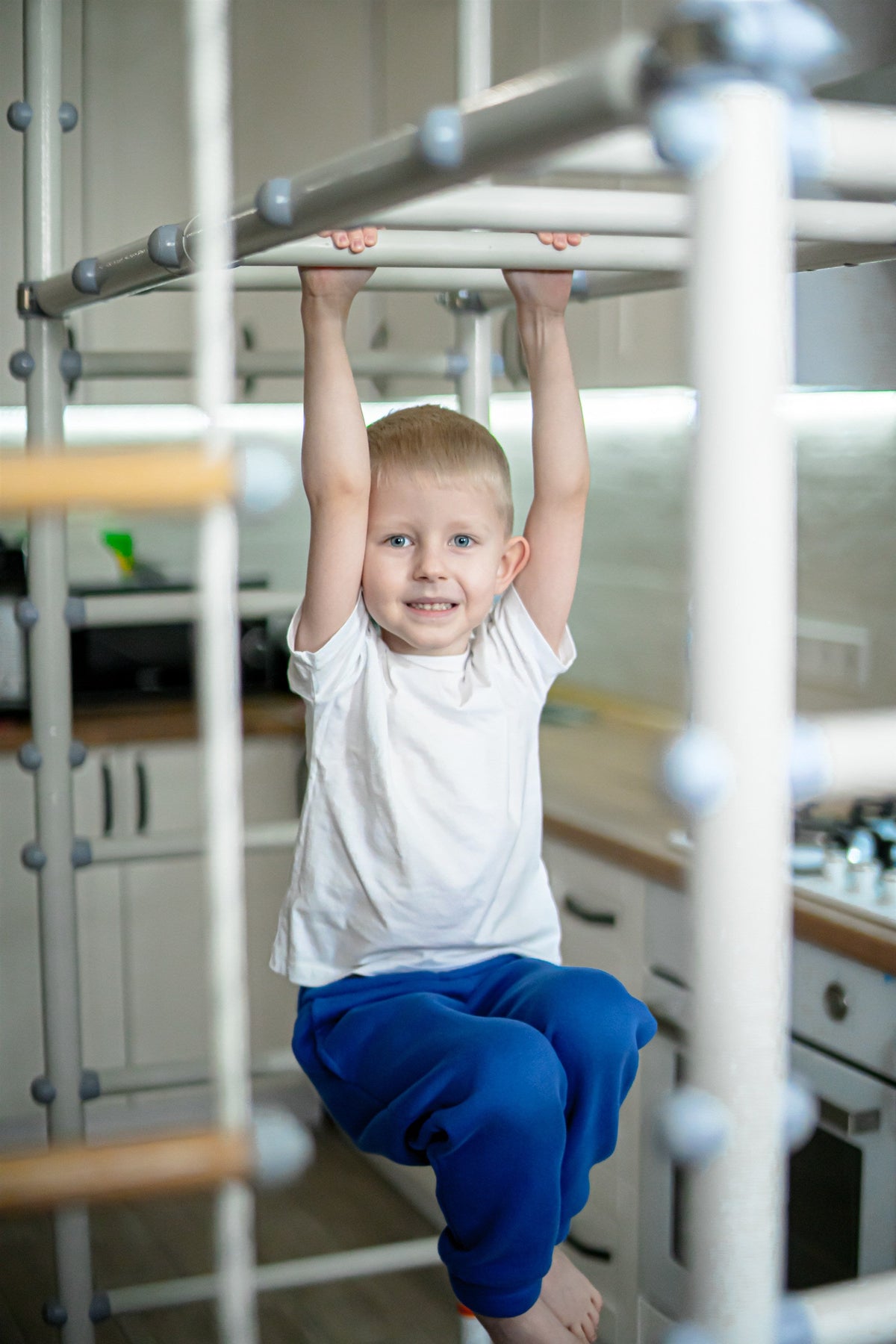
Vertical ladders (rigid and rope), a horizontal monkey-bar span, gymnastic rings, a climbing rope, a trapeze, a net, and a swing bay. Each attachment is a different skill at a different difficulty: a 3-year-old climbs the ladder while a 9-year-old skips rungs on the monkey bars, and the frame accepts new attachments as the child grows.
A dome builds grip, balance, and the courage to sit five feet up. It does not build brachiation (hand-over-hand swinging), because it has no horizontal ladder, and it offers none of the vestibular input of a swing or rope. The indoor gym descends from the Swedish gymnastics apparatus Per Henrik Ling designed in the 1800s, and from the steel frame I grew up climbing in a Ukrainian apartment: ladders, bars, rings, and rope, each loading a different part of a developing body. If your child spins, hangs, and swings to settle down, a dome barely touches that need.
The age-out curve
Look at the maker ratings above: 3 to 8, 3 to 10, up to 10. In practice the dome is outgrown earlier than the label, around 7 to 9. A 5-foot dome is a big object to a 4-year-old and a small one to a 9-year-old, and once the child reaches the top in three moves there is nowhere new to go. Domes get more use from a group of small kids than from one older child.
A modular steel gym goes the other way. Brainrich frames carry a 220 lb working load (tested to 440 lb, rated at half), so a 12-year-old doing pull-ups is inside the design envelope, and so is a parent spotting. The frame you buy at 3 accepts monkey bars at 5 and a pull-up bar at 10. That is how one frame covers ages 3 to 12+ without being replaced, and why a $900 to $1,500 indoor gym is often cheaper per year of use than a $170 dome plus whatever you buy when the dome goes quiet.
My husband rolled his eyes when I said I wanted one. Now he agrees it's the best 'thing' we have ever purchased for our kids.
JENNIFER A., MOM OF 3
Climbing dome vs indoor climbing gym, side by side
| Geodesic climbing dome | Indoor steel climbing gym | |
|---|---|---|
| Footprint | 6 to 10 ft circle, plus a 6 ft use zone all around | A corner about 4 x 3 ft (T3) to a wall span about 8 x 3 ft (Spider), plus one mat in front |
| Indoor or outdoor | Outdoor; galvanized for weather | Indoor; tension-mounted between floor and ceiling, no drilling |
| Ages | Labeled 3 to 8, 3 to 10, or 5 to 12; outgrown around 7 to 9 | Independent use from 3 with a parent in the same room, through 12+ |
| Capacity | 600 to 800 lb total across 4 to 6 kids; 150 lb for plastic; often 220 lb per user | 220 lb working load per frame, tested to 440 lb; covers an adult |
| What it builds | Static climbing, grip, balance, group play at height | Climbing, brachiation, hanging, pulling, rope and net work, swinging (vestibular input) |
| Price bracket | About $130 (plastic) to $180 (10 ft steel) from the makers above | $899 (Model T3) to $1,499 (Spider V3 with monkey bars); no sales, ever |
| Expandability | A hammock or swing seat clipped inside; otherwise fixed | Monkey bars, net, rings, rope, trapeze, swing, pull-up bar added over years |
Which one for you
Buy a climbing dome if: you have a level lawn with a 20-foot clear circle, your kids are 3 to 6, there are two or more of them or cousins visit, and the budget is under $250. Put 9 inches of mulch or rubber under it and it will be the best money you spend on the yard.
Buy an indoor climbing gym if: the climbing has to happen after dark, in heat, cold, rain, or bug season; your child is already 6 or 7; you have one or two children rather than a crowd; your child seeks swinging and hanging to regulate; or you want one purchase that lasts to middle school. Start with a Model T3 in a bedroom corner or a Spider V3 in a playroom.
Buy both if: you have the yard and a Minnesota winter or a Florida summer. The dome takes April to October; the gym takes the other months and every evening. Families who own both tell us the gym gets the daily minutes and the dome gets the weekend crowd.
Dome monkey bars: what that search actually wants
People search for dome monkey bars because some domes carry the phrase in their name and because kids hang under a dome by their hands. But a dome is not a monkey bar set. Monkey bars means a straight, level horizontal ladder travelled hand over hand, rung to rung, feet off the ground. A dome's bars curve, converge at the top, and change angle every triangle, so a child can hang from one but cannot travel. If hand-over-hand is the skill you want, you want a horizontal ladder: the monkey bars for kids guide covers rung spacing, height, and starting age. Our monkey bars set, the Monkey Bars V3, is an attachment that bolts to a Model T3 or Spider frame, never a stand-alone set, and the Spider V3 comes with the monkey bars built in.


Climbing dome FAQ
What age is a climbing dome for? Makers label their domes for ages 3 to 8, 3 to 10, or 5 to 12 depending on the model. In practice a 5-foot dome is outgrown around 7 to 9, when a child can reach the top in a few moves and there is nowhere new to go. Domes get the most use from groups of younger children.
Can you put a climbing dome indoors? Only the smallest sizes, and only in a large room. A 10-foot dome needs a 10 x 10 ft floor plus impact matting around the whole base, since it has no defined front. Ceiling height is rarely the issue; floor area and the fall zone are. A vertical indoor climbing gym goes up instead of out and needs one mat in front.
How much weight can a climbing dome hold? Steel 10-foot domes from Costway and VEVOR publish total loads of 750 to 800 lb spread across 4 to 6 children, with a per-user limit of about 220 lb on the Costway model. The plastic Eezy Peezy tower is rated for 150 lb total. Check the maker's page for your model. For comparison, a Brainrich steel gym carries a 220 lb working load and is tested to 440 lb.
Do climbing domes have monkey bars? No. A dome lets a child hang under it by the hands, but monkey bars means a straight, level, evenly spaced horizontal ladder travelled hand over hand. A dome's bars curve and converge, so a child can hang but cannot travel. For hand-over-hand travel you need a horizontal ladder, on an indoor gym or a backyard set.
Is a climbing dome safe? A steel dome on level ground, within its load rating, with protective surfacing and a 6-foot use zone per the CPSC Public Playground Safety Handbook, and with a parent in the same yard, is well-understood equipment; ASTM F1148 sets the home playground rules for fall height and openings. The common problems are grass instead of surfacing, a dome on a slope or deck, and a plastic model left unanchored. Indoors: a mat under every dismount point and a parent in the same room.
Sources
U.S. Consumer Product Safety Commission. Public Playground Safety Handbook (Publication 325): use zones and protective surfacing. · ASTM International. ASTM F1148, Standard Consumer Safety Performance Specification for Home Playground Equipment. · Lifetime Products. Lifetime 90939 Climbing Dome, product page, accessed September 17, 2026 (ages, capacity, freestanding base). · Costway. 10 Feet Dome Climber with Swing and 800 Lbs Load Capacity, product page, accessed September 17, 2026. · VEVOR. VEVOR 10FT Climbing Dome, product page, accessed September 17, 2026. · Flybar. Eezy Peezy Monkey Bars Climbing Tower, product page, accessed September 17, 2026. · Brainrich Kids engineering specification: frame working load 220 lb, safety-tested to 440 lb. Prices and specifications belong to their makers and change; check the linked pages before buying.
📚 Keep reading in the Decision Guide
Metal vs Plastic vs Wood Jungle Gym · Indoor Climbing Wall for Kids · Monkey Bars for Kids · Indoor Jungle Gym Buyer's Guide · Home vs Commercial Indoor Playground · monkey bars set
Share: