

Published September 2026 · 14-minute read · by Yegor Nadvornyy, founder of Brainrich Kids
An indoor jungle gym is the biggest piece of equipment most families ever put in a child's room, and it gets bought with less research than a car seat. This guide is the research. It covers what an indoor jungle gym actually is, the three ways they mount, how to size one to your ceiling and your room, what safe looks like in numbers, what they cost, and how families pay. We make them, in steel, for ages 3 to 12 and up, so the examples are ours; the checklist works on anyone's.
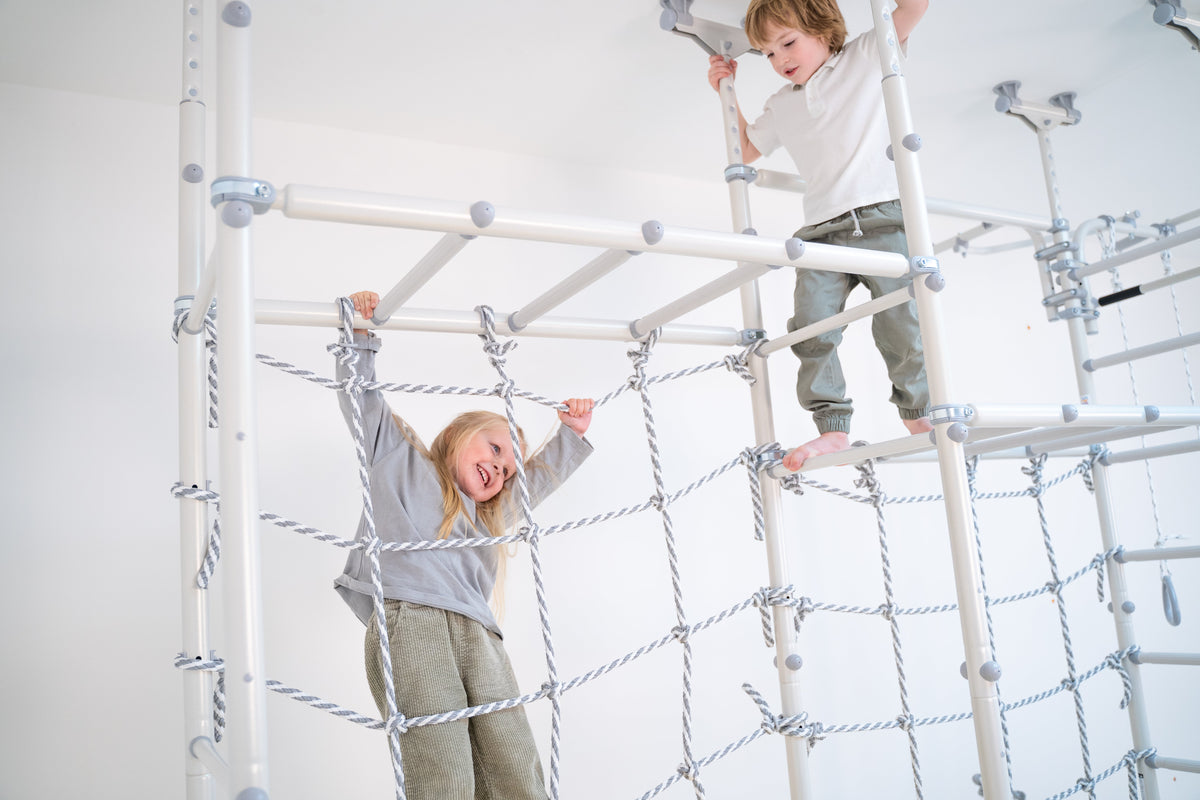
The quick answer: an indoor jungle gym is a climbing frame built for the inside of a home: ladders, monkey bars, a climbing net, rings, a rope, and a swing point on one structure. The three types are wall-mounted (smallest footprint, fixed to studs), tension-mounted (braced floor to ceiling with telescopic poles, no drilling, the most common), and freestanding (no attachment, needs the widest base). Size it to the ceiling first, the room second, and the child last: a good frame fits a 3-year-old and a 12-year-old on the same day. Look for a published load rating (ours: 220 lb working, tested to 440), rigid bolted joints, non-toxic materials, and a growth path. Expect $850 to $2,400 for steel that lasts a decade; with a qualifying diagnosis, HSA/FSA funds may apply.
Jump to: What it is · The three types · Sizing to your room · By age · Safety in numbers · What it costs · How families pay · FAQ
What an indoor jungle gym is (and is not)
The playground jungle gym is a dome or a tower of bars. The home version keeps the idea, climbing in every direction on a rigid frame, and rebuilds it for a room: vertical ladders that carry the load to the floor and ceiling or the wall, crossbars that become monkey bars, and hanging points for a swing, rings, a trapeze, a rope, and a net. It is not a playset (a low slide-and-climber for toddlers, compared in indoor playset vs play gym) and it is not a Pikler triangle (the toddler years, covered in what comes after the Pikler triangle). It is the piece that takes over when those are outgrown, at about age 3, and stays relevant to twelve and beyond. The lineage runs back to the Swedish gymnastics wall bars of the 1800s, which is why our wall-mounted models live in the Swedish ladder collection.
The three types of indoor jungle gym
| Type | How it holds | Best for | Ours |
|---|---|---|---|
| Wall-mounted | Bolted into wall studs; stands about 9 inches off the wall | Smallest rooms, slanted or very tall ceilings, linear swinging | W3, W3 Max |
| Tension-mounted | Telescopic poles brace each ladder between floor and ceiling; no drilling | Most homes and rentals; standard ceilings; full swinging and monkey bars | T3, Spider V3, Spider Max, Mega Max |
| Freestanding | Nothing but its own base; stability comes from width and weight | Rooms where neither wall nor ceiling can be used; lighter use | Not our category; check tip resistance carefully |
The tension-mounted design is the one most families end up with, because it solves the two objections at once: no holes, and a frame that does not move. Each ladder is three parts, a bottom section, a middle section, and a telescopic pole at the top that braces against the ceiling. Tighten it and the frame is as rigid as a wall-mounted one; loosen it and it comes down for a move.
Sizing a jungle gym to your room
Ceiling first. Tension-mounted frames come in height versions: a short or basement version for lower ceilings (the bottom ladder section is one rung shorter), a standard version for typical ceilings from about 7 feet 8 inches to just under 10 feet, and an extension ladder that inserts between the bottom and middle sections to add about 21 inches for tall rooms. Slanted or vaulted ceilings, where a pole cannot brace, point you to a wall-mounted model.
Room second. A single-ladder-pair frame like the T3 takes a corner. A monkey-bar frame adds a span between ladders, so plan the length of the span plus swing clearance along it. Two questions settle most layouts: can a child swing without hitting a wall, and is there a landing zone for a mat? Our 60-second quiz takes ceiling height and room size and returns the model.
Child last. This surprises people. A well-built frame does not need to be sized to the child, because it fits a 3-year-old on the lower rungs and a 12-year-old on the pull-up bar on the same afternoon. What changes with age is the accessory set, not the frame.
Which jungle gym at which age
- 3 to 4: the first frame, with a swing seat and a rope. The Model T3 is built for this year and becomes a Spider V3 later by adding a Cross Bar set.
- 5 to 6: monkey bars arrive. The Spider V3 comes with the monkey bars built in; a monkey-bar span is not a stand-alone unit, so families with a T3 add the Monkey Bars V3 instead of starting over.
- 7 to 12: nets, more routes, rope climbs, pull-ups. The Spider Max V3 for siblings; the Mega Max V3 for the family that has turned a room over to it.
The full by-age map, including the toddler years before a frame makes sense, is in climbing toys by age.
Safety, in numbers
220 / 440
Working load and tested load, in pounds. Two school-age kids plus momentum is the load a frame really meets. A maker who will not publish a number is telling you the number.
Age 3+
Independent climbing starts at three, with a parent in the same room. Younger siblings use a swing seat with a parent's hands close by.
0 slides
A slide built to the ASTM F1148 home playground standard needs about 6 feet of clear exit zone; we designed one and did not ship it. If you add a third-party slide, check side walls, exit region, and clear zone.
1 mat
Under every dismount point, from the first day. Play mats are sized to the V3 frames.
Materials are the quieter half of safety: powder-coated steel that does not splinter, rubber-coated rungs small hands can grip, non-toxic paint, and plastic parts free of phthalates and other substances prohibited by child safety standards. The material comparison is in metal vs plastic vs wood jungle gyms, and the evidence that climbing is worth the equipment at all is in the science of controlled risky play.
What an indoor jungle gym costs
| Configuration | What you get | Price (steel, ours) |
|---|---|---|
| Wall-mounted W3 | Wall bars, hanging points, 9 inches off the wall | $850 |
| Model T3 | Two ladders, crossbar, rope, swing point; no drilling | $899 |
| Spider Max V3 | Monkey bars, two nets, multiple routes, the family favorite | $1,899 |
| Mega Max V3 | The full home jungle gym, every add-on | $2,399 |
Two things that change the math. First, modularity: a T3 bought at three plus a Cross Bar set at five costs about what the Spider would have, and you never bought a second frame. Second, our prices do not move. We do not run sales, so the October price is the December price, and the used market for steel frames is real; families resell after years of use. The DIY alternative, priced out in DIY vs buying, usually lands close to the same number without the load rating.
How families pay for it
For a child with a qualifying diagnosis, a play gym may be HSA/FSA eligible with a Letter of Medical Necessity, and some state waiver programs fund sensory equipment outright; most FSA balances expire December 31. Homeschoolers in ESA states can sometimes use education funds for PE equipment (the ESA guide). And for holidays, the pooled-gift route from our non-toy gifts guide is how a lot of first frames arrive. If a program or plan needs an itemized invoice, email us your full name, address, and the model and color, and we will send one back with shipping, taxes, and the total.


Find the jungle gym that fits your ceiling
Steel indoor jungle gyms for ages 3 to 12+. No drilling, 30-day money-back guarantee.
Frequently asked questions
What is an indoor jungle gym? A climbing frame built for the inside of a home: vertical ladders, monkey bars, a climbing net, rings, a rope, and a swing point on one rigid structure, mounted to a wall or braced between floor and ceiling. It takes over from toddler climbers at about age 3 and stays relevant to twelve and beyond.
What age is an indoor jungle gym for? Independent climbing from age 3 and up, with a parent in the room, through age 12 and into the teens on the pull-up bar. Younger siblings can use a swing seat with a parent's hands close by. The frame does not need to be sized to the child; the accessories change with age, not the structure.
How much does an indoor jungle gym cost? Steel frames that last a decade run from about $850 for a wall-mounted model to $2,400 for a full family gym, with the most popular monkey-bar configuration around $1,900. Modular frames let families start smaller and add a monkey-bar span later instead of replacing anything.
Do you need to drill into the ceiling or wall? Not for tension-mounted frames: telescopic poles brace each ladder between floor and ceiling and the frame comes down for a move. Wall-mounted models bolt into studs and are the answer for slanted or very tall ceilings where a pole cannot brace.
How much space does an indoor jungle gym need? A single-ladder-pair frame takes a corner; a monkey-bar frame adds the span between ladders plus swing clearance along it, and every frame needs a landing zone for a mat. Wall-mounted models stand about 9 inches off the wall. Ceiling height decides the version: short for basements, standard for typical ceilings, an extension ladder for tall rooms.
Is an indoor jungle gym HSA or FSA eligible? It may be, for a child with a qualifying diagnosis, when a licensed provider writes a Letter of Medical Necessity; the plan administrator decides. Most FSA balances expire December 31, and some state waiver programs fund sensory equipment directly.
📚 Keep reading in the Decision Guide
The Home Play Gym Decision Guide · Spider Configurations Explained · Does a Home Climbing Gym Help Kids? · What Is a Jungle Gym? · Jungle Gym for Adults
New: comparing a geodesic climber to a vertical gym? Read Climbing Dome for Kids vs Indoor Climbing Gym, with sizes, weight ratings and the age-out curve.
New: wondering what fits a 1-to-5-year-old? See Best Indoor Play Gym for Kids Under 5.
The big picture: Jungle Gym Guide covers every type, sizes by age and room, safety standards, and what each kind costs.
Sources
ASTM International. ASTM F1148, Standard Consumer Safety Performance Specification for Home Playground Equipment. · CDC. Physical Activity Guidelines for Children and Adolescents. · Brainrich Kids engineering specification: frame working load 220 lb, safety-tested to 440 lb; ladder anatomy and height versions per product documentation.
Share: