

Published September 2026 · 10-minute read · by Yegor Nadvornyy, founder of Brainrich Kids
Every school gym I grew up in had one bolted to the wall: a ladder that went nowhere, and somehow got used more than anything else in the room. That is the Swedish ladder, and it has become the smartest small-space climbing equipment a family can own. This guide covers what it is, where it came from, exercises by age, mounting, and safety. We build a steel version, the Model W3, so the examples are ours; the method works on any wall bars.
The quick answer: a Swedish ladder (also called wall bars, stall bars, or a gymnastics ladder) is a vertical frame of horizontal rungs fixed to a wall, developed inside Pehr Henrik Ling's Swedish gymnastics system in the early 1800s. Children climb and hang from it; adults use the same rungs for hanging and stretching. It stands only about 9 inches off the wall. Independent climbing starts at age 3, with a parent in the same room and a mat underneath. Mount it into wall studs, never drywall alone, and look for a published load rating (ours: 220 lb working, tested to 440).
Jump to: What it is · Origin · Anatomy · Exercises by age · 4-week plan · For parents · Mounting · DIY · Safety · Model W3 · FAQ
What is a Swedish ladder?
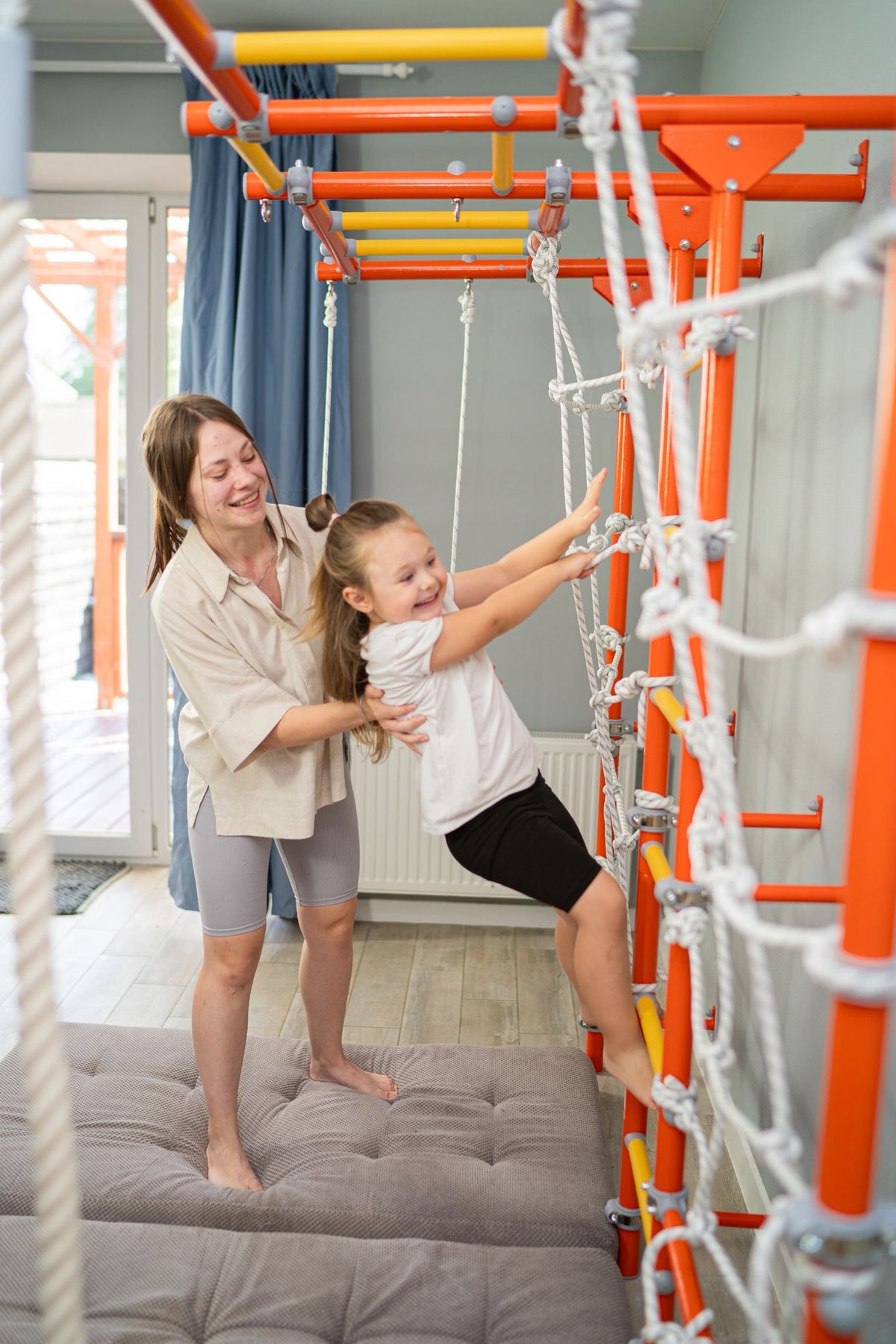
A Swedish ladder is a ladder you never lean. Two vertical rails, a column of rounded rungs between them, and a bracket that holds the whole thing a hand's width off the wall so fingers can wrap all the way around each bar. That gap is the entire design. It turns a wall into something a child can climb up, hang from, stretch against, and hook a foot into, without the frame ever taking up floor.
The same object goes by several names: Swedish ladder, Swedish wall, wall bars, stall bars, and gymnastics ladder. They are one thing. Ours is the Model W3, grouped with its floor-to-ceiling cousins in the Swedish ladder collection.
Where it came from: Ling and Swedish gymnastics
Pehr Henrik Ling (1776 to 1839) was a Swedish fencing master who found that daily exercise eased his own rheumatism and decided the whole country should have some. In 1813 he founded the Royal Central Gymnastics Institute in Stockholm and built a system, later called Swedish gymnastics, around simple, progressive movements with almost no equipment. The wall bars came out of that system; Ling's son Hjalmar later formalized much of the apparatus and the exercise sequences that spread through Europe's schools.
By the early 1900s wall bars were standard in school gyms across Europe, including the kindergarten gym I climbed in as a child in Ukraine. That is the tradition Brainrich comes from.
Anatomy: rungs, spacing, depth
Rungs
Round, about 1.25 to 1.6 inches across: an adult grip, and a 3-year-old can still close a fist around it. Ours are rubber-coated steel, so they do not splinter or slip.
Spacing
Roughly 6 to 9 inches between rungs. Tighter suits small climbers; wider suits stretching and adults. A family ladder sits in the middle.
Depth from wall
Enough for a full hand wrap and a toe. Traditional wooden bars project 5 to 8 inches; the Model W3 stands 9 inches out, which also leaves room for the net and rings.
Height and width
Most wall bars run 7 to 8 feet tall and 30 to 40 inches wide. Check the dimensional drawing on the product page.
Swedish ladder exercises by age
The ladder does not change with age. The exercises do. The table lines up with the CDC's guidance: active play through the day at ages 3 to 5, and at least 60 minutes a day from age 6, with muscle- and bone-strengthening activity 3 days a week. Climbing and hanging are both.
| Age | What they can do | What it builds |
|---|---|---|
| 3 to 5 | Climb 3 to 5 rungs and climb back down. Hang from a rung at chest height for 5 to 10 seconds. "Spider walk" sideways across the ladder. | Grip, hand-over-hand sequencing, climbing down instead of jumping |
| 6 to 8 | Climb to the top. Dead hang from the top rung, 15 to 30 seconds. Hanging knee tucks, 5 to 10. Back-to-ladder hang with feet hooked on a low rung. Hamstring stretches with a foot on a rung. | Shoulder stability, core, the vestibular input of being inverted |
| 9 to 12 | Hanging leg raises to an L-sit. Negative pull-ups from the top rung. Wall-supported handstand, feet walking up the rungs. Circuits with the rings and rope. | Pull strength, straight-body control, the foundations of gymnastics and climbing |
| Adults | Dead hangs for shoulder decompression. Leg raises. Calf and hip flexor stretches. Band rows anchored to a rung. Pull-ups on the bar. | Grip, posture, mobility, and a reason to be in the room while the kids climb |
Two rules run through every row. Never lift a child to a rung they did not climb to. A child who got there alone has the skill to be there. And teach the descent on day one, foot below foot, so the jump-off habit never forms.
A 4-week Swedish ladder progression
Ten minutes a day, parent in the room, mat on the floor, for a child of about 4 to 7.
Week 1: the bottom half. Climb three rungs, come down, repeat five times. Hang from a rung at chest height, feet lifted, counting to five.
Week 2: the top. Climb to the top rung, touch it, come down. Hang from the top rung with the parent's hands at the hips, 10 seconds. Add the sideways spider walk.
Week 3: hang and hold. Dead hang from the top, 15 seconds, three times. Hanging knee tucks, five. Hook the heels on a low rung and lean back for the first upside-down look at the ceiling.
Week 4: circuits. Climb up, transfer to the rings or rope, come down, repeat. By the end of the month most children own the ladder and start inventing routes, which is the point.
A Swedish ladder for adults: yes, the parents too
Stall bars were built for adults first, and physical therapists still use them daily. Three things a parent can do on the ladder the kids climb:
Hang. A daily 30-second dead hang from the top rung or a pull-up bar above it is the simplest shoulder and grip work there is. Stretch. A foot on the third rung is a hamstring stretch; hands on a rung at hip height with a hinge back opens the lats. Pull. The Model W3 accepts TRX-style bands and suspension straps, which turns any rung into rows, presses, and assisted squats. The 220 lb working load covers most adults; the 440 lb test load covers a parent spotting a child on the same bars.
"Nobody in the family outgrows wall bars. The 3-year-old climbs the bottom, the 9-year-old hangs from the top, and I stretch on the same rungs after they go to bed. It is the only piece of exercise equipment in our house that everyone uses every day."
– YEGOR NADVORNYY, FOUNDER OF BRAINRICH KIDS
Mounting: wall studs vs tension vs freestanding
For a true Swedish ladder the wall is the structure. A hanging child creates a pull-out force at the top brackets, and drywall anchors are not built for it. Mount into wood studs or into masonry with sleeve anchors. Lag bolts through a steel bracket into studs will not move for a decade.
| Option | Footprint | Best when |
|---|---|---|
| Wall-mounted (W3, W3 Max) | 9 inches off the wall | Small rooms, slanted or very tall ceilings, homeowners who can drill. Linear swinging only: a small hammock fits, a nest swing does not. |
| Tension-mounted (T3, Spider V3) | A corner, plus swing clearance | Renters, flat ceilings from 6 ft 9 in to about 10 ft, families who want full swinging and monkey bars. No drilling. |
| Freestanding | The widest base of the three | Nothing to attach to. Stability comes from width and weight, so check tip resistance before a child hangs from the top. |
Freestanding vs wall mount, in one line: wall-mounted is more rigid and takes less floor; freestanding is the fallback when neither wall nor ceiling can carry the load. The full comparison is in the indoor jungle gym buyer's guide.
Swedish ladder DIY: why most home builds fail the load test
A wooden Swedish ladder looks like a weekend project. The rungs are the problem. A swinging 60-lb child loads a rung at several times body weight, and a dowel set in a routed hole carries that on a few square inches of end grain. Wood dries and shrinks, the joint loosens, the rung rotates, and a foot rolls. The second failure point is the bracket: a rail screwed into drywall pulls out under the lever arm of a child at the top.
If you build, use hardwood dowels of at least 1.25 inches, glued and pinned through the rails, mount into studs with lag bolts, and load the finished ladder with twice the heaviest user's weight before a child touches it. That test is the step most builds skip, and it is why we publish a number (220 lb working, tested to 440) instead of a promise. Costs and hours are in DIY vs buying an indoor play gym.
Safety: the mat, the spotting, the rules
THE FLOOR
The CPSC treats the surface under equipment as part of the equipment. Indoors that means a play mat under the ladder and the dismount zone from day one.
THE SPOTTER
A parent in the same room for every session, within arm's reach for any new skill. Hands near the hips, not on them. Let the wobble finish; correcting a wobble is what balance is.
Three more rules: bare feet or grippy socks, one child on the ladder at a time, and no climbing when tired. Expect scrapes. The research on controlled risky play is clear that a child who climbs a familiar structure daily builds the balance, grip, and judgment that prevent the falls parents fear.
How the Brainrich Model W3 and W3 Max fit
The Model W3 is our Swedish ladder: a wall-mounted steel ladder that ships with monkey bars, a climbing net, gymnastic rings, and a climbing rope, all on one frame 9 inches from the wall. It is $850, and the price in October is the price in December. The W3 Max ($1,099) adds a second set of monkey bars and a second net for siblings. Both are rated for a 220 lb working load and tested to 440 lb, both are ages 3 and up, and neither is height-adjustable.
Where the W3 is the wrong answer: nest swings and spinning; that family needs a floor-to-ceiling frame like the Spider Max V3, which comes with the monkey bars built in. Where the W3 is the only answer: slanted ceilings, ceilings over 10 feet, and rooms with no spare corner.


A wall of rungs the whole family uses
Steel Swedish ladders for ages 3 to 12+. Backed by a 30-day money-back guarantee.
Frequently asked questions
What is a Swedish ladder used for? Climbing, hanging, and stretching. Children use it to climb, hang from the top rung, hook their feet for inverted play, and as the anchor for rings, a rope, and a net. Adults use the same rungs for dead hangs, leg raises, mobility stretches, and resistance-band work. Physical therapists use them as stall bars for the same reasons.
What age can a child use a Swedish ladder? Independent climbing from age 3, with a parent in the same room and a mat underneath. Three-year-olds climb the bottom rungs and hang at chest height; by 6 to 8 most children hang from the top; by 9 to 12 they are doing leg raises and negative pull-ups. Younger siblings should only be on the ladder with a parent's hands close by.
Can adults use a Swedish ladder? Yes, and they were built for adults first. A Brainrich Model W3 is rated for a 220 lb working load and tested to 440 lb, which covers most parents for hanging, stretching, and resistance-band exercises. Keep the load static rather than swinging when an adult uses it.
Do I have to drill into the wall? For a true wall-mounted Swedish ladder, yes: the brackets must be lag-bolted into wall studs or masonry, because a hanging child creates a pull-out load that drywall anchors cannot hold. Renters and families who cannot drill should use a tension-mounted frame like the Model T3, which braces between floor and ceiling.
How far does a Swedish ladder stick out from the wall? Traditional wooden wall bars project 5 to 8 inches. The Brainrich Model W3 stands 9 inches from the wall, which leaves room for a full hand wrap plus the net and rings that hang from it. It is the smallest footprint of any home climbing equipment.
Can I build a Swedish ladder myself? You can, but most home builds fail at the rungs and the brackets. Hardware-store dowels are not rated for hanging loads, wood joints loosen as they dry, and rails screwed into drywall pull out. If you build, use hardwood dowels of at least 1.25 inches glued and pinned through the rails, mount into studs, and test with twice the heaviest user's weight before a child climbs.
📚 Keep reading in the Decision Guide
Gymnastics at Home: Safe Conditioning Ideas · Children's Climbing Ladder Guide · Pull-Up Bar Gymnastics for Kids · Steel vs. Wood Climbing Gyms · Climbing Toys by Age
Sources
Encyclopaedia Britannica. "Per Henrik Ling," Swedish gymnastics and the Royal Central Gymnastics Institute, Stockholm, 1813. · CDC. Physical Activity Guidelines for Children and Adolescents. · U.S. Consumer Product Safety Commission. Public Playground Safety Handbook (Publication 325). · ASTM International. ASTM F1148, Standard Consumer Safety Performance Specification for Home Playground Equipment. · Brainrich Kids engineering specification: frame working load 220 lb, safety-tested to 440 lb; Model W3 wall offset 9 inches per product documentation.
Share: