

Updated September 2026 · 11-min read · by Yegor Nadvornyy, founder of Brainrich Kids
Every November the same two searches spike together: "pikler climbing set" and "montessori climbing set". Behind both is a parent with a toddler who has started climbing the furniture and one question: buy the wooden triangle now, or skip ahead to the gym the child will grow into? This is a buyer's comparison, not a history lesson. We make steel play gyms, so read the product section with that in mind; the age, capacity, and price-per-year math is the same whoever you buy from.
The quick answer: a Pikler climbing set is a low wooden triangle with a ramp or slide, sometimes an arch, built for roughly ages 1 to 4 and rated for about 90 to 132 lb. A steel play gym is a floor-to-ceiling or wall-mounted frame with ladders, a rope, rings, a swing point, and optional monkey bars, for independent climbing from age 3 to 12 and beyond, rated 220 lb. If your child is under 3, a Pikler set is the right first purchase, with a parent's hands close by. If your child is 3 or older, or turns 3 within the year, the gym gives you 9 years of use for roughly the same cost per year, and it is the piece they will not outgrow at 5. Both belong in the same room as an adult.
Jump to: What a Pikler climbing set is · What a steel play gym is · Age fit · Footprint · Weight capacity · The age 4-5 problem · Price per year of use · Side by side · Which one for you · FAQ
What a Pikler climbing set is (and why "Montessori climbing set" means the same thing)
A Pikler triangle is a wooden A-frame of rungs, usually 24 to 36 inches tall, that a crawling baby can pull up on and a toddler can climb over. The name honors Emmi Pikler, the Hungarian pediatrician whose work centered on self-directed movement: the child chooses when to climb and when to come down, and an adult stays close without lifting or steering. A Pikler climbing set adds one or two accessories to the triangle: a reversible ramp (rock wall on one face, slide on the other) and often a rocker or arch that flips into a small bridge.
A Montessori climbing set is the same product under a different label. Maria Montessori held that movement and learning are inseparable in early childhood, and the Pikler triangle fits that philosophy so neatly that retailers use both names for one object. If you see "Pikler triangle climbing set" and "Montessori climbing set" on two listings, compare the dimensions and the weight rating, not the label.
Three well-known makers, with prices from their own product pages as of September 2026:
Piccalio Climber Set · $349
Triangle plus reversible rock wall and slide ramp. Listed for 6 months to 6 years, up to 132 lb. Open footprint about 27.5 by 36.5 inches.
Lily and River Little Climber · $300
Triangle alone; their rock wall and slide accessory is listed at $99.95. Rated to 90 lb, 6 months to 5 years and up. Open footprint 31.5 by 31.5 inches, 24 inches tall.
Ette Tete Mopitri · €165 plus €97 ramp
A European modifiable triangle, 12 months and older, certified to 50 kg (110 lb). Frame 82.5 cm wide, 60 cm tall.
So the realistic bracket for a triangle-plus-ramp set from a named maker is $350 to $400. Add an arch or rocker and most sets land between $450 and $650.
What a steel play gym is
A steel play gym is a full-height climbing frame that lives indoors. Ours come in two mounting styles. The Model T3 is tension mounted: a telescopic pole presses between floor and ceiling, no drilling, and it comes out when you move. The Model W3 is wall mounted into studs and protrudes only 9 inches from the wall. Both carry vertical ladders, a climbing rope, gymnastic rings, a trapeze, and a swing point. Add the Monkey Bars V3 attachment to a T3 and you have the Spider V3: a horizontal span for brachiating, a movement toddlers on a triangle are years away from.
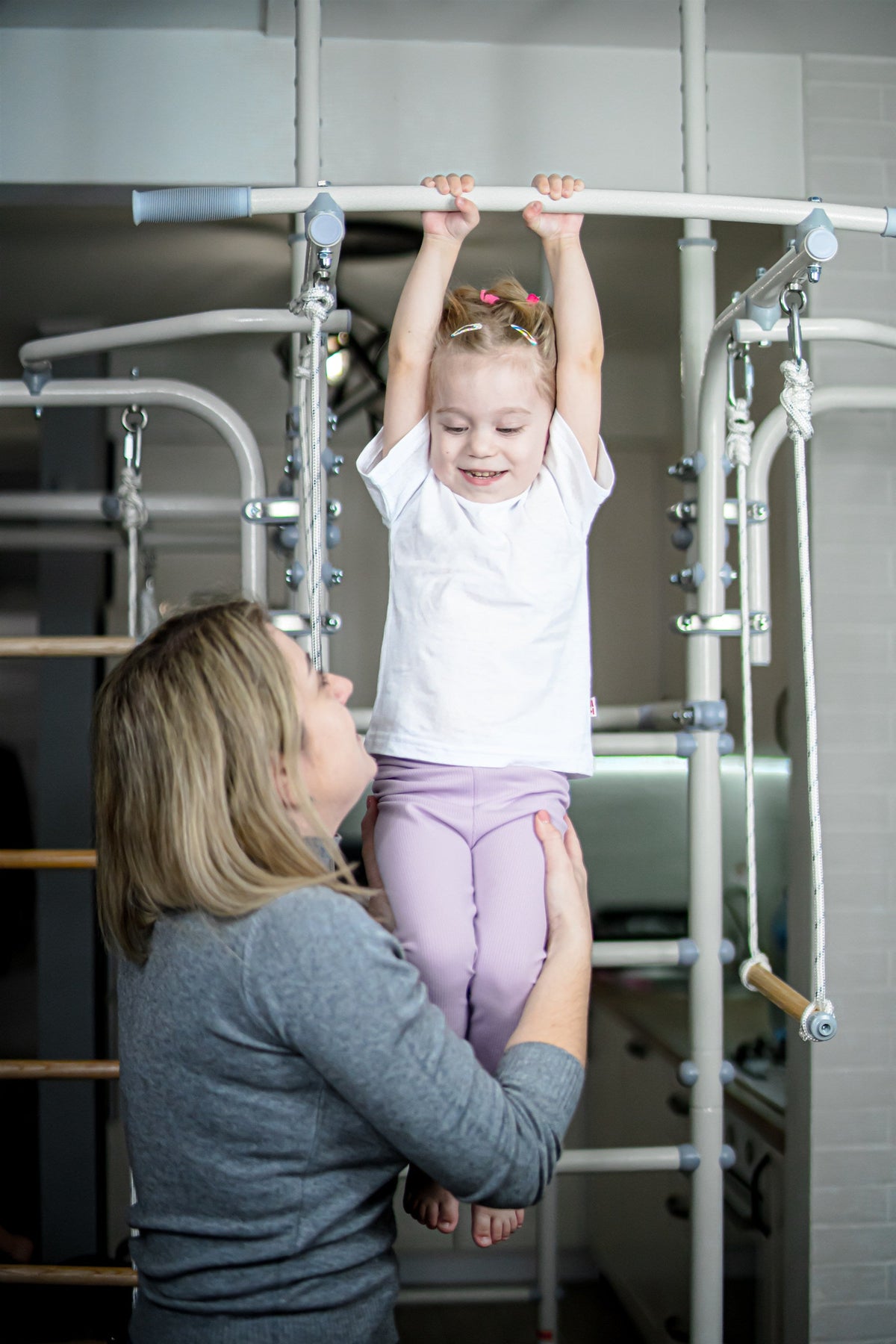
The design comes from Swedish gymnastics, the wall-bar system of Per Henrik Ling, and from the steel gym I grew up climbing as a boy in Ukraine. Every frame is powder-coated steel with rubber-coated rungs, rated for a 220 lb working load and tested to 440 lb. Independent climbing starts at age 3. Younger siblings can use the lowest rungs only with a parent's hands close by, the same rule as a Pikler triangle, and a parent stays in the same room at every age.
Age fit: roughly 1 to 4 versus 3 to 12 and beyond
A Pikler climbing set is the right tool for a child who is just learning to pull up, cruise, and climb over. The rungs are 3 inches apart, the frame is 2 to 3 feet tall, and a fall is short, onto a mat. A 1-year-old uses it well. A 2-year-old uses it hard. A 3-year-old starts asking for something taller.
A steel gym starts where the triangle stops. At 3, a child climbs a vertical ladder rung by rung with a parent in the room. At 4 or 5 they hang from rings and try the rope. At 6 or 7 they cross monkey bars. At 9 or 10 they do pull-ups on the same frame, because the working load covers a teenager. The 2018 American Academy of Pediatrics clinical report on play describes this kind of physical, self-directed play as associated with executive function, self-regulation, and physical health, and the federal Physical Activity Guidelines call for preschoolers to be active throughout the day, about 3 hours in total. An indoor frame is how that happens in a Florida July, a Minnesota January, at 4:30 p.m. in December, and in mosquito season. Outdoors comes first whenever it is feasible; the gym covers the other hours.
Under 3 today
A Pikler climbing set is the right first purchase. It teaches climbing at the scale the child is built for.
Turning 3 within a year
Skip the triangle or buy it used. The gym lasts through elementary school.
3 or older, or two kids
The gym. A toddler sibling uses the low rungs with a parent's hands close by until 3.
Footprint: which one your room can take
A Pikler set with the ramp attached takes about 31 by 52 inches of floor and folds to 6 to 8 inches deep. That is its real advantage in an apartment: it disappears behind a door. It still needs a mat and clear floor at the bottom of the slide.
A Model T3 takes a corner about the size of a dresser and needs a flat patch of ceiling between 6 ft 9 in and just under 10 ft for the tension pole. A Model W3 takes zero floor when nobody is on it: it stands 9 inches off the wall and needs a wall with studs. The Spider V3 with its monkey-bar span needs a longer wall run and a mat under the whole length. None of them fold. Never put a bed under any of them. The 60-second quiz takes ceiling height and room size and returns a model.
Weight capacity: 90 to 132 lb versus 220 lb
Every Pikler set above publishes a limit; buy from makers who do. The range is 90 lb (Lily and River), 110 lb (Ette Tete), and 132 lb (Piccalio). Those ratings cover one child, not two 5-year-olds on the same triangle and not a parent climbing on to help. Wood also loosens at the bolts with years of folding, so check the hardware each season.
A Brainrich frame is rated for 220 lb of working load and tested to 440 lb. Steel does not flex, splinter, or change with humidity, which is why the frame you buy at 3 is still the frame at 12.
What happens at age 4 or 5: the part the listing does not mention
Here is what we hear from families who bought a Pikler set at 1. It was the best thing in the house until about 3 and a half. Then the child could clear it in two moves, the slide was a hop, and the triangle became a fort frame with a blanket over it. By 4 or 5 it was folded in a closet and the child was climbing the bookshelf and the kitchen counters, because the urge to climb had grown and the equipment had not. We cover that moment in What Comes After the Pikler Triangle? and the phase itself in Toddler Climbing on Everything.
The Pikler set is not a bad product at that point. It is a finished one; it did its 3-year job. The question is whether you buy a second piece of equipment at 4, or buy the one at 3 that covers ages 3 to 12 and beyond.
"The only thing we've ever given our children that's gotten played with every day for three years."
RACHEL W., BRAINRICH OWNER, 3+ YEARS
Price per year of use: the math
Take the $350 to $400 bracket for a named-brand triangle with a ramp, and give it a generous 3 years of daily use, from 1 to 4. Then take our three gyms at today's prices, which do not change, because we do not run sales, and give each 9 years, from 3 to 12.
Pikler set · $117 to $133 per year
$350 to $400 over 3 years. Add an arch and the figure rises to $150 to $217 per year.
Model W3 · about $94 per year
$850 over 9 years. Wall mounted, 9 inches off the wall, the smallest footprint.
Model T3 · about $100 per year
$899 over 9 years. Tension mounted, no drilling, grows into a Spider V3 with the monkey-bar attachment.
Spider V3 · about $167 per year
$1,499 over 9 years, with monkey bars from day one. Still less per year than a full three-piece Pikler set.
Two things the per-year figure leaves out, both in the gym's favor. A steel frame resells, and we help owners with resale. And the family that buys a Pikler set at 1 and a gym at 4 spends both amounts; the family that buys the gym at 3 spends one. With a qualifying diagnosis and a Letter of Medical Necessity, a play gym may also be HSA or FSA eligible, which a wooden toddler toy generally is not.
Pikler climbing set vs steel play gym, side by side
| Pikler climbing set (wood) | Brainrich steel play gym | |
|---|---|---|
| Age range | About 1 to 4 in practice; makers list 6 months to 5 or 6 years | Independent from 3 to 12 and beyond; younger siblings with a parent's hands close by |
| Height | 24 to 36 inches | Floor to ceiling, 6 ft 9 in to just under 10 ft (T3); wall height (W3) |
| Weight rating | 90 to 132 lb, one child | 220 lb working load, tested to 440 lb |
| Floor footprint | About 31 by 52 in with ramp; folds to 6 to 8 in deep | A dresser-sized corner (T3); 9 in off the wall, no floor (W3) |
| Mounting | Freestanding, moves and folds | Tension pole, no drilling (T3, Spider V3); studs (W3) |
| Movements | Pull up, climb over, crawl through, slide, rock | Ladder climbing, rope, rings, trapeze, swing, monkey bars, pull-ups |
| Slide | Usually included as one face of the ramp | None; a slide to the home-playground standard needs about 6 ft of clear exit floor |
| Price (Sept 2026) | $350 to $400 with ramp; $450 to $650 with arch | $850 (W3), $899 (T3), $1,499 (Spider V3) |
| Cost per year of use | About $117 to $217 | About $94 to $167 |
| What happens at 5 | Outgrown; folded away or resold | Add monkey bars, rings at a higher rung, a pull-up bar later |
Material trade-offs in more depth are in steel vs wood climbing gyms.
Which one for you: a decision in four lines
Your only child is 6 to 24 months. Buy a Pikler climbing set from a maker who publishes a weight rating, put a mat under it, and plan on the gym at 3.
Your child is 2 and a half or older. Buy the gym. They will be climbing it independently within months, and you skip the second purchase at 4.
You have a toddler and a 4-year-old. Buy the gym for the older one. The toddler uses the lowest rungs with your hands close by and inherits the whole frame at 3.
You rent, or the room is tiny. Tension mounting leaves no marks, so renting is not the obstacle, and a W3 on a stud wall takes 9 inches. If neither works, the folding Pikler set is the space-saver, and the toddler climbing gym collection is where to look when the room changes.
Whichever you choose, the rules are identical: a mat under every dismount point, a parent in the same room, and never lift a child to a height they did not climb to themselves. That is the Pikler principle, and it is our rule at every age.


Frequently asked questions
Is a Pikler climbing set safe for a 1-year-old? Yes, when it is used the way Emmi Pikler intended: the child pulls up and climbs on their own, a parent stays within arm's reach, and a mat sits under the frame. Makers list their sets from 6 or 12 months. Do not place a 1-year-old on top of the triangle or at the top of the slide; let them reach whatever height they can climb to themselves.
What age is a Pikler climbing set for? Makers list 6 months to 5 or 6 years. In practice most families get daily use from about 1 to 4. By 4 or 5 a child clears the triangle in two moves and wants something taller, which is when a full-height frame takes over.
Montessori climbing set vs Pikler triangle: same thing? Yes. A Montessori climbing set is a Pikler triangle, usually sold with a ramp and sometimes an arch, marketed under the Montessori label because the two philosophies overlap on self-directed movement. Compare the dimensions and the weight rating, not the name.
Can a 3-year-old use a Brainrich gym? Yes. Independent climbing on a Brainrich steel play gym starts at age 3, with a parent in the same room and a mat under every dismount point. A 3-year-old climbs the ladder rung by rung and hangs from the lowest rings; the rope and monkey bars come a year or two later.
Is a steel play gym cheaper than a Pikler set over time? Per year of use, usually yes. A $350 to $400 Pikler set over 3 years costs $117 to $133 a year. A Model W3 at $850 or a Model T3 at $899 over 9 years costs $94 to $100 a year, and a steel frame holds resale value. The gym costs more up front and less per year, and it replaces a second purchase at age 4.
📚 Keep reading in the Decision Guide
What Comes After the Pikler Triangle? · Climbing Toys by Age · Climbing Gyms for Babies and Toddlers · Toddler Climbing on Everything · Steel vs Wood Climbing Gyms · Shop the toddler climbing gym collection
New: the method behind the toys: Montessori Parenting at Home, the four habits, the prepared home, and where movement fits.
Sources
Piccalio. Climber Pikler Triangle Set, product page, price and specifications retrieved September 2026. · Lily and River. Little Climber and Little Pro 2 Playset, product pages, retrieved September 2026. · Ette Tete. MOPITRI 4-segment Modifiable Climbing Triangle and Sliding / Climbing Ramp, product pages, retrieved September 2026. · Yogman, M. et al. (2018). The Power of Play: A Pediatric Role in Enhancing Development in Young Children. Pediatrics, American Academy of Pediatrics clinical report. · U.S. Department of Health and Human Services. Physical Activity Guidelines for Americans, 2nd edition, preschool-aged children. · U.S. Consumer Product Safety Commission. Public Playground Safety Handbook (Publication 325), surfacing guidance. · ASTM International. ASTM F1148, Standard Consumer Safety Performance Specification for Home Playground Equipment; ASTM F963, Standard Consumer Safety Specification for Toy Safety. · Pikler USA. Emmi Pikler and self-directed movement. · Association Montessori Internationale. Maria Montessori on movement and learning. · Brainrich Kids engineering specification: frame working load 220 lb, safety-tested to 440 lb; independent use from age 3.
Share: