

Updated September 2026 · 9-min read · by Yegor Nadvornyy, founder
"Under 5" is two different children. A 14-month-old who just found her feet and a 4-year-old who climbs the pantry shelves need different equipment, and most "toddler gym" listings blur them together. This guide splits the question by age, explains what each stage needs, and shows how a steel frame like ours grows with your family from the first wobbly climb to age 12.
The quick answer: the best indoor play gym for kids under 5 is the one your child will still be using at 10. For ages 1 to 2, the job is low climbing under the child's own power, on the bottom rungs of a frame or a Pikler triangle, always with a parent's hands close. Kids approaching 3 start using every part of a steel modular gym such as the Brainrich Model T3 ($899) or the Spider V3 ($1,499, monkey bars built in), rated to 220 lb, with a mat underneath and a parent in the same room.
Jump to: Ages 1 to 2 · Ages 3 to 5 · Comparison table · Who each one is for · Safety by age · FAQ
Ages 1 to 2: low, wide, and close to the floor
A one-year-old is learning to load her own weight through her arms and legs. Emmi Pikler's rule for this stage still holds: let the child get to every position under her own power, and never place her somewhere she did not climb to. That argues for equipment with a top rung at about knee height for an adult, wide steps, and no drop taller than the child's own fall height. The CPSC's playground handbook puts the maximum fall height for toddler climbers at 32 inches, which is a useful ceiling for anything you bring into the living room.
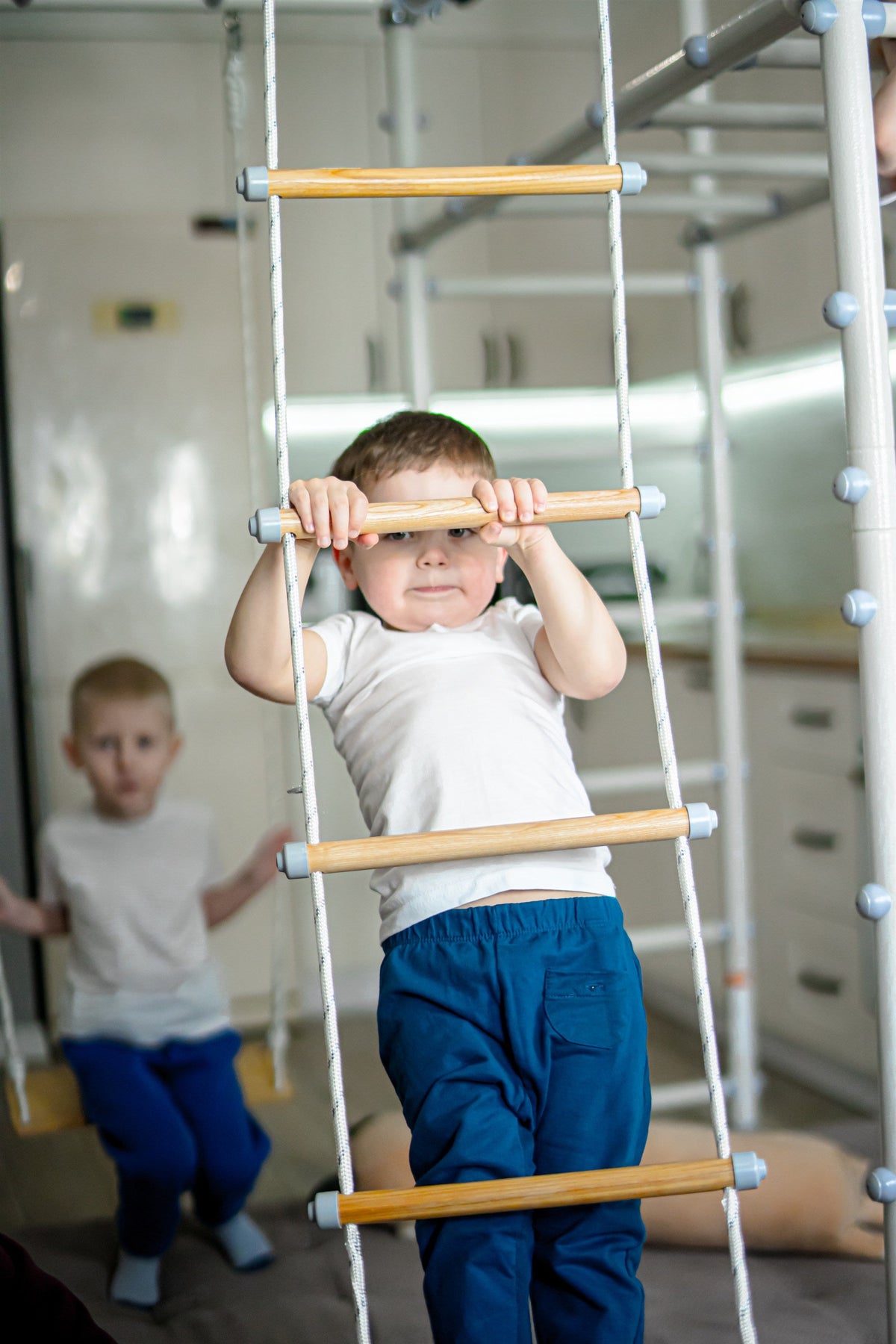
A Pikler triangle fits this brief, and so do the bottom rungs of a steel ladder, a short step off the mat. Many families set up a Brainrich frame when a new baby arrives, so the older sibling has somewhere to climb. The toddler explores the lowest rungs with a parent's hands close by and grows into the rest of the frame.
Nothing at this stage needs to be big. A rung the child can climb over in ten seconds is not a failure; it is doing the job of the first two years, which is to make climbing ordinary. The full progression, from foam blocks to a real frame, is in climbing gyms for babies and toddlers.
Ages 3 to 5: the year a real frame starts
Somewhere around the third birthday the triangle becomes a step stool. The child wants height, a rope, something to hang from. This is the age where families choose between two paths: a larger wooden playset with a slide, or a floor-to-ceiling frame that will still be the right size at 10.
Our position is not subtle: we build the second kind, in powder-coated steel, and kids approaching 3 start using every part of it, because that is when a child can climb up and, more importantly, climb back down a vertical ladder without help. Younger toddlers explore the bottom rungs with a parent's hands close by, so the frame grows with your family instead of being replaced.
The question to ask any maker for the 3-to-5 stage is not "is it fun" but "what is the load rating, and will my 9-year-old still be under it?" Every Brainrich frame carries a 220 lb working load and has been safety-tested to 440. Several wooden playsets in this price range publish 100 to 110 lb per child, which most children reach between 10 and 12.
Two ways to do the 3-to-5 stage:
Brainrich Model T3, $899. One steel ladder pair tension-mounted between floor and a flat ceiling from 6 ft 9 in (Short) or 7 ft 8 in (Standard) up to 9 ft 11 in. No drilling. Comes with rings, a rope, a trapeze, a rope ladder, and two pull-up bar sets. The corner it takes is about the size of a dresser. When the child is ready for monkey bars at 5 or 6, the monkey bars set ($699) bolts on and the T3 becomes a Spider.
Brainrich Spider V3, $1,499. Two ladder pairs with the monkey-bar span already built in, plus a rope net, rings, rope, trapeze, rope ladder, and pull-up bars. Bars are height-adjustable, so the monkey bars can start low for a 4-year-old and rise as the child grows. Sizes cover ceilings from 6 ft 9 in to 10 ft 6 in.
We have no slide on any frame, by design: an ASTM F1148 slide needs about 6 feet of clear exit floor, and the rooms our customers have do not offer it. Wooden playsets with a slide typically publish 100 to 110 lb per child, so they are outgrown right around the age climbing gets serious. The wood-versus-steel argument in full is in steel vs wood climbing gyms.
Comparison table: Brainrich play gyms for kids under 5
| Product | Maker's age range | Material and mount | Load rating | Price (Sep 2026) |
|---|---|---|---|---|
| Brainrich Model W3 | Grows with your family, to 12+ | Steel, wall-mounted into studs, 9 in off the wall | 220 lb, tested to 440 | $850 |
| Brainrich Model T3 | Grows with your family, to 12+ | Steel, tension-mounted, no drilling, ceilings 6 ft 9 in to 9 ft 11 in | 220 lb, tested to 440 | $899 |
| Brainrich Spider V3 | Grows with your family, to 12+ | Steel, tension-mounted, monkey bars built in, ceilings 6 ft 9 in to 10 ft 6 in | 220 lb, tested to 440 | $1,499 |
Brainrich prices do not move because we do not run sales.
Who each one is for
One child, 12 to 30 months
Low climbing with a parent's hands close: the bottom rungs of a Model T3, the floor, the couch cushions. Families who buy now get the frame the child grows into.
A 3-to-5-year-old, buying once
The Model T3 in a bedroom corner, or the Spider V3 if there is playroom floor for a monkey-bar span. Both are the same frame at 10 that they were at 3.
Siblings, one under 3 and one over
One steel frame for both: the older child climbs freely, and the little one explores the bottom rungs with a hand on her back.
Safety by age: what changes between 1 and 5
Ages 1 to 2. Fall height is the whole story. Keep the highest foothold under 32 inches, put a mat or a thick rug under the climber, and stay within arm's reach. A child this age has the urge to climb before the judgment to come down; the equipment should make the second part easy.
Age 3. Independent climbing on a vertical ladder begins. The rule in our house and in our instructions: a parent in the same room, a mat under every dismount point, and the child never lifted to a height she did not reach herself. A. Jean Ayres's work on sensory integration is the reason we care about the hanging and swinging pieces at this age: the rope, the rings, and the trapeze feed the vestibular and proprioceptive systems that a 3-year-old's body is busy organizing.
Ages 4 to 5. Monkey bars enter the picture, but slowly. The CPSC handbook puts the youngest children generally able to use overhead ladders at 4, with a maximum bar height of 60 inches and rung spacing no wider than 12 inches for preschoolers. On a Spider V3 the bars adjust down for exactly this stage. The detail is in safest monkey bars for toddlers.
Every age. ASTM F1148, the home playground standard, covers entrapment openings, protrusions, and fall height; the CPSC handbooks treat the surface under the equipment as part of the equipment. Indoors that means an impact mat, not carpet. Angela Hanscom's argument in Balanced and Barefoot is that children need hours of this kind of whole-body movement, not minutes; an indoor frame exists for the hours when the park is not an option, not instead of the park.


Bought at 3, still the right size at 12
Steel indoor play gyms, 220 lb working load. No drilling, 30-day money-back guarantee.
Frequently asked questions
What is the best indoor play gym for kids under 5? It depends on the child's age. For 1 to 2, low climbing under the child's own power with a parent's hands close. Kids approaching 3 start using every part of a steel modular frame with a published load rating, such as the Brainrich Model T3 ($899) or Spider V3 ($1,499), used with a mat and a parent in the same room.
Can a 2-year-old use a Brainrich play gym? Yes, with a parent's hands close by. A 2-year-old explores the bottom rungs, the rings, or a low trapeze while you spot. Kids approaching 3 start using every part of it, and the same frame is still the right size at 12.
Is a wooden or a steel indoor play gym better for a 3-year-old? Both work at 3. The difference shows up later: wooden playsets in this price range publish per-child limits of 100 to 110 lb, which most children reach between 10 and 12, while a steel frame rated to 220 lb is still the right size for a teenager. Buy for the child at 10, not just at 3.
How much space does an indoor play gym for a toddler need? A Pikler triangle needs about a 3 by 3 ft patch of floor plus a mat. A Model T3 takes a corner about the size of a dresser under a flat ceiling from 6 ft 9 in. A Spider V3 needs floor for a monkey-bar span between two ladders. A wall-mounted Model W3 stands 9 in off a stud wall; plan on about 3 ft of clear floor in front of it for safe play.
At what age can a child start using monkey bars? The CPSC handbook says 4-year-olds are generally the youngest children able to use overhead ladders and recommends a bar height of no more than 60 inches and rung spacing of no more than 12 inches for preschoolers. Most children swing rung to rung with confidence between 5 and 7. A height-adjustable span lets the bars start low.
📚 Keep reading in the Decision Guide
Climbing Toys by Age · Climbing Gyms for Babies and Toddlers · Pikler Climbing Set vs Play Gym · What Comes After the Pikler Triangle · Indoor Jungle Gym Buyer's Guide
Sources
U.S. Consumer Product Safety Commission. Public Playground Safety Handbook (Publication 325), sections 5.3.2 (toddler fall height 32 in; horizontal ladders from age 4, 60 in maximum height and 12 in rung spacing for preschool). · ASTM International. ASTM F1148, Standard Consumer Safety Performance Specification for Home Playground Equipment. · Pikler, E. (1940). Peaceful Babies, Contented Mothers. · Ayres, A. J. (1972). Sensory Integration and Learning Disorders. · Hanscom, A. (2016). Balanced and Barefoot. · Brainrich Kids engineering specification: frame working load 220 lb, safety-tested to 440 lb.
Share: