

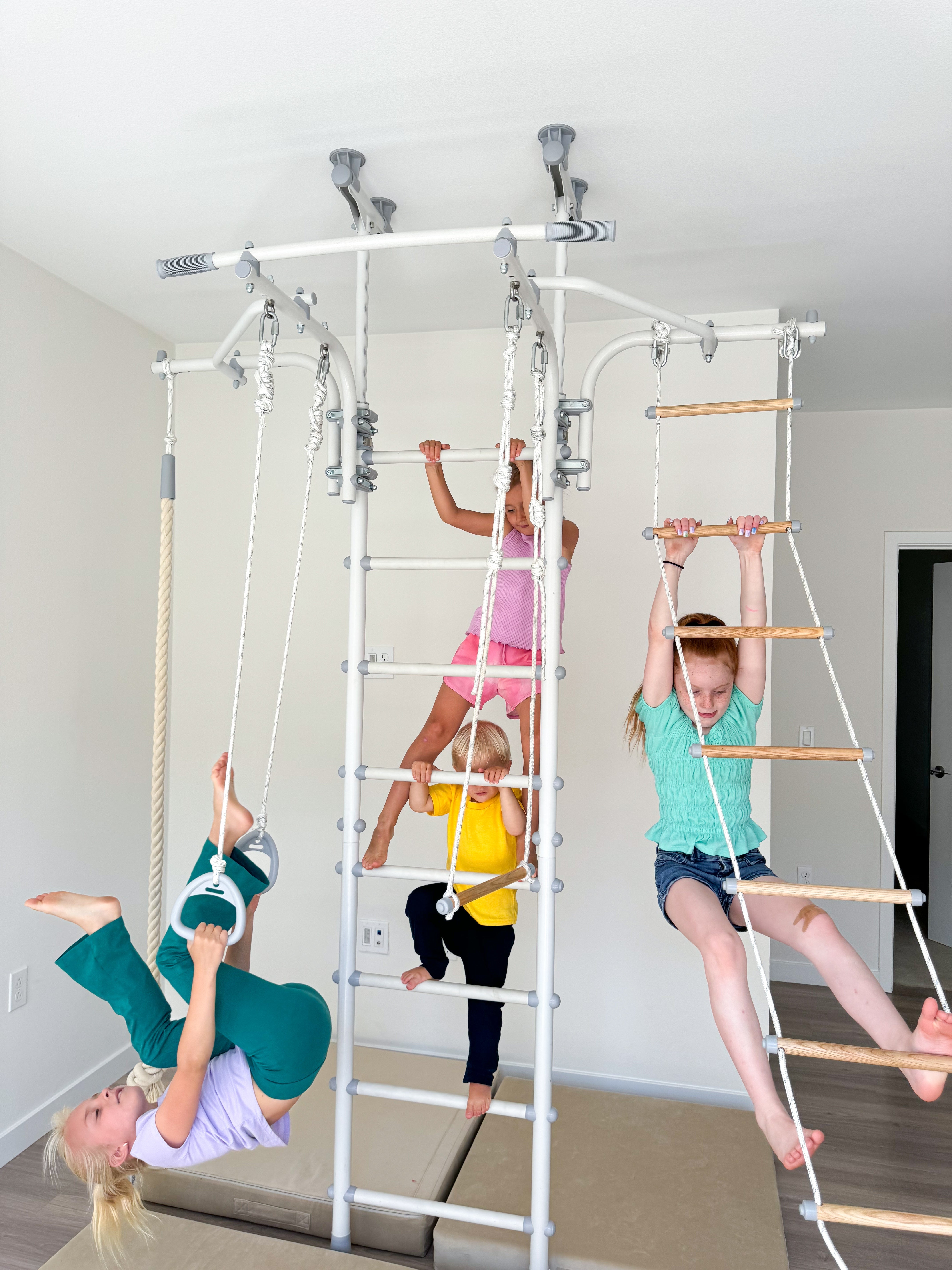
Published September 2026 · 9-minute read · by Yegor Nadvornyy, founder of Brainrich Kids
"Indoor play gym near me" is one of the most-searched phrases in our category, and the people typing it are not shopping for equipment. They are shopping for an afternoon: somewhere warm, dry, and padded where a child can climb until the energy is gone. The commercial indoor playground is a real answer to that, and so is a play gym in the corner of a bedroom. They are different answers to the same question, and almost nobody puts the two side by side with a calculator. This is that calculator, with the assumptions shown so you can change them.
The quick answer: a family that visits a commercial indoor playground once a week spends roughly $900 to $1,600 a year for one child (admission, socks, snacks, gas, and the birthday-party tax), and gets about 50 sessions. A home play gym at $899 to $1,899 delivers daily sessions for a decade, which works out to well under a dollar per use by year two and pennies by year five. The commercial playground still wins on three things: novelty, other kids, and the parent getting a coffee. The home gym wins on frequency, weather, 7 a.m. and 7 p.m., siblings, and sensory needs. Most families who own a frame keep going to the playground; they just stop needing it to be the only outlet.
Jump to: What a year of visits costs · What a home gym costs per use · Side by side · When each is right · FAQ
What a year of indoor playground visits actually costs
Prices vary by city, so here is the math with typical 2026 US numbers, shown so you can substitute your own:
| Line item | Typical | Per year at one visit a week |
|---|---|---|
| Admission, one child | $12 to $25 | $600 to $1,250 |
| Grip socks (required at most venues) | $3 to $5 a pair, several pairs a year | $20 to $40 |
| Snack bar and coffee | $5 to $10 a visit | $250 to $500 |
| Driving (round trip, gas only) | $2 to $6 a visit | $100 to $300 |
| Total, one child | About $970 to $2,090 | |
| Second child | Admission again, usually a small sibling discount | +$500 to $1,100 |
Monthly memberships cut the admission line to about $40 to $80 a month, which helps a lot if you actually go weekly and not at all in the months you do not. Add the sessions themselves: about 50 a year, 60 to 90 minutes each, plus the half hour of transitions on each end that every parent knows and no brochure counts. The playground is also closed exactly when a wound-up child needs it most: 7 a.m. before school and 7 p.m. before bed.
What a home play gym costs per use
A steel frame is a one-time purchase that gets used, in our owner community, most days of the week by every child in the house, from age 3 to 12 and beyond. Run the numbers on a Model T3 at $899 and a Spider Max V3 at $1,899:
| Assumption | Model T3, $899 | Spider Max V3, $1,899 |
|---|---|---|
| Uses per week (one child, conservative) | 4 | 4 |
| Cost per use, year 1 | $4.32 | $9.13 |
| Cost per use, by end of year 2 | $2.16 | $4.56 |
| Cost per use, by end of year 5 | $0.86 | $1.83 |
| With two children using it | Halve every number above | Halve every number above |
| Resale after years of use | Steel frames change hands; owners routinely recover a meaningful share of the price | |
The break-even against weekly playground visits lands somewhere in the first year for a T3 and early in the second for a Spider Max, and that is at four uses a week, which undercounts most households in winter. Two things make the comparison lopsided: the gym is open at the hours the playground is closed, and it is open on the 150 days a year that weather, illness, or a sibling's nap would have cancelled the trip. The evidence on what daily climbing does for a child is in does a home climbing gym help kids?; the CDC's guidance, 60 minutes a day with muscle-strengthening play like climbing at least 3 days a week from age 6, is a daily target, and weekly trips do not meet daily targets.
Home gym vs commercial playground, side by side
| Commercial indoor playground | Home play gym | |
|---|---|---|
| Sessions per year | About 50 at weekly | 200 to 350 |
| When it is open | Business hours, weekends crowded | 7 a.m., 7 p.m., snow days, sick days |
| Novelty | High: slides, ball pits, other kids | Medium: rotate accessories to keep it fresh |
| Sensory control | Loud, bright, crowded: hard for overwhelmed kids | Fully controlled; the reason sensory families buy one |
| Parent's role | Supervise from a bench with coffee | In the room, cooking dinner ten feet away |
| Germs and illness | The ball pit is the ball pit | Your own house |
| Cost, 5 years, one child | $4,900 to $10,500 at weekly | $899 to $1,899 once, plus resale |
When each one is the right answer
Choose the commercial playground when your child is under 3 (our frames start at 3), when the point is other children, when you need the parent to sit down, or when you want the slide, which we do not make for reasons explained in our playset vs play gym guide.
Choose the home gym when the energy problem is daily and not weekly, when the weather or the schedule keeps cancelling the trip, when there are siblings, when a child has sensory needs that a loud venue makes worse (our sensory gym at home guide is the long answer), or when you would simply rather own the equipment than rent the afternoon. Floor space is not the obstacle most people assume: a frame braces floor to ceiling in a corner, wall-mounted models stand 9 inches off the wall, and no drilling is involved. Our 60-second quiz matches ceiling and room to a model.
Choose both, which is what most of our owners do: the frame handles the 300 ordinary days, and the playground becomes the outing it was always meant to be.


Own the afternoon instead of renting it
Steel play gyms for ages 3 to 12+, open at 7 a.m. and 7 p.m. No drilling, 30-day money-back guarantee.
Frequently asked questions
How much does an indoor playground cost per visit? Typically $12 to $25 admission per child in the US, plus grip socks, snacks, and driving, which brings a realistic visit to $20 to $40 for one child. At one visit a week that is roughly $970 to $2,090 a year; memberships lower the admission line to about $40 to $80 a month if you go consistently.
Is a home play gym cheaper than an indoor playground? Over any period longer than about a year, yes, and by a wide margin. A $899 steel frame used four times a week costs about $4 a use in year one and under $1 a use by year five, with resale value on top; weekly playground visits cost $20 to $40 each indefinitely. The playground still wins on novelty and other kids.
Is an indoor play gym worth it for a small apartment? Often it is the better fit, because it goes up rather than out: a tension-mounted frame braces floor to ceiling in a corner with no drilling, and a wall-mounted model stands about 9 inches off the wall. Both come down for a move.
What age is a home play gym for? Independent climbing from age 3 and up with a parent in the room, through age 12 and into the teens on the pull-up bar. Under 3, a commercial toddler area or a low foam climber is the right answer.
Can HSA or FSA funds pay for a home play gym? They may, for a child with a qualifying diagnosis, when a licensed provider writes a Letter of Medical Necessity; the plan administrator decides. The process is in our HSA/FSA guide.
📚 Keep reading in the Decision Guide
The Indoor Jungle Gym Buyer's Guide · DIY vs Buying an Indoor Play Gym · Does a Home Climbing Gym Help Kids? · Basement Play Gym Ideas
New: comparing a geodesic climber to a vertical gym? Read Climbing Dome for Kids vs Indoor Climbing Gym, with sizes, weight ratings and the age-out curve.
Sources
CDC. Physical Activity Guidelines for Children and Adolescents. · Admission, sock, and snack figures are typical 2026 US ranges compiled from published venue price lists; substitute your local numbers. · Brainrich Kids engineering specification: frame working load 220 lb, safety-tested to 440 lb.
Share: