

Updated August 2026 · 10-minute read · by the Brainrich Kids team · Canadian edition, prices in CAD
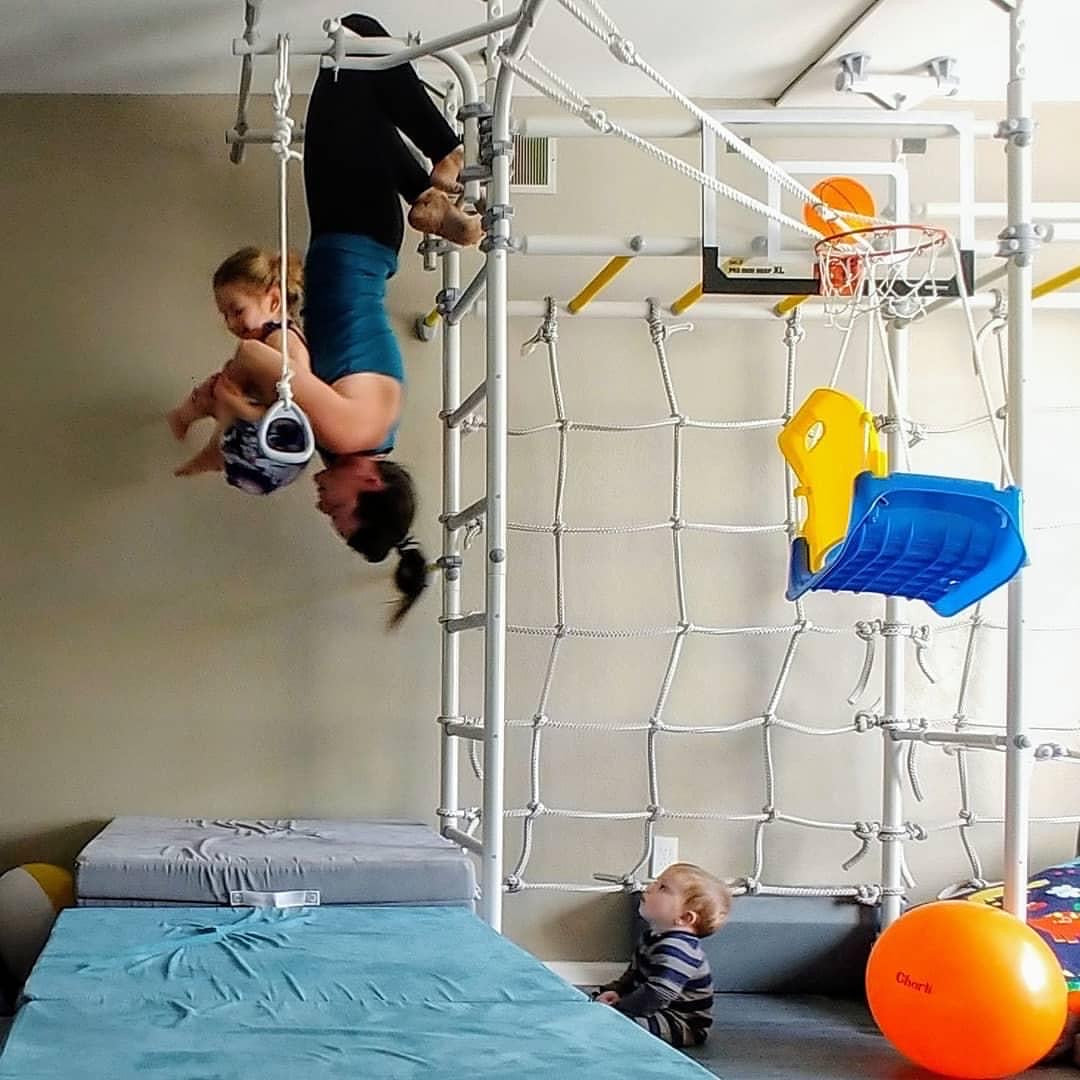
The pull-up bar is the most underestimated piece of a home play gym. On the spec sheet it is one steel bar. In the living room it turns out to be the one piece of equipment your 4-year-old and you will both use in the same afternoon: a grip trainer for small hands, a strength station for grown ones, and, on the V3, an anchor point that swings, rings, ropes, and trapeze bars clip onto in seconds. Here is what that one bar does for a family, what age children can start, and how to get from first hang to first real pull-up.
The quick answer: most children can start supervised hanging around age 3, the age Brainrich rates for independent climbing, while structured strength work becomes appropriate around age 7 to 8 according to the American Academy of Pediatrics, and a full unassisted pull-up usually arrives years after the first hang. The same bar serves parents: every Brainrich pull-up bar is rated to 220 lb (100 kg) and safety-tested to 440 lb (200 kg), so adults train on the exact bar their kids play on. The V3 version adds ring hooks, so accessories clip on and off with carabiners instead of tools, a detail designed with occupational therapists in mind. Set it up right (bar within reach, mats underneath, one child at a time) and run the progression: dead hang → negatives → first pull-up.
Ordering from Canada: Brainrich prices on this page are in Canadian dollars. Every gym component is stocked in our Vancouver, BC warehouse, so your order ships from inside Canada: no duties, no customs paperwork, no cross-border delays. GST/HST is calculated at checkout.
Jump to: One bar, whole family · What age can kids start · V3 ring hooks · Safe setup · Dead hang to first pull-up · Fits the Brainrich system · FAQ
One bar, two completely different workouts
Most fitness equipment in a family home serves exactly one person. The treadmill is yours. The balance bike is theirs. A pull-up bar on a play gym is the rare object that does real work for both generations at once, because hanging is one of the few movements a 35-pound (16 kg) child and a 190-pound (86 kg) adult can practice at their own scale.
For children, the bar is a grip and shoulder laboratory. Hanging loads the hands, forearms, shoulders, and upper back in a way almost nothing else in a modern child's day does: no screen, desk, or car seat asks a child to support their own body weight through their hands. That loading is linked to grip strength, shoulder stability, and body awareness, the same cluster occupational therapists target when they prescribe hanging and climbing as heavy work activities for kids who need help regulating their bodies.
Grip strength in particular deserves more respect than it gets. In adults, it is one of the most studied single measurements in medicine: the PURE study, which followed roughly 140,000 people across 17 countries, found that each 5 kg drop in grip strength was associated with a 16 percent higher risk of all-cause mortality, and that grip predicted cardiovascular death better than systolic blood pressure did. Nobody is claiming a toddler on a bar is doing preventive cardiology. The point is simpler: grip is a lifelong health marker, and childhood hanging is where it starts compounding.
For parents, the math is easier still. The most common reason adults do not train pull-ups is that the bar lives at a gym fifteen minutes away. A bar in the hallway removes the excuse. Every Brainrich pull-up bar is rated to 220 lb and safety-tested to double that, 440 lb, on powder-coated steel, so the kids' gym quietly doubles as the most-used piece of adult fitness equipment in the house. Owners have told us this since the V2 days:
"It's so versatile, being able to add swings or ropes from this. My boys are super active and we've purchased 4 extra swings to add to their Brainrich gym."
– AMANDA BURKS, BRAINRICH OWNER
That versatility, one bar anchoring a rotating cast of accessories, is where the V3 changed the game. More on that below.
What age can kids start hanging (and when do pull-ups actually arrive)?
Parents usually ask this as one question. It is really three, with three different answers:
HANGING · AROUND AGE 3
Brainrich gyms are rated 3+ for independent climbing, and short supervised hangs fit the same window. Early hangs last seconds, not minutes, and every brief hang is still a grip and shoulder rep.
STRUCTURED STRENGTH · AGE 7 TO 8
The American Academy of Pediatrics' 2020 clinical report concludes resistance training is safe and beneficial for children old enough to follow instructions, a threshold most programs place around 7 to 8. Before that, play is the program.
FIRST FULL PULL-UP · WHENEVER IT COMES
A strict pull-up is a genuinely advanced skill (plenty of adults never get one). Some kids who hang daily surprise their parents at 5 or 6; others get there at 9 or 10. The timeline matters far less than the hanging habit that produces it.
Two research notes worth having in your pocket. First, the fear that strength work harms growing bodies has been formally retired: the AAP report and the 2014 international consensus on youth resistance training both find that appropriately supervised strength activity is safe for children and associated with stronger bones, better motor skills, and fewer sports injuries. The old "it stunts growth" story does not survive contact with the literature.
Second, hanging is developmentally upstream of everything else on the gym. The shoulder stability and grip endurance built dangling from a bar are the prerequisites for traversing monkey bars hand over hand. If your child is in that in-between stage, our guide to what age kids can do monkey bars picks up where this section leaves off.
One rule stays constant across every age: the child does the getting up. A child who jumped or climbed to the bar themselves has the grip to be there. A lifted child is at a height their hands did not earn.
Ring hooks: the small V3 change with the biggest daily payoff
On V2 gyms, the pull-up bar was already the anchor point families hung swings and ropes from. The friction was the changeover: swapping accessories was a deliberate job, so most families picked a configuration and left it alone for months.
The V3 pull-up bar adds ring hooks: fixed steel rings along the bar that accessories clip into with carabiners, on and off in seconds, no tools. It reads like a minor hardware note. In practice it changes what the gym is on any given day:
We designed the ring hooks with occupational therapists in mind, because the way OTs work is rotation: a swing for vestibular input in one session, rings or a trapeze for grip work in the next, a rope after that. Equipment that takes ten minutes to reconfigure fights that rhythm; equipment that reconfigures in the time it takes a child to lose patience supports it. The same logic holds at home: novelty keeps a gym in daily use, and carabiner swaps make novelty free.
It is also the cleanest answer to "what is different about V3?" If you are comparing an older listing or a secondhand V2, check the bar: V2 pull-up bars do not have ring hooks, every V3 pull-up bar does. The bar itself remains steel, non-toxic powder coat, rubber-coated grip surface, and phthalate-free plastics wherever plastic touches the design. See the current version at the pull-up bar product page.
Safe setup: three decisions before the first hang
A pull-up bar has one of the best safety profiles on the gym, because the child's feet start near the floor and the child chooses when to let go. Keep it that way with three setup decisions:
| Decision | The rule |
|---|---|
| Bar height | Start low: a beginner should reach the bar flat-footed or with a small hop, so a released grip means a drop of inches, not feet. Raise the bar only as skill rises. The height is adjustable for exactly this reason. |
| What's underneath | Impact mats under the bar and a clear landing zone around it: no toys, no furniture corners, no hard floor. Blankets and pillows slide; mats do not. |
| Traffic control | One child on the bar at a time. Most bar incidents are not falls, they are collisions: a swinging child meeting a waiting sibling. Make turns the house rule from day one. |
Add the habits that cost nothing: bare feet or grippy socks (slippery socks are the one genuinely bad idea in indoor climbing), eyes-on supervision for under-3s, and a quick adult check that carabiners are fully closed after every accessory swap. The structure itself is not the variable: steel, safety-tested to double its rating, with a rubber-coated grip surface so small sweaty hands hold on longer than bare metal would allow.
From first dead hang to first pull-up
The pull-up has a reputation as an all-or-nothing exercise: you can either do one or you cannot. That reputation is why most people, kids and adults alike, never train it. The fix is to treat the pull-up not as a test but as the last step of a ladder anyone can start climbing today:
1 · DEAD HANG
Hang with straight arms, thumbs wrapped, feet off the floor. Start with a few seconds; build toward 20 to 30. For young kids this can be the whole program for a year. Make it a game: count out loud, beat yesterday.
2 · SCAPULAR PULLS & KNEE RAISES
From the hang, shrug the shoulders down and back without bending the elbows, then relax. Add slow knee raises. These teach the body that hanging is an active position, and they are where the first inch of every future pull-up comes from.
3 · NEGATIVES
Start at the top (chin over the bar via a hop or a step from the gym's rungs) and lower down as slowly as possible. Lowering strength arrives before lifting strength, so negatives let a child train the full movement months before they can pull it.
4 · FIRST PULL-UP
One day the negative reverses itself. There is no faking this moment and no gifting it, which is exactly why kids are so proud of it. Celebrate loudly, then start counting to two.
Two coaching notes. First, frequency beats intensity: three short visits to the bar a day, every day, outperform one long Saturday session, and a bar that lives in your home is the only kind that makes that schedule realistic. Second, the progression is identical for adults. If your last pull-up happened in high school, run the same four steps next to your child; modelling the practice is worth more than any instruction, and at 220 lb rated with a 440 lb safety test, the bar is unambiguously rated for you.
Which gym fits your family? Take the 60-Second Quiz →
Where the pull-up bar fits in the Brainrich system
The pull-up bar is not a standalone product bolted to a doorframe. It is a module in a system: it attaches to Brainrich's tension-mounted play gyms, the frames that brace between floor and ceiling, so there is no drilling into walls and the bar moves with the gym if you rearrange the room. Already own a tension-mounted Brainrich gym? The bar drops onto the frame you have. Starting from zero? The bar comes into the picture as part of choosing the gym itself.
It also stretches the gym across the widest age range of any accessory: the 3-year-old hanging for three seconds, the 8-year-old chasing negatives, the 12-year-old doing sets, and the parent using it daily, the argument we lay out in full in why a Brainrich gym works for all ages. Steel makes that range real: the structure a preschooler learns on is the identical structure a teenager trains on.
Worth knowing on the budget side: because play gyms support motor development, some Canadian families fund them through provincial autism funding or Jordan's Principle (the routes are on our funding page). And every gym is covered by a 30-day money-back guarantee: build it, hang from it, and decide with the bar in your hallway rather than in your imagination.


One bar. Every age in the house.
Rated 220 lb, safety-tested to 440 lb, and covered by a 30-day money-back guarantee.
Frequently asked questions
What age can kids start using a pull-up bar? Short supervised hangs fit around age 3, the same age Brainrich rates gyms for independent climbing, and early hangs of a few seconds are exactly what progress looks like. Structured strength training becomes appropriate around age 7 to 8, per the American Academy of Pediatrics' 2020 clinical report. A full unassisted pull-up arrives on its own schedule, sometimes at 5 or 6 for daily hangers, often closer to 9 or 10.
Are pull-up bars safe for kids? Hanging has one of the friendlier risk profiles on a play gym, because the child starts within reach of the floor and chooses when to let go. Keep it that way with three rules: set the bar low enough that a beginner reaches it flat-footed or with a small hop, put impact mats underneath with a clear landing zone, and allow one child on the bar at a time. The bar is steel with a non-toxic powder coat and rubber-coated grip surface, rated to 220 lb and safety-tested to 440 lb.
What are the ring hooks on the V3 pull-up bar? Fixed steel rings along the V3 bar that let accessories (swings, gymnastic rings, ropes, trapeze bars) clip on and off with carabiners in seconds, no tools. They were designed with occupational therapists in mind, because OT practice rotates equipment session to session. V2 pull-up bars did not have them; every V3 pull-up bar does.
Can adults use the Brainrich pull-up bar? Yes, by design. The 220 lb rating with a 440 lb safety test covers nearly all adults, and the bar attaches to a tension-mounted frame braced between floor and ceiling, so it does not rely on a doorframe or drywall anchors.
How do I help my child get their first pull-up? Run the ladder: dead hangs first (build toward 20 to 30 seconds), then scapular pulls and knee raises, then negatives, lowering from chin-over-bar as slowly as possible. Lowering strength develops ahead of lifting strength, so the first pull-up usually announces itself as a negative that reverses. Keep sessions short and frequent, and never lift a child to the bar.
Can I use funding to buy a play gym in Canada? Sometimes. Canada has no HSA or FSA at checkout; families most often use provincial autism funding, Jordan's Principle for First Nations children, or tax-time support such as the disability tax credit, and no route is guaranteed. Every gym also carries a 30-day money-back guarantee.
📚 Keep reading
What Age Can Kids Do Monkey Bars? · Heavy Work Activities for Kids · A Play Gym for All Ages · Pull-Up Bar Gymnastics for Kids
Sources
Stricker, P.R., Faigenbaum, A.D. & McCambridge, T.M. (2020). Resistance Training for Children and Adolescents. Pediatrics, American Academy of Pediatrics clinical report. · Lloyd, R.S. et al. (2014). Position statement on youth resistance training: the 2014 International Consensus. British Journal of Sports Medicine. · Leong, D.P. et al. (2015). Prognostic value of grip strength: findings from the Prospective Urban Rural Epidemiology (PURE) study. The Lancet.
Share: