

Updated October 2026 · 11-minute read · by the Brainrich Kids team
Your kid hangs off the door frame, the kitchen counter, and your arm. A pull-up bar seems like the obvious answer, and then you open a shopping site and find a hundred bars built for adults, with labels like "tension," "multi-grip," and "no screws" that mean very different things once a 40-pound child starts swinging. The right bar for a child depends on three things: how it is held up, how high it sits, and how thick it is. This guide walks through all three, age by age.
The quick answer: for young kids, pick a bar that is anchored to something that cannot pop loose (a play gym frame, studs or joists, or a wide, stable tower), that you can set low enough for them to reach from the floor, and that is thin enough for small hands. The CPSC's playground handbook puts the preferred grip at about 1.25 inches for kids 2 to 12 and 0.90 inches for children under 2. Doorway bars are cheap and fine for teens and adults doing strict pull-ups, but they are a poor fit for little kids who swing, kick, and drop. Toddlers hang with a parent's hands close by; every child needs an adult in the same room and a mat underneath.
Jump to: The 5 types · Safety by age · Height and grip size · What to check · Why kids hang · Where Brainrich fits · FAQ
The 5 types of pull-up bars, compared
Almost every bar on the market falls into one of five groups. The difference that matters most for kids is what holds the bar up, because children load a bar differently than adults do. Adults hang and pull. Children swing, kick, twist, and drop.
1. Doorway tension bar
A straight bar that twists or springs outward until rubber end caps press against the inside of a door frame. It holds by friction. No tools, no screws, often under $40. The weak point is that friction: a bar that holds a slow, still hang can creep or slip under swinging or a sudden drop, and painted or uneven frames grip less. Fine for a careful teen. Not what we would pick for a 4-year-old.
2. Doorway hook-over bar
The multi-grip bar that hooks over the trim on one side and braces against the wall on the other, also sold as a leverage bar. Your body weight locks it in place. It only works when the person hangs on the correct side, and it presses on door trim that was never designed to carry load. A child who pushes up from below, or swings forward, can lift it right off. It also sits at full door height, out of a small child's reach.
3. Wall or ceiling mounted bar
Bolted into studs or ceiling joists with lag bolts. Done right, it is very solid. Done wrong, into drywall alone, it is the most dangerous option on this list. You need the framing, the right hardware for your wall type, and a fixed height you choose once. Renters usually cannot drill at all.
4. Freestanding tower
The "power tower" from the fitness aisle: a floor stand with a bar on top, often with dip handles. No drilling. Two catches for families: most are sized for adults, so the bar sits far above a child's reach, and a tall, narrow frame can rock or tip when someone swings. Check the base width and the weight limit, and never let kids climb the uprights.
5. A bar on a play gym frame
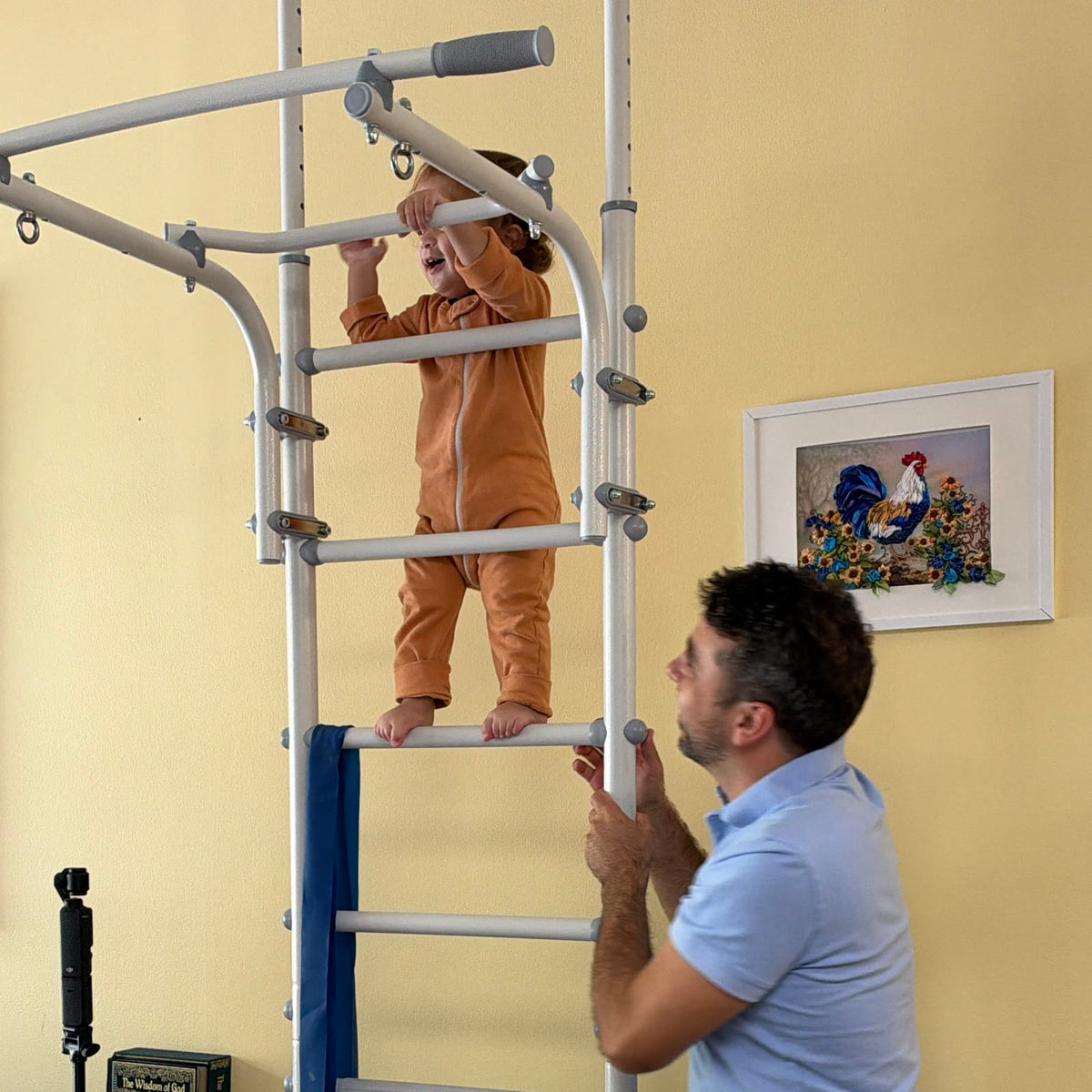
A bar that is part of a climbing structure, like an indoor jungle gym or a Swedish ladder. The bar mounts to the frame, so it can usually be moved up or down as the child grows, and rings, a trapeze, or a rope can hang from the same structure. It costs more and takes more floor space than a doorway bar. In return it is the one type built for how children actually use a bar.
| Type | Holds by | Height adjusts? | Best for |
|---|---|---|---|
| Doorway tension | Friction in the frame | Yes, within the door | Teens and adults, strict pull-ups |
| Doorway hook-over | Body weight against trim | No | Adults, short sessions |
| Wall or ceiling mount | Bolts into framing | No, fixed once installed | Owners who can drill into studs or joists |
| Freestanding tower | Its own base | Sometimes | Adults and older teens |
| Play gym frame | The climbing structure | Usually | Toddlers (with a parent) through adults |
Safety by age: who should use what
There is no national safety standard for a pull-up bar in a family home. The closest public reference is the U.S. Consumer Product Safety Commission's Public Playground Safety Handbook, which sets guidelines for overhead equipment like horizontal ladders and rings on public playgrounds. It is a useful yardstick. Your living room is not a public playground, so read the numbers as reference points, not rules.
👶 Toddlers (about 1 to 3)
Hanging only, for a few seconds at a time, with a parent's hands close to the waist. Set the bar low enough that feet are a few inches off the floor. The CPSC handbook does not recommend overhead rings for toddlers and 3-year-olds on public playgrounds, and that caution is why a parent stays hands-on at this age.
🧒 Preschool (3 to 5)
Dead hangs, knee tucks, and swinging to a count. For ages 4 and 5, the handbook caps overhead ladders and rings at 60 inches from the surface below to the grip. Keep the bar where they can reach it from the floor or a low rung, with an adult in the room.
🧗 School age (6 to 12)
The pull-up years. Hangs get longer, flexed-arm hangs and slow lowering appear, and many kids earn a first pull-up somewhere in this window. The handbook's limit for school-age overhead equipment is 84 inches. Still a mat, still an adult nearby.
🏋️ Teens and adults
Full-height bar, real sets. The American Academy of Pediatrics supports supervised resistance training for children and teens when technique comes first. This is where a doorway bar can work, if the frame suits it and nobody kips or swings on it.
One rule covers every age: no kipping, no flipping over the bar, and no one hanging from a bar that someone else is already using. If your toddler is climbing everything in sight, our guide to toddlers who climb everything covers the home safety side, and controlled risky play explains why letting them try, with you close, matters.
Sizing: bar height and grip diameter
Height. Measure your child's standing reach: feet flat, arms straight up, floor to fingertips. A practical starting point for hanging is a bar 2 to 4 inches above that number, so a small hop or one step on a rung gets them there, and their feet hang just off the floor. For pull-up practice, raise the bar until they can hang with knees bent and feet clear. This is why adjustable height matters most in a family bar: one fixed height suits your 4-year-old or your teenager, never both.
Grip diameter. Small hands cannot wrap a thick bar, and a grip that does not close is a grip that slips. The CPSC handbook gives these ranges for anything children hold onto:
0.60 to 1.20 in
Hand supports for children under 2. 0.90 in preferred.
0.95 to 1.55 in
Rungs and climbing bars, ages 2 to 12. 1.25 in preferred.
Round
Round shapes are easiest to grip, and grips should not turn in the hand.
The handbook chose its preferred sizes to "benefit the weakest children." Many adult bars are thicker, knurled, or wrapped in foam that twists. If the product page does not list a diameter, ask before you buy.
Width and clearance. The bar should be wide enough for a child's shoulder-width grip and an adult's wide grip. Leave room around it too: no wall, furniture, or door edge within reach of swinging feet. Our space guide has the clearances for a full play gym.
What to check before you buy
- The load rating, and what it means. A rating is the weight the bar is designed to carry. A test load is the higher weight it was checked against to build in a margin. Swinging, dropping into a hang, and two kids at once all put more force on a bar than standing body weight. Ask the maker for both numbers, and ask how the bar was tested.
- What it mounts to. A bar is only as strong as the thing holding it. For a tension bar that means your door frame. For a wall bar it means studs or joists, never drywall anchors alone. For a tower it means the base.
- The door frame itself. Doorway bars press on jambs and trim that were built to hold a door, not a swinging child. Look for cracked paint, loose trim, or a frame that flexes when you push on it. Frames with thick molding or an arch often do not fit.
- Height range. Can you set it low for a 4-year-old and high for yourself? If not, plan to replace it as your child grows.
- Grip diameter and finish. See the ranges above. Check the end caps too: no sharp edges, no gaps that could pinch fingers.
- What goes underneath. A thick mat below every bar, every time. Hardwood and tile are unforgiving surfaces for a drop.
- Your own test. Hang from any bar yourself before your child does, and re-check it after the first few sessions.
Why kids hang (and what research links it to)
Hanging loads the hands, forearms, shoulders, and back against full body weight, which very little else in a modern child's day does. Occupational therapists call this kind of push-and-pull effort heavy work, and many kids find it calming and organizing. A. Jean Ayres built sensory integration theory partly around this muscle-and-joint input.
What the research says, stated as carefully as the studies do:
- The World Health Organization recommends that children and teens aged 5 to 17 include muscle- and bone-strengthening activity on at least 3 days a week. Hanging and climbing count.
- Grip and upper-body strength are linked to later health. A Swedish cohort study of more than one million male teenagers found that higher muscular strength, including grip strength, was associated with lower risk of premature death in adulthood (Ortega et al., BMJ, 2012). That is an association in teen boys, not proof that a home bar changes outcomes.
- The AAP's 2020 clinical report on resistance training describes benefits for strength, bone health, and motor development when training is supervised and well taught.
Hanging is also the first rung of the ladder toward monkey bars. For the step-by-step path from first dead hang to first pull-up, see our pull-up bar skills progression, and for what a bar does for the grown-ups in the house, a pull-up bar can do more than you think.
Where Brainrich fits
We do not sell a standalone doorway bar. Our pull-up bars are part of our steel play gyms, which is option 5 on the list above. Each gym ladder presses between floor and ceiling with a telescopic pole, so there is no drilling and no door frame involved. Our Standard height fits ceilings from 7 ft 8 in to 9 ft 11 in, and the Short version fits 6 ft 9 in to 9 ft 1 in.
↕️ Moves with your child
The bars are height-adjustable on the ladder: low for a preschooler's first hangs, high for a parent's pull-ups.
⚖️ Rated for 220 lb
Rated for 220 lb, tested to 440. The same steel bar serves kids and the adults who use it after bedtime.
🪝 Ring hooks on V3
V3 pull-up bars have ring hooks, so rings, a trapeze, or a rope clip on and off with carabiners.
✋ Sized for small hands
The handles are thinner than a typical adult bar so small fingers can close around them, and they are rubber-coated for grip. Each bar is about 2 ft wide.
The Model T3 and the Spider V3 each come with two sets of pull-up bars, plus gymnastic rings, a climbing rope, a trapeze, and a rope ladder. The Spider Max V3 and Mega Max V3 come with one set each. If you already own a Brainrich tension-mounted gym (Model T2 or T3, Spider V2 or V3, Spider Max, or Mega Max), the Pull-up Bars Addon adds another bar to it. It does not fit the older wall-mounted W2 and W2 Max. If you are weighing a full gym against a single bar, our jungle gym guide and monkey bars guide lay out the options, and jungle gym for adults covers how parents use the same frame.
More than 10,000 families have a Brainrich gym at home, and occupational and physical therapists in our owner community recommend them. Toddlers use the bar with a parent's hands close by, and kids approaching 3 start using every part of it. Whoever is hanging, an adult stays in the same room.


A bar that grows with them
Steel frame, no drilling, bars that move up as your child does. Every gym comes with a 30-day money-back guarantee. Questions? Reach out to us.
Frequently asked questions
What age can a child use a pull-up bar? Toddlers can hang for a few seconds with a parent's hands close to their waist and the bar set so their feet are just off the floor. From about 3, kids hang and swing on their own with an adult in the room. Structured pull-up practice usually starts in the school years.
Is a doorway pull-up bar safe for kids? For a teen doing slow, strict pull-ups in a sound door frame, it can be. For young children it is a poor fit: tension bars hold by friction, hook-over bars rely on the user hanging on the correct side, and kids swing, kick, and drop. A bar on a play gym frame, or one bolted into studs, is a better choice for little ones.
How high should a kids' pull-up bar be? For hanging, set it 2 to 4 inches above your child's standing reach (floor to fingertips with arms straight up), so their feet hang just off the floor. For pull-ups, raise it until they can hang with knees bent. For reference, the CPSC playground handbook caps overhead equipment at 60 inches for ages 4 and 5 and 84 inches for school-age kids.
What grip size is best for kids? The CPSC handbook recommends 0.95 to 1.55 inches across for bars children ages 2 to 12 hold onto, with 1.25 inches preferred, and 0.60 to 1.20 inches for children under 2, with 0.90 preferred. Round, non-rotating grips are easiest to hold.
Can adults use the same pull-up bar as kids? Yes, if the bar is rated for adult weight and its height adjusts. Brainrich pull-up bars are rated for 220 lb, tested to 440, and move up and down the gym ladder, so a child and a parent can use the same bar at different heights.
📚 Keep reading in the Decision Guide
Pull-Up Bar Skills: From First Hang to First Pull-Up · The Monkey Bars Guide · How Much Space Does a Play Gym Need? · Swedish Ladder for Kids · Jungle Gym for Adults
Sources
U.S. Consumer Product Safety Commission (2010). Public Playground Safety Handbook, Publication #325, sections 5.2.2 and 5.3.2. · Stricker, P.R., Faigenbaum, A.D., McCambridge, T.M. et al. (2020). Resistance Training for Children and Adolescents. Pediatrics, American Academy of Pediatrics. · Ortega, F.B., Silventoinen, K., Tynelius, P., Rasmussen, F. (2012). Muscular strength in male adolescents and premature death: cohort study of one million participants. BMJ. · World Health Organization (2020). WHO guidelines on physical activity and sedentary behaviour. · Ayres, A.J. (1972). Sensory Integration and Learning Disorders. Western Psychological Services.
Share: