

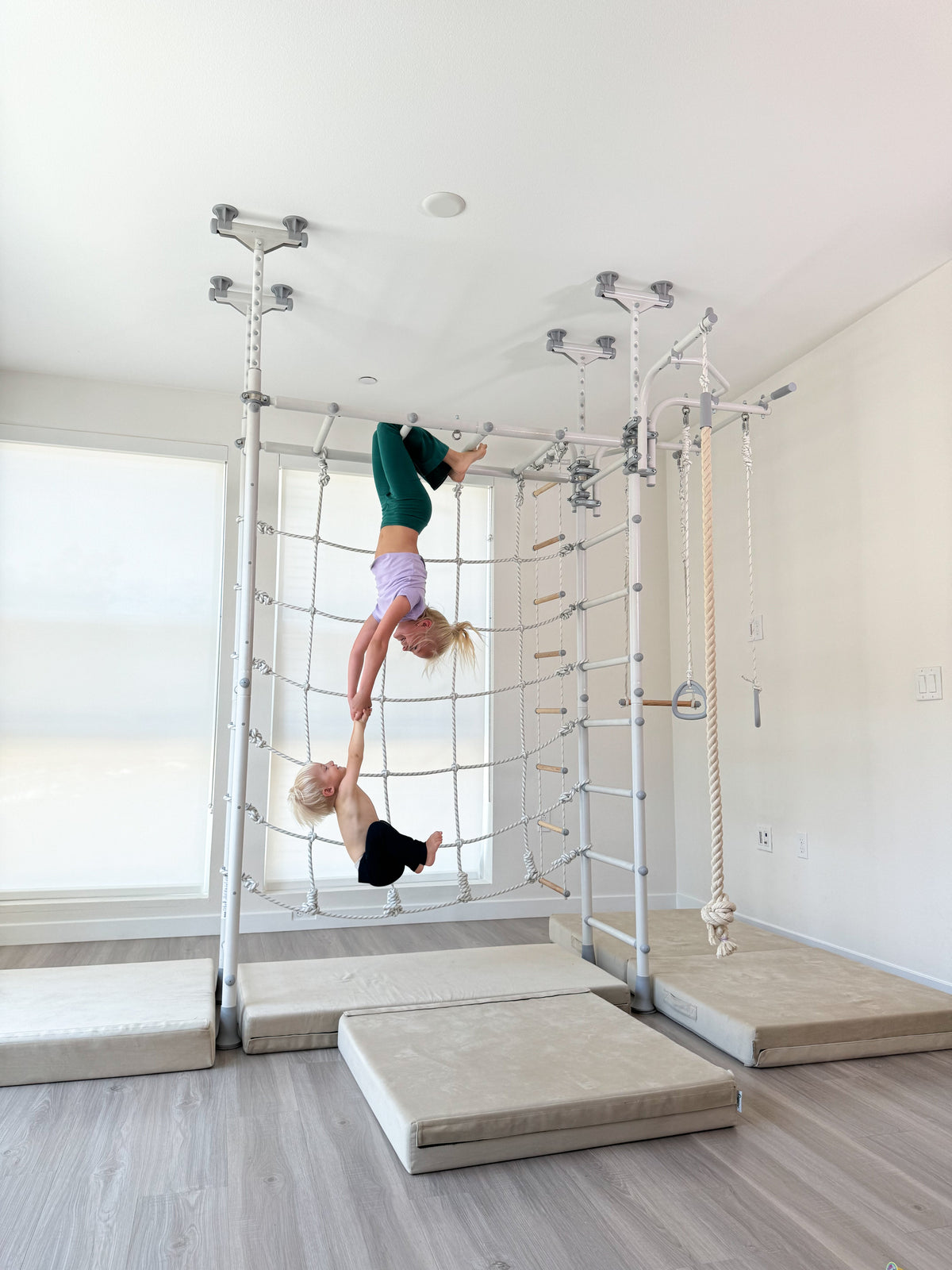
Published September 2026 · 10-minute read · by Yegor Nadvornyy, founder of Brainrich Kids
The pull-up bar is the most underrated piece of equipment in a child's room. Hanging from it builds grip, shoulders, and the cross-body coordination of monkey bars; pulling on it is the first strength skill most kids ever earn on their own. It is also the piece parents are most nervous about, because the internet mixes gym-bro pull-up advice with playground common sense. This guide is the kid version: what a body can do at each age, the exact progression from a five-second hang to a first pull-up, the games that make it happen without anyone noticing it is training, and what safe equipment looks like in numbers.
The quick answer: kids can hang from a bar from about age 3 with a parent in the room, and hanging, not pulling, is the skill to build first: it strengthens grip and shoulders and delivers the proprioceptive input that calms and organizes. Most children reach a first pull-up somewhere between 6 and 9, and the reliable route is a progression: dead hangs to 20 seconds, scapular pulls, negatives (jump up, lower slowly), assisted reps with feet on a rung, then the real thing. No kipping, no weight, no rushing. The equipment matters more than the program: a bar on a frame rated for adult loads (ours: 220 lb working, tested to 440), rubber-coated so small hands grip, with a mat underneath.
Jump to: Why hanging matters · Safety first · The progression · By age · Games that do the training · Equipment · FAQ
Why hanging matters more than pulling
Before a single pull-up, hanging is already doing three jobs. It builds grip strength, which predicts a surprising amount of later athletic ability and is the limiting factor in almost every climbing skill. It loads the shoulders through a full overhead range, which modern childhood (chairs, screens, car seats) barely does. And it is dense proprioceptive input: muscles and joints working against the child's whole body weight, the input occupational therapists prescribe as heavy work because it calms and organizes the nervous system. That last point is why hanging shows up in our heavy work guide, why monkey bars count as sensory equipment, and why a kid who has just hung for a minute walks away steadier than a kid who has just watched a screen for a minute. The CDC's activity guidelines name muscle-strengthening play like climbing and hanging at least 3 days a week from age 6; a bar in the room makes that automatic.
Safety first: the rules that make yes possible
- Age 3 and up for independent hanging, parent in the room. Younger children can be lifted to a bar for a two-second hang with a parent's hands on them; that is play, not training.
- A bar that publishes its load. A child swinging from a bar generates several times their body weight at the bottom of the swing. Ours sit on frames rated 220 lb working, tested to 440.
- A mat underneath. Every drop is a dismount, planned or not.
- Bar height that fits. A child should reach the bar from a low rung or a small jump, not a chair. Frames with ladders solve this: the rungs are the steps.
- No kipping, no added weight, no forced reps. Kids' growth plates do not need momentum or load. Slow, clean, and short is the whole method.
- Teach the drop. Land on two feet with soft knees; practice it from the lowest rung before it happens from the bar.
The progression: five steps to the first pull-up
| Step | What it looks like | Move on when |
|---|---|---|
| 1. Dead hang | Hands on the bar, arms straight, feet off the rung, body still. Count out loud. | 20 seconds, three times, without dropping |
| 2. Scapular pull | From the hang, pull the shoulders down and back without bending the elbows: the body rises an inch. "Make your neck long." | 8 clean reps |
| 3. Negative | Step or jump to chin-over-bar, then lower as slowly as possible. Count the way down. | A 5-second lower, 5 times |
| 4. Assisted pull-up | One foot on a low rung takes part of the weight; pull with the arms, push lightly with the foot. | 5 reps with barely any leg push |
| 5. The pull-up | Straight-arm hang to chin over the bar, no swing, lower under control. | Celebrate. Then build to 3. |
Two or three short sessions a week, a few minutes each, is plenty; the frame in the corner makes "a few minutes" happen on the way past. Most kids move through the whole ladder in 3 to 9 months depending on where they start, and the dead hang alone is worth keeping in the rotation forever.
What to expect by age
- 3 to 4: hangs of a few seconds with a parent close, dropping to a mat, swinging gently. Rings are often easier than a bar because the grip rotates.
- 5 to 6: 10 to 20 second hangs, monkey-bar traverses, first scapular pulls and negatives. This is the monkey-bar age; a monkey-bar span on the frame (the Spider V3 comes with one built in) does more for pull-up strength than any drill.
- 7 to 9: the first pull-up window for most kids. Assisted reps and negatives pay off here.
- 10 to 12: sets of pull-ups, leg raises, skin-the-cat with a spotter, and the start of real training. The same bar the rings hung from at four.
These are ranges, not tests. A child who hangs happily at six and pulls at nine is on schedule.
Games that do the training without calling it training
- Hang for the count. Everyone in the room counts out loud; beat yesterday's number by one.
- Monkey-bar traverse. Across, then across and back, then across skipping a rung. The traverse is a moving hang.
- Sloth. Hang with hands and feet on a low bar or rung, belly up, and crawl along it. Whole-body grip work disguised as an animal.
- Answer and hang. Spelling words or math facts: correct answer, five-second hang. The homeschool families in our community run half their review this way (more in homeschool PE at home).
- Ring switch. Hang on rings, let go with one hand, grab again. Grip plus courage.
Equipment: what a kids' pull-up bar should be
A doorway bar works for an adult and badly for a child: it is too high to reach without a chair, it has no place to put a foot for assisted reps, and its load rating is for one still adult, not a swinging kid. A bar on a climbing frame fixes all three. On our gyms the pull-up bars are part of the structure, the ladder rungs are the steps up to it and the foot support for assisted reps, and the V3 bars carry ring hooks so rings, a trapeze, or a rope clip on and off with carabiners for the rotation. The frame is the safety system: 220 lb working load, tested to 440, braced floor to ceiling so it does not move when a child swings. Full anatomy and the evidence for daily climbing are in does a home climbing gym help kids? Still comparing bar types? Our pull-up bar buyer's guide covers all five, with grip sizes and bar heights by age.


A bar they can reach, on a frame that holds
Steel frames rated 220 lb working, tested to 440, with rungs to the bar and ring hooks for the rotation. No drilling, 30-day money-back guarantee.
Frequently asked questions
At what age can kids do pull-ups? Most children reach a first unassisted pull-up between 6 and 9, with wide normal variation. Hanging comes much earlier: kids can hang from a bar from about age 3 with a parent in the room, and the hang is the skill to build first.
Is hanging from a bar safe for kids? Yes, with a rated bar, a mat underneath, a reachable height, and a parent in the room for younger children. Hanging strengthens grip and shoulders and delivers calming proprioceptive input. Avoid kipping, added weight, and forced reps; growth plates do not need momentum or load.
How long should a 6 year old be able to hang? Ten to twenty seconds is a strong hang at six, and twenty seconds three times is the readiness marker for scapular pulls and negatives. Treat it as a game to beat by one second, not a test to pass.
How do I teach my child a pull-up? In five steps: dead hangs to 20 seconds, scapular pulls (shoulders down and back, elbows straight), negatives (jump to chin over bar, lower slowly for 5 seconds), assisted reps with one foot on a low rung, then the real pull-up. Two or three short sessions a week; most kids complete the progression in 3 to 9 months.
Can you do gymnastics on a pull-up bar at home? The bar version of beginner gymnastics, yes: hangs, swings, leg raises, and, with a spotter and a mat, skin-the-cat and back hip circles for older kids. Rings on the same frame add the rotation gymnasts use. Flips and releases belong in a gym with coaching.
📚 Keep reading in the Decision Guide
At-Home Strength for Young Athletes · Gymnastics at Home: Safe Conditioning Ideas · How Monkey Bars Support Every Sport · Pull-Up Bar for Kids: How to Choose a Safe Bar for Every Age · Indoor Monkey Bars Are Sensory Equipment · Heavy Work Activities for Kids · A Pull-Up Bar Can Do More Than You Think · Swedish Ladder for Kids · Climbing Rope for Kids
Sources
CDC. Physical Activity Guidelines for Children and Adolescents. · Ayres, A.J. (1972). Sensory Integration and Learning Disorders. Western Psychological Services. · Hanscom, A. (2016). Balanced and Barefoot. New Harbinger. · Brainrich Kids engineering specification: frame working load 220 lb, safety-tested to 440 lb.
Share: