

Updated August 2026 · 10-minute read · by the Brainrich Kids team
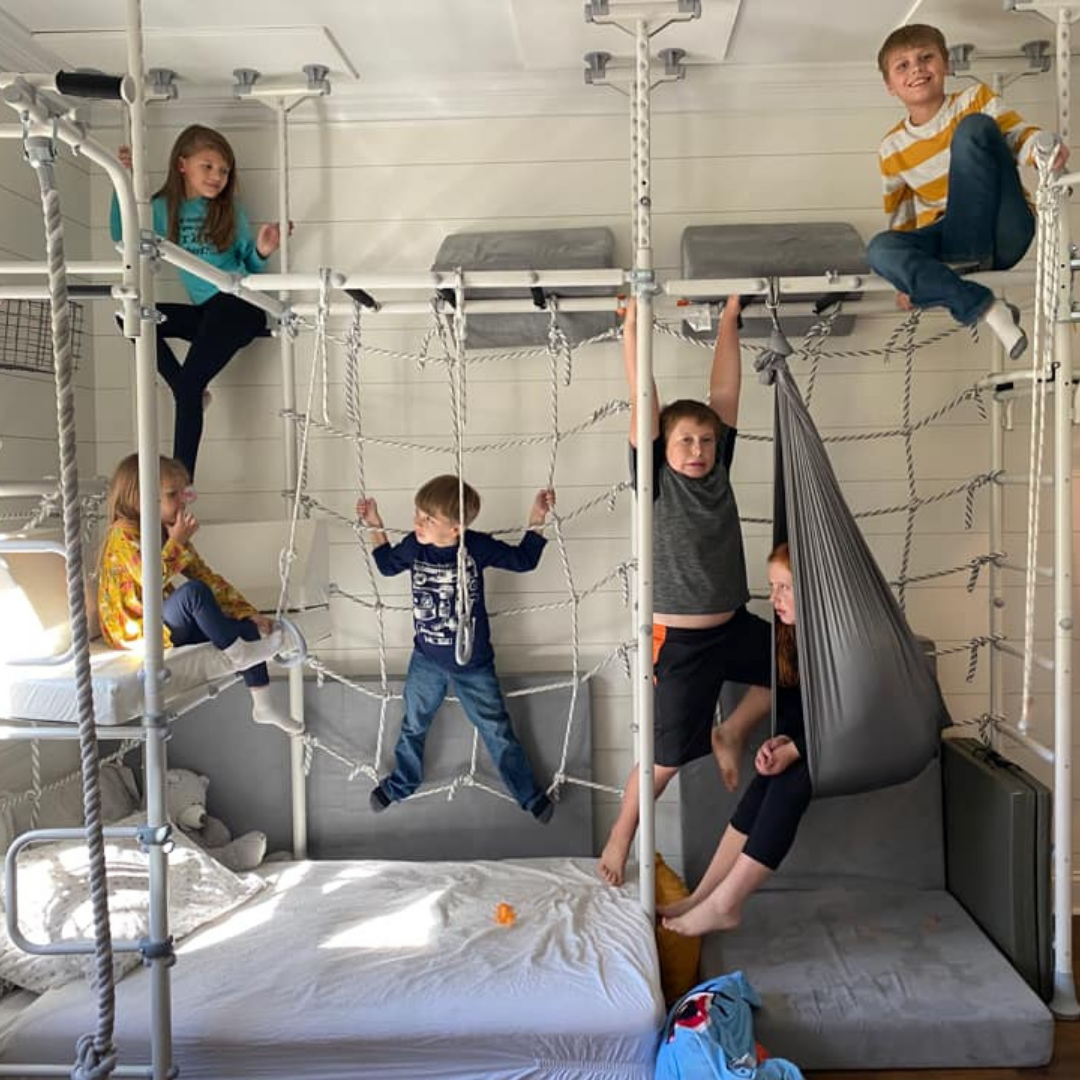
It is the first question almost every family asks us, and it is really three questions wearing one coat: is my child old enough, is my child too old, and how long before we outgrow it? Fair questions, because most kids' equipment is built for a two-year window and then becomes furniture. A Brainrich gym is built the opposite way: one steel frame, adjustable everything, a different job at every age. Here is the whole timeline, from a 3-year-old's first chest-height hang to a parent's morning pull-ups.
The quick answer: Brainrich play gyms are designed for ages 3 and up for independent climbing, and the same gym keeps working through the preteen and teen years because the bars are height-adjustable: they start at chest height for a 3-year-old and rise as skills grow. Children under 3 can enjoy supervised low play (swing seat, low hangs, hands-on spotting) but should not climb independently. The frame is rated to 220 lb and safety-tested to 440 lb, so parents use it too: pull-ups, hangs, and TRX-style suspension work. One gym, one footprint, a decade of users.
Jump to: Ages at a glance · Under 3 · Ages 3–4 · Ages 5–7 · Ages 8–10 · Ages 11+ · Parents · The outgrowing math · FAQ
Ages and stages at a glance
Every family's timeline differs a little, because the gym has no fixed difficulty and the child sets the pace. But across the thousands of families in our 12,500-member owner community, the stages are remarkably consistent:
| Age | What the gym is at this stage | Setup |
|---|---|---|
| Under 3 | Supervised low play only: swing seat, assisted hangs, watching siblings. No independent climbing. | Toddler swing, parent within arm's reach |
| 3–4 | First independent climbs: low bars, first dead hangs, bottom of the net | Bars at chest height, mats down |
| 5–7 | The mastery years: full monkey bar crossings, net fluency, swinging skills | Bars rising in increments as skills grow |
| 8–10 | The challenge years: rings, climbing rope, trapeze, skip-a-rung crossings, upside-down hangs | Bars at full height, accessories rotated in |
| 11+ | Hammock hangout, pull-up bar training, real strength work | Hammock, pull-up bar, dip station |
| Parents | Pull-ups, hangs, TRX-style suspension training, stretching | 220 lb rated, safety-tested to 440 lb |
Now the timeline in detail, starting with the most-asked question.
Under 3: welcome, but not solo yet
Let's answer it plainly, because plenty of families ask us with a determined 2-year-old already scaling the couch: Brainrich gyms are rated 3+ for independent climbing, and we hold that line. Under 3, the systems that make climbing safe, grip endurance, balance recovery, judgment about height, are still under construction, and no equipment design substitutes for them.
That does not mean younger siblings sit in the corner. Their chapter is supervised low play: a toddler swing seat hung from the frame, assisted hangs on a chest-height bar with your hands on their ribs, sitting on the bottom rung of the net while a big sibling climbs overhead. Eyes on, hands close, feet near the floor. Families with toddlers in occupational therapy use the frame this way too:
"Our almost-2-year-old can use it as an extension of OT! We've been able to attach her sensory swings and other attachments for her therapy."
– LARISSA N. & REBECCA P., PARENTS IN OCCUPATIONAL THERAPY, FROM OUR REVIEWS PAGE
That is attachment-and-supervision territory, not solo climbing, and the distinction matters. If your child is under 3, we wrote a whole guide to the toddler climbing progression: What Comes After the Pikler Triangle? The short version: many families buy while their oldest is 3 or 4 and their youngest is a baby, and the younger child grows up alongside the gym for years before their first solo climb, arriving at independence on a structure their body already knows.
Ages 3–4: low bars and first hangs
This is where independent climbing begins, and the key spec is one most shoppers skim past: the bars are height-adjustable, and they start at chest height. A 3-year-old facing a bar at their own chest faces a challenge sized exactly to them: grab, hang, feet an inch off the floor, let go, land. That is the whole curriculum for a while, and it is exactly the right one.
What ages 3–4 actually do on the gym:
💪 FIRST DEAD HANGS
Hanging from a chest-height bar builds grip and shoulder strength with the floor an inch away. This is the foundation every later skill sits on.
🕸️ THE BOTTOM OF THE NET
Two or three rungs up, then down, then up again. The net teaches feet and hands to work independently, and the child chooses the height every time.
🪢 SWINGING
A swing or rings set low trains the vestibular system, the balance machinery that makes every future climb steadier.
🏰 PRETEND EVERYTHING
At this age the frame spends half its life as a fort, a ship, or a castle. That is not a detour from development. That is development.
The non-toxic build matters most at this age, because 3-year-olds experience equipment with every sense they have: non-toxic powder-coated steel, non-toxic rubber-coated rungs, phthalate-free plastics. Small hands grip better on the rubber coating, and you never have to think about what those hands touch.
Ages 5–7: the monkey bar and net mastery years
Somewhere around age five, the gym changes jobs. The tentative bottom-of-the-net climber becomes a child who wants the whole structure, and the years from 5 to 7 are when the two signature skills get conquered: the full monkey bar crossing and top-of-the-net fluency.
The first unassisted rung-to-rung-to-rung crossing is a genuine childhood milestone, and it rarely happens in one day. It happens because the bars were low enough to try safely a hundred times: hang, reach, miss, drop six inches to a mat, try again. Adjustability is what turns the monkey bars from a pass/fail test into a curriculum. As the crossings get easy, the bars go up a notch, and the challenge is new again. (On V3 gyms the monkey bar run is also a foot longer with an extra rung than the V2 design, which means more crossing to master and a longer runway before it gets easy.) If your child is deep in this phase, we wrote a full stage-by-stage guide: the monkey bars age guide.
The net follows the same arc: by 6 or 7, most kids climb it the way they walk up stairs, without looking, mid-conversation. That fluency, hundreds of repetitions on the same familiar structure, builds the grip strength, coordination, and confidence that show up everywhere else, at recess, on equipment they have never seen. And this is the age where daily use peaks:
"Their most used toy by FAR, like by a landslide. They use it every day for hours."
– LEISA L., MOM OF 3, BRAINRICH OWNER
Ages 8–10: rings, rope, and trapeze challenges
Here is where lesser equipment gets abandoned, because an 8-year-old who has mastered a structure needs the structure to answer back. On a Brainrich gym, the answer is the accessory set and the vertical challenges:
Gymnastic rings
Skin-the-cat, tucked holds, ring swings. Rings are unstable on purpose, so every second on them trains the whole body.
Climbing rope
The classic full-body test. Most kids take months to get their first ascent, which is exactly what makes it worth having at home.
Trapeze bar
Knee hangs, upside-down time, and the big-kid swinging that a playground line never allows enough turns of.
Harder crossings
Bars at full height, skipping rungs, crossing backwards, racing a sibling's time. Kids invent the next level themselves.
Notice what happened to the monkey bars: the bars that sat at chest height five years ago are now at full height, crossed two rungs at a time. Nothing was replaced. The settings changed. This is also the age where the gym becomes the brain-break station between homeschool blocks and the thing that makes screen-time negotiations easier, because the alternative is genuinely more fun.
"As an early childhood special educator and mom, I wish I had this earlier. My kids, 7 and 9, still love this thing!"
– JEAN C., EARLY CHILDHOOD SPECIAL EDUCATOR, FROM OUR REVIEWS PAGE
Ages 11+: hammock and pull-up bar territory
Preteens do not stop using the gym. They change what it is for. The pretend-castle years end, and two new identities take over.
The hangout. Hang a hammock from the frame and the gym becomes the most contested real estate in the house: the reading spot, the headphones spot, the place a 12-year-old goes to be near the family without being in the family. A structure a preteen chooses to be on is a structure still doing its job.
The training rig. This is when the pull-up bar earns its keep: first negative pull-ups, then the first real one, then sets. Add the rings and the dip station and a middle-schooler has a legitimate bodyweight setup years before a gym membership makes sense. For a kid in sports, it is off-season strength work in the hallway. For a kid who is not, it may be the thing that makes strength feel like theirs.
Because the frame is steel rated to 220 lb, a growing teenager never ages out of the weight capacity the way they would on toddler-grade equipment. Which raises the obvious next question.
And yes, parents: it holds you too
Every Brainrich gym is rated for 220 lb and safety-tested to double that, 440 lb. That margin is why the frame does not wobble when an 8-year-old swings with full commitment, and why the gym moonlights as adult equipment:
PULL-UPS & HANGS
The pull-up bar at full height is dad-and-mom territory: morning pull-ups, dead hangs for shoulder health, grip work. The most-used piece of adult equipment is the one you walk past forty times a day.
SUSPENSION TRAINING
The frame anchors TRX-style suspension straps for rows, presses, and stretching, a full home workout hanging from the same steel your kids climb.
There is also a quieter reason the adult rating matters: you can climb with them. Spot a first crossing from inside the frame, not across the room. Lose a pull-up contest to your 13-year-old, which we are told builds their character and dents yours.
"My husband rolled his eyes when I said I wanted one. Now he agrees it's the best 'thing' we have ever purchased for our kids."
– JENNIFER A., MOM OF 3, BRAINRICH OWNER
The outgrowing math (or: why this is not a two-year toy)
Run the numbers on a typical family. Oldest child is 4 at purchase, youngest is 1. The 4-year-old climbs independently for the next eight or more years. The 1-year-old starts supervised low play now, solo climbing at 3, then runs their own eight-year arc. That is over a decade of daily use from one purchase, on one footprint, because the bars move as the skills grow: there is never a fixed difficulty to outgrow.
"The only thing we've ever given our children that's gotten played with every day for three years."
– RACHEL W., BRAINRICH OWNER, 3+ YEARS, FROM OUR REVIEWS PAGE
Three details finish the math:
The gym upgrades instead of expiring. Families who bought a V2 gym years ago did not need a new gym when V3 arrived: a Cross Bar V3 set with rope net ($395) or without ($325) converts a V2 frame to the current V3 architecture. Equipment that accepts upgrades is equipment designed to stay a decade.
Steel holds resale value. When the last child finally ages out, a powder-coated steel frame with no worn joints, splinters, or faded finish sells on to a second family at a strong fraction of the original price, which drives the true cost-per-year below almost anything else in the playroom. (It also ships like a Lego set, in multiple clearly marked boxes, so disassembling and rehoming it is a job, not a project.)
The risk of trying it is 30 days, not $899+. Every gym, from the Model T3 at $899 through the Spider V3 at $1,499, Spider Max V3 at $1,899, and Mega Max V3 at $2,399, carries a 30-day money-back guarantee that holds even after assembly and use. And because climbing gyms qualify as developmental equipment, many families purchase with HSA/FSA funds using a Letter of Medical Necessity, which effectively buys the decade with pre-tax dollars.
Which gym fits your family? Take the 60-Second Quiz →


Frequently asked questions
Can a 2-year-old use a Brainrich play gym? Not for independent climbing: Brainrich gyms are rated 3+ for climbing solo. A 2-year-old can absolutely enjoy the gym in supervised ways, a toddler swing seat, assisted hangs on a chest-height bar with a parent's hands on, sensory swing attachments, while an older sibling climbs. Many families buy while their youngest is 1 or 2, and that child grows up alongside the gym before their first solo climb at 3.
What age is a Brainrich gym designed for? Ages 3 and up for independent climbing, with no practical upper limit inside the 220 lb weight rating. Because the bars are height-adjustable, the same gym serves a chest-height first hang at 3, monkey bar mastery at 5–7, rings, rope, and trapeze challenges at 8–10, and hammock plus pull-up bar use at 11 and beyond.
Is a Brainrich gym good for teenagers? Yes, though the job changes: for teens the gym is a hammock hangout and a bodyweight training rig, pull-ups, dips, rings, hanging core work. The steel frame is rated to 220 lb and safety-tested to 440 lb, so a growing teenager never ages out of the capacity.
Can adults use a Brainrich play gym? Yes. The 220 lb rating (safety-tested to 440 lb) covers most adults for pull-ups, dead hangs, stretching, and TRX-style suspension training anchored to the frame. Parents also climb alongside young children to spot first crossings from inside the frame rather than across the room.
What age is too old for a play gym? In practice, none inside the weight rating. The gym's identity simply shifts with age: pretend fort at 4, monkey bar course at 6, challenge rig at 9, hammock-and-pull-up-bar station at 12, home fitness anchor for adults. Families stop using it when the last person in the house stops wanting to hang, swing, or train, which takes far longer than most buyers expect.
Will my child outgrow the gym in a year or two? The design works against that: height-adjustable bars mean the difficulty rises with the child instead of expiring, V2 frames convert to the current V3 architecture with a Cross Bar set, and a steel frame holds resale value when the family is truly done. A typical multi-child family gets a decade of daily use from one purchase, backed by a 30-day money-back guarantee, even after assembly.
Share: