

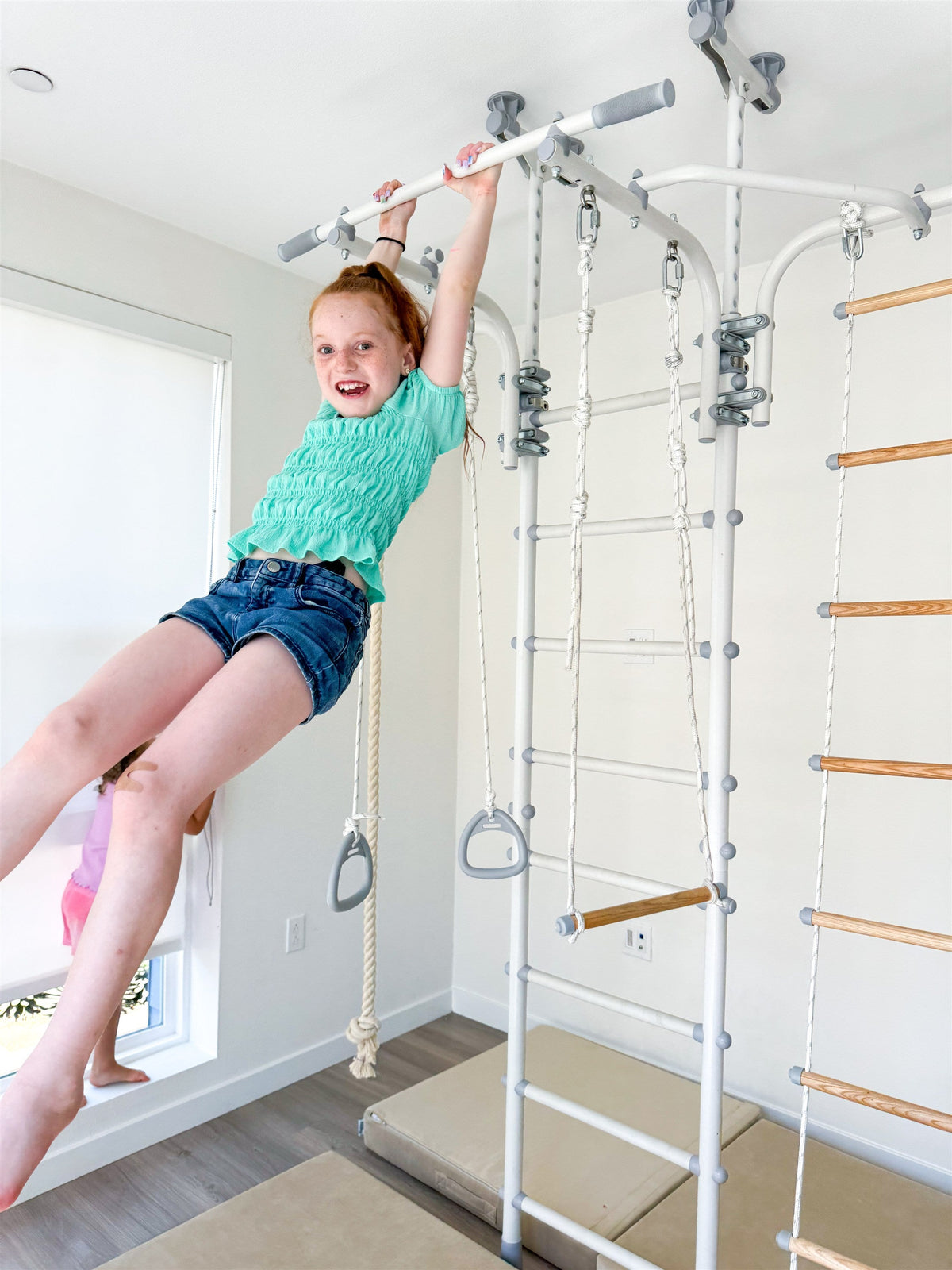
Published September 2026 · 15-minute read · by Yegor Nadvornyy, founder of Brainrich Kids
Monkey bars are the simplest piece of play equipment ever built: a ladder turned on its side. Every question parents ask about them has a number hiding in it: how high, how far apart, what age, what goes underneath, what a good set costs. This is the hub for all of it: where monkey bars came from, every type you will meet around the world, a sizing chart by age and height, what the safety standards actually say, a maintenance schedule, real cost ranges, and a router at the end that sends you to the right deep guide.
The quick answer: monkey bars are a horizontal (overhead) ladder that a child crosses hand over hand, a movement called brachiation. The U.S. Consumer Product Safety Commission (CPSC) treats them as "upper body equipment" and says 4-year-olds are generally the youngest children able to cross them. On public playgrounds the bar tops out at 60 inches for ages 4 and 5 and 84 inches for school-age children, with rungs no more than 12 and 15 inches apart. At home the rule is simpler: the child reaches the first rung from a ladder rung, hangs with feet a few inches above a mat, and the bar goes up as the child does. Monkey bars are never a stand-alone object. They always need two supports: posts in a yard, platforms at a park, or two floor-to-ceiling ladders in a room.
Jump to: What they are · History · Types worldwide · Sizing chart · Safety standards · What goes underneath · Indoor or outdoor · Maintenance · Cost ranges · Which monkey bars are right for you · FAQ
What monkey bars are, in one paragraph
A set of monkey bars is a row of parallel rungs held overhead by two rails, high enough that a child hangs by the hands with feet off the ground and travels from one end to the other. Standards documents never say "monkey bars." They say horizontal ladder or overhead ladder, and they group it with overhead rings and track rides as upper body equipment: equipment "designed to support a child by the hands only." That definition explains everything else in this guide. The whole child hangs from two hands, so grip, rung size, spacing, height, and the surface underneath all matter more than they do on a ladder a child stands on.
What crossing does for a child's grip, shoulders, and coordination, and how to teach it in four steps, is its own article: Monkey Bars for Kids. This page is the map around it.
History: from the tree branch to the playroom
The movement is older than the equipment. Brachiation, traveling by swinging from one handhold to the next, is how gibbons cross a forest canopy. Humans kept the hardware for it: a shallow, mobile shoulder socket, a long collarbone, and a hand that can carry body weight. A child who hangs from a bar is using anatomy that predates every playground.
The gymnasium came first. The horizontal ladder was adult training equipment long before it was a toy. The gymnastics halls of the 1800s, from Per Henrik Ling's Swedish system to the German gymnastics clubs, used wall bars, beams, climbing ropes, and overhead ladders to build the upper body. The Swedish wall bar survives almost unchanged, and it is the ancestor of every home gym we make (the story is in the Swedish ladder guide).
The playground arrived in 1920. Sebastian Hinton, a Chicago lawyer, filed his "climbing structure" patent on July 22, 1920 (granted in 1923 as U.S. Patent 1,471,465) and trademarked it as the Junglegym. His patent text appeals to what he called the "monkey instinct" in children, and the name followed the idea: the term "monkey bars" shows up in print at least as far back as the 1930s. Over the following decades the overhead ladder split off from the cube-shaped jungle gym and became the separate piece of equipment we now mean by the words. The jungle gym side of the family tree is in our jungle gym guide.
Hinton did not invent hanging. He noticed that children do it without being asked, and he argued that the instinct deserved a structure built for it. A century later that is still the whole design brief: a bar that holds, at a height the child earned, over a surface that forgives.
U.S. PATENT 1,471,465 · FILED JULY 22, 1920
The brachiation ladder came home in the 1950s. Glenn Doman founded the Institutes for the Achievement of Human Potential in 1955 and later made an overhead "brachiation ladder" a centerpiece of the physical programs described in How to Teach Your Baby to Be Physically Superb. Those are parent-led programs for babies and toddlers; our frames are built for independent climbing from age 3, so we describe his work and do not borrow its claims. The details are in the brachiation ladder and the Doman method. The same decades gave occupational therapists their vocabulary for hanging: A. Jean Ayres's sensory integration work is where the idea of "heavy work" comes from.
And then it moved indoors. In much of Europe the steel home gym, two ladders braced floor to ceiling with a ladder across the top, has been a bedroom fixture for generations. I grew up on one in Ukraine, and it is still standing about 35 years later. Brainrich exists because that object was missing from American homes.
Types of monkey bars around the world
The object is universal and the names are wonderful. In the United States, Canada, the UK, and Australia it is monkey bars (on a British "climbing frame"). In Germany it is a Hangelleiter, a "hand-over-hand ladder." In Sweden it is armgång, "arm walk." In Japan it is untei, written with the characters for "cloud ladder," and a familiar sight in elementary schoolyards. In much of Latin America it is pasamanos, "pass the hands." Every one of those names describes the movement, not the object.
| Type | Where you find it | What it is good at | Watch for |
|---|---|---|---|
| Straight horizontal ladder | Parks, schools | The classic crossing; even rungs; easy to measure progress | School-age height (up to 84 in) is too tall for most 5-year-olds |
| Arched ("rainbow") ladder | Parks, older schoolyards | Doubles as a climber; low at both ends | Kids climb over the top, which raises the fall height |
| Overhead rings (ring trek) | Parks, ninja courses | Swinging handholds; harder timing; the next step after rungs | The CPSC caps heights the same way as ladders; not for under 4 |
| Backyard A-frame or post set | Home yards, often on a swing set | Long runs, fresh air, room for friends | Needs anchoring, level ground, deep surfacing, and the weather's permission |
| Geodesic dome | Yards, parks | Climbing at every height for ages 3 to 6 | Not a true traverse: no level run of rungs (see dome vs gym) |
| Ceiling-mounted ladder | Basements, garages, playrooms | Zero floor footprint | Everything depends on the joists; fixed height (see the ceiling-mount install guide) |
| Tension-mounted frame (floor to ceiling) | Bedrooms, living rooms, basements | No drilling; adjustable bar height; ladders, net, rings, and swing on the same frame; used every day of the year | Needs a flat, solid ceiling between 6 ft 9 in and 10 ft 6 in |
| Wall-mounted bars | Any wall with studs | Stands 9 inches off the wall; works under slanted ceilings | A hanging and pull-up station more than a long traverse |
The outdoor rows and the indoor rows are not rivals. We love a park ladder on a good day. The indoor types exist for the other days: the heat advisory, the week of rain, mosquito season at dusk, a 4:30 p.m. sunset in December.
Sizing chart: bar height and rung spacing by age and height
Three measurements decide whether a child can use a set of monkey bars: how high the bar is, how far apart the rungs are, and how thick they are. The public-playground numbers come from the CPSC handbook. The home numbers are a rule of thumb you should check against your own child, and the check takes one minute: stand the child on the mat, arms straight up, and measure to the middle of the palm. That is their standing grip reach, usually about 1.15 to 1.2 times their height. A home bar set 3 to 4 inches above that lets them hang with straight arms and feet just clear of the mat, which keeps the drop tiny.
| Age | Typical height | Standing grip reach (about) | Home starting bar height, from the top of the mat | Public playground maximum (CPSC) | Stage |
|---|---|---|---|---|---|
| 3 | 36 to 39 in | 43 to 45 in | 46 to 49 in | Not recommended on public equipment | Two-hand hangs, parent's hands close |
| 4 | 39 to 42 in | 46 to 49 in | 49 to 53 in | 60 in; rungs up to 12 in apart | Swinging hangs, first assisted reaches |
| 5 | 41 to 45 in | 49 to 52 in | 52 to 56 in | 60 in; rungs up to 12 in apart | First full crossings for many |
| 6 to 7 | 44 to 50 in | 52 to 58 in | 55 to 62 in | 84 in; rungs up to 15 in apart | Crossing is typical |
| 8 to 10 | 49 to 57 in | 58 to 66 in | 61 to 70 in | 84 in; rungs up to 15 in apart | Skipping rungs, crossing backward |
| 11 to 12+ | 55 to 62 in | 65 to 72 in | 68 to 76 in | 84 in; rungs up to 15 in apart | The bars become a pull-up station |
Typical heights are rounded from CDC growth charts. Grip reach and home bar heights are estimates; measure your own child. Public maximums are from the CPSC Public Playground Safety Handbook, section 5.3.2, measured from the center of the rung to the top of the protective surfacing.
The chart shows the problem with a fixed-height ladder. A bar set for a 10-year-old forces a 5-year-old to jump for it or be lifted, which puts a child at a height their own skill did not earn. The fix is an adjustable bar, not a compromise height. On a tension-mounted frame every horizontal bar moves up the ladders as the child grows.
Rung spacing
CPSC: more than 9 inches between rungs (so a head cannot lodge), no more than 12 inches center to center for ages 4 and 5, no more than 15 for school-age. Even spacing for preschoolers.
Rung diameter
CPSC: 0.95 to 1.55 inches for hand-gripped rungs. Small hands do best near 1 to 1.25 inches. Rungs should be round and must not rotate.
First handhold
CPSC: 8 to 10 inches out from the access rungs and never directly above them, so a slip at the start does not land on the ladder.
Room for the run
Indoors, a Spider V3 stands in about 8 ft 6 in by 4 ft 7 in. Leave about 12 inches behind the frame and keep the span clear of walls, furniture, and beds.
Ceiling height picks the version, not the child: Short for 6 ft 9 in to 9 ft 1 in, Standard for 7 ft 8 in to 9 ft 11 in, Tall for 9 ft 4 in to 10 ft 6 in. Low ceilings are covered in the basement monkey bars installation guide, and tight rooms in monkey bars that fit a compact space.
Safety standards: who writes the rules
There are three documents behind almost every monkey bar safety claim you will read, and they cover different places.
1. CPSC Public Playground Safety Handbook (Publication 325). Free, readable, and the source of the height and spacing numbers above. It is guidance, not law, though many states and school districts adopt it. On age it is blunt: 4-year-olds are generally the youngest children able to use overhead equipment, so horizontal ladders should not be on playgrounds meant for toddlers and 3-year-olds.
2. ASTM F1487, the public-use standard. The technical specification for playground equipment in parks, schools, and childcare centers, for ages 2 through 12. Commercial makers build to it and certified inspectors audit against it.
3. ASTM F1148, the home standard. The consumer specification for home playground equipment, written for children from over 18 months through 10 years. It addresses entrapment openings, protrusions, sharp edges, stability, and the link between fall height and protective surfacing in a backyard.
Plus one for the ground: ASTM F1292. The impact test for surfacing. When a rubber tile or an engineered wood fiber says it is rated to a "critical fall height" of 8 feet, F1292 is the test behind that number.
What should a parent do with this? Ask any seller which standard the product was designed around, and what load it was tested to, in pounds. Ours: every Brainrich frame carries a 220 lb working load and is safety-tested to 440 lb, because two school-age kids plus momentum is the load a span really meets.
The handbook also explains why supervision language matters. The CPSC counts more than 200,000 emergency-room-treated playground injuries a year, and in its most recent review of incident reports, falls were the most common hazard pattern at 44 percent, followed by equipment failures such as breakage, tip-over, and poor assembly at 23 percent. The bar rarely hurts anyone. The landing does, and sometimes the hardware does. The at-home do-and-skip list is in Monkey Bars for Kids, and the toddler-specific version is in safest monkey bars for toddlers.
What goes underneath
The CPSC treats the ground as part of the equipment. For upper body equipment, fall height is measured from the highest part of the equipment to the surface, and the surfacing has to be rated for that height across a use zone that extends 6 feet in every direction.
| Loose-fill material | Compressed depth | Protects to a fall height of |
|---|---|---|
| Shredded or recycled rubber | 6 in | 10 ft |
| Wood chips | 9 in | 10 ft |
| Wood mulch (not CCA-treated) | 9 in | 7 ft |
| Pea gravel | 9 in | 5 ft |
| Sand | 9 in | 4 ft |
Source: CPSC Public Playground Safety Handbook, Table 2. Loose fill compresses at least 25 percent over time, so 9 inches of wood chips means filling to 12. The handbook lists grass, dirt, asphalt, and concrete as inappropriate surfacing.
Two lessons travel indoors. Sand and lawn protect far less than people assume, and the smartest surfacing decision is a lower fall. An indoor bar set so the child's feet hang a few inches above a firm mat makes the fall a step down, not a drop. Carpet and rugs are not surfacing. A fitted play mat under the full span, extended past both ends where dismounts happen, is.
Indoor or outdoor: a two-question decision
Question one: how many days a year will the bars be usable? Crossing is built by short daily hangs, not by a big Saturday. Subtract ice, heat index, rain, dark, and mosquito season from your yard's calendar and see what is left. Indoor bars are there 365 days a year.
Question two: what do you own, and for how long? A backyard set needs level ground, anchoring, and a surfacing bed, and it stays with the house. A ceiling-mounted ladder needs verified joists. A tension-mounted frame needs a flat ceiling and comes down in an afternoon when you move, which is why renters favor it (see freestanding indoor monkey bars).
Plenty of families do both. The full side-by-side is in monkey bar sets for home.
Maintenance: the schedule nobody prints on the box
Equipment failure was the second-largest hazard pattern in the CPSC's data, and most of it is preventable with a wrench and ten minutes.
| When | Outdoor monkey bars | Indoor monkey bars |
|---|---|---|
| Every use | Touch the bars in summer (metal in full sun can burn); clear toys and debris from the landing zone | Mat in place under the span; necklaces, drawstrings, and hooded cords off |
| Monthly | Rake loose fill back under the ends, where it gets kicked out; check depth against a marked post | Check every bolt and connector by hand; push the top of the frame and confirm nothing shifts; re-check ceiling pressure on tension-mounted frames |
| Each season | Tighten all hardware; look for rust at welds and joints; on wood, check for splinters, cracks, and rot at ground level; confirm anchors are still buried and firm | Raise the bar to match the child's new reach; inspect ropes, nets, and straps for fraying; wipe rubber-coated rungs with mild soap |
| Retire it when | A rung rotates, a weld cracks, wood is soft at the base, or rust has pitted a load-bearing tube | A part is bent or a connector is stripped. Replace the part, not the habit; steel frames accept replacement parts for decades |
What monkey bars cost: outdoor, indoor, and commercial
The ranges below are approximate U.S. retail figures as of September 2026, gathered from public listings; commercial equipment is usually quoted, not listed. Brainrich prices are exact, and they do not move, because we do not run sales.
| Category | Typical price | What is not in the price |
|---|---|---|
| Light backyard metal set | About $250 to $700 | Surfacing, anchoring; per-child limits near 110 lb are common |
| Heavy backyard steel set | About $1,000 to $3,500 | Concrete footings, surfacing bed (often $300 to $1,000 more), a weekend |
| Wooden swing set with a monkey bar arm | About $1,500 to $6,000+ | Installation, sealing every year or two, surfacing |
| DIY ceiling or backyard build | About $150 to $600 in materials | Your time, and any tested load rating at all (see DIY vs buying) |
| Indoor steel frame with monkey bars built in | Spider V3 $1,499 · Spider Max V3 $1,899 · Mega Max V3 $2,399 | A mat. No drilling, no surfacing bed, no installer. Tall-ceiling versions cost more |
| Monkey bars add-on for a frame you own | Monkey Bars V3 $699 ($749 Tall) | The frame. This is an attachment, not a stand-alone unit |
| Commercial freestanding overhead ladder | About $3,000 and up for the component | Freight, certified installation, engineered surfacing, which together often exceed the equipment |
The number that matters is cost per use: days a year, times years of use. With a qualifying diagnosis and a Letter of Medical Necessity, a play gym may be eligible for HSA/FSA funds; the plan administrator decides.
Which monkey bars are right for you?
Find your sentence. Follow the link.
"I want to know what age, what benefits, and how to teach it." → Monkey Bars for Kids: ages, benefits, the four-step traverse
"I am shopping for a set and do not know what a set includes." → Monkey Bar Sets for Home
"It is going in the basement." → Basement Monkey Bars: the installation guide (low ceilings, ducts, concrete, humidity)
"I rent, or I refuse to drill." → Freestanding Indoor Monkey Bars
"I want bars bolted to my ceiling joists." → How to Install Ceiling-Mount Monkey Bars
"My child is 2 to 4." → Safest Monkey Bars for Toddlers
"The room is small." → Monkey Bars That Fit a Compact Space
"I want a swing under the bars." → Monkey Bars With Swings
"My child's OT talks about heavy work." → Indoor Monkey Bars Are Sensory Equipment
"My 10-year-old wants pull-ups." → Pull-Up Bar Gymnastics for Kids
"Spider V3 or Spider Max V3?" → the model comparison, with footprints and placement rules
How the Brainrich line handles monkey bars. Monkey bars are an attachment, never a stand-alone unit, because a span needs two supports. The Spider V3 comes with the monkey bars built in: two floor-to-ceiling steel ladders, the span between them, a net, a rope, and rings. The Spider Max V3 has two spans, which is why it is our most popular model: the spans double as bays for a hammock or nest swing. The Monkey Bars V3 add-on is for families that already own a Brainrich frame. It supplies one more ladder plus the span and uses your existing frame as the other support, so a Model T3 plus the add-on becomes a Spider V3.


Monkey bars for the other 200 days a year
Steel, 220 lb working load tested to 440, no drilling, 30-day money-back guarantee. Ages 3 to 12+, with a parent in the same room.
Frequently asked questions
What are monkey bars? Monkey bars are a horizontal, overhead ladder that a child crosses hand over hand with feet off the ground. Safety standards call them a horizontal ladder and classify them as upper body equipment, meaning equipment that supports a child by the hands only. They always span two supports, such as posts, platforms, or floor-to-ceiling ladders.
Why are they called monkey bars? The name comes from the movement. Sebastian Hinton's 1920 jungle gym patent appealed to what he called the monkey instinct in children, and the term monkey bars appears in print at least as far back as the 1930s. Other languages name the movement too: armgång (arm walk) in Swedish, Hangelleiter in German, untei (cloud ladder) in Japanese, and pasamanos in Spanish.
How high should monkey bars be? On public playgrounds the CPSC handbook sets a maximum of 60 inches for ages 4 and 5 and 84 inches for school-age children, measured from the rung to the surfacing. At home, set an adjustable bar 3 to 4 inches above the child's standing grip reach, so they hang with straight arms and feet just clear of a mat, and raise it as they grow.
Can I buy monkey bars on their own? Not as a working unit. A span needs two supports. The Brainrich Spider V3 comes with the monkey bars built in, and the Monkey Bars V3 add-on ($699) is for families that already own a Brainrich frame such as the Model T3, which supplies the second support.
How much do monkey bars cost? As of September 2026, light backyard metal sets run about $250 to $700, heavy backyard steel sets about $1,000 to $3,500 before surfacing, and commercial overhead ladders about $3,000 and up before installation. Brainrich indoor steel frames with monkey bars built in are $1,499 for the Spider V3, $1,899 for the Spider Max V3, and $2,399 for the Mega Max V3.
📚 Keep reading in the Decision Guide
Monkey Bars for Kids · Monkey Bar Sets for Home · Basement Monkey Bars Installation · Freestanding Indoor Monkey Bars · Ceiling-Mount Monkey Bars · The Jungle Gym Guide
Sources
U.S. Consumer Product Safety Commission. Public Playground Safety Handbook (Publication 325): section 1.7 (injury data), section 2.4 and Table 2 (surfacing), section 5.2.2 (rung diameter), section 5.3.2 (horizontal ladders, overhead rings, track rides). · ASTM International. ASTM F1487, Standard Consumer Safety Performance Specification for Playground Equipment for Public Use; ASTM F1148, Standard Consumer Safety Performance Specification for Home Playground Equipment; ASTM F1292, Standard Specification for Impact Attenuation of Surfacing Materials Within the Use Zone of Playground Equipment. · Hinton, S. (1923). Climbing structure. U.S. Patent 1,471,465, filed July 22, 1920. · Doman, G. et al. How to Teach Your Baby to Be Physically Superb. The Institutes for the Achievement of Human Potential (founded 1955). · Ayres, A. J. Sensory Integration and the Child. · CDC. Growth charts (typical stature by age). · Retail price ranges: public U.S. listings reviewed September 2026; Brainrich prices from brainrichkids.com on the publication date. · Brainrich Kids engineering specification: frame working load 220 lb, safety-tested to 440 lb; ceiling-height versions and footprints per product documentation.
Share: