

Published September 2026 · 10-minute read · by Yegor Nadvornyy, founder of Brainrich Kids
An occupational therapist says "we should put together a sensory diet," and half the parents in the room quietly wonder what food has to do with it. Nothing, it turns out. A sensory diet is one of the most practical tools in all of pediatric OT, and once you understand the logic, you can run a good one at home with a printed schedule and a corner of a room. Here's the whole concept, plus a complete sample day you can copy tonight.
The quick answer: a sensory diet is a planned schedule of sensory activities, delivered through the day, that keeps a child's nervous system regulated, exactly the way planned meals keep blood sugar steady. The term was coined by occupational therapist Patricia Wilbarger in the 1980s. The core move: give input before it's needed (before school, before homework, before bed) instead of reacting after dysregulation hits. Activities come in three flavors: alerting (wakes the system up), organizing (focuses it), and calming (settles it), and the daily rhythm alternates them around the child's real schedule. An OT personalizes it best; the sample day below shows the shape.
Jump to: What it is (and isn't) · How it works · The three input types · The sample day · How to tell it's working · FAQ
📥 Free printable: The Sensory Diet Starter Kit
This whole article as a 5-page system: the 26-activity Dose Menu, the fridge-door day, and the Two-Week Dots tracker your child colors. No blank forms, ready tonight.
What a sensory diet is (and isn't)
The term comes from Patricia Wilbarger, the occupational therapist who coined it in 1984, building on A. Jean Ayres's sensory integration framework. Wilbarger's insight was dietary in structure, not content: nervous systems, like bodies, do best on scheduled, balanced intake rather than famine-and-binge. A child who gets rich movement and pressure input at planned intervals spends the day regulated; a child who gets none until they're already melting down is being asked to run on empty and then blamed for the stall.
What it isn't: a food plan, a punishment-and-reward chart, or a rigid clinical protocol only professionals can touch. It's a rhythm. OTs personalize the specific activities to the child's profile (a seeker needs bigger doses; an easily overwhelmed child needs gentler, more predictable ones), but the architecture is the same for everyone, and parents run it day to day.
How it works: input before demand
The single most important idea, worth a highlight: a sensory diet is proactive, not reactive: the input comes before the demand, not after the meltdown. Ten minutes of hanging, climbing, and swinging before homework buys thirty minutes of seated focus. Deep pressure before a grocery store buys the trip. The nervous system arrives at the hard thing already fed.
The heaviest lifting in most diets is done by two senses most parents never learned in school: proprioception (muscle-and-joint work: the great organizer, nearly impossible to overdose) and the vestibular sense (motion: powerful in both directions, dosed with more care). Most scheduled "doses" are built from those two, with touch, sound, and oral input as supporting players.
The three input types
☀️ ALERTING
Wakes up a sluggish system: fast swinging, spinning (carefully dosed), jumping, cold water on the face, crunchy snacks, upbeat music. Use before demands that need energy, never near bedtime.
🧭 ORGANIZING
Focuses and grounds: hanging from a bar, climbing, monkey bars, pushing and pulling, carrying, chewy snacks, wall push-ups. The proprioceptive core of every diet, safe almost any time.
🌙 CALMING
Settles an overloaded system: slow linear swinging, deep pressure, cushion sandwiches, warm baths, dim light, slow rocking. Use after intensity and in the runway to sleep.
A full sample day (school-age, movement-seeking profile)
| Time | Dose | Type |
|---|---|---|
| 7:00 wake-up | 5 minutes on the home gym: hang from the bar, 3 climbs to the top, 10 big swing pumps | Alerting + organizing |
| 7:40 before school | Backpack carried to the car by the kid (add a water bottle for weight); crunchy breakfast element | Organizing |
| School hours | Whatever the school allows: recess maximized, chair push-ups, a chewy pencil topper, errand jobs that involve carrying (ask the teacher for the "heavy helper" role) | Organizing |
| 3:30 after school | The big dose, 20-30 minutes: climbing, monkey bars, swinging, crash-pad jumps, or playground. This is the non-negotiable meal of the day | Alerting → organizing |
| 4:30 homework | 2 minutes of wall push-ups or bar hangs first; movement break every 15-20 minutes | Organizing |
| 5:30 pre-dinner | Kitchen jobs with force: kneading, stirring thick batter, carrying plates, wiping the table hard | Organizing |
| 7:00 downshift begins | Last intense movement ends; warm bath; pajamas straight from the dryer | Calming |
| 7:45 runway to bed | Cushion sandwich squeeze, slow rocking or slow linear swinging, books in dim light, weighted blanket if your pediatrician approves | Calming |
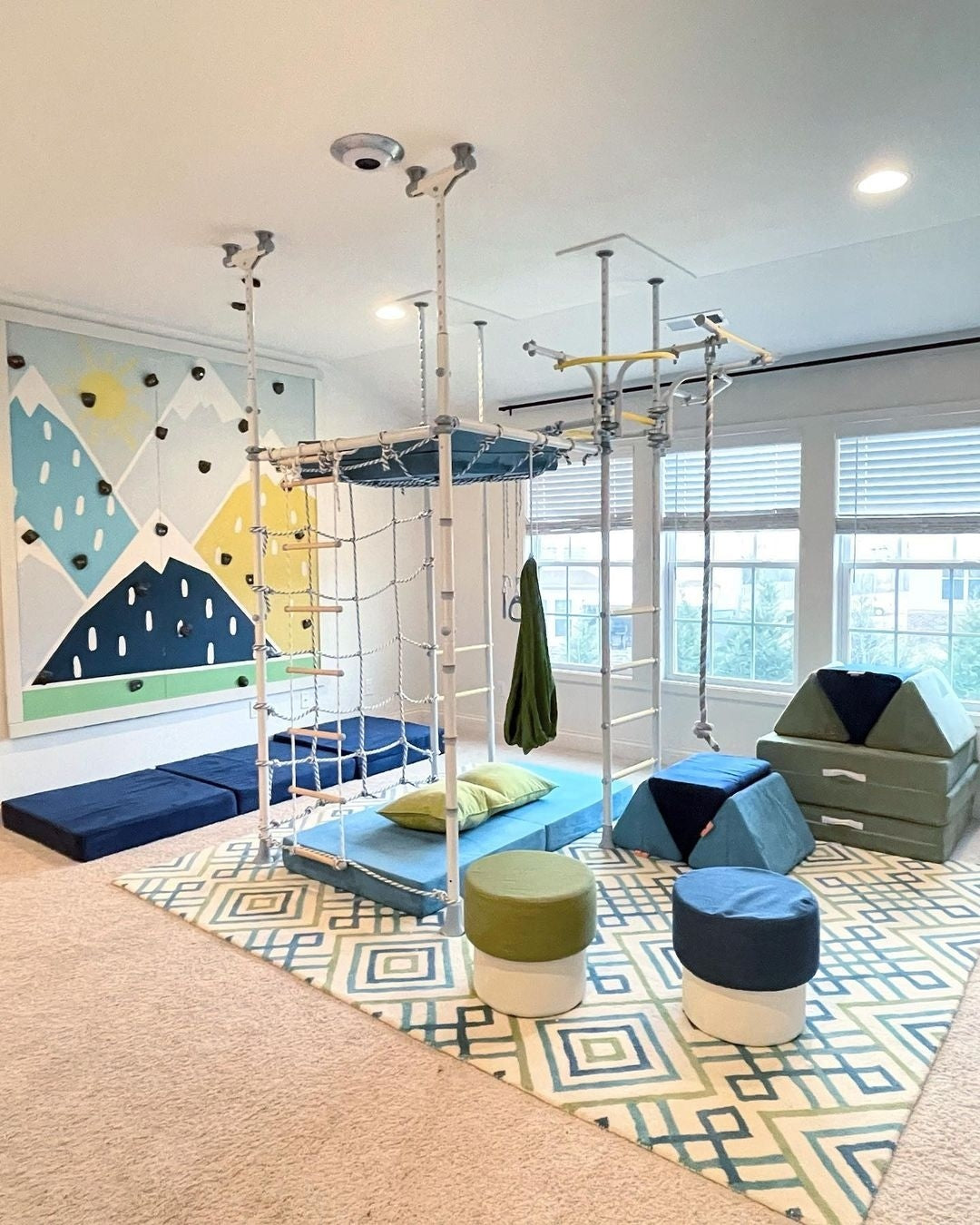
Adjust the doses to your child: easily overwhelmed kids get the same schedule with gentler intensities and more predictability (same order every day matters more than duration). The at-home station matters more than any single activity: when the climbing, hanging, and swinging equipment lives three steps from the homework table, the diet runs itself. That's the design brief behind building a sensory gym at home.
How to tell it's working
Give it two weeks and watch four dials: transition friction (leaving the house, starting homework, starting bed), meltdown frequency and recovery time, sleep onset, and the child's own requests (kids on a working diet start asking for their input: "can I swing first?" is the system learning to feed itself, and it's the actual goal). If nothing moves in two weeks, the doses are probably wrong for the profile, which is precisely the moment an OT evaluation pays for itself: a professional can map whether your child needs more intensity, different senses, or a different schedule. Organizations like the STAR Institute can help you find sensory-trained providers.
The station that runs the whole diet
Morning hangs, the after-school big dose, homework breaks, and the slow bedtime swing, one steel frame covers every scheduled dose. No drilling, 30-day money-back guarantee.
Frequently asked questions
What is a sensory diet? A planned schedule of sensory activities, delivered at set points through the day, that keeps a child's nervous system regulated, the way planned meals keep blood sugar steady. It has nothing to do with food: the "diet" is movement, pressure, and other sensory input. The term was coined by occupational therapist Patricia Wilbarger in the 1980s.
What does a sensory diet look like for an autistic child? The same architecture as any sensory diet, personalized harder: scheduled doses of the input that child's profile needs, delivered before demands. For many autistic kids that means substantial proprioceptive input (hanging, climbing, deep pressure) at regular intervals, carefully dosed vestibular input like swinging, predictable ordering, and calming pressure in the bedtime runway. An OT personalizes the specifics.
Is there a sensory diet template or PDF I can use? The sample day in this article is a copyable starting shape: morning dose, pre-school heavy work, the big after-school session, homework micro-breaks, and a calming bedtime runway. Personalize the activities to your child's profile and, ideally, review the plan with an occupational therapist, since the right doses differ between seekers and easily overwhelmed kids.
How long until a sensory diet works? Watch for movement within about two weeks on four dials: easier transitions, fewer and shorter meltdowns, faster sleep onset, and the child starting to request their input. If nothing changes, the activity mix is likely mismatched to the profile, which is the signal to bring in an OT rather than to abandon the approach.
Do sensory diets work for ADHD too? The structure transfers well: many ADHD kids focus noticeably better after scheduled movement and heavy work, which is why movement breaks before and during homework are a standard recommendation. The same input-before-demand logic applies; only the personalization differs.
📚 Keep reading in the Decision Guide
Heavy Work Activities for Kids · Proprioception Explained · Sensory Seekers: The Signs and the Science
Sources
Wilbarger, P. (1984). Planning an adequate sensory diet: Sensory processing from a developmental perspective. Zero to Three. · Ayres, A.J. (1972). Sensory Integration and Learning Disorders. Western Psychological Services. · Kranowitz, C. (2005). The Out-of-Sync Child. Perigee. · STAR Institute for Sensory Processing. sensoryhealth.org.
Share: