

Updated August 2026 · 11-min read · by the Brainrich Kids team
Search "homeschool room ideas" and the internet hands you a converted barn with a wall of built-ins, a farmhouse table for eight, and a reading loft with a ladder. Lovely. You have a two-bedroom apartment, a kitchen table that hosts three meals a day, and a hallway closet that is already losing a war with winter coats. Here is the part the barn photos never tell you: some of the most functional homeschool spaces we have ever seen fit inside 40 square feet, and the families running them would not trade up. This is the small-space playbook.
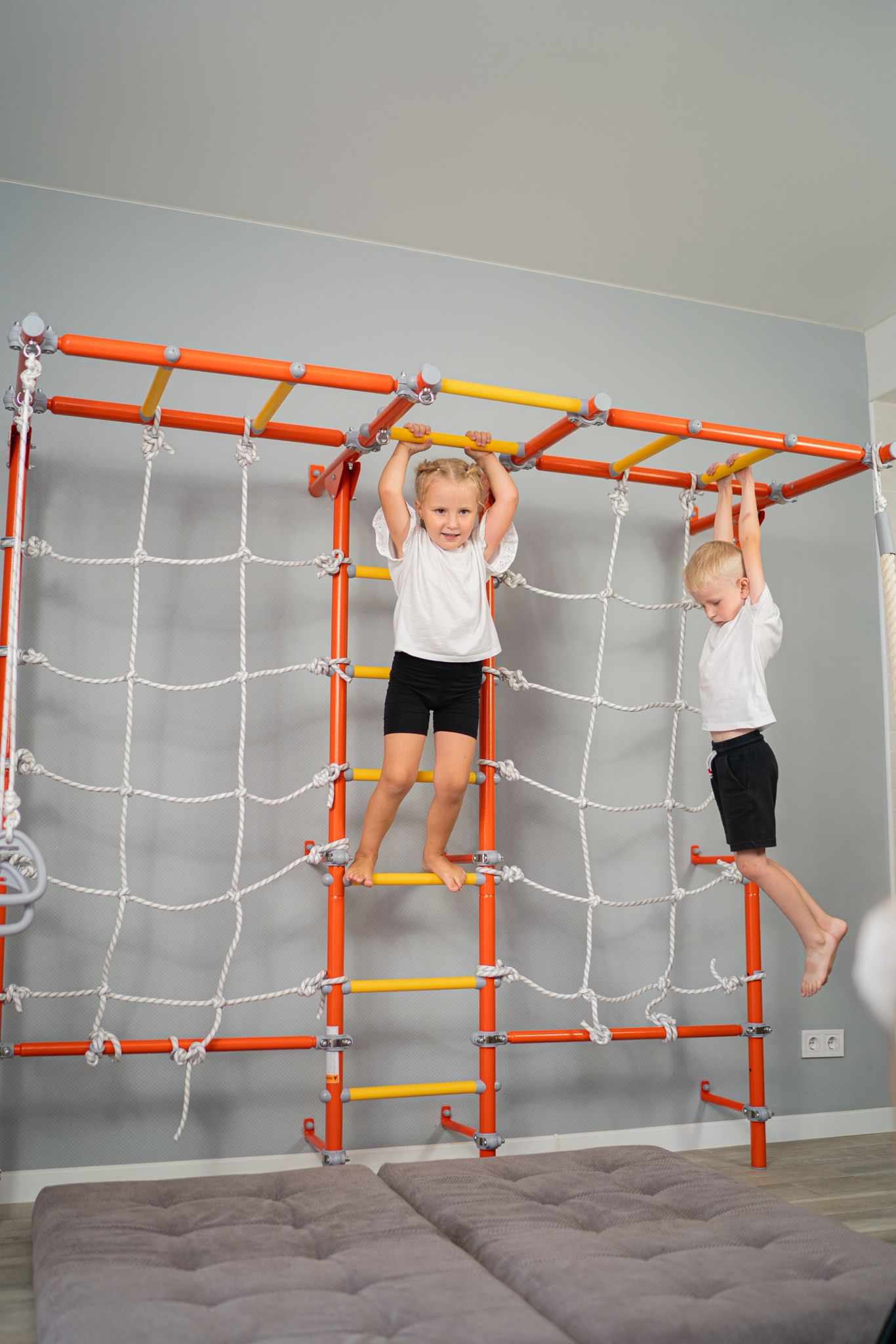
The quick answer: you do not need a homeschool room. You need three or four dedicated zones: a work surface, storage that closes, a quiet reading spot, and a movement zone, and each one can be a corner, a cart, or a stretch of wall rather than a room of its own. The most under-used asset in a small home is vertical space: a wall-mounted Swedish ladder or a compact floor-to-ceiling gym turns one corner into a full movement zone with almost zero floor footprint, which matters because the child with no recess bell still needs recess. Zones, not rooms. Walls, not floors.
Jump to: Zones, not rooms · Living-room corners · Bedrooms & shared rooms · Closet & cart systems · The vertical movement zone · What to skip · FAQ
The zones-not-rooms principle
Roughly 3.4 million children homeschool in the United States, and the majority of them do not learn in a dedicated schoolroom, because the majority of American homes do not have a spare one. Yet the Pinterest ideal persists, and it quietly convinces apartment and townhouse families that they are doing it wrong. They are not. A dedicated room is a luxury. What learning actually requires is far cheaper: predictability. A child works better when math happens in the same spot every day, when the pencils live in the same drawer, and when there is a known place to put their body when it needs to move.
That is a zoning problem, not a square-footage problem. Before you rearrange a single piece of furniture, walk your home and assign four jobs:
✏️ THE FOCUS ZONE
One work surface with a clear top and good light. The kitchen table counts, if it can be reset for school in under two minutes. The surface matters less than the ritual of clearing it.
📦 THE STORAGE ZONE
Everything school-related lives in one closable place: a cart, a cabinet, a closet shelf. When storage closes, the school day can end, which protects the rest of the home for family life.
📖 THE QUIET ZONE
A reading chair, a floor cushion behind the sofa, a bottom bunk with a clip light. It needs softness and a boundary, not walls. This is where read-alouds and decompression happen.
🤸 THE MOVEMENT ZONE
The one zone small-space families cut first, and the one that keeps the other three functional. A homeschooled child has no recess bell. Between-lesson movement is what makes the focus zone work.
Notice what is missing from that list: a teacher desk, a whiteboard wall, a reading loft. Those are photographs, not requirements. Four zones, clearly assigned, beat one beautiful room every time, because zones travel with your real life: they survive a move, a new sibling, and the day your dining table has to host Thanksgiving.
The movement zone deserves one more sentence before we get practical, because the research explains why it cannot be the zone you skip. Classroom studies have associated short physical-activity breaks with improved attention and on-task behavior in students (Watson et al., 2017 systematic review), and the CDC recommends children ages 6 to 17 get at least 60 minutes of physical activity a day, with preschoolers active throughout the day. A school delivers that through recess, PE, and hallway transitions. At home, if the space does not offer a place to move, the movement finds furniture instead. Our full guide to replacing recess is here: Homeschool PE at Home.
Living-room corner setups
The living room is the most common small-space homeschool room for a simple reason: it has the best light, the most floor, and it is where everyone already is. The mistake is trying to make it a classroom. The goal is a school corner that disappears at 3 p.m.
Three setups we see work over and over:
1. The cabinet school. One closed cabinet (an IKEA BILLY with doors, a sideboard, a repurposed armoire) holds every curriculum book, the pencil caddy, and the printer. School happens at the coffee table or dining table; the cabinet opens at 9 and closes at 2. Families call this "school in a cupboard," and its superpower is that closing the doors ends the school day, a boundary both parent and child feel.
2. The defined corner. A small desk or fold-down wall desk in one corner, a rug to mark the territory, a lamp, and a single rail or pegboard above the desk for the week's materials. The rug is doing real work here: it is a visual boundary that says this part of the room is school, which lets the rest of the living room stay a living room.
3. The rolling-cart school. No fixed furniture at all. A three-tier cart holds each child's workbooks (one tier per child), rolls out of the closet at 9, docks beside the table, and rolls away at the end. This is the renter's favorite, and it scales to two or three kids better than any desk does.
The 3 p.m. test: whatever setup you choose, your living room should be able to return to being a living room in under five minutes. If school can be put away, the space serves the whole family, and resentment about "the house being taken over" never gets a foothold. Setups that fail this test get dismantled by December.
For the aesthetic side of a shared family space (what to put on the walls, how to keep a play area from swallowing the room), our kids' playroom ideas guide covers the same territory from the design angle.
Bedroom and shared-room setups
A child's bedroom is the second most common answer, and it can be a great one, with two caveats the barn photos never mention.
Caveat one: beds are magnetic. A desk that faces the bed loses. Angle the work surface toward a wall or window, and if you can, put a low bookcase between desk and bed as a sight break. The child does not need a separate room, just a seat from which the bed is not the view.
Caveat two: a shared bedroom needs staggered zones, not duplicate ones. Two siblings do not need two desks; they need one focus zone and one everything-else zone, used in shifts. While the 7-year-old does copywork at the desk, the 4-year-old is at the floor zone with blocks or on the movement zone burning energy, and then they trade. The zones give each child a legitimate place to be, which is most of what sibling-conflict management is.
Space-savers that earn their keep in a bedroom school:
Loft and bunk logic. A loft bed opens the entire footprint underneath for a desk and shelf, the closest a small home gets to adding a room. Headboard and over-door storage catch the clipboard, the read-aloud stack, and the headphones. A fold-down desk mounted at child height gives a real work surface that vanishes for playtime. And a wall calendar at child height, not parent height, turns one strip of wall into the command center.
One age note, because bedrooms are where the youngest siblings roam: our gyms and climbing equipment are designed for ages 3 and up, with younger toddlers joining only hands-on, with an adult right there. If your youngest is still in the Pikler-triangle stage, the graduation path is mapped in What Comes After the Pikler Triangle.
Closet and cart storage systems
Storage is where small homeschool room ideas live or die, because a small space cannot absorb clutter the way a barn can. One shelf of visual chaos in a 900-square-foot apartment reads like a room full of it. The fix is a system, and the good news is that the best systems are cheap.
| System | Best for | The rule that makes it work |
|---|---|---|
| The rolling cart (one per child) | Families with no fixed school furniture | Color-code by child. Top tier = today's work, middle = this week, bottom = supplies. If it does not fit the cart, it does not stay. |
| The "cloffice" (closet turned school hub) | Homes with one sacrificial closet | Shelf at parent height for curriculum and the printer, shelf at child height for daily materials, door closes at day's end. |
| The workbox drawers | Kids who thrive on visible progress | Each numbered drawer holds one subject's work for the day. The child works the drawers in order, and an empty stack means done, no negotiation. |
| The quarterly rotation | Everyone, no exceptions | Only the current quarter's materials stay in the living space. The rest goes to a labeled bin under a bed or on a high shelf. Small spaces run on rotation. |
The through-line: in a small home, storage is not where school things go, it is what ends the school day. Closed doors, docked carts, and empty workboxes are the small-space equivalent of the school bell, and children read those signals faster than we expect.
The vertical movement zone: the most under-used space in your home
Now the zone this article exists for. Every square foot of floor in a small home is contested territory, fought over by the sofa, the table, the toy bin, and the laundry. But look up: the wall between the floor and the ceiling is doing almost nothing, in every room, in every apartment. Vertical space is the one resource small homes have as much of as big ones, and it happens to be exactly the resource movement needs.
The old-world proof is the wall-mounted Swedish ladder, also called stall bars, a design from the Swedish gymnastics tradition that has hung in school gymnasiums for the better part of two centuries. Its genius is the footprint: mounted flat against the wall, it takes the floor space of roughly a doormat, yet gives a child climbing, hanging, and stretching, the full vertical menu. When physical educators needed maximum movement from minimum floor, this is what they built, and it remains the pattern for every small-space movement zone since.
A modern floor-to-ceiling home gym applies the same logic to a corner instead of a wall. Our compact Model T3 braces between floor and ceiling on a pressure-fit steel frame, no drilling, no bolts in the wall, and occupies about the footprint of an armchair, with the climbing, swing, rings, and trapeze stacked upward instead of outward. When a lesson ends and a child needs five minutes of hard movement before the next one, the zone is four steps away. That availability is the entire point: the between-lesson reset only works if it does not require a coat, a drive, or good weather, and none of this is an argument against the park, which remains undefeated for fresh air and other kids. It is an argument for Tuesday at 10:40 a.m., in January, between math and reading.
Parents of wiggly kids already know what the studies formalize: movement breaks are associated with better attention when the child sits back down (Watson et al., 2017). If your child's wiggle is spelled A-D-H-D, the movement zone stops being furniture and starts being methodology; we wrote that guide separately: Homeschooling a Child With ADHD. And for the sensory side, swinging, hanging upside down, and the vestibular reset, see How to Build a Sensory Gym at Home.
SAFETY, BEFORE STYLE
A movement zone in a shared room follows the same rules as one in a playroom: impact mats under the climbing and landing areas, clearance between the gym and hard furniture edges (swing arcs need room), independent climbing from age 3+, and an adult nearby. In a small space the clearance rule is the one to respect most, because the sofa is always closer than it looks.


Which gym fits your space? Take the 60-Second Quiz →
What to skip in a small space
Half of small-space design is subtraction. Every item below shows up constantly in DIY homeschool room ideas, and every one of them is a poor trade in a small home:
| Skip | Why, and what to do instead |
|---|---|
| The teacher desk | You are not stationed at a desk; you are circulating. Your "desk" is a clipboard and one cabinet shelf. Reclaim the 15 square feet. |
| Classroom walls at home | Alphabet borders, word walls, and laminated everything create visual noise in a room that also has to be a home. One rail or corkboard that rotates the current week's work does the same job quietly. |
| Single-purpose bulk | Reading tents, ball pits, giant bean bags, novelty play furniture: each does one job and eats floor all day for it. In a small space every large object must earn its footprint daily. |
| The DIY climbing build | Tempting when budgets are tight, but load-bearing play equipment is the wrong project to learn joinery on, and in a tight room there is no buffer around a mistake. We priced the build line-by-line against buying in DIY vs. Buying an Indoor Play Gym. |
| Bulky wooden climbers | Freestanding wooden frames spread their structure outward for stability, exactly the wrong direction for a small room. A pressure-fit steel frame borrows its stability from the ceiling and stays narrow. The full comparison: Steel vs. Wood Climbing Gyms. |
The pattern in every row: in a small home, prefer things that store flat, climb the wall, or leave. Furniture that spreads sideways is the enemy; structure that goes up is the friend.
Frequently asked questions
We live in an apartment. What about noise and the downstairs neighbors? Climbing and hanging are mostly quiet: the noisy part of active play is impact, feet hitting floor. Put thick impact mats (with a rug pad beneath them) under the whole movement zone, coach "climb down, don't jump down" as the house rule from day one, and schedule the hardest-moving breaks for mid-morning and mid-afternoon rather than early morning or evening. Families in condos and apartments run gyms this way every day; the mats you need for safety are the same ones that keep the peace downstairs.
We rent. Can we even have a movement zone without drilling into walls? Yes, and this is exactly why our frames are pressure-fit: the gym braces between floor and ceiling like a giant tension rod engineered in steel, with no bolts in walls or studs, and it comes down without a trace when your lease ends. A traditional wall-mounted Swedish ladder does require anchoring into studs, so in a rental, the floor-to-ceiling frame is the way to get the vertical zone without the security-deposit conversation. Either way, mats underneath are non-negotiable.
How much floor does a movement corner actually need? Plan for the gym's own footprint, roughly an armchair's worth for a compact frame like the Model T3, plus clear mat space around the climbing and swing arc, free of hard furniture edges. In practice most families give up one corner and one armchair-sized patch of floor, and get back a child who can reset between lessons without leaving the apartment.
Can the school corner and the movement zone share a room? They usually have to, and it works, with one rule: movement happens between lessons, not during a sibling's focused work. The zones give you the vocabulary ("desk time" vs. "gym break"), and a visual timer by the desk manages the handoffs. Shared rooms actually make the rhythm easier to enforce, because you can see both zones from one chair.
My 2-year-old will want to climb too. Is that okay? Independent climbing starts at age 3. Younger toddlers join only with an adult hands-on, and the gym's early value for them is watching an older sibling and growing into it. If your youngest is in the Pikler stage, this guide maps the progression.
Is there funding help for homeschool room equipment? Depending on your state, possibly yes: 18+ states now run ESA programs whose funds families spend on curriculum, equipment, and PE, and HSA/FSA routes exist for qualifying sensory and therapy equipment. We keep the current state-by-state picture in Homeschool Grants & Funding.
One corner. Zero drilling. Recess solved.
Every gym assembles in an afternoon and is covered by a 30-day money-back guarantee.
📚 Keep reading in the Homeschool Hub
Homeschool Room Setup: The Step-by-Step Checklist · Homeschool Room Ideas: 25 Spaces That Actually Get Used · The Brainrich Homeschool Hub
Sources
National Home Education Research Institute (2025). How many homeschool students are there in the United States? · Watson, A. et al. (2017). Effect of classroom-based physical activity interventions on academic and physical activity outcomes: a systematic review and meta-analysis. International Journal of Behavioral Nutrition and Physical Activity. · Centers for Disease Control and Prevention. Physical activity guidelines for children and adolescents. · Brussoni, M. et al. (2015). What is the relationship between risky outdoor play and health in children? A systematic review. Int. Journal of Environmental Research and Public Health.
Share: