

Updated August 2026 · 14-min read · by the Brainrich Kids team
Every parent who teaches a child at home eventually discovers the same law of nature: attention is a battery, not a faucet. Somewhere in the middle of the second lesson the pencil starts tapping, the chair starts tipping, and the child who read beautifully at 9:00 is staring through the page at 9:40. The standard response is to push through. The research suggests something different: stop the lesson and let the body move. This article walks through what studies of movement breaks actually found, where the evidence is thinner than the headlines admit, and how to build breaks into a homeschool day without losing the morning to them.
The quick answer: a movement break is a short burst of physical activity, usually 2 to 10 minutes, taken between or during lessons. The best-known classroom study (Mahar 2006) reported an 8% improvement in on-task behavior after daily 10-minute activity breaks, rising to 20% for the least focused students, and a 2017 meta-analysis of 39 studies linked classroom movement to better on-task behavior (effect size 0.60). The evidence has real limits (studies vary widely and the ideal dose is unsettled), but the direction is consistent, the cost is a few minutes, and pediatric groups including the AAP and CDC recommend regular activity breaks for children. For a homeschooler, the practical version is simple: a 3-to-5-minute movement break between lessons, using big-muscle work (climbing, hanging, swinging, jumping), then back to the table.
Jump to: What a movement break is · The evidence · What the research doesn't show · Break types · How long, how often · Break menu by age · The homeschool advantage · FAQ
What a movement break actually is
A movement break (researchers also say "activity break," "brain break," or "energizer") is a deliberate, short period of physical activity inserted into academic time. The CDC files it under classroom physical activity: movement that happens during the school day, either as a pause between lessons or woven into the lesson itself, in "one or several brief periods."
It helps to be precise about what a movement break is not, because the categories get blurred and the research treats them differently:
A MOVEMENT BREAK
2 to 10 minutes, between or inside lessons, many times a day. Goal: reset attention and let the body do what it has been suppressing. No curriculum, no scorekeeping.
RECESS
A longer block of free, unstructured play. The AAP calls it "a necessary break in the day" in its own right, and says it should not be withheld as a punishment. Breaks supplement recess; they don't replace it.
PE
A planned subject with skills to learn and progress to track. If you homeschool, PE deserves its own slot; our homeschool PE guide covers it.
The idea behind all three is the same and is not new: children are built to move, and sitting still is work for them. A movement break stops asking the child to spend effort on stillness and lets that effort go back into thinking.
What the research actually shows
Movement breaks are one of the better-studied low-cost interventions in elementary education, and the classroom findings translate naturally to a homeschool table. The short version: the strongest, most repeated finding is about attention and behavior, with academic scores a more mixed picture.
The Energizers study. In 2006, Matthew Mahar's team at East Carolina University had teachers run daily 10-minute "Energizers" activity breaks with 243 K-4 students and directly observed on-task behavior before and after. On-task behavior improved by about 8 percentage points after the breaks. The detail worth pinning to the wall: the students who were least on-task to begin with improved by roughly 20%. The children who most struggle to sit still are the ones a movement break helps most, which is exactly the opposite of the intuition that says the wiggly child has not yet earned a break.
After daily 10-minute activity breaks, the least focused students improved their on-task behavior by around 20%. The breaks helped everyone, but they helped the wiggliest kids most.
MAHAR ET AL., MEDICINE & SCIENCE IN SPORTS & EXERCISE, 2006 · READ THE STUDY
The academic-achievement signal. Joseph Donnelly and Kate Lambourne's 2011 review of the multi-year "Physical Activity Across the Curriculum" project reported that classrooms using physically active academic lessons improved standardized-test performance by about 6%, while control classrooms drifted down 1% over the same period. These were lessons taught through movement (math facts while hopping, spelling while marching), which is close cousin to the pure break and overlaps with what we cover in our kinesthetic learning guide.
The meta-analysis. In 2017, Amanda Watson and colleagues pooled 39 studies of classroom-based physical activity. The clearest result: a positive effect on on-task behavior, with a standardized mean difference of 0.60 (in plain language, a moderate-to-large effect, the kind you can often see with your own eyes). Effects on academic achievement depended on how it was measured, which we'll be straight with you about in the next section.
The single-bout finding. Matthew Pontifex's team published a tidy experiment in the Journal of Pediatrics in 2013: after a single 20-minute bout of moderate exercise, children with ADHD showed better response accuracy and better reading and arithmetic performance than after 20 minutes of quiet reading, and children without ADHD improved too. One bout, immediate effect. For families homeschooling an ADHD child, this is the study behind the "movement first, then math" ordering we describe in our ADHD homeschool guide.
The pediatric consensus. The American Academy of Pediatrics' recess policy statement (first issued 2013, revised in 2026) calls breaks from instruction "necessary" for optimizing cognitive, social, emotional, and physical development, and the AAP's Power of Play clinical report (2018, reaffirmed 2025) links active play to the executive-function skills (attention, self-control, working memory) that academics run on. The CDC recommends classroom activity breaks as one of its standard strategies for schools. None of these bodies are talking about a homeschool specifically. All of them are describing children, and you have one of those.
What the research does and doesn't show
We cite studies for a living, so let us be the ones to tell you where this literature is soft. If you read only the section above, you'd think movement breaks were a settled miracle. Here is the rest of the picture:
The studies vary enormously. Watson's meta-analysis says it plainly: there was "considerable variation between studies in study designs, intervention content and outcome assessment tools," and 36 of the 39 included studies earned only weak or moderate quality ratings. When studies differ that much, a pooled number is a rough average of unlike things, not a precise measurement.
Test scores are not the strong suit. In the same meta-analysis, academic results split by how they were measured: teacher progress-monitoring tools showed improvement, standardized tests did not. Donnelly's 6% gain came from active lessons, not pure breaks. If someone tells you a 4-minute dance break will raise standardized test scores, the evidence does not say that.
The dose is unsettled. Nobody has established the optimal length, intensity, or frequency of a movement break. Ten minutes daily worked in Mahar's study; 20 minutes worked in Pontifex's lab; other studies used 4-minute bursts. "Unsettled" cuts both ways: there is no evidence you must hit a magic number either.
So what survives the scrutiny? The on-task and behavior finding. It shows up in the direct-observation studies, it shows up in the meta-analysis at a moderate-to-large effect size, it shows up immediately after single bouts, and it is strongest for the kids who struggle most. Attention is the currency a homeschool lesson actually runs on. And notice the shape of the bet: the possible upside is a child who focuses noticeably better, the documented downside is a few minutes of your morning, and Watson's review found breaks took nothing away from learning. Low stakes, repeated signal, biologically plausible mechanism. That is not a miracle. It is simply a good trade.
Not all breaks do the same job
Parents usually discover breaks as one generic tool ("go run around"). Occupational therapists and researchers think in categories, because different movement feeds different systems. Three are worth knowing:
AEROBIC
Gets the heart rate up: jumping jacks, running in place, ladder sprints, dance songs. This is what most of the classroom studies used, and the category behind the Pontifex finding. Best when energy is low and attention is drifting.
VESTIBULAR
Moves the head through space: swinging, spinning, hanging upside down, rolling. Feeds the inner-ear balance system that helps a child feel oriented and settled. Our vestibular input guide goes deep on this one.
HEAVY WORK
Pushes and pulls against resistance: climbing, hanging from a bar, carrying books, wall pushes, animal walks. OTs reach for it to calm and organize a revved-up child. Full list in our heavy work activities guide.
The practical rule of thumb many families land on: aerobic when the child is sluggish, heavy work when the child is wound up, vestibular when the child seems disoriented or "floppy." You do not need to diagnose anything to use this; you just need to notice which kind of break returns a more settled child to the table, and climbing conveniently combines heavy work and vestibular input in one activity.
How long, how often: a working schedule
Since the research has not crowned an official dose, borrow what the studies actually used and adjust to the child in front of you. The studied range is roughly 4 to 20 minutes of movement, with 10 minutes the classic, inserted at least once between sustained seat-work blocks.
| Age | Seat-work block before a break | Break length |
|---|---|---|
| 3-5 | 10-15 minutes (little formal seat-work at all) | 5-10 minutes, or simply alternate activity and table |
| 6-8 | 15-25 minutes | 3-5 minutes between lessons |
| 9-12 | 25-45 minutes | 3-5 minutes, plus one longer 15-20 minute midday block |
Treat the table as a starting grid, not a rulebook, and let the child's behavior tune it. The three reliable signals that a break is overdue: fidgeting that escalates instead of passing (tapping becomes chair-tipping becomes sibling-poking), error rates climbing on work the child can normally do, and the second request to "just take a break" (the first one might be negotiation; the second one is usually data). Families who schedule breaks before these signals appear tend to report calmer days than families who use breaks as an emergency brake, and scheduled breaks also sidestep the trap the AAP warns schools about: movement should never become a reward to earn or a privilege to lose. It is maintenance, like lunch.
One more note from the whole-day view: breaks work best on top of a real baseline of activity. Health authorities recommend school-age children get at least 60 minutes of moderate-to-vigorous activity a day, and movement breaks contribute to that number without ever replacing outdoor time, sports, or free play. Breaks are the between-lessons tool, not the whole physical life of a child.
A break menu by age
Post this list where you teach. When the lesson ends, the child picks one (choice is half the fun), does it for 3-5 minutes, and comes back. Everything here assumes a safe setup: mats under anything a child hangs or climbs on, bare feet or grippy socks, and equipment rated for independent use at age 3 and up.
Ages 3-5
Animal walks across the room (bear, crab, frog), a "floor is lava" cushion path, 20 big jumps on a marked spot, hanging from the lowest bar with feet brushing the floor, a gentle swing session with a grown-up nearby, pushing the laundry basket "delivery truck" down the hall, chasing bubbles. At this age the line between break and lesson should stay blurry; movement is most of the curriculum.
Ages 6-8
A timed obstacle circuit (under the table, over the cushion, up the ladder, touch the top rung, down), 10 monkey-bar rungs or as far as arms allow, 30 seconds of dead-hang "battery charging," jumping jacks to a favorite song, swing-and-count-backward-from-50, wall pushes ("try to push the house over"), rope climbing one pull higher than last week. Kids this age love progress markers; let them chalk up personal records.
Ages 9-12
A 3-round mini-circuit (5 pull-up attempts or ring rows, 10 squats, 20-second hang), timed monkey-bar laps, climbing races against the stopwatch, upside-down hangs while reciting times tables (vestibular input plus math review, the classic two-for-one), a 15-minute midday block of real exertion: bike, trampoline, basketball over the garage, or a full gym session. Older kids do best when the break has a challenge baked in.
When the weather is good, the best version of many of these is simply outside: the backyard, the sidewalk chalk circuit, the park. The indoor menu exists because attention does not check the forecast, and February and August exist. That is the entire case for having a dedicated indoor movement zone: the break has to be available at 9:40 on a Tuesday in the rain, or the schedule quietly stops using it.
The homeschool advantage: no logistics
Here is what a classroom teacher has to solve to run one movement break: 25 children, 700 square feet of desks, one hallway shared with three other classes, a schedule where the gym is booked and recess is fixed by the bell. Researchers studying why classroom activity programs fizzle keep finding the same barriers: time, space, and classroom management. None of that is a criticism of teachers. It is a description of why a 10-minute break is genuinely expensive in a school building.
Now count your logistics at home: one to four kids, ten steps from the table, zero bells. The transition that costs a classroom ten minutes costs you thirty seconds. You can run six breaks a day without losing a minute of instruction, time them to the child in front of you instead of the median of 25, and match the break type to the kid (aerobic for the sluggish one, heavy work for the spun-up one) on the fly. Movement breaks may be the single clearest case where a homeschool can simply out-execute the institution.
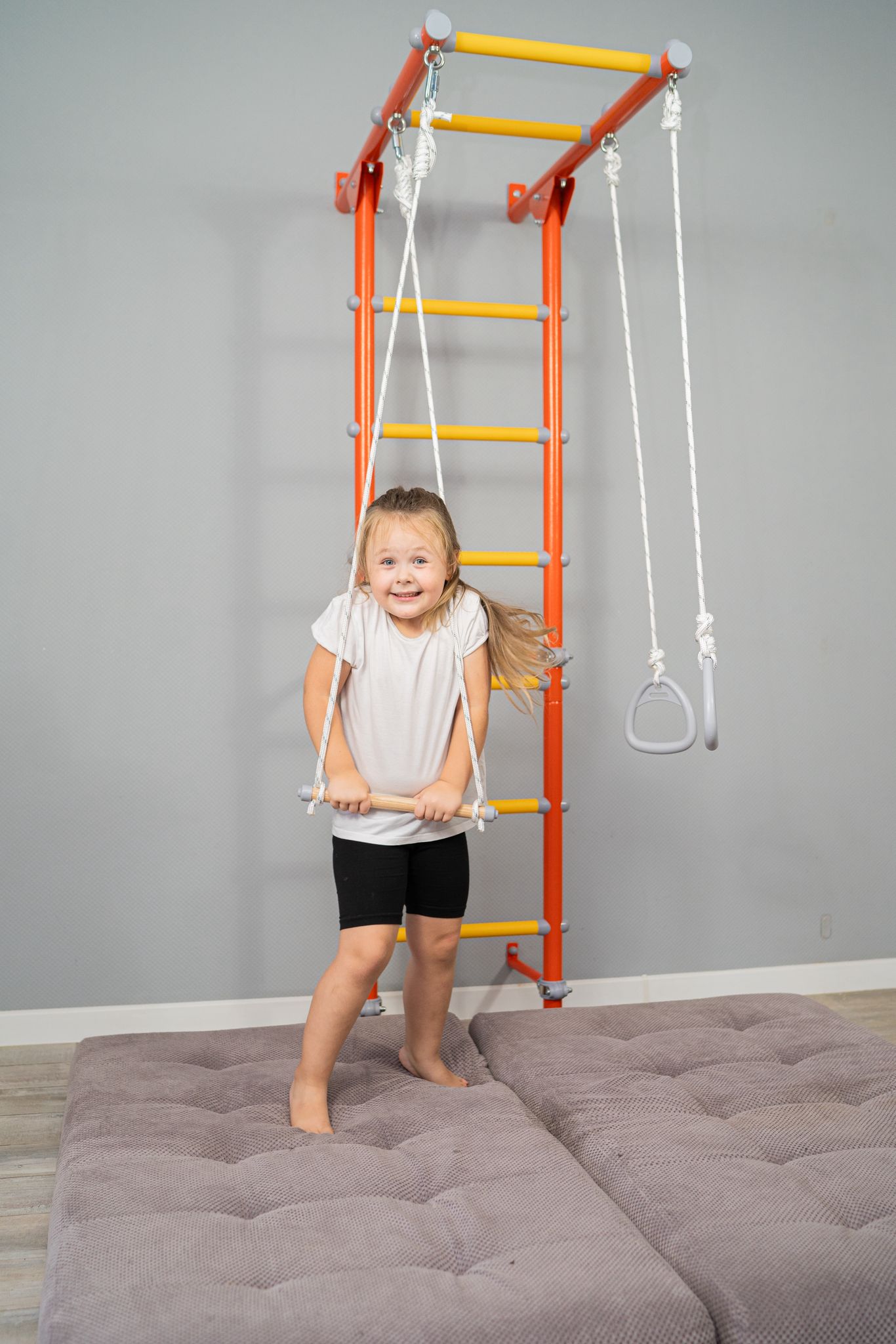
The one thing the school building does have is equipment: a playground, a gym, monkey bars. That is the gap a home movement zone closes. A corner with a climbing gym turns "go take a break" from a vague instruction into a specific, self-directed routine: ladder, rings, bar, swing, back to the table. It is the recess bell, the playground, and the PE storage closet in about the footprint of an armchair, available every 40 minutes, every day, all year.


Which gym fits your space? Take the 60-Second Quiz →
Frequently asked questions
What is a movement break? A short burst of physical activity, usually 2 to 10 minutes, inserted between or during lessons to reset attention. Researchers also call them activity breaks, brain breaks, or energizers. They are distinct from recess (longer, unstructured free play) and PE (a planned subject), and they supplement both rather than replacing either.
Do movement breaks actually improve focus? The most consistent research finding is improved on-task behavior. The Mahar 2006 classroom study reported an 8% improvement after daily 10-minute breaks (20% for the least focused students), and the Watson 2017 meta-analysis of 39 studies found a moderate-to-large positive effect on on-task behavior. Effects on standardized test scores are less consistent, so the fair claim is: breaks are linked to better attention and behavior, not to automatic academic gains.
How often should kids take movement breaks? There is no research-established dose. A practical pattern many homeschool families use: a 3-to-5-minute break after every 15-25 minutes of seat-work for young elementary kids, stretching to 25-45 minute blocks for ages 9-12, plus one longer midday activity block. Schedule breaks before restlessness peaks rather than using them as an emergency brake.
Do movement breaks help children with ADHD? The Pontifex 2013 study in the Journal of Pediatrics found that a single 20-minute bout of moderate exercise was followed by better attention-task accuracy and better reading and arithmetic performance in children with ADHD. Mahar's data also showed the largest on-task gains in the least focused students. Many families front-load movement before the hardest subject; our ADHD homeschool guide covers the full approach.
Should a break be earned by finishing work? No. The AAP is explicit that recess and activity should not be withheld as punishment or dangled as a reward, and the research logic agrees: the child struggling to finish is usually the child whose attention battery is empty, which is what the break refills. Making movement conditional takes the tool away from exactly the child who needs it.
Are indoor breaks as good as outdoor play? Outdoor free play is irreplaceable and this article is not an argument against it. Movement breaks are a between-lessons tool, and their value is availability: attention crashes at 9:40 on rainy Tuesdays too. Most families run both: outside when weather and schedule allow, an indoor movement zone for everything in between.
What age can a child start using a climbing gym for breaks? Brainrich gyms are rated for independent climbing at age 3 and up, with mats under the landing zones and an adult nearby for younger climbers. Younger siblings can join with hands-on supervision and toddler attachments, but solo break routines are for 3+.
📚 Keep reading in the Decision Guide
The Homeschool Schedule That Works · Homeschool PE at Home: the Complete Guide · Kinesthetic Learning Activities · The Homeschool Hub · Exercise and Autism · Indoor Activities for High-Energy Kids: Winter Survival Guide
Sources
Mahar, M.T. et al. (2006). Effects of a classroom-based program on physical activity and on-task behavior. Medicine & Science in Sports & Exercise. · Donnelly, J.E. & Lambourne, K. (2011). Classroom-based physical activity, cognition, and academic achievement. Preventive Medicine. · Watson, A. et al. (2017). Effect of classroom-based physical activity interventions on academic and physical activity outcomes: a systematic review and meta-analysis. International Journal of Behavioral Nutrition and Physical Activity. · Pontifex, M.B. et al. (2013). Exercise improves behavioral, neurocognitive, and scholastic performance in children with attention-deficit/hyperactivity disorder. Journal of Pediatrics. · American Academy of Pediatrics, Council on School Health (2026 revision). The Crucial Role of Recess in School. Pediatrics. · Yogman, M. et al. (2018). The Power of Play: A Pediatric Role in Enhancing Development in Young Children. Pediatrics. · CDC. Classroom Physical Activity. Physical Education and Physical Activity.
Share: