

Updated October 2026 · 12-minute read · by Yegor Nadvornyy, founder of Brainrich Kids
Every sport has its own skills, but underneath them sit the same few abilities: staying balanced, knowing where your arms and legs are without looking, holding on, planning the next move, and staying calm when something feels a little scary. Climbing asks for all of those at once, and kids do it because it's fun, not because anyone told them to train. This guide covers what a climb asks of a young body, what research on balance, coordination and risky play has found, and how climbing at home fits around every sport your child plays.
The quick answer: climbing practices balance, body awareness, grip, coordination of all four limbs, route planning and the nerve to handle height. Research shows balance improves with practice at every age studied, kids who move well tend to stay more active and fitter, and safe early exposure to heights is linked with less fear of them later. No study has yet tested a home climbing gym directly, so we describe climbing as practice for these abilities, not as a cure for anything. About ten minutes of climbing on most days, plus free play, fits around any sport. An adult stays in the room and a mat goes under every bar.
Jump to: What a climb asks · Balance · Body awareness · Grip and planning · Nerve · Every sport · 10-minute routine · FAQ
What a climb asks of a young body
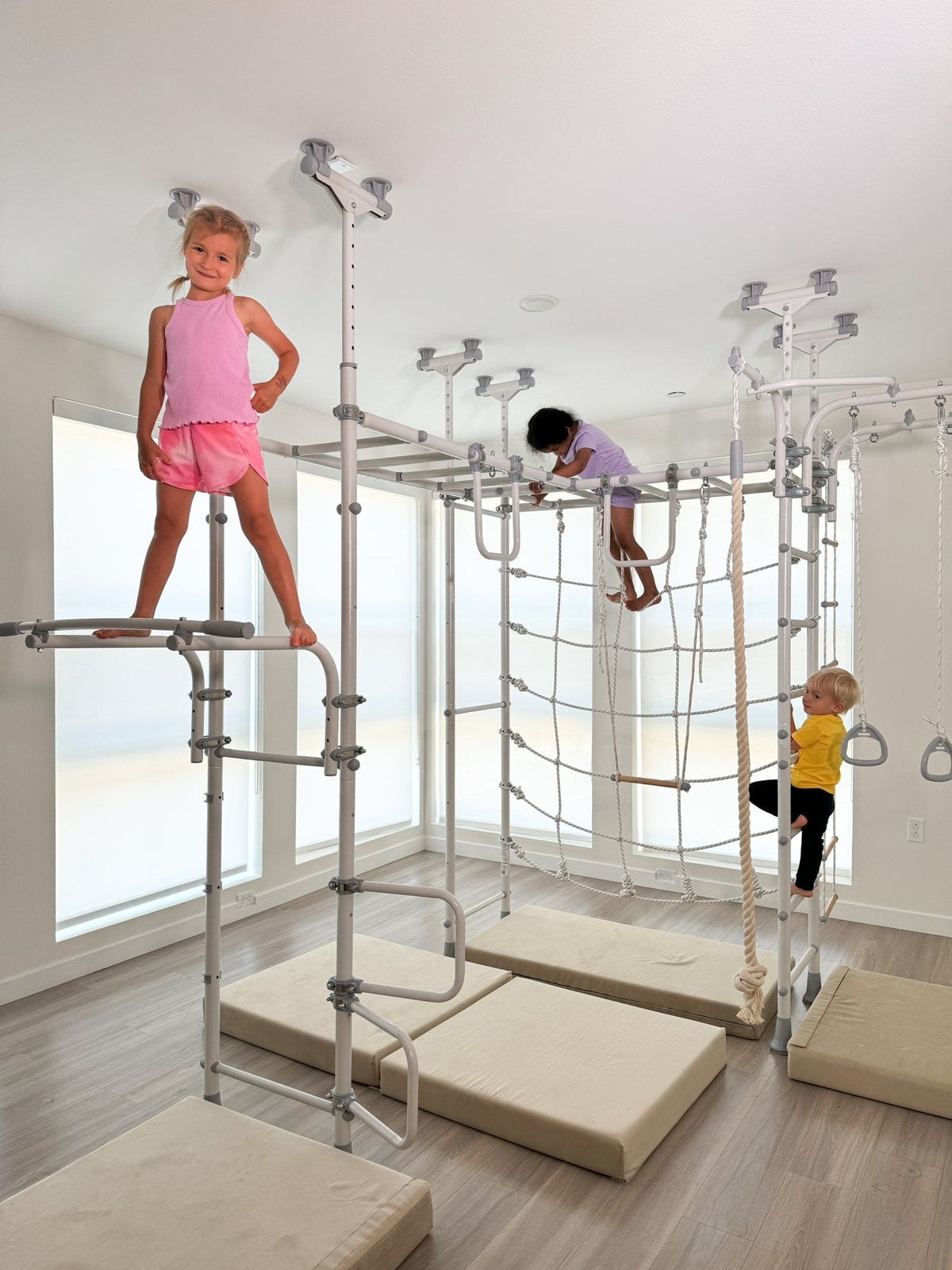
Watch a seven-year-old climb a rope net. One hand reaches up, a foot searches for a hold, the hips shift to stay close to the net, the other hand lets go, and the weight moves from one corner of the body to another. Every move is a small balance problem. The child is pulling with the arms, pushing with the legs, holding with the hands and steering with the core, all while keeping track of four limbs at once.
That's why climbing works almost every muscle group: the forearms and hands for grip, the lats and shoulders for pulling and reaching, the chest for pushing up and over a bar, the core for keeping the hips close, and the legs for stepping up.

Anatomy art adapted from OpenStax, Anatomy and Physiology, licensed under CC BY 4.0. Changes: cropped, recolored and relabeled by Brainrich Kids.
| What climbing practices | What it looks like on the gym | Where it shows up in sports |
|---|---|---|
| Balance | Shifting weight from one foot to the other on a net or ladder | Landing from a jump, cutting, kicking, hitting on the run |
| Body awareness | Placing a foot on a rung without looking down | Gymnastics, dance, a wrestler's position, a swimmer's turn |
| Four-limb coordination | Right hand with left foot, then left hand with right foot | Running, swimming strokes, throwing |
| Grip and pulling | Hanging, pulling up to the next rung | Wrestling, baseball, tennis, rebounds, ninja |
| Planning | Choosing the next hold before moving | Reading the play, picking a line, setting up a move |
| Nerve | Going one rung higher than last time | A first tryout, a new skill, a dive off the block |
Balance: one of the most trainable skills
Balance is often treated as something kids either have or don't. The research says otherwise. Gebel and colleagues pooled 17 controlled trials of balance training in healthy children and teens aged 6 to 19. Balance improved with practice in every age group studied, with moderate gains in standing balance and large gains in balance while moving. The trials that showed the biggest gains used short sessions, often under 15 minutes, a couple of times a week over about three months, though the authors cautioned that the dose findings need more study.
Climbing hasn't been tested that way in children. One 2026 study did compare experienced competitive climbers with other active people, probably adults: the climbers made far fewer errors on a standard balance test (about 7.5 to 7.8 errors against 12.4) and scored higher on reaching balance tests. A snapshot like that can't show whether climbing built the balance or good balancers kept climbing, but it fits with how much climbing asks of it.

On a net, every step is a small balance problem.
Body awareness and coordination
Body awareness, or proprioception, is the sense that tells a child where their arms and legs are without looking. It's how a gymnast knows her legs are straight, how a soccer player traps a ball without staring at it, and how a climber puts a foot on the next rung while looking up. Climbing exercises it constantly, because the eyes can't watch all four limbs at once.
Coordination like this seems to carry forward. In Portugal, Lopes and colleagues measured the coordination of 285 children at age 6, using a test of balance, hopping and side-to-side jumping, then tracked their activity to age 10. Most kids became less active as they got older, but the best-coordinated six-year-olds held their activity level almost steady, while the rest slowed down each year. An Australian study of 276 teens found that kids who were more skilled at ball games in primary school were more active six years later.
The wider picture is encouraging but more careful. A 2015 review of movement skills found that kids who move well tend to be more active, fitter and stronger, and to feel more capable. A 2022 review of 43 long-term studies found the most consistent link was between early movement skill and later fitness. The link to how active kids stay was less consistent on its own. So the safest summary is that good movers tend to become fitter kids, and climbing is one more way to practice moving well.
Grip, pulling and planning a route
Grip and pulling get their own guides in this series: how monkey bars support every sport covers grip, shoulders and posture, and at-home strength for young athletes covers hangs, pull-ups and how much is enough.
Planning is harder to measure. A climb asks a child to look at the holds, pick a path, try it, notice what didn't work and try another way. That's the same loop as reading a defense or picking a line through a course. We haven't found a study that tests whether climbing improves planning in children, so we won't claim it does. What we can say is that a climbing gym gives kids a lot of small problems to solve with their bodies, and they solve them because they want to get to the top.
Nerve: height, risk and confidence
Every sport has scary moments: the first dive off the blocks, a new skill on the beam, a tryout. Climbing offers a way to practice that feeling in small, controlled doses, one rung higher than last time, with an adult nearby.
Risky play. A 2015 review of 21 studies on risky outdoor play, the climbing-high, moving-fast kind, linked it with more physical activity and better social health, and its authors recommended making more room for it in children's lives. Two Norwegian researchers, Ellen Sandseter and Leif Kennair, have proposed that thrilling play may help children grow out of normal early fears, such as of heights, as their skills catch up. That's a theory, not a tested result, but it matches what many parents see.
Fear of heights. A New Zealand study followed children from birth. The 18-year-olds who were afraid of heights had spent less time around heights as children. That's a link, not proof that climbing prevents fear, and it's no reason to let kids fall. It's a reason to let them climb at their own pace, with a mat underneath.
Climbing programs. A 2025 review found five controlled trials of climbing programs for children and teens, mostly therapeutic climbing for mental health. They reported gains in confidence, mood and well-being. The trials were small and none compared climbing with other sports, so we can't say climbing beats them, only that it's a promising way for kids to build confidence.

What the research doesn't show
No study has tested a home climbing gym in children, and no trial has measured climbing's effect on balance or coordination in typical kids. The studies above are about balance training, movement skills, risky play and climbing programs. We cover the full picture in Is There Any Proof a Home Climbing Gym Helps Kids? None of this is a claim that climbing prevents injuries.
How climbing supports every sport
Each sport takes something different from climbing. The guides below go deeper, with a muscle chart, the research on young athletes and a 10-minute home routine for each.
| Sport | What climbing practices for it |
|---|---|
| Gymnastics | Grip, pulling to balance all the pushing, body awareness upside down |
| Swimming | Shoulder blade control, lats, core, without more overhead strokes |
| Soccer | Balance on one leg, hips, core, upper body the sport leaves out |
| Basketball | Landings, ankles, balance, grip for rebounds |
| Baseball and softball | Grip, core, legs, both sides of the body, with no extra throwing |
| Tennis | Legs, balance, core, and work for the side the racket doesn't use |
| Wrestling and martial arts | Grip, pulling strength, body control |
| Cheer and dance | Strength to match flexibility, balance, core |
| Ninja | Grip endurance, swing control, soft landings between classes |
Variety matters. In a study of 1,190 young athletes aged 7 to 18, Dr. Neeru Jayanthi and colleagues found that specializing in one sport was linked with higher odds of injury (odds ratio 1.27) and of serious overuse injury (1.36). Kids who played more hours of organized sport per week than their age in years, or who spent more than twice as many hours in organized sport as in free play, also had higher odds of serious overuse injuries. Climbing at home is free play, and it moves the body in ways most team sports don't. The American Academy of Pediatrics has also warned that specializing too early can carry physical and psychological costs.
A 10-minute climbing routine for any sport
This routine runs on a home climbing gym with a net or ladder, monkey bars and a thick mat. Use it on most days, around practices and games, and let free play fill the rest.
| Station | Ages about 3 to 6 | Ages about 7 to 10 | Ages 11 and up | What it practices |
|---|---|---|---|---|
|
Ladder climb 1.5 min |
Up a few rungs and down, a parent's hand close | To the top and down, 2 times | Up and down without knees on the rungs, then hands only on the way down for a few rungs | Four-limb coordination |
|
Net climb 2 min |
Up the net as far as they like, and back down | Up, across and down, eyes up the whole way | Up and across with three points of contact at all times, then a new route | Balance, body awareness, planning |
|
Hangs 1.5 min |
"Monkey hang," 5 seconds, 2 or 3 times | Overhand and underhand, 10 to 20 seconds each | Up to 30 seconds each, plus 5 active hangs | Grip, shoulder control |
|
Traverse 2 min |
One or two rungs with a parent supporting the hips | Across and back, leading with each hand | Across and back, then skip a rung | Grip, both sides of the body |
|
"One higher" 1 min |
One rung higher than last week, then down | Same, pausing at the top to look around | A route they haven't tried, at a height they choose | Nerve, at the child's own pace |
|
Balance 2 min |
"Flamingo" holding a rung, 5 to 10 seconds each leg | 20 seconds each leg, one hand off the rung | 30 seconds each leg, hands free, eyes closed for the last 5 | Balance |
Safety rules for climbing at home
- An adult in the same room, every time, and thick mats under the whole climbing area.
- Kids choose their own height. Never lift a child higher than they can climb on their own.
- Climb down, don't jump down, from anything above the lowest rungs.
- Three points of contact on the net and ladder: two hands and a foot, or two feet and a hand.
- Stop while the grip is still strong. No training to failure, no added weights.
- One child per section of the gym at a time.

A rope ladder moves under every step, so balance works the whole way up.
We love team sports, long afternoons at the park and real rock, and none of this replaces them or a coach. The home gym is for the days in between, the rain, the dark winter evenings and the ten minutes before dinner.
Equipment for climbing at home
For the routine above you need a ladder, a net, monkey bars and thick mats. The Spider V3 has the monkey bars built in, plus pull-up bars, rings, a rope and a net. The Spider Max V3 adds a second span and a second net, which helps when siblings or friends come over. Both are steel, rated for 220 lb and tension-mounted between floor and ceiling with no drilling. More than 10,000 families have a Brainrich gym at home, and occupational and physical therapists in our owner community recommend them.


Sports have seasons. Climbing doesn't.
For every sport, every age and every rainy day. Steel, no drilling, and a 30-day money-back guarantee. Questions? Reach out to us.
Frequently asked questions
What are the benefits of climbing for kids? Climbing practices balance, body awareness, grip, coordination of all four limbs, planning and the nerve to handle height. Research shows balance improves with practice at every age studied, and kids who move well tend to become fitter. No study has yet tested a home climbing gym directly, so think of climbing as practice for these abilities rather than a cure for anything.
Does climbing help kids in other sports? It practices abilities every sport uses: balance, body awareness, grip and confidence. It also adds variety, and a study of 1,190 young athletes linked specializing in one sport, and having much more organized sport than free play, with higher odds of overuse injuries. Climbing doesn't replace sport-specific practice or a coach.
Is climbing good for balance? Balance is very trainable in children and teens: a review of 17 trials found it improved with practice in every age group studied. Climbing hasn't been tested in children that way, but experienced climbers made fewer balance errors than other active people in one study, and every move on a net or ladder is a small balance task.
Will climbing make my child less afraid of heights? It may help. A New Zealand study that followed children from birth found that 18-year-olds afraid of heights had spent less time around heights as children. That's a link, not proof. Let kids climb at their own pace, never lift them higher than they can climb, and keep a mat underneath.
How much climbing is enough? About ten minutes on most days is a good structured dose, plus as much free play as they want. The balance trials that showed the biggest gains used short sessions a couple of times a week, so consistency matters more than long sessions.
📚 Keep reading in the Decision Guide
How Monkey Bars Support Every Sport · At-Home Strength for Young Athletes · Is There Any Proof a Home Climbing Gym Helps Kids? · Controlled Risky Play · Climbing Rope for Kids · What Comes After the Pikler Triangle?
About the author
Yegor Nadvornyy is the founder of Brainrich Kids and a dad. More than 10,000 families have a Brainrich gym at home. Every study in this article was checked against the original paper, and results are reported as the researchers found them.
Sources
Gebel, A., Lesinski, M., Behm, D.G., Granacher, U. (2018). Effects and Dose-Response Relationship of Balance Training on Balance Performance in Youth: A Systematic Review and Meta-Analysis. Sports Medicine, 48(9). · Feeny, H., Wagner, D.R. (2026). Static and Dynamic Balance of Competitive Sport Climbers Compared to Controls. International Journal of Sports Physiology and Performance, 21(11). · Lopes, V.P., Rodrigues, L.P., Maia, J.A., Malina, R.M. (2011). Motor Coordination as Predictor of Physical Activity in Childhood. Scandinavian Journal of Medicine and Science in Sports, 21(5). · Barnett, L.M., van Beurden, E., Morgan, P.J. et al. (2009). Childhood Motor Skill Proficiency as a Predictor of Adolescent Physical Activity. Journal of Adolescent Health, 44(3). · Robinson, L.E., Stodden, D.F., Barnett, L.M. et al. (2015). Motor Competence and its Effect on Positive Developmental Trajectories of Health. Sports Medicine, 45(9). · Barnett, L.M., Webster, E.K., Hulteen, R.M. et al. (2022). Through the Looking Glass: A Systematic Review of Longitudinal Evidence, Providing New Insight for Motor Competence and Health. Sports Medicine, 52(4). · Brussoni, M., Gibbons, R., Gray, C. et al. (2015). What is the Relationship between Risky Outdoor Play and Health in Children? A Systematic Review. International Journal of Environmental Research and Public Health, 12(6). · Sandseter, E.B., Kennair, L.E. (2011). Children's Risky Play from an Evolutionary Perspective: The Anti-Phobic Effects of Thrilling Experiences. Evolutionary Psychology, 9(2). · Poulton, R., Waldie, K.E., Menzies, R.G. et al. (2001). Failure to Overcome 'Innate' Fear: A Developmental Test of the Non-Associative Model of Fear Acquisition. Behaviour Research and Therapy, 39(1). · Kaar, C., Frühauf, A., Kopp, M. (2025). The Role of Therapeutic Climbing in Child and Adolescent Mental Health: A Systematic Literature Review. BMC Sports Science, Medicine and Rehabilitation, 17(1). · Jayanthi, N., LaBella, C.R., Fischer, D. et al. (2015). Sports-Specialized Intensive Training and the Risk of Injury in Young Athletes: A Clinical Case-Control Study. American Journal of Sports Medicine, 43(4). · Brenner, J.S., AAP Council on Sports Medicine and Fitness (2016). Sports Specialization and Intensive Training in Young Athletes. Pediatrics, 138(3). · OpenStax (2016). Anterior and Posterior Views of Muscles, Anatomy and Physiology, Rice University, CC BY 4.0 (muscle chart, adapted).
Share: