

Updated October 2026 · 14-minute read · by Yegor Nadvornyy, founder of Brainrich Kids
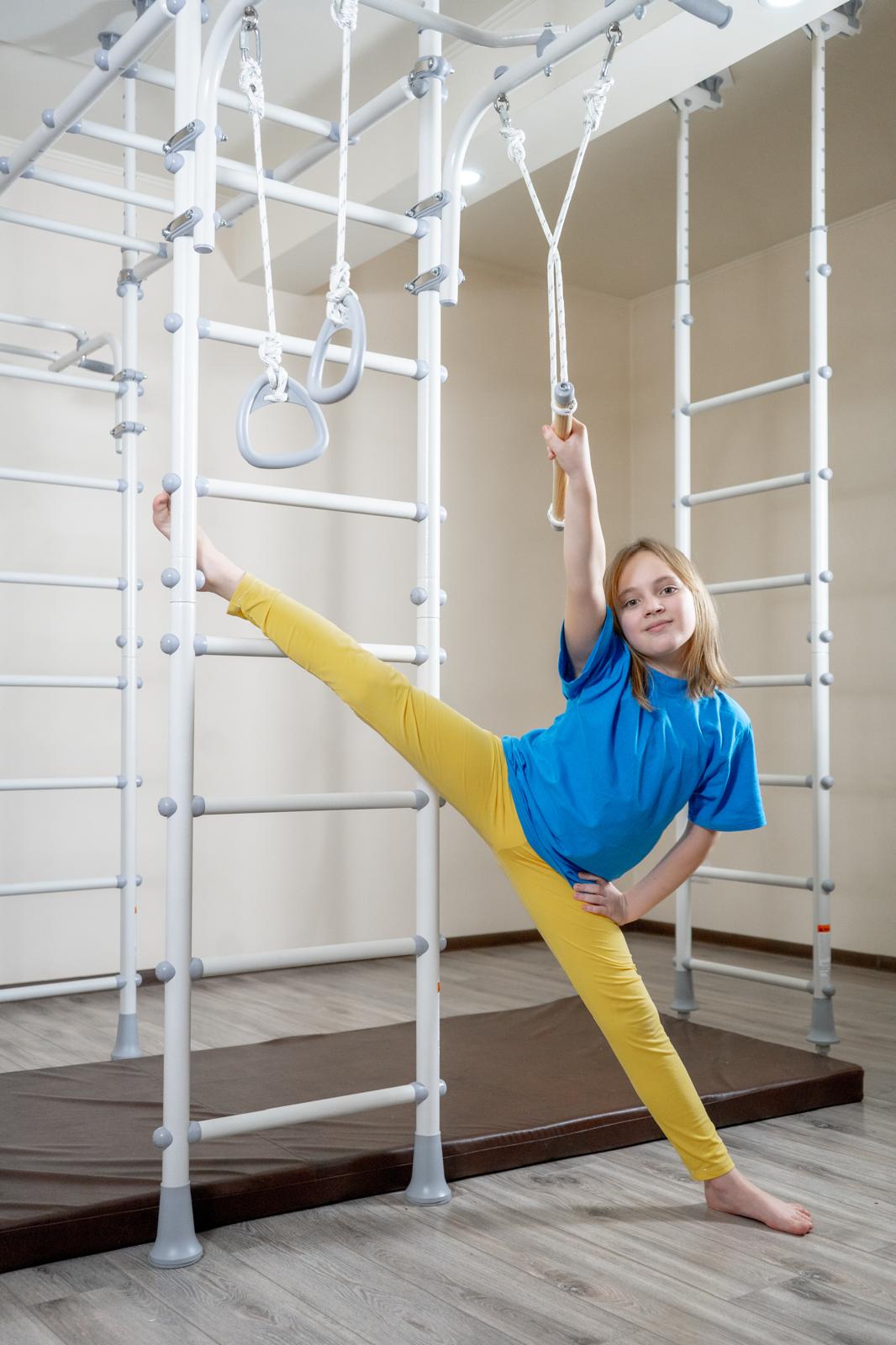
Cartwheels in the hallway, handstands against the bedroom door, a split on the living room rug while the TV is on. Gymnastics kids don't stop when class ends, and most parents end up searching for gymnastics at home ideas that won't end in a trip to urgent care. The good news: the strength, grip and body control that gymnastics leans on can be practiced safely at home. The skills themselves, the flips and the handsprings, belong in the gym with a coach. This guide shows where that line sits, what gymnastics asks of a young body, and a 10-minute conditioning routine for bars, rings and ladders.
The quick answer: the safest gymnastics at home is conditioning, not tumbling. Hangs, leg lifts, chin-up holds, low rings and stretches on a ladder practice the grip, shoulders and core that gymnastics leans on. Flips, handsprings, kips and anything fast and upside down should wait for the gym, a coach and a spotter. Gymnastics already loads the wrists through handstands and support, so hanging and pulling add the opposite direction. Keep an adult in the room, a mat under every bar, and about ten minutes on most days. For gymnasts who already train many hours a week, the home gym should be free play, not extra training.
Jump to: Safe at home vs. the gym · What gymnastics asks · Push, pull and wrists · Wall bars came from gymnastics · 10-minute routine · Hours and rest · Equipment · FAQ
Gymnastics at home: what's safe, and what to save for the gym
Gymnastics coaches spend years teaching a skill in steps, on soft surfaces, with a hand on the child's back at the moment it matters. Home doesn't have the pit, the spring floor or the coach. It does have something the gym can't offer: time, every day, with no drive and no class schedule. So split the work the way the space allows.
✅ Good at home, with an adult in the room
- Dead hangs and active hangs
- Hanging knee tucks and leg lifts
- Chin-up holds and slow lowering
- Monkey bar traverses
- Ladder and rope climbing
- Low rings: tuck hangs, supported holds
- Stretches on the ladder
- Balance on a line on the floor
🏟️ Save for the gym, with a coach
- Flips, saltos and handsprings
- Back walkovers and other new back skills
- Kips, casts and releases on a bar
- Skin-the-cat and inverted ring work your coach hasn't taught
- Tumbling on hard floors
- Anything fast with the head below the hips
Coaches often prefer that new skills stay inside the gym for this reason, so check with your child's coach about what they're cleared to practice at home. On a Brainrich gym the house rules are simple: no kipping, no flipping over the bar, and no hanging from a bar someone else is using.
What gymnastics asks of a young body
Gymnastics is one of the few sports that uses almost every muscle group, often while upside down. Coaches talk about strength-to-weight: the ability to hold and move your own body in any position. Here are the upper-body and core pieces it leans on most.

Anatomy art adapted from OpenStax, Anatomy and Physiology, licensed under CC BY 4.0. Changes: cropped, recolored and relabeled by Brainrich Kids.
| What gymnastics asks | Where you see it | What the home gym practices |
|---|---|---|
| Shoulder strength overhead | Handstands, bars, rings, arms by the ears in every jump | Hanging with arms fully overhead, active hangs |
| Shoulder blade control | Holding a straight handstand, support on bars | "Shoulders away from the ears" on the bar |
| Grip | Uneven bars, high bar, rings, rope | Every hang, traverse and rope climb |
| Pulling strength | Pulling up to the bar, rope climbs, ring work | Chin-up holds, slow lowering, climbing |
| Core: hollow and arch | Tight body in handstands, swings and landings | Holding still under the bar, leg lifts |
| Hip flexor strength and flexibility | Pikes, leg lifts, splits, leaps | Knee tucks, L-holds, stretches on the ladder |
| Body awareness upside down | Every inversion and rotation | Low ring tucks and inverted hangs, with an adult spotting |
Being upside down and spinning also feeds the vestibular system, the balance sense in the inner ear. Our guide to vestibular input explains why kids seek it out. For how hanging works the shoulders, grip and core across every sport, see how monkey bars support every sport.
What the home gym doesn't cover
Jumping power, landings, sprinting into a vault, beam work, dance elements and every tumbling skill. Those need a spring floor, a beam, a coach and time in the gym. The bars at home add strength and comfort in the positions those skills use. They don't teach the skills.
Push, pull, and the wrist question
Here's something gymnastics parents learn fast: the sport is heavy on pushing. Handstands, round-offs, vaults, support on the bars and beam all carry body weight through the hands with the wrists bent back. Practice after practice, that adds up.
Wrist pain is common in young gymnasts, and it isn't only an elite problem. In a one-year study of 47 recreational and club-level (non-elite) gymnasts aged 5 to 16, Dr. John DiFiori and colleagues found that 57% reported wrist pain at the start, and almost 9 in 10 of those still had it a year later. Gymnasts aged 10 to 14 were the most likely to report it, and only 5 of the 27 with wrist pain had seen a doctor. A second study by the same team, of 59 young gymnasts averaging 9 years old, linked wrist pain to signs of stress on the growth plate at the end of the forearm bone (the distal radius) on X-ray.

Hanging and pulling work the hands, forearms, shoulders and back in the other direction: the hands close around a bar, the wrists stay roughly in line, and the body hangs below instead of pressing down on top. That's a different load from a handstand. We want to be clear about what that does and doesn't mean. No study has tested whether hanging prevents wrist pain in gymnasts, and we won't claim it does. What hanging adds is time in the pulling direction, alongside a sport that does a lot of pushing.
If your gymnast's wrist hurts
Wrist pain that keeps coming back, or that's there at the start of practice, is worth a visit to your pediatrician or a sports medicine doctor, especially between about 10 and 14. In the study above, most kids with wrist pain never saw one. Don't add weight-bearing wrist work at home while it's being checked.
Wall bars came from gymnastics
The ladder in your playroom has a gymnastics history. Pehr Henrik Ling, a Swedish fencing master, founded the Royal Central Gymnastics Institute in Stockholm in 1813 and built a system of simple, progressive exercises that became known as Swedish gymnastics. Wall bars came out of that system, and by the early 1900s they lined school gyms across Europe. Our Swedish ladder guide tells the full story. When a young gymnast hangs from a rung, leans into a stretch or climbs to the top, they're using equipment that was designed for gymnastics in the first place.
Gymnastics conditioning at home: a 10-minute routine
This is conditioning a gymnast can do on a home climbing gym or wall bars, sorted by age. Younger kids will play it as a game. Older gymnasts can run it as a short circuit on non-practice days. It adds up to about ten minutes with rest between rounds.
| Station | Ages about 3 to 6 | Ages about 7 to 10 | Ages 11 and up | What it practices |
|---|---|---|---|---|
|
Ladder climb 1 min |
Up a few rungs and back down, slowly | To the top and down, 3 times | Same, without knees on the rungs | Warm-up, cross-lateral climbing |
|
Hangs 2 min |
5 to 10 seconds, 3 times, a parent's hands close | 15-second dead hang, then 5 slow "shoulders down" | 30-second hang, then 8 to 10 active hangs with a 2-second hold | Grip, shoulder blade control overhead |
|
Leg lifts 1.5 min |
2 or 3 "cannonball" tucks | 5 slow knee raises, a pause at the top | 5 straight-leg raises to an L, or a 5- to 10-second L-hold | Hollow core, hip flexors |
|
Chin-up hold 1.5 min |
Stand on a rung, hold the bar at chest height for 5 seconds | Step up, chin over the bar, hold 5 seconds, 3 times | 10- to 15-second holds, or 3 slow lowerings | Pulling strength, lats |
|
Low rings 2 min |
Tuck hang, feet near the mat, a parent's hands at the waist | Tuck hang, then a tucked upside-down hang with an adult spotting | Piked inverted hang, only the ring skills their coach has taught | Body awareness upside down, grip |
|
Ladder stretches 2 min |
"Reach for the top rung" on tiptoes | Shoulder opener (hands on a rung at hip height, walk the feet back, let the chest sink), heel on a low rung for the back of the leg, lunge holding a rung for the front of the hip. 20 to 30 seconds each, no bouncing | Shoulder and hip range for handstands, splits and leaps | |
Safety rules for gymnastics at home
- An adult in the same room, every time, and hands-on for anything upside down.
- A thick mat under every bar, ring and landing zone. Hard floors are for walking.
- Rings low enough that feet can reach the mat when trying anything new.
- Only the skills their coach has cleared. No flips, handsprings, kips or releases at home.
- Stop each hang while the grip still feels good. No training to failure, no added weights.
- No kipping or flipping over the bar, and one child on a bar at a time.
- Lift little ones by the waist, never by the hands or arms.
- Wrist, back or shoulder pain that doesn't fade means a day off and a call to the pediatrician.
The American Academy of Pediatrics supports strength activity for children when it's supervised, technique comes first and loads fit the child's age. Body-weight hangs and holds sit comfortably inside that. For the step-by-step path from a first hang to a first pull-up, see our pull-up skills progression.

Rings are gymnastics equipment too. At home, keep them low and the mats thick.
How much is too much? Hours, rest and free play
Gymnastics is a sport where kids can rack up a lot of training hours young, and that's where the home gym needs a light touch. In a study of 1,190 young athletes aged 7 to 18, Dr. Neeru Jayanthi and colleagues found that kids who played more hours of organized sport per week than their age in years had about twice the odds of a serious overuse injury. So did kids whose organized-sport hours were more than double their hours of free play. Specializing in one sport carried a risk of its own, even after accounting for hours. The AAP's 2016 report on sports specialization cautions about early single-sport focus for the same reasons.
🤸 Recreational gymnasts
One or two classes a week. The 10-minute routine on most off days fills the gaps, and free climbing and swinging fill the rest.
🏅 Club and team gymnasts
Many hours a week already. At home, skip the structured routine and let the gym be free play: climbing, swinging, hanging for fun. Rest days stay rest days.
That second point matters. Free play on a climbing gym, the kind where a child decides what to do, isn't the same as more conditioning. It's movement without a coach, a count or a score, and that's the piece the research above says many young athletes are short on. Sports have seasons and competition calendars. Climbing at home doesn't.
Gymnastics equipment at home: what's worth having
Parents searching for a bar for gymnastics at home usually find two kinds of products. A kip bar is a single horizontal bar built for bar skills such as kips, casts and swings, the skills that need a coach. A climbing gym or set of wall bars is built for hanging, climbing, pulling and stretching, with rings, a rope and a net attached. They do different jobs, and some families have both. For conditioning, a climbing gym covers more of the list above.
- Something to hang from at the right height: bars that move up the ladder as your child grows.
- Gymnastic rings on adjustable straps, so they can sit low.
- A ladder or wall bars for climbing and stretching.
- Thick mats under all of it.
- Floor space: about 3 feet of clear floor around the bars for swinging and dropping down. Our space guide has the details.
The Spider V3 comes with the monkey bars built in, plus gymnastic rings, a climbing rope, a net and two sets of pull-up bars, all tension-mounted between floor and ceiling with no drilling. The Model W3 is our wall-mounted version, the closest thing to classic gymnastics wall bars: it sits 9 inches off the wall, so plan on about 3 feet of clear floor in front of it. Both are steel and rated for 220 lb. More than 10,000 families have a Brainrich gym at home, and occupational and physical therapists in our owner community recommend them.


Wall bars came from gymnastics. Now they're in your hallway.
Rings, bars and a ladder for the days between practices. Steel, no drilling on our tension-mounted gyms, and a 30-day money-back guarantee. Questions? Reach out to us.
Frequently asked questions
Can kids do gymnastics at home safely? Yes, if home is for conditioning and the skills stay in the gym. Hangs, leg lifts, chin-up holds, low rings and stretches are good at home with an adult in the room and mats underneath. Flips, handsprings, kips and anything fast and upside down need a coach, a spotter and gym surfaces.
What are good gymnastics at home ideas for kids? Dead hangs and active hangs, hanging knee tucks or L-holds, chin-up holds, monkey bar traverses, rope or ladder climbs, tuck hangs on low rings, balance walks along a line on the floor, and shoulder and hip stretches on a ladder. Keep the session short, about ten minutes, and make it a game for younger kids.
What is a good bar for gymnastics at home? It depends on the job. A kip bar is built for coached bar skills such as kips and casts. A climbing gym or wall bars is built for hanging, pulling, climbing and stretching, with rings and a rope attached, which covers more of a gymnast's conditioning. Whatever you choose, it needs to be anchored securely, adjustable in height, and placed over thick mats.
Does hanging help with gymnastics? Hanging practices grip, shoulder strength overhead, shoulder blade control and core tension, which gymnastics leans on. It also works in the pulling direction, while much of gymnastics is pushing and support. No study has tested hanging on gymnastics results, so think of it as daily practice of the basics alongside coached training.
Is wrist pain normal for young gymnasts? It's common, but it isn't something to ignore. In one study of non-elite gymnasts aged 5 to 16, 57% reported wrist pain and most still had it a year later, yet few had seen a doctor. Ongoing wrist pain, especially between about 10 and 14, is worth a visit to a pediatrician or sports medicine doctor.
How much should a gymnast train at home? For recreational gymnasts, about ten minutes on most non-practice days is plenty. For club gymnasts who already train many hours a week, keep home time as free play and protect rest days. One study linked weekly sport hours above a child's age in years to higher odds of serious overuse injury.
📚 Keep reading in the Decision Guide
Swimming Dryland Exercises for Kids · At-Home Strength for Young Athletes · How Monkey Bars Support Every Sport · Pull-Up Bar Skills: From First Hang to First Pull-Up · Swedish Ladder for Kids · Vestibular Input · Controlled Risky Play · Soccer Conditioning for Kids at Home
About the author
Yegor Nadvornyy is the founder of Brainrich Kids and a dad. More than 10,000 families have a Brainrich gym at home. Every study in this article was checked against the original paper, and results are reported as the researchers found them.
Sources
DiFiori, J.P., Puffer, J.C., Aish, B. et al. (2002). Wrist Pain in Young Gymnasts: Frequency and Effects Upon Training Over 1 Year. Clinical Journal of Sport Medicine, 12(6). · DiFiori, J.P., Puffer, J.C., Aish, B. et al. (2002). Wrist Pain, Distal Radial Physeal Injury, and Ulnar Variance in Young Gymnasts: Does a Relationship Exist? American Journal of Sports Medicine, 30(6). · Jayanthi, N., LaBella, C.R., Fischer, D. et al. (2015). Sports-Specialized Intensive Training and the Risk of Injury in Young Athletes: A Clinical Case-Control Study. American Journal of Sports Medicine, 43(4). · Brenner, J.S., AAP Council on Sports Medicine and Fitness (2016). Sports Specialization and Intensive Training in Young Athletes. Pediatrics, 138(3). · Stricker, P.R., Faigenbaum, A.D., McCambridge, T.M. et al. (2020). Resistance Training for Children and Adolescents. Pediatrics, 145(6). · OpenStax (2016). Anterior and Posterior Views of Muscles, Anatomy and Physiology, Rice University, CC BY 4.0 (muscle chart, adapted).
Share: