

Updated October 2026 · 13-minute read · by Yegor Nadvornyy, founder of Brainrich Kids
Wrestling season starts in November, and the questions start with it. How do I help my kid get stronger without overdoing it? What can we do at home that won't get anyone hurt? Grip, pulling strength, a braced core and strong hips are the pieces wrestling and grappling arts lean on most, and every one of them can be practiced at home as play. This guide covers what these sports ask of a young body, what the research on wrestlers and judo athletes found, and a 10-minute routine that leaves the takedowns to the coach.
The quick answer: wrestling, judo and jiu-jitsu lean on the forearms (grip), lats and upper back (pulling), core (bracing), and glutes and quads (driving from the hips). Studies of older and competitive athletes link strength, grip and upper-body power with higher-level performance, and wrestlers' grip tends to develop evenly in both hands. At home, about ten minutes on most days of hanging, monkey bar traverses, rope work, core and hip exercises covers the conditioning side. Takedowns, throws, breakfalls and neck work belong at practice with a coach. An adult stays in the room and a mat goes under every bar.
Jump to: What these sports ask · What the research found · Practice vs. home · 10-minute routine · Martial arts · Around the season · Equipment · FAQ
What wrestling and martial arts ask of a young body
Wrestling looks like a strength contest, but most of it is grip and position. Hands fight for wrists and elbows. The arms and back pull an opponent close or hold one off. The core stays braced while someone tries to turn you. Then the hips do the heavy lifting: a level change, a shot, a sprawl, a bridge off the mat. Judo and Brazilian jiu-jitsu add grips on a jacket, which puts even more load on the hands and forearms.

Anatomy art adapted from OpenStax, Anatomy and Physiology, licensed under CC BY 4.0. Changes: cropped, recolored and relabeled by Brainrich Kids.
| What the sport asks | Where you see it | What the home gym practices |
|---|---|---|
| Grip | Hand fighting, wrist control, jacket grips in judo and jiu-jitsu | Hangs with different grips, monkey bar traverses, rope |
| Pulling strength | Pulling an opponent in, holding a tie-up, finishing a takedown | Rope climbs, flexed-arm hangs, assisted pull-ups |
| Core bracing | Staying solid when someone tries to turn or lift you | Hanging knee raises, hollow holds, planks |
| Hip drive | Level changes, shots, sprawls, bridging off the mat | Glute bridges, squats holding the ladder, bear crawls |
| Body awareness | Scrambles, knowing where your feet and hands are | Climbing up and down, crossing the monkey bars, the net |
| Both sides | Opponents attack from either side | Hand-over-hand traverses lead with each hand in turn |
From a young wrestler we talked to this fall
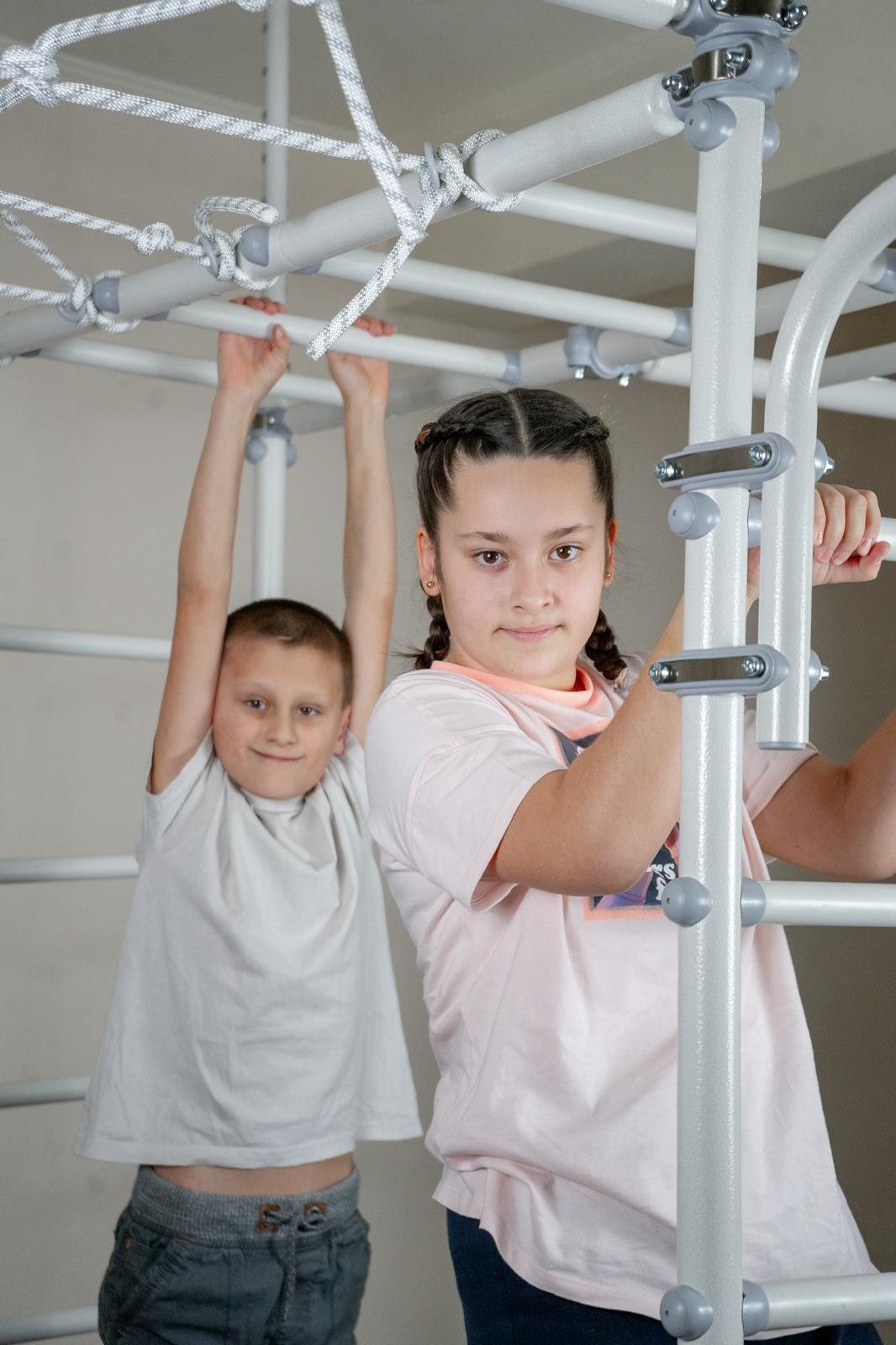
A young wrestler told us that when people ask her mom how she got so strong, the answer always comes back to the monkey bars. That's one family's story, not a study, and her coaches and years on the mat are a big part of it. But it's a story we hear a lot from families whose kids hang, swing and climb every day.
What the research on wrestlers and judo athletes found
Most strength research in combat sports was done with teenagers, adults and competitive athletes, so it describes what the sport rewards, not what a seven-year-old needs. With that in mind, three findings stand out.
Strength goes with higher-level wrestling. A 2017 review of wrestling research by Helmi Chaabene and colleagues found that maximal strength, isometric strength, explosive strength and strength endurance are closely related to high-level wrestling performance, and that anaerobic power separated more successful wrestlers from less successful ones across ages and weight classes. Flexibility didn't seem to be one of the deciding factors.
Judo rewards upper-body power. In a review of elite judo athletes, Emerson Franchini and colleagues found that elite athletes had higher upper-body anaerobic power and capacity than non-elite athletes.
Wrestlers' grip grows evenly. Gerodimos and colleagues compared grip strength in 122 wrestlers and 122 non-athletes from childhood to adulthood. In children and young teens, grip was about the same in both groups. In late teens and adults, wrestlers had stronger grips. Non-athletes over 15 had about 10% more grip in their preferred hand, while older wrestlers were about equal in both hands.
✋ Strength builds over years
Young wrestlers' grip matched non-athletes' in the study above. The differences showed up later, which makes the case for steady, playful practice now rather than heavy training.
🤲 Both hands get the work
Hanging loads both hands at once, and a hand-over-hand traverse leads with each hand in turn. That's the even, two-sided grip the sport uses.
For the American Academy of Pediatrics' guidance on strength training for kids, see at-home strength for young athletes. For what hanging does for the shoulders and grip in every sport, see how monkey bars support every sport.
What belongs at practice and what belongs at home
A prospective study by Pasque and Hewett followed 418 high school wrestlers through a season. The shoulder (24%) and knee (17%) were the most injured areas, most injuries happened at practice, and the takedown position caused the most injuries. Of the practice injuries, 68% happened during live wrestling, 23% during drills and 9% during conditioning.

A review of youth wrestling studies by Timothy Hewett and colleagues found that injury rates rose with age, experience and level of participation. In judo, a review by Pocecco and colleagues found that being thrown was the most common way athletes got hurt. A review of breakfall research in adults concluded that a good breakfall, called ukemi in judo, is key to protecting the head and neck. Technique differed between beginners and experienced athletes, and one study linked fatigue with worse breakfalls.
What this means for parents
Takedowns, throws, breakfalls, live wrestling and neck work are skills, and they're taught by a coach on a proper mat. The home gym is for the conditioning underneath: grip, pulling, core and hips. That split keeps the riskiest parts of the sport where there's a coach watching, and none of this is a claim that home training prevents injuries.
Wrestling conditioning at home: a 10-minute routine
This routine runs on a home climbing gym or wall bars with a rope and a mat. Use it on most non-practice days, keep it light the day before a meet, and turn it into a game for the younger kids.
| Station | Ages about 5 to 7 | Ages about 8 to 11 | Ages 12 and up | What it practices |
|---|---|---|---|---|
|
Ladder climb 1 min |
Up a few rungs and down, slowly | To the top and down, 2 times | Same, hands only for the last few rungs, feet still on | Warm-up, coordination |
|
Grip hangs 2 min |
"Monkey hang," 5 to 10 seconds, 2 or 3 times | Overhand, underhand, then mixed grip, 10 to 20 seconds each | Same, up to 30 seconds each, plus a flexed-arm hang | Grip and hand fighting |
|
Traverse 1.5 min |
A few rungs, a parent's hands close | Across and back, leading with each hand | Across and back, then skip a rung | Two-sided grip, shoulders |
|
Rope 1.5 min |
Sit on the mat and pull to standing, hand over hand | Short climb with feet locked on the rope | Climb with feet, come down hand over hand, slowly | Pulling strength |
|
Core 2 min |
2 or 3 hanging "cannonball" tucks, a plank on the mat | 5 hanging knee raises, hollow hold 15 seconds | 8 knee raises, hollow hold 30 seconds | Bracing |
|
Hips 2 min |
"Bear walk" across the mat and back | 10 glute bridges, 10 squats holding the ladder | Single-leg glute bridges, 8 each side, squats with a pause | Hip drive |

Rope work starts low. For a step-by-step progression, see how to teach rope climbing at home.
Safety rules for wrestling conditioning at home
- An adult in the same room, every time, and a thick mat under the bars and the rope.
- No takedowns, throws, chokes, joint locks or neck bridges at home. Those are taught by a coach on a wrestling or judo mat.
- No wrestling on or around the gym. One child on a bar or the rope at a time, and nobody pulls anyone off.
- Stop each set while the form is still clean. No training to failure, no added weights.
- Come down the rope hand over hand. No sliding.
- Shoulder, elbow or knee pain that doesn't fade means a day off and a call to the pediatrician.

A spotter's hands make the first pull-ups possible and keep them safe.
A note for martial arts kids
The grappling arts, judo and Brazilian jiu-jitsu, use grip and pulling the most, so the routine above fits them as written. Striking arts like karate and taekwondo lean more on balance on one leg, hip range for kicks and a strong core. For those kids, swap the rope station for one-leg balance holding a rung, and add hip and hamstring stretches holding the ladder. Our soccer conditioning routine has the balance progression step by step. Kicks, strikes and forms stay with the instructor.
Around the season: practice, meets and the off-season
Wrestling practice can be long and hard. The home gym should add to a child's week without adding pressure, so it should feel like play on practice days and be a little more structured on off days.
| Day type | On the gym |
|---|---|
| Practice day | Free play only, if they want it |
| Off day | The full 10-minute routine |
| Day before a meet | A few easy hangs and stretches, nothing tiring |
| Meet or tournament day | Nothing planned. Rest is part of training |
| Off-season | The routine on most days, plus climbing, swinging and other sports |
Variety matters as much as consistency. In a study of 1,190 young athletes, Dr. Neeru Jayanthi and colleagues found that kids who played more hours of organized sport per week than their age in years had about twice the odds of a serious overuse injury, and specializing in one sport carried a risk of its own. The AAP's 2016 report on sports specialization makes the same case for variety. Climbing, swinging and hanging give a wrestler's week a different kind of movement.
We love outdoor play and time on the mat with a team, and none of this replaces a coach. The gym is for the hours between practices, and for the long winter evenings of wrestling season.
Equipment for wrestling conditioning at home
For the routine above you need a bar to hang from, monkey bars to traverse, a climbing rope, a ladder to hold for squats, and a thick mat. The Spider V3 has the monkey bars built in, plus pull-up bars, rings, a rope and a net. The Spider Max V3 adds a second span, which helps when siblings or teammates come over. Both are steel, rated for 220 lb and tension-mounted between floor and ceiling with no drilling. More than 10,000 families have a Brainrich gym at home, and occupational and physical therapists in our owner community recommend them.


Takedowns at practice. Monkey bars at home.
For off days, winter evenings and the whole off-season. Steel, no drilling, and a 30-day money-back guarantee. Questions? Reach out to us.
Frequently asked questions
What is good wrestling conditioning for kids at home? Short, varied work on grip, pulling, core and hips: hangs with different grips, monkey bar traverses, rope work, hanging knee raises, hollow holds, glute bridges and squats. About ten minutes on non-practice days is plenty. Takedowns, throws and live wrestling stay at practice with a coach.
How can kids build grip strength for wrestling? Hanging is the simplest way: overhand, underhand and mixed grips for 10 to 30 seconds depending on age, plus hand-over-hand traverses on the monkey bars and rope work. Traverses lead with each hand in turn, so both hands get the work.
Is strength training safe for young wrestlers? The American Academy of Pediatrics says strength training is appropriate for kids who are ready for organized sports, with good technique, low loads and qualified supervision. Body-weight work like hangs, rope climbs and bridges fits that. Skip maximal lifts and training to failure.
Should kids practice wrestling moves at home? Keep the moves at practice. In a study of high school wrestlers, most practice injuries happened during live wrestling and the takedown position caused the most injuries overall, while conditioning caused the fewest. At home, stick to conditioning on the gym, with an adult in the room and a mat underneath.
What helps martial arts kids at home? Judo and jiu-jitsu kids use the same grip, pulling and core work as wrestlers. Karate and taekwondo kids get more from one-leg balance, hip and hamstring stretches and core work. Kicks, strikes, throws and forms stay with the instructor.
📚 Keep reading in the Decision Guide
How Monkey Bars Support Every Sport · At-Home Strength for Young Athletes · Climbing Rope for Kids · Soccer Conditioning for Kids at Home · Gymnastics at Home: Safe Conditioning Ideas · Controlled Risky Play
About the author
Yegor Nadvornyy is the founder of Brainrich Kids and a dad. More than 10,000 families have a Brainrich gym at home. Every study in this article was checked against the original paper, and results are reported as the researchers found them.
Sources
Chaabene, H., Negra, Y., Bouguezzi, R. et al. (2017). Physical and Physiological Attributes of Wrestlers: An Update. Journal of Strength and Conditioning Research, 31(5). · Franchini, E., Del Vecchio, F.B., Matsushigue, K.A. et al. (2011). Physiological Profiles of Elite Judo Athletes. Sports Medicine, 41(2). · Gerodimos, V., Karatrantou, K., Dipla, K. et al. (2013). Age-Related Differences in Peak Handgrip Strength Between Wrestlers and Nonathletes During the Developmental Years. Journal of Strength and Conditioning Research, 27(3). · Pasque, C.B., Hewett, T.E. (2000). A Prospective Study of High School Wrestling Injuries. American Journal of Sports Medicine, 28(4). · Hewett, T.E., Pasque, C., Heyl, R. et al. (2005). Wrestling Injuries. Medicine and Sport Science, 48. · Pocecco, E., Ruedl, G., Stankovic, N. et al. (2013). Injuries in judo: a systematic literature review including suggestions for prevention. British Journal of Sports Medicine, 47(18). · Lockhart, R., Błach, W., Angioi, M. et al. (2022). A Systematic Review on the Biomechanics of Breakfall Technique (Ukemi) in Relation to Injury in Judo within the Adult Judoka Population. International Journal of Environmental Research and Public Health, 19(7). · Jayanthi, N., LaBella, C.R., Fischer, D. et al. (2015). Sports-Specialized Intensive Training and the Risk of Injury in Young Athletes: A Clinical Case-Control Study. American Journal of Sports Medicine, 43(4). · Brenner, J.S., AAP Council on Sports Medicine and Fitness (2016). Sports Specialization and Intensive Training in Young Athletes. Pediatrics, 138(3). · Stricker, P.R., Faigenbaum, A.D., McCambridge, T.M. et al. (2020). Resistance Training for Children and Adolescents. Pediatrics, 145(6). · OpenStax (2016). Anterior and Posterior Views of Muscles, Anatomy and Physiology, Rice University, CC BY 4.0 (muscle chart, adapted).
Share: