

Updated October 2026 · 15-minute read · by Yegor Nadvornyy, founder of Brainrich Kids
Soccer on Tuesday and Thursday, a game on Saturday, and a kid who still hangs off the kitchen doorway every night. Parents of kids in very different sports ask us the same question: does all that hanging carry over to the field, the pool, or the mat? That isn't magic, and it isn't a shortcut to a trophy. It's grip, shoulders, core, and two sides of the body learning to work together, and almost every sport borrows those. This guide explains what hanging and monkey bars actually work, what the research links them to, and how to fit ten minutes a day around team practice.
The quick answer: monkey bars ask a child to hold their whole body weight with their hands, keep their shoulder blades steady, brace their core, and move the left and right sides in turn. Those same pieces show up in throwing, swinging a bat, swimming strokes, wrestling, gymnastics, cheer, and keeping your balance in a crowd of soccer players. The American Academy of Pediatrics supports supervised strength activity for children, and youth injury-prevention studies link structured strength and neuromuscular training to fewer sports injuries. No study has tested monkey bars on sports results, so think of the bars as daily practice of the building blocks, not a performance promise. Short and frequent is easier to keep up than long and rare: about ten minutes on most days, with an adult in the room and a mat underneath.
Jump to: Muscles worked · The muscles kids miss · Every sport, one table · Posture · Two sides of the brain · Why at home works · 10-minute routine · Around team practice · Where Brainrich fits · FAQ
What muscles do monkey bars work?
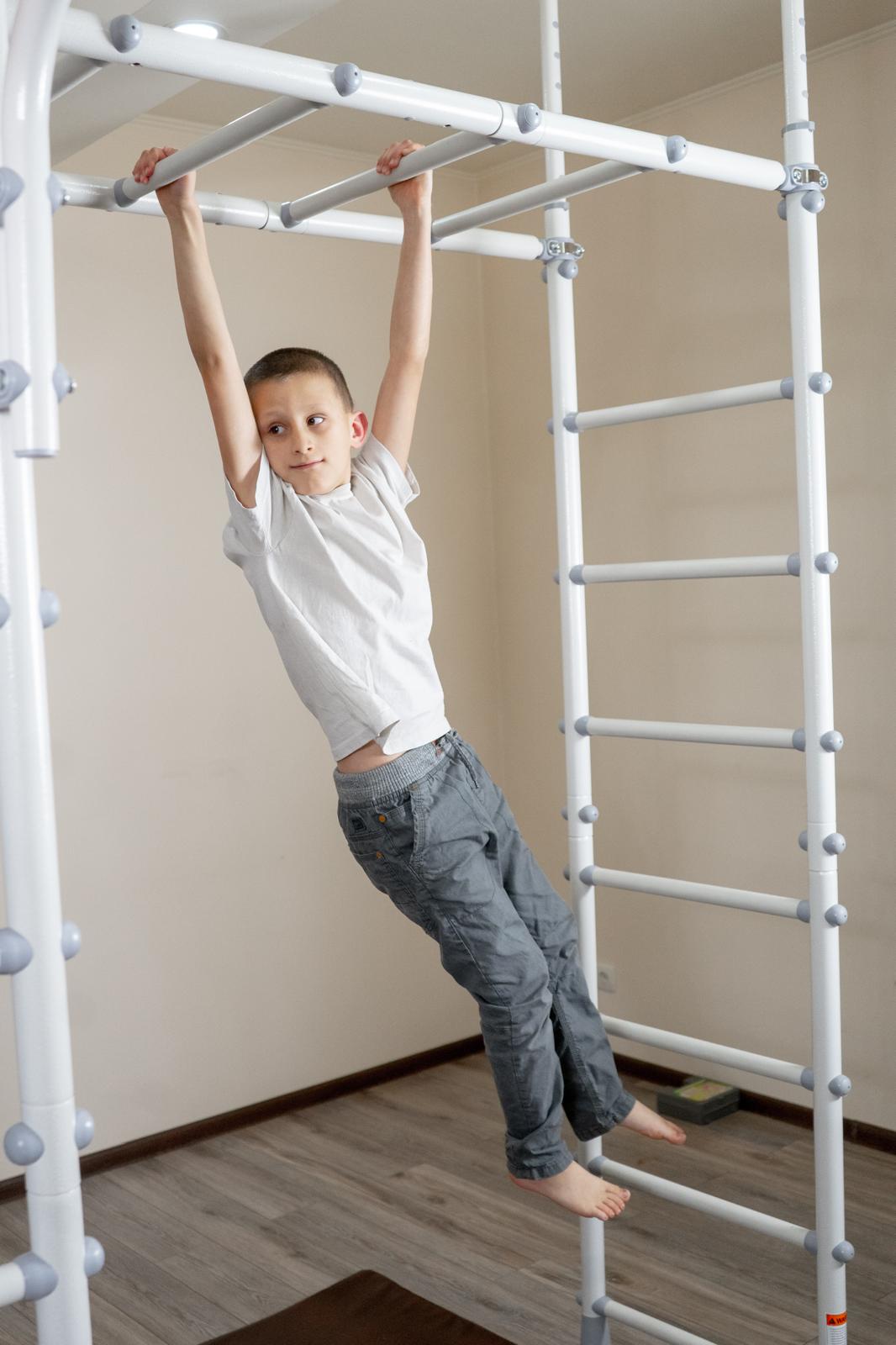
A child hanging from a bar looks like they're doing nothing. Inside, a lot is happening. The hands and forearms squeeze to keep the body from dropping. The shoulder blades have to decide where to sit, either pulled down and steady or shrugged up by the ears. The trunk keeps the legs from swinging wildly. And the moment the child lets go with one hand to reach for the next rung, the whole body has to reorganize around a single arm.

Anatomy art adapted from OpenStax, Anatomy and Physiology, licensed under CC BY 4.0. Changes: cropped, recolored and relabeled by Brainrich Kids.
✊ Grip and forearms
The forearm flexors close the fingers around the bar and hold them there. Grip is more than a hand skill: in a Dutch study of 384 young people aged 8 to 20, grip strength correlated strongly with total body strength (correlations of 0.74 to 0.89), which is why the authors suggest it as a quick indication of overall strength.
🦋 Shoulder blades
The middle and lower trapezius and the muscles around the rotator cuff hold the shoulder blades in place so the arm has a stable base. On the bars this is the difference between a "floppy" hang and an active one, where the child pulls the shoulders away from the ears.
🪽 Lats and upper back
The latissimus dorsi are the big, wing-shaped pulling muscles of the back. They work hardest when a child pulls up to reach the next rung, holds a bent-arm hang, or works toward a first chin-up.
🎯 Core and hip flexors
The abdominals and obliques keep the body from swinging out of control, and knee tucks bring in the hip flexors. A still, organized hang is a core exercise even when it doesn't look like one.
The fifth piece isn't a muscle at all. It's coordination. Going hand over hand means the left and right sides take turns: one holds the body while the other lets go, reaches, and catches. We'll come back to that in the brain section, because it's the part parents ask about most.
Occupational therapists call this kind of whole-body push and pull heavy work, and it sends a rich stream of information from muscles and joints to the brain (proprioceptive input). A. Jean Ayres, the occupational therapist who developed sensory integration theory, built much of her work on how that input helps children know where their bodies are in space. For an athlete, that body sense is the quiet part of every skill.
The muscles kids often miss, even busy athletes
Here's the surprise for a lot of sports parents: being on a team doesn't mean a child gets the basics. A 2011 review on youth training by Gregory Myer, Avery Faigenbaum and colleagues made the point that regular participation in organized sports does not by itself ensure kids get enough exposure to the skill- and health-related fitness work that underpins those sports. Practice time goes to the sport itself, which is how it should be. The AAP's 2020 clinical report on resistance training adds a wider worry: measures of muscular fitness in today's children have declined over time, and the report calls for strength activity for non-athletes as well as athletes.
A typical school day is full of sitting, carrying a backpack, and pushing up off a chair or the floor. It has very little hanging, very little pulling the body up, and almost nothing with the arms overhead. That's where the bars fill a gap.
| Muscle group | Why kids often under-use it | What the bars give it | Sports that lean on it |
|---|---|---|---|
| Grip and forearms | Few daily tasks ask small hands to hold full body weight | Every hang is a grip hold | Baseball, softball, wrestling, martial arts, gymnastics, climbing |
| Shoulder blade stabilizers | Arms spend most of the day low and forward | Active hangs, slow controlled swings | Throwing sports, swimming, cheer, gymnastics |
| Lats and upper back | Everyday play has much more pushing than pulling | Traverses, bent-arm holds, chin-up practice | Swimming, wrestling, climbing, ninja |
| Deep core | Chairs and car seats do the holding | Holding still under the bar, knee tucks, L-holds | Every sport on this page |
| Two-sided coordination | Screens and desks ask both hands to do small, matching things | Hand over hand: one side holds, the other moves | Batting, throwing, swimming, dance, martial arts |
What the bars don't cover
Monkey bars are an upper-body and coordination tool. They do very little for running speed, jumping, hamstrings, ankles, or endurance, and nothing at all for the skills of a sport: reading a play, timing a kick, learning a routine. Those belong to practice, coaches, and plenty of outdoor running around. Our sport-by-sport guides add the lower-body and stretching pieces each sport needs.
Benefits of monkey bars for every sport: one table
We looked at the sports our families tell us their kids play and asked one question for each: how much does this sport lean on the things a hang practices? The dots are our read of each sport's physical demands, not a measurement, and every sport needs far more than this table shows.
| Sport | Grip | Shoulder stability | Core | Pulling | Two-sided coordination | Where it shows up |
|---|---|---|---|---|---|---|
| Soccer | ● Low |
● Low |
●●● High |
● Low |
●●● High |
Balancing on one leg while the other kicks, holding ground when shielding the ball, throw-ins, a keeper's catch |
| Baseball and softball | ●●● High |
●●● High |
●●● High |
●● Medium |
●●● High |
Holding the bat, a throw that runs from the hips to the fingertips, glove side and throwing side doing different jobs |
| Basketball | ●● Medium |
●● Medium |
●●● High |
● Low |
●●● High |
Ball control with either hand, contact under the rim, landing steady after a jump |
| Gymnastics | ●●● High |
●●● High |
●●● High |
●●● High |
●●● High |
Bars and rings are the sport. Wall bars came out of 1800s Swedish gymnastics |
| Cheer and dance | ●● Medium |
●●● High |
●●● High |
●● Medium |
●●● High |
Bases lifting and catching, arms held overhead, holding a shape without wobbling |
| Wrestling and martial arts | ●●● High |
●●● High |
●●● High |
●●● High |
●●● High |
Gripping a wrist or a uniform, pulling a partner in, staying balanced in contact |
| Swimming | ● Low |
●●● High |
●●● High |
●●● High |
●●● High |
The pull of every stroke, arms overhead lap after lap, alternating arms in freestyle and backstroke |
| Climbing and ninja | ●●● High |
●●● High |
●●● High |
●●● High |
●●● High |
The same movements, at home, between classes |
High (●●●) leans on it heavily · Medium (●●) uses it often · Low (●) plays a smaller part
A young wrestler we talked with this fall told us something we hear in different words from a lot of families. When people ask her mom how she got so strong, the answer always comes back to the monkey bars. One family's story isn't a study, and her coaches and her own hard work deserve the credit. But it's a good picture of what "daily practice of the basics" looks like in real life.
Sport-by-sport guides are on the way, each with the muscle groups that sport leans on, the ones kids tend to miss, and a routine that fits around practice. The first one is live: gymnastics at home and swimming dryland exercises. For soccer, see soccer conditioning at home. For wrestling and martial arts, see wrestling conditioning at home.
Posture: the opposite shape
Coaches notice posture before parents do: the rounded shoulders, the head drifting forward, the arms that never quite reach full height overhead. Some of that is just growing. Some of it is the shape a child's body spends the most time in. School desks, car seats, and screens all put kids in the same position for hours: arms down and forward, shoulders rolled in, hips bent.

Hanging is close to the opposite shape: arms fully overhead, the shoulder blades working to stay put, hips open, and the body long under the hands. Sports that ask for arms overhead (swimming, throwing, serving, cheer, gymnastics) need that range to be comfortable and strong.
We want to be careful here, because posture is an area full of overpromises. No piece of equipment "fixes" posture, and you'll never hear us claim a gym corrects a spine. Posture is shaped by many things, including growth, habits, sleep, and how much a child moves overall. What daily hanging changes is the variety of shapes a child's body spends time in, and it practices strength in the muscles that hold the shoulder blades in place. If you have a real concern about your child's back or shoulders, that's a conversation for your pediatrician or a physical therapist.
Two hands, two sides of the brain: what's real and what's myth
Myth check: "left-brained" and "right-brained" kids
You may have read that some kids are "right-brained" (creative) and others "left-brained" (logical), or that an activity trains one side of the brain. That idea doesn't hold up. A University of Utah team looked at brain scans of 1,011 people aged 7 to 29 and found that while some functions, such as parts of language and attention, lean to one side, nobody's brain as a whole was more "left" or more "right." So the idea of an activity that trains "the left brain" or "the right brain" doesn't fit how the brain works, and that includes monkey bars.
What is real is more interesting. The two halves of the brain are connected by a thick bundle of nerve fibers called the corpus callosum, which lets them share information and divide up jobs. It keeps developing all through childhood. A study that mapped it in 190 children and teens aged 5 to 18 found it thickened across almost its entire length over those years, with phases of growth and fine-tuning that researchers link to myelination and pruning of the connecting fibers.
Movement scientists and occupational therapists use a few terms for the skills that ride on that teamwork:
- Bilateral coordination: using both sides of the body together, often doing different jobs. One hand holds the paper while the other cuts. One arm holds the bar while the other reaches.
- Crossing the midline: reaching a hand or foot across the center line of the body, as when a child climbs a net and reaches to the far side, or turns around on the bars.
- Cross-lateral movement: opposite arm and leg moving together, as in crawling, climbing a ladder, or running.
- Motor planning (praxis): seeing a new movement problem, planning the steps, and doing them in order. Ayres wrote about praxis at length. Every unfamiliar rung, swing or dismount is a small praxis puzzle.

Hand over hand on the monkey bars is a clear example of bilateral coordination with rhythm: hold with the left, swing, reach with the right, catch, shift the weight, repeat. Nobody has studied whether monkey bars change the corpus callosum, so we won't claim they do. What we can say is that a traverse asks the two sides to cooperate in a fast, timed way, over and over, in a form kids choose to repeat.
And yes, this matters for baseball. A throw is often described as a kinetic chain: force starts in the legs and hips, travels through the trunk and the shoulder, and finishes in the fingers, with each link firing in sequence. A 2010 review of pitching mechanics in Sports Health described the throw as a coordinated effort of muscles from the entire body. The two sides do different jobs at the same moment: the glove side pulls in and stabilizes while the throwing side whips through. A swing is similar, with two hands on one bat and the hips leading the hands. The bars don't teach a child to hit or throw. That's a coach's job. They do give daily practice to grip, shoulder control, and two sides of the body working on different tasks at once, which are pieces those skills are built from. For a full routine, see baseball and softball conditioning at home.
Why short, daily practice at home makes sense
The Physical Activity Guidelines for Americans ask children aged 6 to 17 for 60 minutes of activity a day, with muscle-strengthening and bone-strengthening activity on at least 3 of those days. For younger children the guidance is simpler: be active throughout the day. Team practice usually covers two or three days a week, and much of it is drills, waiting turns, and listening. That leaves gaps.
36% lower
Risk of lower-body injury in youth sport with neuromuscular training programs (review of 25 studies, Emery 2015)
Under 1/3
The injury risk with strength training programs vs. without, athletes of all ages, 25 trials and 26,610 participants (Lauersen 2014)
3 days
Muscle- and bone-strengthening a week, as part of the daily hour, for ages 6 to 17 (U.S. guidelines)
Two notes on those numbers, because they matter. First, they come from structured programs with coaches or trainers, mostly warm-ups, strength and balance work, not from monkey bars, and the second analysis included adult athletes as well as young ones. They tell us that strength and body-control work in general is linked to fewer sports injuries. They don't tell us that a home gym prevents injuries. Second, in the same 2014 analysis, stretching programs on their own showed no injury-prevention effect. We still include stretching in our routine because it supports range of motion and feels good, but we won't sell it as armor.
So why does home matter? Because the thing that makes any practice work is doing it, and the easiest practice to repeat is the one with no drive, no schedule, and no weather. A bar in the hallway turns "we should do strength work" into "I did three hangs on my way to brush my teeth." Ten minutes on most days adds up to about an hour a week, and it happens in short bursts that kids don't experience as training at all. It also keeps going when the season doesn't: rainouts, snow days, the long gap between fall ball and spring. Rainout? Climb in.
We love outdoor play, and nothing here replaces a park, a field, or a backyard. The gym is for the hours when outside isn't on the table, which for most families is a lot of hours.
A 10-minute monkey bars routine, by age
This is a play routine, not a workout plan. Younger kids will do it as a game, and that's the point. Older kids can treat it like a short circuit between homework and dinner. The time column adds up to about ten minutes with rest between rounds.
| Station | Ages about 3 to 6 | Ages about 7 to 10 | Ages 11 and up | What it practices |
|---|---|---|---|---|
|
Ladder warm-up 1 min |
Climb up a few rungs and back down, slowly | Climb to the top and down, 3 times | Same, without using knees on the rungs | Cross-lateral climbing, warming the hands |
|
Dead hang 2 min |
5 to 10 seconds, 3 times, a parent's hands close | 10 to 20 seconds, 3 times | 20 to 40 seconds, 3 times | Grip, shoulder comfort overhead |
|
Active hang 1.5 min |
"Make yourself tall" while hanging | 5 slow "shoulders away from your ears" | 8 to 10 slow, with a 2-second hold | Shoulder blade control |
|
Knee tucks 1.5 min |
2 or 3 knees-up "cannonballs" | 5 slow tucks | 8 tucks, or an L-hold for 5 to 10 seconds | Core, hip flexors |
|
Traverse 2 min |
1 to 3 rungs, with a hand at the waist | The full span, 2 or 3 times | Full span, then skip a rung or go backward | Bilateral coordination, motor planning, pulling |
|
Ladder stretches 2 min |
"Reach for the top rung" on tiptoes | Chest opener (hand on a rung at shoulder height, turn the chest away), lunge holding a rung for the front of the hip, heel on a low rung for the back of the leg. 20 to 30 seconds each side | Range of motion for shoulders and hips | |
The safety rules that make "yes" possible
- An adult in the same room, every time. Toddlers and new hangers get a parent's hands close to the waist. Lift little ones by the waist, never by the hands or arms, which can strain a young elbow.
- A thick mat under every bar and every landing zone.
- Stop each hang while the grip still feels good. Never hang until the hands give out, and no maximal efforts or added weights for kids.
- One child on a bar at a time. No kipping, no flipping over the bar, no hanging from someone who is already hanging.
- Drop with soft knees onto the mat, or climb down the ladder.
- Sore hands or shoulders mean a day off. Pain that doesn't fade is a reason to call the pediatrician, and a child with a joint, heart or other medical condition should get the pediatrician's OK before starting.
The AAP's 2020 report supports strength activity for children and teens when it's supervised, technique comes first, and loads are age-appropriate. A literature review by Avery Faigenbaum and Gregory Myer found that most injuries reported in young lifters were accidental, often linked to poor technique, too much weight, or no qualified supervision. Hanging uses only the child's own body weight, and the main risk on monkey bars is falling, which is why the height, the mat and an adult nearby matter more than anything else. For the step-by-step path from a first hang to a first pull-up, see our pull-up skills progression.

Every athlete's first hang looks like this: short, supported, and a parent's hands close by.
How it fits around team practice
Practice is twice a week. Climbing is every day. The goal is to add to a child's week without adding to the pressure, so the gym should feel like play on practice days and a little more structured on off days.
| Day | Team schedule (example) | On the gym |
|---|---|---|
| Monday | Off | The full 10-minute routine |
| Tuesday | Practice | Free play only, if they want it |
| Wednesday | Off | The full routine |
| Thursday | Practice | Hangs and stretches, 5 minutes |
| Friday | Off | Free play, swings, games |
| Saturday | Game | Nothing planned. Free play only if they ask. Rest is part of training |
| Sunday | Off | Family round: everyone takes a turn, parents too |
In season, keep it light and fun, and skip anything the day before a game if your child feels tired. Off season, there's more time, so the routine can become a steady habit. When they're between sports, or not into one yet, free climbing, hanging and swinging are a great way to stay active with no program at all.
Variety helps too. The AAP's 2016 clinical report on sports specialization cautions that specializing in one sport too early can carry physical and psychological costs. A 2015 study of 1,190 young athletes aged 7 to 18 found that specializing in a single sport carried an injury risk of its own, independent of total training hours. Hanging, climbing and swinging are a different kind of movement from most team sports, and that difference is part of their value. Sports have seasons. Climbing doesn't.
Where Brainrich fits
Monkey bars need two supports and a span between them, so they are never a stand-alone piece. The Spider V3 comes with the monkey bars built in: two floor-to-ceiling steel ladders, the span, a climbing net, a rope, gymnastic rings, and two sets of pull-up bars. The Spider Max V3 has two spans, which leaves room for siblings or a swing in the second bay. The Monkey Bars V3 add-on is for families that already own a Brainrich frame: it adds one more ladder and the span and uses your existing frame as the other support, so a Model T3 plus the add-on becomes a Spider V3.
Every gym is tension-mounted between floor and ceiling, with no drilling. The frame is steel, rated for 220 lb, and tested to 440, so parents can hang from the same bars after bedtime. The pull-up bars and rings move up and down the ladder as your child grows, and the same frame keeps working from a toddler's first supported hang to a teenager's pull-ups. More than 10,000 families have a Brainrich gym at home, and occupational and physical therapists in our owner community recommend them. For types, sizes and ceiling heights, our complete monkey bars guide compares every option, indoor and outdoor.


Every kid is a climber first
Monkey bars in the hallway, for the days between practices. Steel, no drilling, and a 30-day money-back guarantee. Questions? Reach out to us.
Frequently asked questions
Do monkey bars help kids with sports? Monkey bars practice grip, shoulder stability, core control and coordination between the two sides of the body, and most sports lean on those. Research links supervised strength and neuromuscular training to fewer youth sports injuries, but no study has tested monkey bars on sports performance. Treat them as daily practice of the basics that sit alongside team practice and coaching, not in place of them.
What muscles do monkey bars work? Mainly the grip and forearm muscles, the shoulders and rotator cuff, the middle and lower trapezius that hold the shoulder blades in place, the lats of the upper back, and the core. Knee tucks and L-holds add the hip flexors. Going hand over hand also practices bilateral coordination and motor planning.
What age can kids start on monkey bars? Toddlers can hang for a few seconds with a parent's hands close to their waist and a mat underneath. Kids approaching 3 start trying a rung or two with help, and most children can cross a full span somewhere in the early school years. An adult stays in the room at every age.
How often should a young athlete do monkey bars? Short and frequent is easiest to keep up: about ten minutes on most days, lighter on practice days, and nothing planned on game days. U.S. guidelines ask children aged 6 to 17 for muscle- and bone-strengthening activity on at least 3 days a week, and hanging and climbing count.
Is hanging safe for growing kids? Hanging uses only a child's own body weight, and the main risk on monkey bars is falling, so height, a mat and supervision matter most. The American Academy of Pediatrics supports supervised, age-appropriate strength training for children, and reviews of youth training found most reported injuries were accidents tied to poor technique, heavy loads, or no supervision. Keep an adult in the room, a mat under the bar, and stop before the grip gives out.
Do monkey bars make kids taller? No. Height comes mostly from genetics, with nutrition and sleep playing their part, and hanging doesn't lengthen bones. What hanging can change is how comfortable a child is with arms overhead and how long they can hold their own weight.
📚 Keep reading in the Decision Guide
Swimming Dryland Exercises for Kids · At-Home Strength for Young Athletes · Gymnastics at Home: Safe Conditioning Ideas · The Monkey Bars Guide · Pull-Up Bar Skills: From First Hang to First Pull-Up · Heavy Work Activities for Kids · Proprioceptive Input · Controlled Risky Play · Soccer Conditioning for Kids at Home · Wrestling and Martial Arts Conditioning for Kids · Baseball and Softball Conditioning for Kids
About the author
Yegor Nadvornyy is the founder of Brainrich Kids and a dad. More than 10,000 families have a Brainrich gym at home. Every study in this article was checked against the original paper, and results are reported as the researchers found them, including the ones that don't flatter monkey bars.
Sources
Stricker, P.R., Faigenbaum, A.D., McCambridge, T.M. et al. (2020). Resistance Training for Children and Adolescents. Pediatrics, 145(6), American Academy of Pediatrics. · Myer, G.D., Faigenbaum, A.D., Ford, K.R. et al. (2011). When to Initiate Integrative Neuromuscular Training to Reduce Sports-Related Injuries and Enhance Health in Youth? Current Sports Medicine Reports, 10(3). · Faigenbaum, A.D., Myer, G.D. (2010). Resistance training among young athletes: safety, efficacy and injury prevention effects. British Journal of Sports Medicine, 44(1). · Wind, A.E., Takken, T., Helders, P.J., Engelbert, R.H. (2010). Is grip strength a predictor for total muscle strength in healthy children, adolescents, and young adults? European Journal of Pediatrics, 169. · Emery, C.A., Roy, T.O., Whittaker, J.L. et al. (2015). Neuromuscular training injury prevention strategies in youth sport: a systematic review and meta-analysis. British Journal of Sports Medicine, 49. · Lauersen, J.B., Bertelsen, D.M., Andersen, L.B. (2014). The effectiveness of exercise interventions to prevent sports injuries: a systematic review and meta-analysis of randomised controlled trials. British Journal of Sports Medicine, 48. · Nielsen, J.A., Zielinski, B.A., Ferguson, M.A. et al. (2013). An Evaluation of the Left-Brain vs. Right-Brain Hypothesis with Resting State Functional Connectivity Magnetic Resonance Imaging. PLoS ONE, 8(8). · Luders, E., Thompson, P.M., Toga, A.W. (2010). The Development of the Corpus Callosum in the Healthy Human Brain. Journal of Neuroscience, 30(33). · Seroyer, S.T., Nho, S.J., Bach, B.R. et al. (2010). The Kinetic Chain in Overhand Pitching: Its Potential Role for Performance Enhancement and Injury Prevention. Sports Health, 2(2). · Brenner, J.S., AAP Council on Sports Medicine and Fitness (2016). Sports Specialization and Intensive Training in Young Athletes. Pediatrics, 138(3). · Jayanthi, N., LaBella, C.R., Fischer, D. et al. (2015). Sports-Specialized Intensive Training and the Risk of Injury in Young Athletes: A Clinical Case-Control Study. American Journal of Sports Medicine, 43(4). · U.S. Department of Health and Human Services (2018). Physical Activity Guidelines for Americans, 2nd edition. · OpenStax (2016). Anterior and Posterior Views of Muscles, Anatomy and Physiology, Rice University, CC BY 4.0 (muscle chart, adapted). · Ayres, A.J. (1979). Sensory Integration and the Child. Western Psychological Services.
Share: