

Updated October 2026 · 11-minute read · by Yegor Nadvornyy, founder of Brainrich Kids
Basketball looks like a game of hands: dribbling, passing, shooting. Watch a young player for a whole game, though, and you'll count dozens of jumps, landings, quick stops and cuts. In US high school basketball, about 4 in 10 injuries are to the ankle or foot, and how a player lands has been linked to knee injuries too. This guide covers what basketball asks of a young body, what research on young players found, and a 10-minute home routine for landings, ankles, core and grip that doesn't add more basketball to the week.
The quick answer: basketball asks for jumping, soft landings, quick stops, steady ankles, a strong core and good hands. Ankle sprains are the most common basketball injury in kids and teens, and finger injuries top the list at ages 7 to 11. Studies of team warm-ups that mix balance, strength and landing practice have linked them to fewer ankle and knee injuries. At home, the useful work is grip, core, calf and leg strength, landing practice and one-leg balance: about ten minutes on days without a game, on bars, a ladder and a mat. NBA and USA Basketball guidelines suggest at least two days a week off organized basketball for kids 7 to 11, so the home gym should feel like play, not another practice. An adult stays in the room and a mat goes under every bar.
Jump to: What basketball asks · The research on young players · Landings and ankles · 10-minute routine · Around the season · Equipment · FAQ
What basketball asks of a young body
A rebound is a good example. A player reads the ball, bends the knees, swings the arms, jumps, grabs the ball with both hands, holds on through contact and lands, often on one foot and often off balance. Then they turn and sprint. A layup, a closeout on defense and a jump stop all ask for the same things in a different order: legs that push, a trunk that stays steady, ankles that hold and hands that grip.
The muscles behind that are mostly in the legs and hips: the quadriceps, glutes, hamstrings and calves for jumping and landing, and the core for keeping the trunk upright when a player lands or gets bumped. The hands and forearms handle the ball, the rebound and the contact.

Anatomy art adapted from OpenStax, Anatomy and Physiology, licensed under CC BY 4.0. Changes: cropped, recolored and relabeled by Brainrich Kids.
| What basketball asks | Where you see it | What the home gym practices |
|---|---|---|
| Soft landings | Coming down from a rebound, a layup or a jump shot | Small step-offs onto the mat: knees bent, knees over toes, quiet feet |
| Steady ankles and calves | Jump stops, cuts, landing on someone's foot | Calf raises holding the ladder, one-leg balance |
| Legs and hips | The jump, the first step, a defensive stance | Squats and lunges holding the ladder, ladder climbing |
| Core | Staying upright through contact, landing without folding | Hanging knee raises, planks and side planks |
| Grip and hands | Securing a rebound, holding the ball through contact | Hangs with different grips, monkey bar traverses |
| Both sides of the body | Dribbling with the weak hand, jumping off either foot | Hand-over-hand traverses, climbing the net, balance on each leg |
What the research on young basketball players found
Youth basketball has a growing body of research, much of it from high school teams in the US and Canada.
Ankles come first. Borowski and colleagues tracked injuries at 100 US high schools over two seasons: 1,518 injuries in all. About 4 in 10 (39.7%) were to the ankle or foot, followed by the knee (14.7%). Ligament sprains were the most common diagnosis (44%), and injury rates were more than twice as high in games as in practice.
In younger kids, fingers lead the list. Zynda and colleagues looked at US emergency room visits for basketball injuries in kids aged 7 to 17 from 2012 to 2018. Ankle sprains were the most common diagnosis overall (17.7%), followed by finger sprains and fractures (12.1%). At ages 7 to 11, finger injuries came first, ahead of head injuries. Teens made up most of the visits, with about four times as many injuries a year as the younger group.
How a player lands matters. Hewett and colleagues filmed 205 female soccer, basketball and volleyball players doing a jump-landing test, then followed them. The nine who later tore an ACL had landed with their knees collapsing inward more, and landed harder and faster, than the players who didn't. That's a link between landing style and later injury, not proof that practicing landings prevents one, but it's why coaches teach "soft landings, knees over toes."
Short warm-ups have been linked to fewer injuries. In Calgary, Emery and colleagues compared one season of standard warm-ups with a season of a 10-minute warm-up of 13 exercises mixing balance, strength and agility, in players aged 11 to 18. Teams using it had a 36% lower rate of ankle and knee injuries. The program was run by coaches before practice, and the results were similar whether or not someone supervised it.

What this means for parents
Get every ankle sprain checked and fully healed before going back to full play: a past sprain was one of the strongest warning signs for the next one. Follow your league's rest guidance. The home gym fits around all of that because it works the pieces team studies focus on, landings, balance, legs and core, without adding more games or drills. None of it is a claim that home training prevents basketball injuries.
Landings and ankles: what balance training studies found
Two trials are especially useful for parents, because one of them included work at home.
Balance training and ankle sprains. McGuine and Keene randomly assigned 55 high school soccer and basketball teams in Wisconsin (765 athletes) to a balance training program or standard conditioning. Ankle sprains happened to 6.1% of athletes on balance-training teams and 9.9% on the others. Athletes with a past sprain had about twice the risk of a new one.
A home wobble-board program. Emery and colleagues randomized 25 Calgary high schools (920 basketball players aged 12 to 18). One group added a balance warm-up plus a home balance program on a wobble board. That group had about 29% fewer sudden-onset injuries. The drop in ankle sprains alone wasn't statistically clear, and only about 6 in 10 players kept up the home part, which says a lot about how hard home routines are to stick with.
Landing practice has been studied too, though in the lab rather than on injury rates. In a small study of 18 high school girls, both jump training and balance training changed how they landed: knees bent more and caved in less. In a randomized study of 75 basketball players around age 16, eight weeks of single-leg jump training helped them steady themselves faster after a one-leg landing and land with less force than two-leg jumps or no jump training.

Mats under the gym turn the floor into a place to practice landings.
Basketball conditioning at home: a 10-minute routine
This routine runs on a home climbing gym or wall bars with a thick mat. Use it on days without a game, and keep it playful. No ball, no hoop, no extra drills.
| Station | Ages about 5 to 7 | Ages about 8 to 11 | Ages 12 and up | What it practices |
|---|---|---|---|---|
|
Ladder climb 1 min |
Up a few rungs and down, slowly | To the top and down, 2 times | Same, without knees on the rungs | Warm-up, left and right taking turns |
|
Grip hangs 1.5 min |
"Monkey hang," 5 to 10 seconds, 2 or 3 times | Overhand and underhand, 10 to 20 seconds each | Up to 30 seconds each, plus 5 active hangs: shoulders down, hold 3 seconds | Grip, hands that hold on |
|
Core 1.5 min |
2 or 3 hanging "cannonball" tucks, a plank on the mat | 5 knee raises, side plank 15 seconds each side | 8 knee raises, side plank 30 seconds each side | Staying upright through contact |
|
Calves and legs 2 min |
10 "tiptoe" calf raises and 5 "frog squats," holding a rung | 15 calf raises, 10 squats, 5 lunges each leg, holding the ladder | One-leg calf raises, 10 each side, then lunges with a pause | Jumping, first step, ankles |
|
Landings 2 min |
Step off the lowest rung onto the mat, land on two feet like a "quiet cat," 5 times | Same from the lowest rung, freeze for 3 seconds, knees over toes, 8 times | Two-foot landings, then small hops landing on one foot and holding 3 seconds, 5 each side | Soft landings, knee control |
|
Balance 2 min |
"Flamingo" holding a rung, 10 seconds each leg | 20 seconds each leg, one hand off the rung | 30 seconds each leg, hands free, then reach a hand forward and back on one leg | Ankle control, landing off balance |
Safety rules for basketball conditioning at home
- An adult in the same room, every time, and a thick mat under the bars and the landing area.
- Landings only from the lowest rung. No jumping off the top of the gym or from the monkey bars.
- A sprained ankle sits out the landings and balance until it's fully healed. Pain that doesn't fade means a call to the pediatrician.
- Jammed or sore finger? Skip the hangs that day.
- Stop each set while the form is still clean. No training to failure, no added weights.
- One child on a bar at a time, and no balls bouncing around the gym.

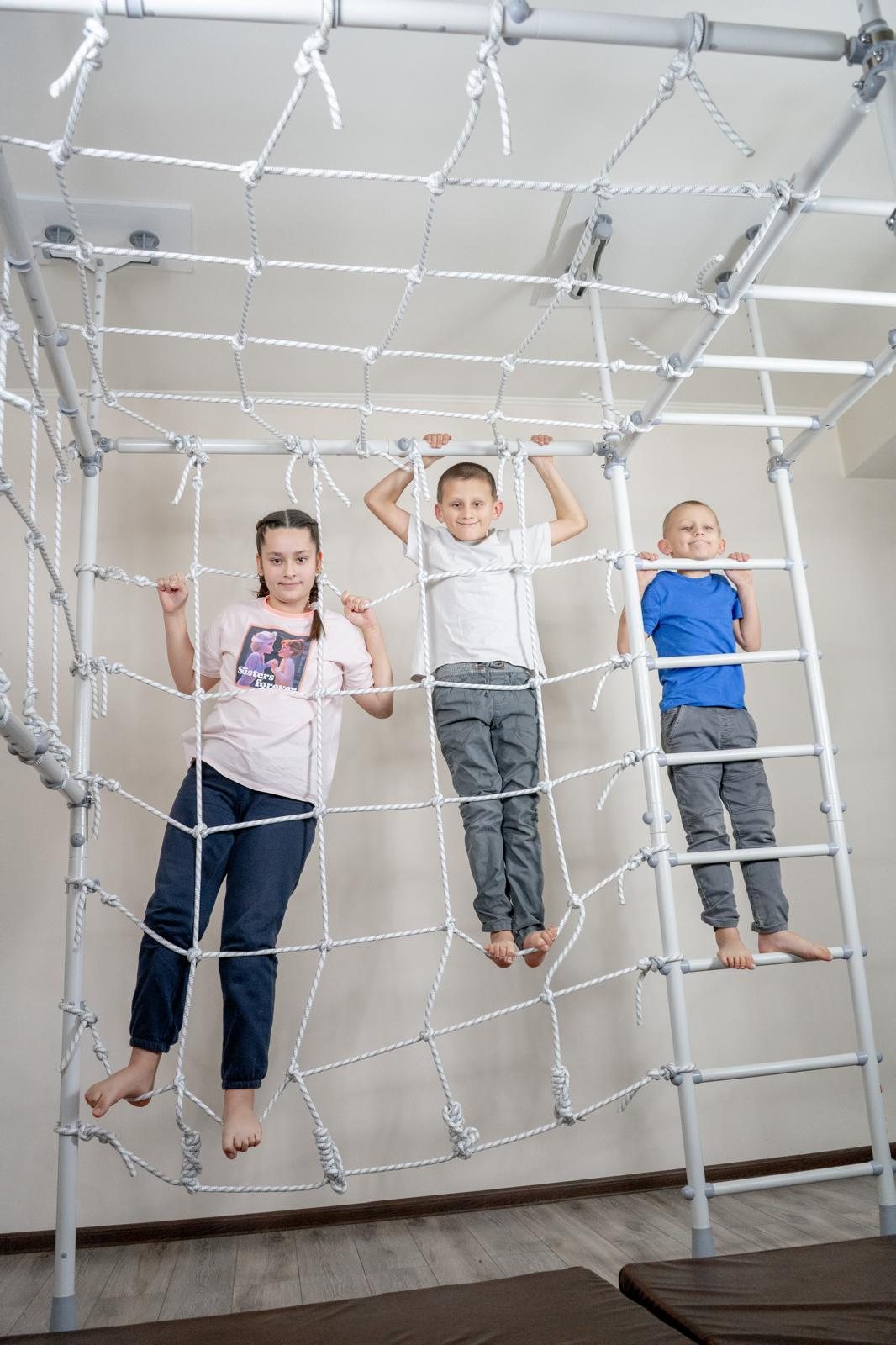
Hanging works the grip that holds on to a rebound.
Around the season: games, practices and rest days
NBA and USA Basketball published youth guidelines in 2018 with specific limits by age. For kids 7 to 11 they suggest at least two days a week off organized basketball and no more than 3 to 5 hours a week of it, rising to 10 hours at ages 12 to 14. They also suggest waiting until at least 14 to focus on basketball alone. Free play, like shooting hoops in the driveway, doesn't count toward those limits, and neither does climbing at home. The gym should still feel like play, not a second practice.
| Day type | On the gym |
|---|---|
| Practice day | Free play only, if they want it |
| Rest day from basketball | The full 10-minute routine, kept playful |
| Game day | Nothing planned |
| Day after a tournament weekend | Easy hangs and balance only. No landings |
| Off-season | The routine on most days, plus climbing, swinging and other sports |
We love a driveway hoop and a gym full of parents cheering, and none of this replaces a coach. The home gym is for the winter evenings, the rainy weekends and the days between games.
Equipment for basketball conditioning at home
For the routine above you need a bar to hang from, monkey bars, a ladder to hold for calf raises, squats and balance, and a thick mat to land on. The Spider V3 has the monkey bars built in, plus pull-up bars, rings, a rope and a net. The Spider Max V3 adds a second span, which helps when siblings or teammates come over. Both are steel, rated for 220 lb and tension-mounted between floor and ceiling with no drilling. More than 10,000 families have a Brainrich gym at home, and occupational and physical therapists in our owner community recommend them.


Games on the court. Landings at home.
For winter evenings, rainy weekends and the days between games. Steel, no drilling, and a 30-day money-back guarantee. Questions? Reach out to us.
Frequently asked questions
What are good basketball conditioning exercises for kids at home? Work that doesn't add more basketball: calf raises and squats holding a ladder, small step-off landings onto a mat, one-leg balance, hanging knee raises and side planks for the core, and grip hangs. About ten minutes on days without a game is plenty. Skills and drills stay with the coach.
Can kids do basketball conditioning drills without a ball? Yes. The pieces that team warm-up studies focus on, balance, landings, leg strength and core, don't need a ball or a hoop. A ladder, a bar and a mat cover all of them.
What is the most common basketball injury in kids? Ankle sprains. In US emergency room data on players aged 7 to 17, ankle sprains were the most common diagnosis, and finger injuries came second. At ages 7 to 11, finger injuries came first. Get every sprain checked and fully healed before full play: a past sprain is one of the strongest warning signs for the next one.
How many days a week should kids play basketball? NBA and USA Basketball guidelines suggest at least two days a week off organized basketball for ages 7 to 11 and at least one for older kids, plus several months a year away from it. They suggest a limit of 3 hours a week at ages 7 to 8 and 5 hours at 9 to 11.
Is strength training safe for young basketball players? The American Academy of Pediatrics supports strength training for children and teens, athletes and non-athletes alike, when it's done with good technique and sensible loads. Body-weight work on bars, a ladder and a mat fits that. Skip maximal lifts and training to failure.
📚 Keep reading in the Decision Guide
How Monkey Bars Support Every Sport · At-Home Strength for Young Athletes · Soccer Conditioning for Kids at Home · Tennis Conditioning for Kids at Home · Cheer and Dance Conditioning at Home · Controlled Risky Play · How Climbing Supports Every Sport
About the author
Yegor Nadvornyy is the founder of Brainrich Kids and a dad. More than 10,000 families have a Brainrich gym at home. Every study in this article was checked against the original paper, and results are reported as the researchers found them.
Sources
Borowski, L.A., Yard, E.E., Fields, S.K., Comstock, R.D. (2008). The Epidemiology of US High School Basketball Injuries, 2005-2007. American Journal of Sports Medicine, 36(12). · Zynda, A.J., Wagner, K.J., Liu, J. et al. (2022). Epidemiology of Pediatric Basketball Injuries Presenting to Emergency Departments: Sex- and Age-Based Patterns. Orthopaedic Journal of Sports Medicine, 10(1). · Hewett, T.E., Myer, G.D., Ford, K.R. et al. (2005). Biomechanical Measures of Neuromuscular Control and Valgus Loading of the Knee Predict Anterior Cruciate Ligament Injury Risk in Female Athletes: A Prospective Study. American Journal of Sports Medicine, 33(4). · Emery, C.A., Owoeye, O.B.A., Räisänen, A.M. et al. (2022). The "SHRed Injuries Basketball" Neuromuscular Training Warm-up Program Reduces Ankle and Knee Injury Rates by 36% in Youth Basketball. Journal of Orthopaedic and Sports Physical Therapy, 52(1). · McGuine, T.A., Keene, J.S. (2006). The Effect of a Balance Training Program on the Risk of Ankle Sprains in High School Athletes. American Journal of Sports Medicine, 34(7). · Emery, C.A., Rose, M.S., McAllister, J.R., Meeuwisse, W.H. (2007). A Prevention Strategy to Reduce the Incidence of Injury in High School Basketball: A Cluster Randomized Controlled Trial. Clinical Journal of Sport Medicine, 17(1). · Myer, G.D., Ford, K.R., McLean, S.G., Hewett, T.E. (2006). The Effects of Plyometric Versus Dynamic Stabilization and Balance Training on Lower Extremity Biomechanics. American Journal of Sports Medicine, 34(3). · Zhao, Y., Sun, M., Wang, X., Xu, Q. (2024). Unilateral Plyometric Jump Training Shows Significantly More Effective Than Bilateral Training in Improving Both Time to Stabilization and Peak Landing Force in Single-Leg Land and Hold Test. Journal of Sports Science and Medicine, 23(1). · DiFiori, J.P., Güllich, A., Brenner, J.S. et al. (2018). The NBA and Youth Basketball: Recommendations for Promoting a Healthy and Positive Experience. Sports Medicine, 48(9). · Stricker, P.R., Faigenbaum, A.D., McCambridge, T.M. et al. (2020). Resistance Training for Children and Adolescents. Pediatrics, 145(6). · OpenStax (2016). Anterior and Posterior Views of Muscles, Anatomy and Physiology, Rice University, CC BY 4.0 (muscle chart, adapted).
Share: