

Updated October 2026 · 13-minute read · by Yegor Nadvornyy, founder of Brainrich Kids
Swim kids live on a strange schedule: early mornings, chlorine hair, a pool that closes for the holidays, and a coach who keeps saying "dryland." If you've searched for swimming dryland exercises for your child and found programs built for college athletes, this guide is the kid-sized version. Young swimmers already give their shoulders a lot of repeated work in the water. The best dryland time at home is short, varied, and kind to those shoulders: shoulder blade control, core, legs, stretching, and plenty of play that isn't swimming at all.
The quick answer: swimming leans on the shoulders, lats, chest, triceps, core and hip flexors, with arms overhead stroke after stroke. Shoulder pain is common in swimmers, even young ones, and in research it's linked to more time in the water and less time in other sports. Good dryland for kids works the shoulder blade muscles and rotator cuff lightly, builds core endurance, adds legs and jumping for starts and turns, stretches the chest and back of the shoulder, and mixes in other movement like climbing. Keep it to about ten minutes on most days, lighter in heavy training weeks, with an adult in the room. Shoulder pain means rest and a doctor, not more hanging.
Jump to: What swimming asks · The swimmer's shoulder question · What dryland adds · 10-minute routine · Seasons and breaks · Equipment · FAQ
What swimming asks of a young body
Every stroke has the same two halves: reach and pull. The arm reaches overhead and forward, catches the water, and pulls it back past the body, while the core keeps the body long and the legs kick. Freestyle and backstroke alternate arms, butterfly and breaststroke move both together, and all four ask the shoulder to work through a big range many times a practice.

Anatomy art adapted from OpenStax, Anatomy and Physiology, licensed under CC BY 4.0. Changes: cropped, recolored and relabeled by Brainrich Kids.
| What swimming asks | Where you see it | What dryland at home practices |
|---|---|---|
| Shoulder control overhead | The reach and catch of every stroke | Active hangs: "shoulders away from the ears" |
| Rotator cuff endurance | Keeping the shoulder centered lap after lap | Light band rotations tied to a ladder rung |
| Pulling strength | The pull phase: lats, chest, triceps | Short chin-up holds and slow lowering, a few reps |
| Core endurance | A long, flat body line, rotation in freestyle | Hollow holds, hanging knee raises, side planks |
| Leg power | Starts off the block, push-offs at every wall | Squats, jumps, climbing the ladder |
| Chest and shoulder flexibility | Reaching long without the shoulders rounding | Chest and back-of-shoulder stretches on the ladder |
For how hanging works the shoulders, grip and core in every sport, see how monkey bars support every sport. Swimmers are the one group where we'd add a caution to that article: their shoulders already do a lot of overhead work, so on land the goal is control and balance, not volume.
The swimmer's shoulder question
Coaches and doctors use the phrase "swimmer's shoulder" for a reason. In a study of 80 elite swimmers aged 13 to 25, Sein and colleagues found that 91% reported shoulder pain, and most of those who had an MRI showed tendinopathy of the supraspinatus, a rotator cuff tendon. The authors linked it mainly to the amount of swimming training. Those were elite athletes, but younger swimmers aren't immune.
About 1 in 5
Competitive swimmers aged 8 to 11 with shoulder pain and disability (Tate 2012)
91%
Elite swimmers aged 13 to 25 reporting shoulder pain (Sein 2010)
A study by Tate and colleagues looked at 236 competitive female swimmers from age 8 to 77. Shoulder pain with disability showed up at every age: about 21% of 8- to 11-year-olds, 19% of 12- to 14-year-olds, 23% of high schoolers, and 19% of masters swimmers. In two or more age groups, the swimmers with pain had more swimming exposure, more past injuries, more feelings of shoulder instability, and less participation in another sport. The authors suggested that a prevention program might include less exposure, cross-training, stretching of the chest and back of the shoulder, strengthening, and core endurance.
That's an association, not proof that any one fix prevents pain. But it points in a clear direction for parents: variety, balance, and not stacking more overhead work on top of a heavy pool week.
If your swimmer's shoulder hurts
Skip hanging and overhead work at home, tell the coach, and see your pediatrician or a sports medicine doctor if the pain lasts or keeps coming back. Pain that wakes your child at night, or that makes them change their stroke, is worth a visit sooner.
What dryland time at home adds
The pool gives a swimmer plenty of one kind of work. Dryland is the chance to train the pieces the water doesn't, and to move in ways that have nothing to do with swimming.

🦋 Shoulder blades first
An active hang, pulling the shoulders away from the ears, trains the lower trapezius and lats to hold the shoulder blades steady. For swimmers, a few slow reps are plenty. There's no need for long hangs.
🎯 Core endurance
Holding a long, tight body line is what keeps a swimmer flat in the water. Hollow holds on the mat and hanging knee raises practice the same tension.
🦵 Legs and landings
Starts and turns are leg-powered. The U.S. guidelines also ask kids for bone-strengthening activity on at least 3 days a week, the kind with impact such as jumping and running. Swimming is low-impact, so jumping and climbing on land fill that gap.
🧗 A different sport
Climbing a ladder, swinging and crawling through a net are nothing like a swim set, and that's the point. The AAP encourages variety over early specialization, and in the Tate study the swimmers with pain played fewer other sports.
Swimming dryland exercises for kids: a 10-minute routine
This runs on a home climbing gym or wall bars plus a mat, sorted by age. It's about ten minutes. Do it on most days that aren't heavy pool days, and make it a game for the younger ones.
| Station | Ages about 5 to 7 | Ages about 8 to 11 | Ages 12 and up | What it practices |
|---|---|---|---|---|
|
Ladder climb 1 min |
Up a few rungs and down, slowly | To the top and down, 2 times | Same, without knees on the rungs | Warm-up, legs, coordination |
|
Active hangs 1.5 min |
"Make yourself tall," 3 short hangs | 5 slow "shoulders down," 2 rounds | 8 slow reps with a 2-second hold | Shoulder blade control |
|
Band rotations 1.5 min |
Skip, or "open the door" with no band | Light band tied to a rung at elbow height, elbow at the side, rotate out slowly, 8 each arm | Same, 12 to 15 each arm | Rotator cuff endurance |
|
Core 2 min |
"Banana" hollow hold on the mat, 3 short holds | Hollow hold 10 to 15 seconds, 5 hanging knee raises | Hollow hold 20 seconds, side planks, knee raises | A long, steady body line |
|
Legs 2 min |
Frog jumps onto the mat | Squats, then 5 jumps for height | Squat jumps, split squats | Starts, push-offs, bone-loading |
|
Stretches 2 min |
"Reach for the top rung" on tiptoes | Chest stretch (hand on a rung at shoulder height, turn the body away), back-of-shoulder stretch (arm across the chest), hip flexor lunge holding a rung. 20 to 30 seconds each, no bouncing | Chest and shoulder range, hips | |
Safety rules for swimmers at home
- An adult in the same room, every time, and a thick mat under the bar and the jumping zone.
- Shoulder pain means no hanging and no overhead work until a doctor or physical therapist clears it.
- Heavy pool weeks and meet weeks get less overhead work at home, not more. Climbing and play are fine.
- Light bands only, slow and controlled. No added weights without a qualified coach.
- Stop each set while the form is still clean. Never train to failure.
- One child on a bar at a time. No kipping, no flipping over the bar.
If your swimmer is also working toward chin-ups, our guide to at-home strength for young athletes has the AAP's recommendations and a progression by age. For swimmers, keep pulling sets short and stop at the first sign of shoulder discomfort.

Dryland doesn't have to look like training. Climbing and hanging for fun count.
Seasons, breaks and how much is enough
Swimming is a year-round sport for many families, and that's where the hours can pile up. In a study of 1,190 young athletes aged 7 to 18, Dr. Neeru Jayanthi and colleagues found that kids who played more hours of organized sport per week than their age in years had about twice the odds of a serious overuse injury, and so did kids whose organized-sport hours were more than double their free play. The AAP's 2016 report on sports specialization cautions against early single-sport focus for the same reasons.
🏊 In a heavy training block
Core, legs and stretching only, plus free climbing for fun. Save the hangs and band work for lighter weeks.
❄️ When the pool closes
Holiday closures, a season break, a family trip home. The full 10-minute routine keeps the habit going, and the gym is there on the coldest, darkest days.
We love time outdoors and in the water, and none of this replaces a good coach or a swim team. Practice is a few times a week. Climbing is every day, for any kid who wants it.
Equipment for dryland at home
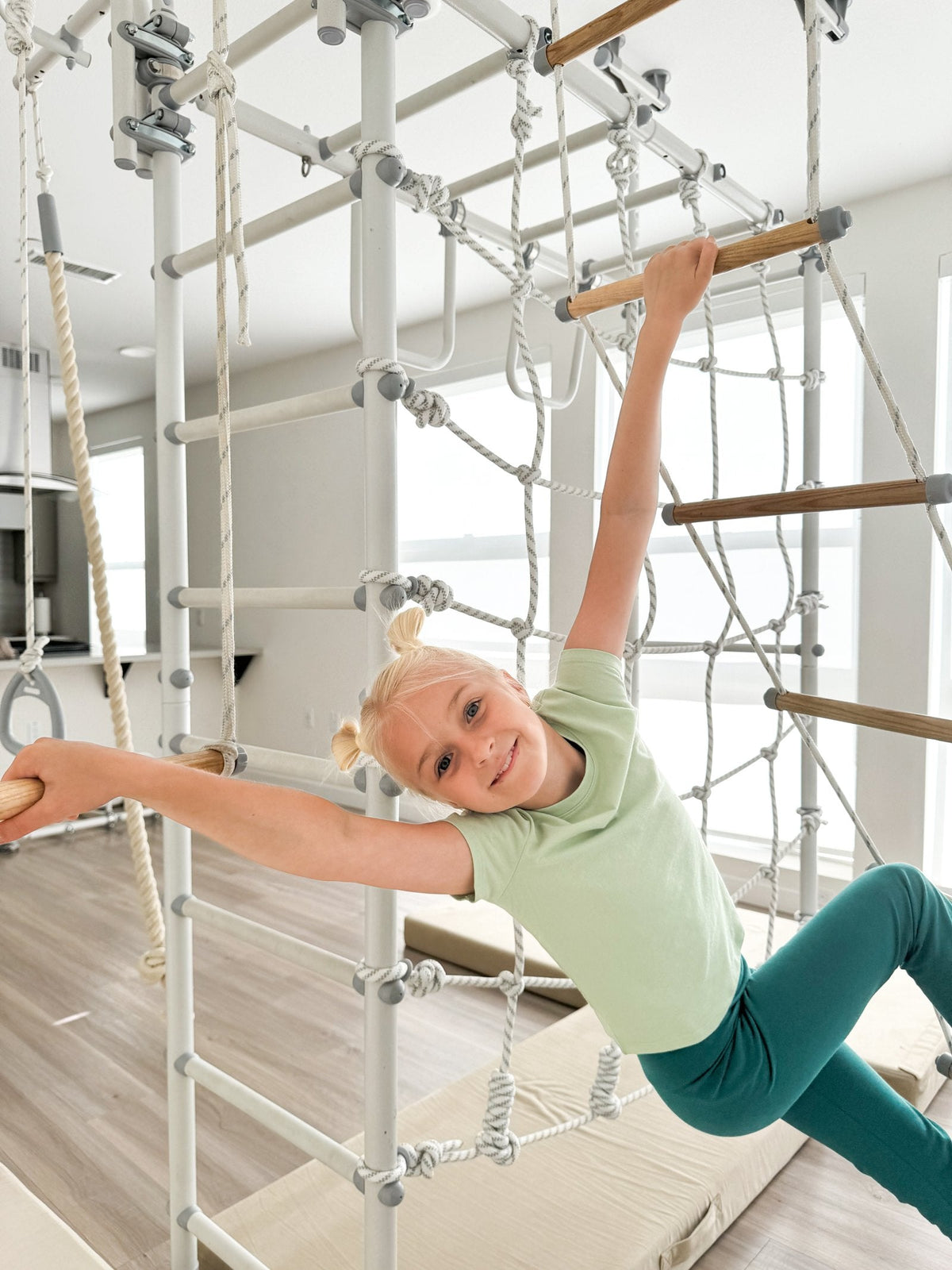
A swimmer's dryland setup is simple: a bar at the right height for active hangs, a ladder or wall bars for climbing, stretching and tying off a light band, and a mat for core work and jumps. The Spider V3 has monkey bars built in plus pull-up bars, rings and a rope, and it's tension-mounted between floor and ceiling with no drilling. The Model W3 mounts to the wall, sits 9 inches off it (plan on about 3 feet of clear floor in front), and supports TRX-style resistance bands. The compact Model T3 fits smaller rooms and comes with two sets of pull-up bars. All are steel and rated for 220 lb. More than 10,000 families have a Brainrich gym at home, and occupational and physical therapists in our owner community recommend them.


Sports have seasons. Climbing doesn't.
Dryland on the days the pool is closed. Steel, built for the whole family, and a 30-day money-back guarantee. Questions? Reach out to us.
Frequently asked questions
What are good dryland exercises for young swimmers? Active hangs for shoulder blade control, light band rotations for the rotator cuff, hollow holds and hanging knee raises for the core, squats and jumps for starts and turns, and stretches for the chest and back of the shoulder. Keep sessions around ten minutes and add play that isn't swimming, like climbing.
Is hanging good for swimmers? Short, controlled active hangs practice shoulder blade control, which swimming leans on. Because swimmers already do so much overhead work, keep hangs brief, skip them in heavy training weeks, and stop completely if the shoulder hurts.
How common is shoulder pain in young swimmers? Fairly common. In one study of competitive female swimmers, about 21% of those aged 8 to 11 had shoulder pain with disability, and the rate was similar at older ages. Swimmers with pain tended to swim more and play fewer other sports. Ongoing shoulder pain is worth a visit to a pediatrician or sports medicine doctor.
Should kids do dryland training on swim days? Light dryland, like core work, stretching and play, is fine on most days. In heavy training or meet weeks, skip the overhead work at home. Rest days and other sports are part of a healthy swim schedule.
At what age can swimmers start dryland training? Simple body-weight dryland and play can start whenever a child swims on a team. The AAP says body-weight strength work is acceptable for kids ready for organized sports, often around 5 to 7. Light bands and structured sets suit older kids, with good form and an adult in the room.
📚 Keep reading in the Decision Guide
How Monkey Bars Support Every Sport · At-Home Strength for Young Athletes · Gymnastics at Home: Safe Conditioning Ideas · Swedish Ladder for Kids · Heavy Work Activities for Kids
About the author
Yegor Nadvornyy is the founder of Brainrich Kids and a dad. More than 10,000 families have a Brainrich gym at home. Every study in this article was checked against the original paper, and results are reported as the researchers found them.
Sources
Sein, M.L., Walton, J., Linklater, J. et al. (2010). Shoulder pain in elite swimmers: primarily due to swim-volume-induced supraspinatus tendinopathy. British Journal of Sports Medicine, 44. · Tate, A., Turner, G.N., Knab, S.E. et al. (2012). Risk Factors Associated With Shoulder Pain and Disability Across the Lifespan of Competitive Swimmers. Journal of Athletic Training, 47(2). · Wanivenhaus, F., Fox, A.J.S., Chaudhury, S. et al. (2012). Epidemiology of Injuries and Prevention Strategies in Competitive Swimmers. Sports Health, 4(3). · Jayanthi, N., LaBella, C.R., Fischer, D. et al. (2015). Sports-Specialized Intensive Training and the Risk of Injury in Young Athletes: A Clinical Case-Control Study. American Journal of Sports Medicine, 43(4). · Brenner, J.S., AAP Council on Sports Medicine and Fitness (2016). Sports Specialization and Intensive Training in Young Athletes. Pediatrics, 138(3). · Stricker, P.R., Faigenbaum, A.D., McCambridge, T.M. et al. (2020). Resistance Training for Children and Adolescents. Pediatrics, 145(6). · U.S. Department of Health and Human Services (2018). Physical Activity Guidelines for Americans, 2nd edition. · OpenStax (2016). Anterior and Posterior Views of Muscles, Anatomy and Physiology, Rice University, CC BY 4.0 (muscle chart, adapted).
Share: