

Updated October 2026 · 13-minute read · by Yegor Nadvornyy, founder of Brainrich Kids
Soccer on Tuesday and Thursday, a game on Saturday, and a rainout at least once a month. Soccer kids run a lot, but most of that running happens at practice, and most practice goes to the ball. The pieces that sit underneath the skills, like balance on one leg, soft landings, a strong core and some upper-body strength for shielding and throw-ins, are easy to practice at home in ten minutes. This guide covers what soccer asks of a young body, what the best youth-soccer research found about warm-ups, and a routine that fits around the team schedule.
The quick answer: soccer leans on the quads, hamstrings, glutes, calves, adductors and core, plus single-leg balance and landing control. Kids often get less core, upper-body and balance work than running. In a large trial of players around 10 years old, a structured team warm-up called FIFA 11+ Kids was linked to 48% fewer injuries, and teams that used it more often had fewer injuries still. At home, about ten minutes on most days of balance, soft landings, core work on the bars, hanging and stretching fills the gaps between practices. It doesn't replace the coach or the warm-up. An adult stays in the room and a mat goes under every landing.
Jump to: What soccer asks · What kids often miss · The warm-up research · 10-minute routine · Goalkeepers · Around the season · Equipment · FAQ
What soccer asks of a young body
Soccer looks like a running sport, and it is, but the running is full of stops, cuts, jumps and one-legged moments. Every kick is a balance test on the standing leg. Every header is a jump and a landing. Every shoulder-to-shoulder battle for the ball is a core and upper-body test.

Anatomy art adapted from OpenStax, Anatomy and Physiology, licensed under CC BY 4.0. Changes: cropped, recolored and relabeled by Brainrich Kids.
| What soccer asks | Where you see it | What the home gym practices |
|---|---|---|
| Single-leg balance | The standing leg on every kick and pass | One-leg stands holding a rung, then letting go |
| Landing control | Headers, jumps, stopping fast | Jumping off a low rung and sticking a soft landing on the mat |
| Core strength | Shielding the ball, holding off a defender, quick turns | Hanging knee raises, planks, side planks |
| Hips: adductors and hip flexors | Inside-foot passes, cutting, long kicks | Knee tucks on the bar, side lunges and hip stretches holding the ladder |
| Hamstrings and glutes | Sprinting, braking, jumping | Squats, lunges, ladder climbing, hamstring stretches on a low rung |
| Upper body | Throw-ins, shielding, a keeper's catch | Hangs, monkey bar traverses, push-ups |
What young soccer players often miss
Practice time is precious, and most of it rightly goes to the ball. That leaves a few pieces that kids tend to get less of, even on busy teams. A 2011 review by Gregory Myer, Avery Faigenbaum and colleagues made the general point that playing organized sport doesn't by itself guarantee kids enough of the fitness work underneath the sport.
💪 Upper body and grip
Soccer is a legs sport, so arms and shoulders get little direct work. Hanging and traversing the monkey bars are the opposite of a soccer practice, and that's what makes them useful.
🎯 Core
A strong trunk helps a player hold position in contact and turn quickly. Hanging knee raises and planks practice it without any equipment beyond a bar and a mat.
🦩 Balance on one leg
Kids get plenty of two-legged running and less slow, controlled one-legged work. A ladder rung to hold onto makes it easy to start and easy to progress.
🧘 Hip and hamstring range
Growth spurts often outpace flexibility, and the front of the hips tightens with sitting. A couple of minutes of stretching on the ladder covers both.
For how hanging works the shoulders, grip and core across every sport, see how monkey bars support every sport. For the AAP's guidance on strength training for kids, see at-home strength for young athletes.
What the youth-soccer warm-up research found
Soccer has some of the best injury-prevention research in youth sport. The most relevant trial for younger kids tested a short warm-up called FIFA 11+ Kids, which takes about 15 to 20 minutes and mixes running, balance, jumping and strength exercises. Rössler and colleagues followed 3,895 players from under-9 to under-13 teams in four European countries for a season.

Teams that replaced their usual warm-up with 11+ Kids had a 48% lower overall injury rate, 74% fewer severe injuries and 55% fewer leg injuries. Injuries dropped further as teams used it more consistently, and the authors recommended doing it at least once a week, with twice a week for more benefit.
Two other findings point the same way. In older girls aged 13 to 17, the adult FIFA 11+ warm-up was linked to fewer overall, overuse and severe injuries, although its main outcome, lower-body injuries, didn't reach statistical significance. And in a review of neuromuscular training programs in young female athletes, Sugimoto and colleagues found that teams with high compliance had much lower rates of ACL (knee ligament) injury than teams with low compliance.
What this means for parents
These were coached team warm-ups, not home gyms, so ask your child's coach whether the team uses 11+ Kids or something like it. What the studies add for home is the theme that runs through all of them: the work only helps when it actually happens, week after week. Balance, landing, core and strength practice at home is easy to repeat because it's right there.
Soccer conditioning at home: a 10-minute routine
This routine runs on a home climbing gym or wall bars with a mat. Use it on most non-practice days, keep it light the day before a game, and make it a game for the younger players.
| Station | Ages about 5 to 7 | Ages about 8 to 11 | Ages 12 and up | What it practices |
|---|---|---|---|---|
|
Ladder climb 1 min |
Up a few rungs and down, slowly | To the top and down, 2 times | Same, without knees on the rungs | Warm-up, cross-lateral movement |
|
One-leg balance 2 min |
"Flamingo" holding a rung, 10 seconds each leg | 20 seconds each leg, one hand off the rung | 30 seconds each leg, hands free, then eyes closed with a hand near the rung | Standing-leg balance for kicks and passes |
|
Soft landings 1.5 min |
Step off the lowest rung, land "quiet like a cat," 5 times | Jump from a low rung, land on two feet with knees over toes, hold 2 seconds, 5 times | Same, then land on one leg, 3 each side | Landing control for headers and stops |
|
Core on the bar 2 min |
2 or 3 hanging "cannonball" tucks, a plank on the mat | 5 hanging knee raises, side plank 15 seconds each side | 8 knee raises, side plank 30 seconds each side | Core for shielding and turning |
|
Upper body 1.5 min |
Short hangs, a parent's hands close | Monkey bar traverse, 2 times | Traverse, then a few push-ups | Grip and shoulders for throw-ins and shielding |
|
Stretches 2 min |
"Reach for the top rung" on tiptoes | Hip flexor lunge holding a rung, heel on a low rung for the hamstrings, side lunge holding the ladder for the inner thigh. 20 to 30 seconds each side, no bouncing | Hip and hamstring range | |
Safety rules for soccer conditioning at home
- An adult in the same room, every time, and a thick mat under the bar and every landing.
- Jumps start low. Knees track over the toes, and landings are soft and quiet.
- Stop each set while the form is still clean. No training to failure, no added weights.
- One child on a bar at a time. No kipping, no flipping over the bar.
- Heel, knee or hip pain that doesn't fade means a day off and a call to the pediatrician. Heel and knee pain are common in growing players and worth checking.

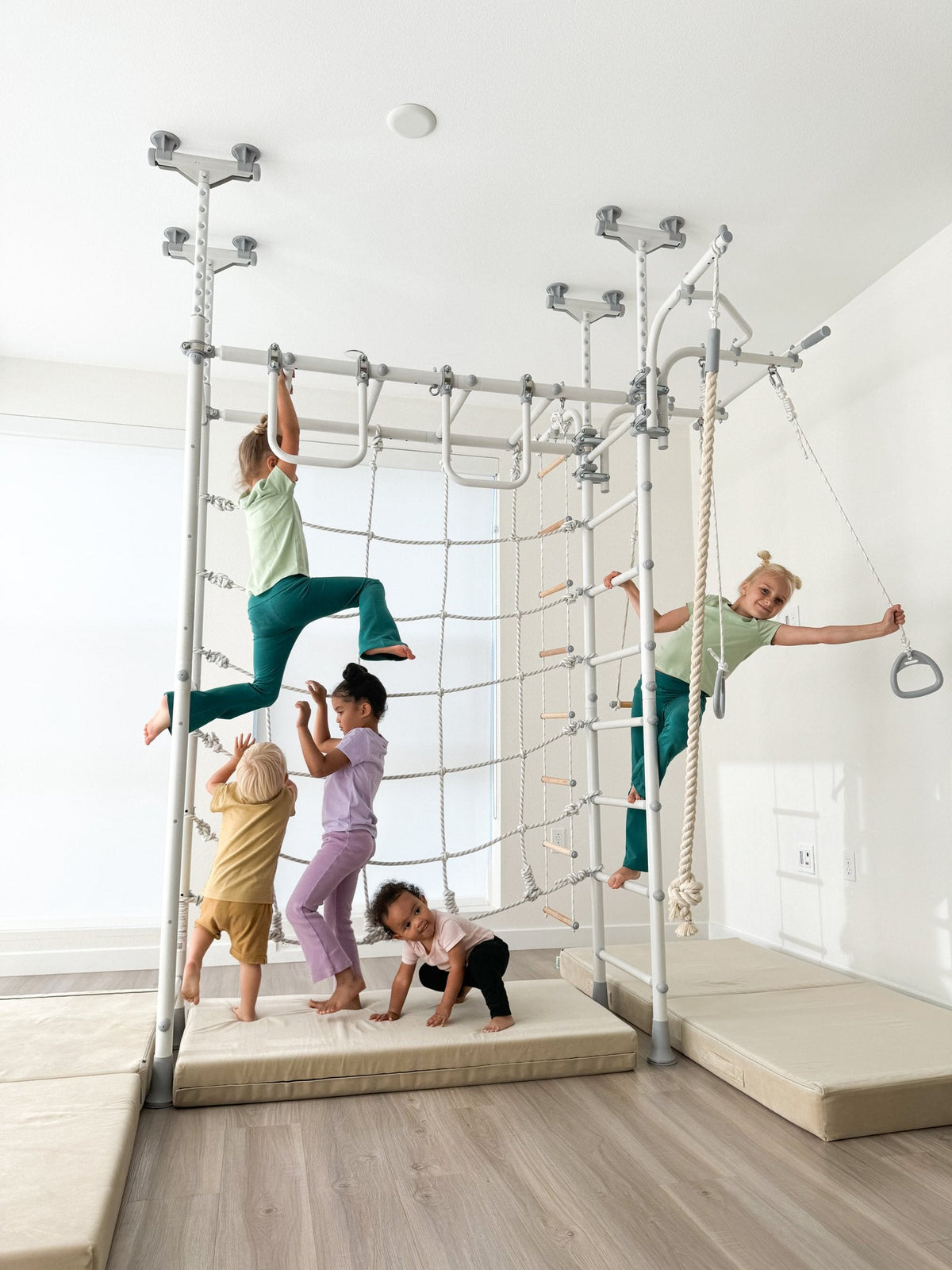
Balance, grip and landings, practiced as play between practices.
A note for goalkeepers
Keepers are the one soccer position that uses the hands all game: catching, punching, gripping, reaching overhead and landing from dives. That makes the upper body and grip work above even more relevant, along with the core and soft landings. Dive technique itself belongs with a keeper coach on soft ground. At home, keep it to hangs, traverses, core work and two-footed landings on the mat.
Around the season: practice days, rainouts and the off-season
Practice is twice a week. Climbing is every day. The goal is to add to a child's week without adding pressure, so the home gym should feel like play on practice days and be a little more structured on off days.
| Day type | On the gym |
|---|---|
| Practice day | Free play only, if they want it |
| Off day | The full 10-minute routine |
| Day before a game | Balance and stretches only, nothing tiring |
| Game day | Nothing planned. Rest is part of training |
| Rainout | Rainout? Climb in. The full routine plus free play |
| Off-season | The routine on most days, plus climbing, swinging and other sports |
Variety matters as much as consistency. In a study of 1,190 young athletes, Dr. Neeru Jayanthi and colleagues found that kids who played more hours of organized sport per week than their age in years had about twice the odds of a serious overuse injury, and specializing in one sport carried a risk of its own. The AAP's 2016 report on sports specialization makes the same case for variety. Climbing and hanging are about as different from soccer as movement gets.
We love outdoor play and time on the field, and none of this replaces a coach or a team. The gym is for the hours when the field is muddy, dark, or closed for the season.
Equipment for soccer conditioning at home
For the routine above you need a ladder to hold for balance work, a low rung to jump from, a bar for hangs and knee raises, monkey bars to traverse, and a thick mat. The Spider V3 has the monkey bars built in, plus pull-up bars, rings, a rope and a net. The Spider Max V3 adds a second span, which helps when siblings or teammates come over. Both are steel, rated for 220 lb and tension-mounted between floor and ceiling with no drilling. More than 10,000 families have a Brainrich gym at home, and occupational and physical therapists in our owner community recommend them.


Soccer on Saturday. Monkey bars every day.
For rainouts, winter and the evenings between practices. Steel, no drilling, and a 30-day money-back guarantee. Questions? Reach out to us.
Frequently asked questions
What is good soccer conditioning for kids at home? Short, varied work that practice doesn't cover: one-leg balance holding a ladder rung, soft landings from a low rung onto a mat, hanging knee raises and planks for the core, hangs and monkey bar traverses for the upper body, and hip and hamstring stretches. About ten minutes on non-practice days is plenty.
How can kids practice balance for soccer? Start with one-leg stands while holding a rung, about 10 to 20 seconds each leg. As it gets easy, let go with one hand, then both, then try it with eyes closed and a hand near the rung. Slow, controlled landings from a low rung add the next step.
Should young soccer players do strength training? Body-weight strength work is fine for kids who are ready for organized sports, according to the American Academy of Pediatrics, with good technique and an adult supervising. Structured strength sessions of about 20 to 30 minutes, 2 to 3 times a week, are what the AAP recommends for strength gains.
What is FIFA 11+ Kids? A warm-up of about 15 to 20 minutes for young players that mixes running, balance, jumping and strength exercises. In a trial with 3,895 players, teams using it had 48% fewer injuries overall than teams using their usual warm-up. Ask your child's coach whether the team uses it.
What can soccer kids do on rainy days? Move practice indoors: balance work, soft landings, core on the bar, monkey bar traverses and stretching on a home climbing gym, plus free climbing and swinging. It keeps the habit going without needing a field.
📚 Keep reading in the Decision Guide
How Monkey Bars Support Every Sport · At-Home Strength for Young Athletes · Swimming Dryland Exercises for Kids · Gymnastics at Home: Safe Conditioning Ideas · Controlled Risky Play · Wrestling and Martial Arts Conditioning for Kids
About the author
Yegor Nadvornyy is the founder of Brainrich Kids and a dad. More than 10,000 families have a Brainrich gym at home. Every study in this article was checked against the original paper, and results are reported as the researchers found them.
Sources
Rössler, R., Junge, A., Bizzini, M. et al. (2018). A Multinational Cluster Randomised Controlled Trial to Assess the Efficacy of "11+ Kids": A Warm-Up Programme to Prevent Injuries in Children's Football. Sports Medicine, 48. · Soligard, T., Myklebust, G., Steffen, K. et al. (2008). Comprehensive warm-up programme to prevent injuries in young female footballers: cluster randomised controlled trial. BMJ, 337. · Sugimoto, D., Myer, G.D., Bush, H.M. et al. (2012). Compliance With Neuromuscular Training and Anterior Cruciate Ligament Injury Risk Reduction in Female Athletes: A Meta-Analysis. Journal of Athletic Training, 47(6). · Myer, G.D., Faigenbaum, A.D., Ford, K.R. et al. (2011). When to Initiate Integrative Neuromuscular Training to Reduce Sports-Related Injuries and Enhance Health in Youth? Current Sports Medicine Reports, 10(3). · Jayanthi, N., LaBella, C.R., Fischer, D. et al. (2015). Sports-Specialized Intensive Training and the Risk of Injury in Young Athletes: A Clinical Case-Control Study. American Journal of Sports Medicine, 43(4). · Brenner, J.S., AAP Council on Sports Medicine and Fitness (2016). Sports Specialization and Intensive Training in Young Athletes. Pediatrics, 138(3). · Stricker, P.R., Faigenbaum, A.D., McCambridge, T.M. et al. (2020). Resistance Training for Children and Adolescents. Pediatrics, 145(6). · OpenStax (2016). Anterior and Posterior Views of Muscles, Anatomy and Physiology, Rice University, CC BY 4.0 (muscle chart, adapted).
Share: