

Updated October 2026 · 10-minute read · by Yegor Nadvornyy, founder of Brainrich Kids
Kids who love ninja class usually want to do it every day. Class is once or twice a week, and in between they hang from door frames, swing from the kitchen counter and climb anything that holds still. A home climbing gym gives that energy the right places to go: bars to hang from, rings to swing on and a mat to land on, with the big drops and fly-through obstacles left at the ninja gym. This guide covers what ninja training asks of a young body, what research says about ninja athletes and falls from bars, and a 10-minute routine for the days between classes.
The quick answer: ninja courses ask for grip endurance, shoulder control, a strong core to steer a swing, and soft landings. Research on ninja athletes is new and mostly in adults: in one survey of 103 athletes, the shoulder was the most injured area, overuse was the most common cause, and rings and swinging obstacles accounted for about 3 in 10 injuries. In kids, falls from monkey bars are a common cause of arm fractures, and fall height and what's underneath matter most. At home, the useful work is grip hangs, traverses, small controlled swings, core and landing practice from a low hang: about ten minutes on days without class. No flying releases, no jumping from the top, a thick mat under every bar, and an adult in the room.
Jump to: What ninja asks · What the research says · Falls, height and landings · 10-minute routine · Around classes · Equipment · FAQ
What ninja training asks of a young body
A ninja course is a string of short, hard grip tests. Monkey bars, rings, ropes, cargo nets and swinging bars all ask a child to hold their own body weight, often while it's moving. In between come balance steps, climbing walls and landings. The skills behind all of it are the same few pieces: a grip that lasts, shoulders that stay steady in a hang, a core that controls a swing, and legs that land softly.
The muscles doing the work are mostly in the upper body: the forearms for grip, the shoulders and the muscles around the shoulder blades, and the lats, the wide back muscles that pull the body up and drive a swing. The core links them to the legs, and the quadriceps take the landing.

Anatomy art adapted from OpenStax, Anatomy and Physiology, licensed under CC BY 4.0. Changes: cropped, recolored and relabeled by Brainrich Kids.
| What ninja asks | Where you see it | What the home gym practices |
|---|---|---|
| Grip endurance | Hanging on through a long set of bars or rings | Hangs with different grips, longer traverses over time |
| Shoulder control | Staying "active" in a hang instead of dangling | Active hangs: shoulders pulled down, away from the ears |
| Swing control | Rings, swinging bars, ropes | Small swings on the rings or trapeze with feet close to the mat, then a still stop |
| Pulling | Getting up on a ledge, climbing a rope or net | Net and rope ladder climbing, flexed-arm hangs |
| Core | Lifting the legs over obstacles, steering a swing | Hanging knee raises, tucks, planks |
| Landings | Coming off every obstacle | Small drops from a low hang: knees bent, quiet feet, freeze |
What the research says about ninja and obstacle training
Ninja is a young sport, and the research is new. There's no published study yet on injuries in children doing ninja classes, so the best information comes from adult ninja and obstacle-course athletes, plus a long record of research on kids falling from playground bars.
In ninja athletes, the shoulder takes the most strain. Lindner and colleagues surveyed 103 ninja warrior athletes, mostly adults. The shoulder was the most injured area (19.1%), followed by the ankle (12.6%) and the wrist (11.5%). Overuse was the most common cause (30.8%), and rings and other swinging obstacles accounted for about 3 in 10 injuries. Athletes training five or more times a week took longer to get back after an injury. The authors suggested checking technique before moving on to rings and swinging releases.
In obstacle races, hard landings were the knee's problem. A 2024 review of 16 studies of adult obstacle course races found knee and ACL injuries were linked to obstacles that ended in high-impact landings or sudden stops, and to hard rubber-matting surfaces.

The upside is real too. A 2015 review of 21 studies on risky outdoor play, the climbing-high, moving-fast kind, linked it with more physical activity and better social health, and its authors recommended making more room for it. And a review of 30 long-term studies of children and teens found that kids with stronger muscles, measured with tests like grip strength and jumping, tended to have healthier body fat, blood fats and bone density years later.
What this means for parents
Leave the big skills to class: flying releases between rings or bars, swinging laches, the warped wall and big drops all belong in a ninja gym with deep padding and a coach. At home, build what those skills rest on, grip, shoulder control, core and landings, in short sessions with rest days. None of it is a claim that home training prevents injuries in class.
Falls, height and landings
We sell monkey bars, so we want parents to know this part well. Falls from playground monkey bars are one of the most common ways kids break an arm.
Makar and colleagues looked at 11 years of US emergency room visits for monkey bar injuries in kids up to 18. About half were fractures, and 94% of those were in the arm, most often the forearm. The average age was six and a half, and most happened at schools and parks. A Toronto study found that broken bones from falls off playground equipment were about four times as likely to need setting as those from falling over while standing. Another Toronto study found that falls from higher up were linked to more severe injuries, and that the surface under most of the children was only about 3 cm deep, far thinner than safety standards call for.
The lessons for home are simple. Keep drops short, keep the landing soft and deep, and keep an adult close.
- Drop from a low hang. Practice drops only from a hang where the feet are close to the mat, never from the top of the gym or from sitting on the monkey bars.
- Thick mats under every bar. A thin rug doesn't do much. Use real play mats and cover the whole area under the bars and rings.
- Stop before the grip goes. Most falls from bars happen when the hands give out. End each set while the child still has grip left.
- An adult in the room. Not a research finding, just our rule.

Soft, deep padding under the whole climbing area.
Ninja training at home: a 10-minute routine
This routine runs on a home climbing gym with monkey bars, rings or a trapeze, and a thick mat. Use it on days without class, and keep it short. Ninja kids will happily do more, which is exactly why the time limit matters.
| Station | Ages about 5 to 7 | Ages about 8 to 11 | Ages 12 and up | What it practices |
|---|---|---|---|---|
|
Net or ladder climb 1 min |
Up a few rungs and down, slowly | Up and down the net, 2 times | Up the net, across, down the ladder | Warm-up, pulling, four-limb coordination |
|
Grip hangs 2 min |
"Monkey hang," 5 to 10 seconds, 2 or 3 times | Overhand, underhand and mixed grip, 10 to 20 seconds each | Up to 30 seconds each, plus 5 active hangs and a 10-second flexed-arm hang | Grip endurance, shoulder control |
|
Traverse 2 min |
A few rungs, a parent's hands close | Across and back, leading with each hand | Across and back, then skip a rung or go sideways | Grip under movement, rhythm |
|
Swing control 1.5 min |
Gentle swing on the trapeze, feet near the mat | 5 small swings on the rings, then stop still | 8 swings on the rings, stopping still at the back and the front | Steering a swing without letting go |
|
Core 1.5 min |
2 or 3 hanging "cannonball" tucks, a plank on the mat | 5 knee raises, 20-second plank | 8 knee raises, side plank 30 seconds each side | Lifting the legs, holding a shape |
|
Landings 2 min |
Hang low, let go, land like a "quiet cat," 5 times | Same, then freeze for 3 seconds with knees over toes, 6 times | Low-hang drops, freeze, then small hops landing on one foot and holding, 4 each side | Soft landings, knee control |
Safety rules for ninja training at home
- An adult in the same room, every time, and thick mats under every bar, ring and landing spot.
- No flying releases, no letting go mid-swing, no jumping from the top or from sitting on the monkey bars. Those belong in class.
- Drops only from a low hang, feet close to the mat.
- End each set while the grip is still strong. Torn skin on the hands or a sore shoulder means a rest day.
- No training to failure and no added weights.
- One child on a bar or ring at a time.

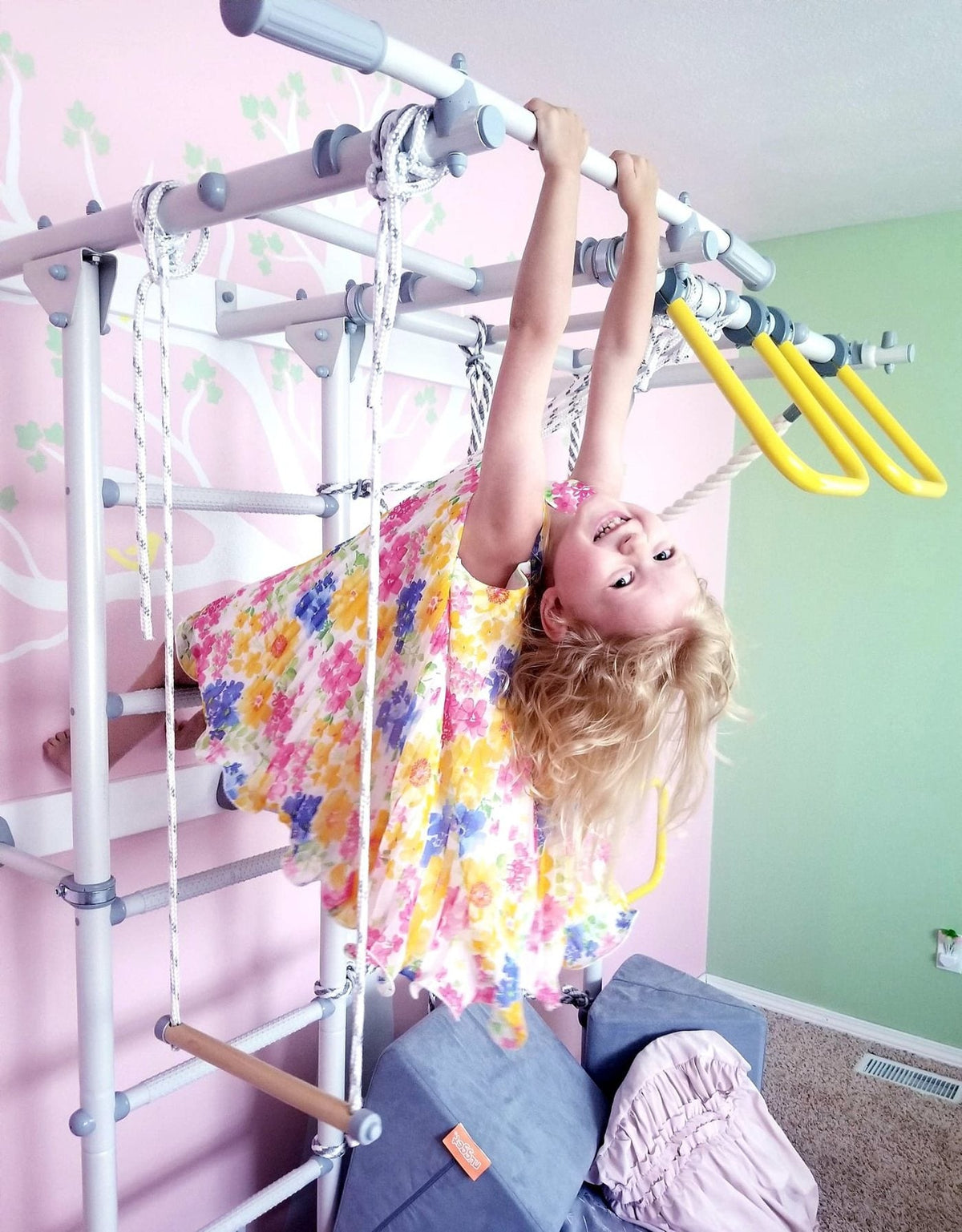
Free play between classes: a bar and a swing.
Around classes and competitions
Ninja kids often love it so much that they'd train every day, and some gyms offer classes, open gym and competition teams on top of each other. In a study of 1,190 young athletes, Dr. Neeru Jayanthi and colleagues found that kids who spent more hours a week in organized sport than their age in years had about twice the odds of a serious overuse injury. Spending more than twice as many hours in organized sport as in free play was linked with higher odds too. Play on a home gym counts as free play, so keep it that way.
| Day type | On the gym |
|---|---|
| Class day | Free play only, if they want it |
| Day after class | Climbing and landings only. Easy on the grip |
| Days without class | The full 10-minute routine |
| Competition day | Nothing planned |
| Torn hands or sore shoulder | Rest the bars. Legs, balance and climbing the net only |
We love a good ninja gym, and none of this replaces a coach. The home gym is for the days in between, when the energy is still there and the class isn't.
Equipment for ninja training at home
For the routine above you need monkey bars, rings or a trapeze, a net or ladder to climb, and thick mats. The Spider V3 has the monkey bars built in, plus pull-up bars, rings, a rope and a net. The Spider Max V3 adds a second span, which turns it into a longer course when siblings or friends come over. Both are steel, rated for 220 lb and tension-mounted between floor and ceiling with no drilling. More than 10,000 families have a Brainrich gym at home, and occupational and physical therapists in our owner community recommend them.


Class twice a week. Hanging every day.
For the days between classes, rainy weekends and winter evenings. Steel, no drilling, and a 30-day money-back guarantee. Questions? Reach out to us.
Frequently asked questions
How can my kid do ninja training at home? Practice the building blocks rather than the obstacles: grip hangs, monkey bar traverses, small controlled swings on rings, hanging knee raises, net climbing and soft landings from a low hang onto a thick mat. About ten minutes on days without class is plenty. Big drops and flying releases stay in class.
Is ninja training safe for kids? There's no published research yet on injuries in children doing ninja classes. In adult ninja athletes, the shoulder was the most injured area and overuse the most common cause. In kids, falls from bars are a common cause of arm fractures, so fall height, deep padding and supervision matter. Choose a gym with coaches and padded landing areas, and keep home practice low and short.
How do I help my child build grip strength for ninja? Hang. Short hangs with different grips, a few times through the session, and monkey bar traverses that get a little longer over the weeks. End each set while the grip is still strong rather than hanging until the hands slip.
How often should kids do ninja training? Leave rest days. In adult ninja athletes, training five or more times a week was linked with a slower return after an injury. For kids, a rule of thumb from youth sports research is to keep weekly hours of organized sport below their age in years, and to keep plenty of free play in the week.
What equipment do you need for ninja training at home? Monkey bars, rings or a trapeze, a net or ladder to climb, and thick mats under all of it. A steel indoor gym rated for 220 lb, mounted between floor and ceiling, covers the bars, rings and net in one footprint.
📚 Keep reading in the Decision Guide
How Monkey Bars Support Every Sport · At-Home Strength for Young Athletes · Gymnastics at Home · Climbing Rope for Kids · Controlled Risky Play · Wrestling and Martial Arts Conditioning for Kids · How Climbing Supports Every Sport
About the author
Yegor Nadvornyy is the founder of Brainrich Kids and a dad. More than 10,000 families have a Brainrich gym at home. Every study in this article was checked against the original paper, and results are reported as the researchers found them.
Sources
Lindner, D., Yona, T., Haichin, L. et al. (2026). Ninja Warrior Injuries: From Epidemiology to Management and Return to Sports. Journal of Sports Medicine and Physical Fitness, 66(3). · Lessiohadi, N.J., Pai, J., Goodman, W.B. et al. (2024). Obstacle Course Races Present a Risk of Musculoskeletal, Knee, and Anterior Cruciate Ligament Injury, Especially in High-Impact Landing Maneuvers and Female Athletes: A Systematic Review. Arthroscopy, Sports Medicine, and Rehabilitation, 6(6). · Makar, G.S., Davis, W., Udoeyo, I.F. et al. (2024). Monkey Bar-Associated Pediatric Fractures: A National Epidemiologic Study of Emergency Department Visits. Journal of the American Academy of Orthopaedic Surgeons, 32(21). · Fiissel, D., Pattison, G., Howard, A. (2005). Severity of Playground Fractures: Play Equipment Versus Standing Height Falls. Injury Prevention, 11(6). · Macarthur, C., Hu, X., Wesson, D.E., Parkin, P.C. (2000). Risk Factors for Severe Injuries Associated with Falls from Playground Equipment. Accident Analysis and Prevention, 32(3). · Brussoni, M., Gibbons, R., Gray, C. et al. (2015). What is the Relationship between Risky Outdoor Play and Health in Children? A Systematic Review. International Journal of Environmental Research and Public Health, 12(6). · García-Hermoso, A., Ramírez-Campillo, R., Izquierdo, M. (2019). Is Muscular Fitness Associated with Future Health Benefits in Children and Adolescents? A Systematic Review and Meta-Analysis of Longitudinal Studies. Sports Medicine, 49(7). · Jayanthi, N., LaBella, C.R., Fischer, D. et al. (2015). Sports-Specialized Intensive Training and the Risk of Injury in Young Athletes: A Clinical Case-Control Study. American Journal of Sports Medicine, 43(4). · OpenStax (2016). Anterior and Posterior Views of Muscles, Anatomy and Physiology, Rice University, CC BY 4.0 (muscle chart, adapted).
Share: