

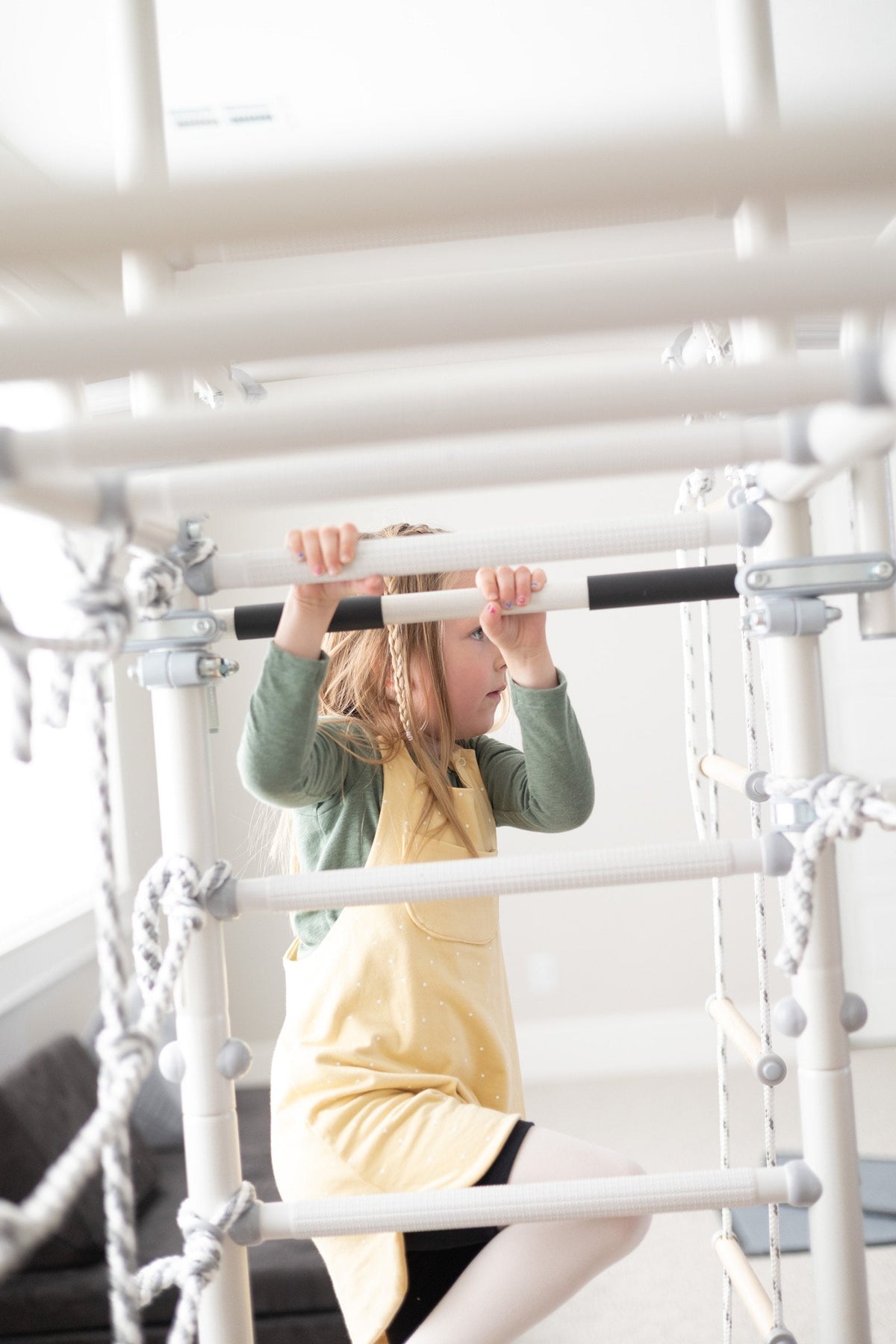
Updated October 2026 · 15-minute read · by Yegor Nadvornyy, founder of Brainrich Kids
Your child's coach mentions "strength" at the end of the season, and suddenly you're wondering whether a 9-year-old should be doing pull-ups, whether it's safe, and whether it will stunt their growth. The short answers are yes, yes with an adult in the room, and no. The American Academy of Pediatrics supports body-weight strength work for kids who are old enough to play organized sports, and the hardest part isn't the exercise. It's doing it often enough to matter. This guide covers dead hangs, chin-ups, pull-ups and stretching by age, what the research says, and why home is the easiest place to keep it going.
The quick answer: the AAP's 2020 clinical report says children who are ready for sports, often around 5 to 7, can start body-weight strength training. Begin with 1 to 2 sets of 8 to 12 easy repetitions while technique develops. Strength gains need sessions of about 20 to 30 minutes, 2 to 3 times a week on non-consecutive days. Properly designed programs show no apparent harm to growth or growth plates. At home, that looks like two layers: a few minutes of free hanging and climbing on most days, plus two or three short, structured sessions a week. Dead hangs build toward chin-up holds, slow lowering, a first chin-up and then a pull-up. An adult stays in the room, a mat stays under the bar, and nobody trains to failure.
Jump to: Is it safe? · Why strength matters · Hang, chin-up, pull-up · The progression by age · Stretching and mobility · Why home works · A weekly plan · Equipment · FAQ
Is strength training safe for kids? What the AAP says
Most parents carry at least one of three worries: that lifting stunts growth, that it damages growth plates, or that kids are too young to gain strength at all. The AAP's 2020 clinical report on resistance training, written by Dr. Paul Stricker, Dr. Avery Faigenbaum and colleagues, addresses all three.
📏 Growth and growth plates
The report states that appropriately designed resistance training programs have no apparent negative effect on linear growth or growth plate health. Risk rises with poor technique, heavy loads and no supervision, which is why the rest of this guide is about body weight, form and an adult nearby.
🧒 When to start
There's no single starting age. The AAP says that if a child is ready for sports at about 5, body-weight strength movements at that age are acceptable, and 5 to 7 is a reasonable range for many kids. In practice, a child who can follow instructions and hold good form is ready to begin.
🧠 Kids can get stronger before puberty
Before puberty, most strength gains come from the nervous system getting better at using the muscles a child already has. Bigger muscles come later. The report is plain that more training doesn't speed up puberty.
🩹 Where injuries come from
A review by Avery Faigenbaum and Gregory Myer found that most injuries reported in young lifters were accidental, often linked to poor technique, too much weight or no qualified supervision. Hanging from a bar at home over a mat, with a parent watching, removes most of that list.
The AAP also recommends qualified instruction, especially once kids move past body weight to bands, dumbbells or barbells. Body-weight hangs and holds are a sensible place for parents to start at home. Anything with added weight belongs with a coach or a certified youth strength trainer.
Why strength matters for young athletes
Strength isn't only about being strong. For kids who play sports, the research mostly points to two things: fewer injuries, and better movement skills.
| Study | Who | What it found |
|---|---|---|
|
Lauersen 2014 meta-analysis |
25 trials, 26,610 athletes of all ages | Strength training programs cut sports injuries to less than a third. Stretching on its own showed no effect. |
|
Emery 2015 meta-analysis |
Youth sport, 25 studies | Neuromuscular training was linked to 36% lower risk of lower-body injury. The drop for knee injuries didn't reach statistical significance. |
|
Soligard 2008 randomized trial |
1,892 female soccer players aged 13 to 17 | A structured warm-up (the FIFA 11+) lowered overall, overuse and severe injuries. The main outcome, lower-body injuries, didn't reach significance. |
|
Robinson 2015 review |
Children and adolescents | Motor competence was positively associated with physical activity, fitness, muscular strength and a healthy weight. |
We list the neutral results on purpose. Not every outcome in every study moved, and structured programs led by coaches aren't the same as a bar at home. Taken together, though, the evidence lines up with the AAP's position: integrative neuromuscular training, which mixes strength, balance, core and jumping work, can improve muscular fitness and motor skills and lower sports injury risk in youth.
There's a longer-term picture too. In a Swedish cohort of more than a million male teenagers followed for 24 years, higher muscular strength, including grip strength, was associated with a 20% to 35% lower risk of early death from any cause or from cardiovascular disease. That's an association in teen boys, not proof that a home pull-up bar changes anyone's future. It's still a reason strength gets so much attention in pediatrics.
Dead hang, chin-up, pull-up: what's the difference?
All three hang from the same bar. They differ in the grip and in how much the arms pull.

Anatomy art adapted from OpenStax, Anatomy and Physiology, licensed under CC BY 4.0. Changes: cropped, recolored and relabeled by Brainrich Kids.
| Move | Grip | What it leans on | For kids |
|---|---|---|---|
| Dead hang | Either way | Grip, forearms, shoulders overhead | The starting point at every age |
| Active hang | Either way | Shoulder blade muscles (lower trapezius, lats) | Teaches "shoulders down" before any pulling |
| Chin-up | Palms facing you | Lats plus more biceps | Usually the easier first rep |
| Pull-up | Palms facing away | Lats and upper back, less biceps help | Usually comes after chin-ups |
Dead hangs and grip strength. A dead hang is the simplest grip exercise there is: hold your own body weight for as long as your hands allow, then let go before they give out. In a Dutch study of 384 young people aged 8 to 20, grip strength correlated strongly with total body strength (correlations of 0.74 to 0.89), which is why researchers use it as a quick indication of overall strength. For young athletes, grip shows up in batting, throwing, wrestling, climbing and every sport with a stick, a bat or a bar.
The progression: from first hang to first pull-up, by age
Most kids can't do a pull-up at first, and that's normal. Many adults can't either. The way there is a ladder of easier steps, each one practiced until it feels comfortable.

| Age (about) | Focus | What it looks like | Keep in mind |
|---|---|---|---|
| Toddlers to 4 | Play | Short hangs with a parent's hands at the waist, climbing, swinging | No sets or counts. Lift by the waist, never by the arms |
| 5 to 7 | Steps 1 and 2 | Dead hangs of 5 to 15 seconds, active hangs, knee tucks, monkey bar traverses | The AAP's start window for body-weight work. Make it a game |
| 8 to 10 | Steps 2 to 4 | Chin-over-bar holds, 3 to 5 slow lowerings, longer hangs | 1 to 2 sets of a few reps, good form only |
| 11 to 13 | Steps 4 to 5 | First chin-ups, then sets of 2 or 3 | Growth spurts can make pull-ups feel harder for a while. That's normal |
| 14 and up | Steps 5 to 6 | Chin-ups and pull-ups in sets, working toward 8 to 12 easy reps | Added weight only with a qualified coach |
Ages are a rough guide. A strong 7-year-old may do a chin-up before a long-limbed 12-year-old. For the step-by-step detail of each rung, plus games that make the training feel like play, see our pull-up skills progression. For what hanging works across every sport, see how monkey bars support every sport.
Stretching and mobility: what it does and doesn't do
Here's a finding that surprises many parents: in the 2014 analysis of 25 injury-prevention trials, stretching programs on their own showed no injury-prevention effect, while strength, balance and combined programs did. That doesn't make stretching useless. It means stretching is for range of motion and comfort, and warm-ups before sport should be active.
🏃 Before practice or a session
Move, don't hold: ladder climbs, skips, arm circles, walking lunges, a few easy hangs. The FIFA 11+ warm-up tested in young soccer players is built this way: running, strength, jumping and balance.
🧘 After, or in the evening
Hold each stretch 20 to 30 seconds without bouncing. The ladder makes a good stretching partner: hands on a rung for the shoulders, a heel on a low rung for the back of the leg, a lunge holding a rung for the front of the hip.
Three areas tend to get tight in kids who sit a lot and play a lot: the front of the hips (hours in chairs and car seats), the back of the legs (growth spurts often outpace flexibility), and the shoulders overhead (backpacks and screens keep the arms low and forward). Hanging covers the third one on its own. A minute or two of the stretches above covers the other two.
Why at home works: consistency beats intensity
Every guideline above assumes one thing: that the work actually happens, week after week. That's where most programs fall apart, and it's where home has an edge.
Habits form through repetition in the same place. In a study by Phillippa Lally and colleagues at University College London, 96 adult volunteers picked a healthy behavior and did it daily in the same context, like "after breakfast," for 12 weeks. The time it took for the behavior to feel automatic ranged from 18 to 254 days, which shows how much people differ. Two findings matter for families: doing it consistently in the same setting is what built the habit, and missing a single day didn't materially set it back. A bar in the hallway, used after school snack every day, is that kind of consistent context.
Gains fade when practice stops. In a study by Avery Faigenbaum's team, 7-year-olds who did 15 minutes of muscular fitness work at the start of PE for 8 weeks improved on some tests. After 8 weeks without it, they kept their gains on curl-ups and single-leg hops, but balance and long jump slipped back. The authors concluded that regular participation may be needed to maintain all the gains. Seasons end, and practice schedules change. A home routine keeps going between them.
2 to 3
Strength sessions a week, on non-consecutive days (AAP 2020)
20 to 30 min
Per session for strength gains, building up gradually (AAP 2020)
0 minutes
Drive time when the bar is in the hallway
We love outdoor play, team practice and good coaches, and none of this replaces them. Home is simply where the in-between days happen: rainouts, winter, the off-season and the evenings.
A weekly plan: daily play plus 2 or 3 strength sessions
Think of it as two layers. Layer one is free play on most days: a few minutes of hanging, climbing and swinging, whatever the child chooses. Layer two is two or three short, structured sessions a week on non-consecutive days, which is what the AAP recommends for strength gains. On team-practice days, layer one is plenty.
| Part of a 25-minute session | Ages about 5 to 8 | Ages about 9 to 12 | Ages 13 and up |
|---|---|---|---|
|
Active warm-up 5 min |
Ladder climbs up and down, skips, arm circles, walking lunges, two easy hangs | ||
|
Hang work 5 min |
Dead hangs and active hangs, 3 rounds | Chin-over-bar holds, 2 rounds, plus active hangs | Chin-ups or pull-ups, 2 sets of a few clean reps |
|
Pull and lower 4 min |
Monkey bar traverses | 3 to 5 slow lowerings, 1 or 2 sets | Slow lowerings or pull-ups toward 8 to 12 easy reps |
|
Core 4 min |
Hanging knee tucks, a plank on the mat | Knee raises, side planks | L-holds or straight-leg raises, planks |
|
Legs and pushing 4 min |
Squats, bear crawls, frog jumps | Squats, lunges, push-ups with hands on a low rung | Split squats, glute bridges, push-ups |
|
Stretch 3 min |
Shoulders, front of the hip, back of the leg on the ladder, 20 to 30 seconds each, no bouncing | ||
The AAP suggests beginning with 1 to 2 sets of 8 to 12 easy repetitions, working the large muscle groups first, and building up only as technique improves. The legs and pushing block is there on purpose: a balanced program works the whole body, not just the bar muscles.
Safety rules for strength at home
- An adult in the same room, every time. Coach the form, count the reps, keep it fun.
- Technique first. If the form breaks, the set is over.
- Never train to failure, no maximal lifts, and no added weight without a qualified coach.
- A thick mat under the bar. Drop with soft knees or climb down.
- One child on a bar at a time. No kipping, swinging pull-ups or flipping over the bar.
- Rest days between structured sessions, and extra rest during growth spurts and heavy sport weeks.
- Pain that doesn't fade, or any joint or medical condition, means a check with the pediatrician first.

The same bars work for parents. Kids copy what they see, so a family hang after dinner counts.
Equipment: what a home strength setup needs
For the plan above you need a bar at the right height for each child, ideally adjustable as they grow, something to climb, a mat, and a bar strong enough for parents too. Doorway bars work for some teens and adults; our pull-up bar buyer's guide compares every type for kids.
Brainrich gyms are steel, tension-mounted between floor and ceiling with no drilling, and rated for 220 lb, so the same bars serve a 5-year-old and a parent. The pull-up bars are rubber-coated and thinner than a typical adult bar for smaller hands, and they move up and down the ladder as your child grows. The Model T3 and the Spider V3 each come with two sets of pull-up bars, plus rings and a climbing rope, and the Spider V3 has monkey bars built in. If you already own a Brainrich tension-mounted gym, the Pull-up Bars Addon adds another bar at a second height. More than 10,000 families have a Brainrich gym at home, and occupational and physical therapists in our owner community recommend them.


Practice is twice a week. Climbing is every day.
A bar for every height in the family, no drilling, and a 30-day money-back guarantee. Questions? Reach out to us.
Frequently asked questions
At what age can kids start strength training? The AAP's 2020 report says there's no single age, but if a child is ready for organized sports at about 5, body-weight strength movements are acceptable, and 5 to 7 is a reasonable range for many kids. The child should be able to follow instructions and hold good form. Added weights come later, with qualified instruction.
Does strength training stunt kids' growth? No. The AAP reports that appropriately designed resistance training programs have no apparent negative effect on linear growth or growth plate health. Most reported injuries in young lifters were accidents linked to poor technique, heavy loads or no supervision.
Is a dead hang good for kids' grip strength? Yes. A dead hang asks the hands and forearms to hold full body weight, which makes it a simple grip exercise for any age. Start with 5 to 15 seconds and stop while the grip still feels good. Grip strength in young people correlates strongly with overall strength.
Should kids learn chin-ups or pull-ups first? Usually chin-ups. With palms facing them, kids get more help from the biceps, so the first rep often comes sooner. Pull-ups, with palms facing away, lean more on the back and usually follow. Both start from hangs, chin-over-bar holds and slow lowering.
How often should young athletes strength train? The AAP recommends sessions of about 20 to 30 minutes, 2 to 3 times a week on non-consecutive days, building up gradually. Free hanging and climbing on other days is play, not extra training, and rest days matter, especially in heavy sport weeks.
Does stretching prevent sports injuries? Not on its own, according to a 2014 analysis of 25 trials, which found no injury-prevention effect for stretching programs while strength and balance work showed benefits. Stretching is still useful for range of motion. Before sport, use an active warm-up.
📚 Keep reading in the Decision Guide
Swimming Dryland Exercises for Kids · How Monkey Bars Support Every Sport · Gymnastics at Home: Safe Conditioning Ideas · Pull-Up Bar Skills: From First Hang to First Pull-Up · Pull-Up Bar for Kids: How to Choose · Heavy Work Activities for Kids
About the author
Yegor Nadvornyy is the founder of Brainrich Kids and a dad. More than 10,000 families have a Brainrich gym at home. Every study in this article was checked against the original paper, and results are reported as the researchers found them, including the neutral ones.
Sources
Stricker, P.R., Faigenbaum, A.D., McCambridge, T.M. et al. (2020). Resistance Training for Children and Adolescents. Pediatrics, 145(6), American Academy of Pediatrics. · Faigenbaum, A.D., Myer, G.D. (2010). Resistance training among young athletes: safety, efficacy and injury prevention effects. British Journal of Sports Medicine, 44(1). · Lauersen, J.B., Bertelsen, D.M., Andersen, L.B. (2014). The effectiveness of exercise interventions to prevent sports injuries: a systematic review and meta-analysis of randomised controlled trials. British Journal of Sports Medicine, 48. · Emery, C.A., Roy, T.O., Whittaker, J.L. et al. (2015). Neuromuscular training injury prevention strategies in youth sport: a systematic review and meta-analysis. British Journal of Sports Medicine, 49. · Soligard, T., Myklebust, G., Steffen, K. et al. (2008). Comprehensive warm-up programme to prevent injuries in young female footballers: cluster randomised controlled trial. BMJ, 337. · Robinson, L.E., Stodden, D.F., Barnett, L.M. et al. (2015). Motor Competence and its Effect on Positive Developmental Trajectories of Health. Sports Medicine, 45. · Ortega, F.B., Silventoinen, K., Tynelius, P., Rasmussen, F. (2012). Muscular strength in male adolescents and premature death: cohort study of one million participants. BMJ, 345. · Wind, A.E., Takken, T., Helders, P.J., Engelbert, R.H. (2010). Is grip strength a predictor for total muscle strength in healthy children, adolescents, and young adults? European Journal of Pediatrics, 169. · Lally, P., van Jaarsveld, C.H.M., Potts, H.W.W., Wardle, J. (2010). How are habits formed: Modelling habit formation in the real world. European Journal of Social Psychology, 40(6). · Faigenbaum, A.D., Farrell, A., Fabiano, M. et al. (2013). Effects of Detraining on Fitness Performance in 7-Year-Old Children. Journal of Strength and Conditioning Research, 27(2). · OpenStax (2016). Anterior and Posterior Views of Muscles, Anatomy and Physiology, Rice University, CC BY 4.0 (muscle chart, adapted).
Share: