

Updated October 2026 · 12-minute read · by Yegor Nadvornyy, founder of Brainrich Kids
Baseball and softball parents get two kinds of advice. One says throw more, swing more, practice every day. The other says protect the arm. Both are partly right, and the research on young throwers helps sort them out. The throwing arm needs rest, but the grip, core, hips and legs that power a throw and a swing can be practiced at home without adding a single pitch. This guide covers what these sports ask of a young body, what studies of young pitchers found, and a 10-minute routine that leaves the arm alone.
The quick answer: a throw and a swing start in the legs and hips, turn through the core, and finish in the shoulder and hand. Grip, the muscles around the shoulder blade, the rotator cuff, the core, the glutes and the legs all take part. Studies of young pitchers link arm pain and injury with throwing a lot and throwing tired, so the answer at home isn't more throwing. It's about ten minutes on most days of grip, core, leg and balance work on bars and a ladder, with no extra pitches. A sore throwing arm means rest and a call to the pediatrician. An adult stays in the room and a mat goes under every bar.
Jump to: What these sports ask · The research on young throwers · Both sides of the body · 10-minute routine · Around the season · Equipment · FAQ
What baseball and softball ask of a young body
A throw looks like an arm movement, but the arm is the last link. A 2010 review of pitching mechanics in Sports Health described the throw as a coordinated effort of muscles from the entire body: the stride leg plants, the hips turn, the trunk follows, and the shoulder and hand finish. A swing works the same way, with the hips leading the hands. Fielding adds quick first steps, and catching adds hours in a squat.

Anatomy art adapted from OpenStax, Anatomy and Physiology, licensed under CC BY 4.0. Changes: cropped, recolored and relabeled by Brainrich Kids.
| What the sport asks | Where you see it | What the home gym practices |
|---|---|---|
| Grip | Holding the bat through contact, the ball, the glove | Hangs with different grips, monkey bar traverses |
| Shoulder blade control | A steady base for the throwing arm | Active hangs: shoulders pulled down, away from the ears |
| Core and rotation control | Passing the turn from hips to shoulders, in the throw and the swing | Hanging knee raises to each side, side planks |
| Hips and legs | The stride, the hip turn, running the bases, a catcher's squat | Lunges and squats holding the ladder, ladder climbing |
| Balance | Landing on the stride leg, fielding off balance | One-leg stands holding a rung, then letting go |
| Both sides | Glove arm and throwing arm doing different jobs at once | Hand-over-hand traverses, climbing the net |
What the research on young throwers found
Youth baseball has some of the best long-term injury research in kids' sports, most of it on pitchers. Four findings matter most for parents.
Arm pain is common. Lyman and colleagues followed 476 pitchers aged 9 to 14 through a season. Half had elbow or shoulder pain at some point, and the more pitches a child threw in a game and over the season, the higher the rate of pain. Curveballs were linked with a 52% higher risk of shoulder pain and sliders with an 86% higher risk of elbow pain.
Throwing a lot adds up over years. Fleisig and colleagues followed 481 young pitchers for 10 years. About 5% had a serious throwing injury, and those who pitched more than 100 innings in a year were 3.5 times as likely to be injured. The authors encouraged young pitchers to play other positions too.
Throwing tired matters. Olsen and colleagues compared 95 teenage pitchers who'd had shoulder or elbow surgery with 45 who hadn't. The injured group had pitched more months a year, more pitches a game and more often with arm pain and fatigue. Overuse and fatigue had the strongest links with injury.
Softball isn't exempt. Werner and colleagues measured 53 youth windmill pitchers and found shoulder and elbow loads similar to baseball pitchers, with the shoulder pulled on with force close to the pitcher's own body weight.

One more study is worth knowing about. In 246 high school baseball and softball players, Shanley and colleagues found that players whose throwing shoulder had lost 25 degrees or more of inward rotation compared with the other side had about four times the risk of an arm injury that season. That's a measurement for an athletic trainer or physical therapist to take, not something to test at home.
What this means for parents
Follow your league's pitch count and rest rules, such as the USA Baseball and MLB Pitch Smart guidelines, and don't add throwing at home. A child who says the arm hurts stops throwing for the day. The home gym fits around all of that because it works everything except the throwing motion: grip, core, hips, legs and balance. None of it is a claim that home training prevents arm injuries.
Both sides of the body, working at once
In a throw, the glove arm pulls in and steadies the body while the throwing arm whips through. In a swing, two hands share one bat while the hips lead. Movement scientists call this bilateral coordination: the two sides of the body doing different jobs at the same moment.
Monkey bars ask for the same kind of teamwork. Hold with the left, swing, reach with the right, catch, shift the weight, repeat. Climbing a net adds crossing the midline, reaching a hand across the center of the body. The bars don't teach a child to hit or throw. That's a coach's job. They give daily practice to grip, shoulder control and two sides of the body working on different tasks, which are pieces those skills are built from.

Climbing a net: reaching across the body, one hand and foot at a time.
You may also hear that some kids are "left-brained" or "right-brained," or that a sport trains one side of the brain. A University of Utah team looked at brain scans of 1,011 people aged 7 to 29 and found no evidence that anyone's brain as a whole is more "left" or more "right." What's real is that the two halves work as a team. For more on that, see how monkey bars support every sport.
Baseball and softball conditioning at home: a 10-minute routine
This routine runs on a home climbing gym or wall bars with a mat. Use it on most days that aren't game or pitching days, and never as a replacement for arm rest.
| Station | Ages about 5 to 7 | Ages about 8 to 11 | Ages 12 and up | What it practices |
|---|---|---|---|---|
|
Ladder climb 1 min |
Up a few rungs and down, slowly | To the top and down, 2 times | Same, without knees on the rungs | Warm-up, cross-lateral movement |
|
Grip hangs 1.5 min |
"Monkey hang," 5 to 10 seconds, 2 or 3 times | Overhand and underhand, 10 to 20 seconds each | Up to 30 seconds each, plus 5 active hangs: shoulders down, hold 3 seconds | Grip, shoulder blade control |
|
Traverse 1.5 min |
A few rungs, a parent's hands close | Across and back, leading with each hand | Across and back, then skip a rung | Both sides, rhythm |
|
Core 2 min |
2 or 3 hanging "cannonball" tucks, a plank on the mat | 5 knee raises, side plank 15 seconds each side | Knee raises to the left and right, 4 each, side plank 30 seconds each side | Rotation control |
|
Legs 2 min |
"Frog squats" holding a rung | 6 lunges each leg and 10 squats, holding the ladder | Lunges with a pause at the bottom, 8 each leg | Stride, hip turn |
|
Balance 2 min |
"Flamingo" holding a rung, 10 seconds each leg | 20 seconds each leg, one hand off the rung | 30 seconds each leg, hands free | Landing on the stride leg |
Safety rules for baseball and softball conditioning at home
- An adult in the same room, every time, and a thick mat under the bars.
- No extra pitching, long toss or weighted-ball throwing at home. Throwing volume belongs to the coach and the league rules.
- Throwing arm sore? Skip the hangs and traverses that day and stick to legs and balance. Pain that doesn't fade means a call to the pediatrician.
- Stop each set while the form is still clean. No training to failure, no added weights.
- One child on a bar at a time. No kipping and no swinging bats near the gym.

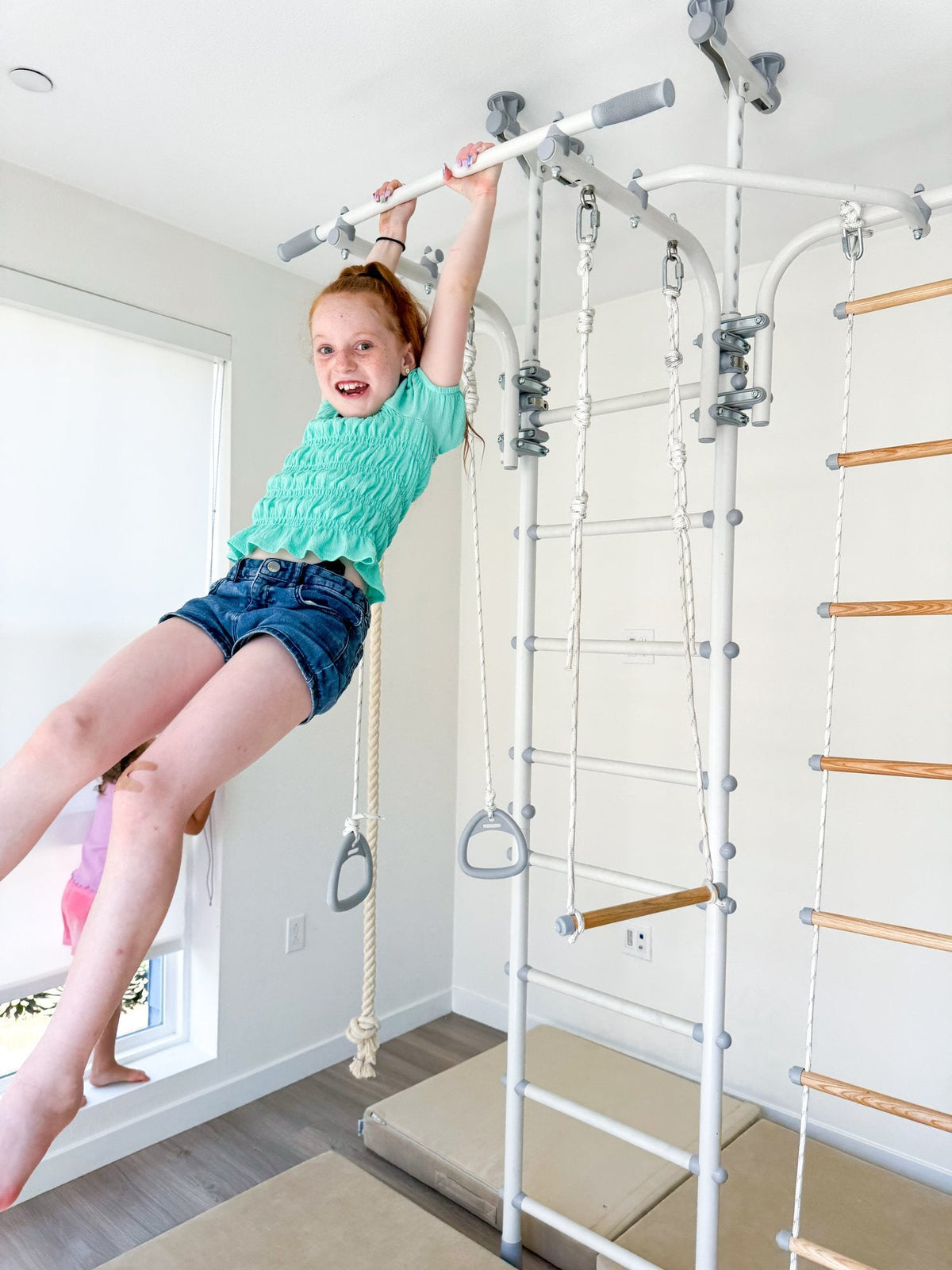
Grip and shoulder work, with the throwing motion left out.
Around the season: games, pitching days and the off-season
Many families find the home gym most useful in the months between seasons, when practice is off and the arm is resting. During the season it should feel like play, built around the team schedule.
| Day type | On the gym |
|---|---|
| Practice day | Free play only, if they want it |
| Off day | The full 10-minute routine |
| Game or pitching day | Nothing planned |
| Day after pitching | Legs, balance and core on the mat only. No hangs, no traverses |
| Off-season | The routine on most days, plus climbing, swinging and other sports |
Variety matters as much as consistency. In a study of 1,190 young athletes, Dr. Neeru Jayanthi and colleagues found that kids who played more hours of organized sport per week than their age in years had about twice the odds of a serious overuse injury, and specializing in one sport carried a risk of its own. The AAP's 2016 report on sports specialization makes the same case for variety. Climbing and hanging are about as different from throwing as movement gets.
We love outdoor play and long summer evenings at the ballfield, and none of this replaces a coach. The gym is for the winter, the rainouts and the days the arm needs a break.
Equipment for baseball and softball conditioning at home
For the routine above you need a bar to hang from, monkey bars to traverse, a ladder to hold for lunges and balance, and a thick mat. The Spider V3 has the monkey bars built in, plus pull-up bars, rings, a rope and a net. The Spider Max V3 adds a second span, which helps when siblings or teammates come over. Both are steel, rated for 220 lb and tension-mounted between floor and ceiling with no drilling. More than 10,000 families have a Brainrich gym at home, and occupational and physical therapists in our owner community recommend them.


Rest the arm. Keep the kid moving.
For winter, rainouts and the days between games. Steel, no drilling, and a 30-day money-back guarantee. Questions? Reach out to us.
Frequently asked questions
What are good baseball conditioning exercises for kids at home? Work that doesn't add throwing: grip hangs, monkey bar traverses, hanging knee raises and side planks for the core, lunges and squats holding a ladder, and one-leg balance. About ten minutes on off days is plenty. Throwing volume stays with the coach and the league's pitch count rules.
What are good softball workouts at home? The same routine fits softball. Youth windmill pitchers' shoulders and elbows carry loads similar to baseball pitchers', so softball players get the same advice: no extra pitching at home, and grip, core, leg and balance work instead.
Should young pitchers practice pitching at home? Not on top of team practice. Studies of young pitchers link arm pain and injury with high pitch counts, pitching many months a year and pitching while tired. Follow the league's pitch count and rest rules, and stop any time the arm hurts.
Are monkey bars okay for a baseball player's shoulder? For a healthy arm, short hangs and traverses with a parent nearby are a normal part of play, and they work grip and shoulder blade control. If the throwing shoulder or elbow is sore, skip the bars that day and call the pediatrician if the pain doesn't fade.
Is strength training safe for young baseball and softball players? The American Academy of Pediatrics says strength training is appropriate for kids who are ready for organized sports, with good technique, low loads and qualified supervision. Body-weight work on bars, a ladder and a mat fits that. Skip maximal lifts and training to failure.
📚 Keep reading in the Decision Guide
How Monkey Bars Support Every Sport · At-Home Strength for Young Athletes · Swimming Dryland Exercises for Kids · Soccer Conditioning for Kids at Home · Wrestling and Martial Arts Conditioning for Kids · Controlled Risky Play
About the author
Yegor Nadvornyy is the founder of Brainrich Kids and a dad. More than 10,000 families have a Brainrich gym at home. Every study in this article was checked against the original paper, and results are reported as the researchers found them.
Sources
Seroyer, S.T., Nho, S.J., Bach, B.R. et al. (2010). The Kinetic Chain in Overhand Pitching: Its Potential Role for Performance Enhancement and Injury Prevention. Sports Health, 2(2). · Lyman, S., Fleisig, G.S., Andrews, J.R. et al. (2002). Effect of Pitch Type, Pitch Count, and Pitching Mechanics on Risk of Elbow and Shoulder Pain in Youth Baseball Pitchers. American Journal of Sports Medicine, 30(4). · Fleisig, G.S., Andrews, J.R., Cutter, G.R. et al. (2011). Risk of Serious Injury for Young Baseball Pitchers: A 10-Year Prospective Study. American Journal of Sports Medicine, 39(2). · Olsen, S.J., Fleisig, G.S., Dun, S. et al. (2006). Risk Factors for Shoulder and Elbow Injuries in Adolescent Baseball Pitchers. American Journal of Sports Medicine, 34(6). · Werner, S.L., Guido, J.A., McNeice, R.P. et al. (2005). Biomechanics of Youth Windmill Softball Pitching. American Journal of Sports Medicine, 33(4). · Shanley, E., Rauh, M.J., Michener, L.A. et al. (2011). Shoulder Range of Motion Measures as Risk Factors for Shoulder and Elbow Injuries in High School Softball and Baseball Players. American Journal of Sports Medicine, 39(9). · Nielsen, J.A., Zielinski, B.A., Ferguson, M.A. et al. (2013). An Evaluation of the Left-Brain vs. Right-Brain Hypothesis with Resting State Functional Connectivity Magnetic Resonance Imaging. PLoS ONE, 8(8). · Jayanthi, N., LaBella, C.R., Fischer, D. et al. (2015). Sports-Specialized Intensive Training and the Risk of Injury in Young Athletes: A Clinical Case-Control Study. American Journal of Sports Medicine, 43(4). · Brenner, J.S., AAP Council on Sports Medicine and Fitness (2016). Sports Specialization and Intensive Training in Young Athletes. Pediatrics, 138(3). · Stricker, P.R., Faigenbaum, A.D., McCambridge, T.M. et al. (2020). Resistance Training for Children and Adolescents. Pediatrics, 145(6). · OpenStax (2016). Anterior and Posterior Views of Muscles, Anatomy and Physiology, Rice University, CC BY 4.0 (muscle chart, adapted).
Share: