

Updated August 2026 · 14-min read · by the Brainrich Kids team
It is 9:04 a.m. The worksheet has been on the table for nine minutes. Your child has been under the table, on the table, across the room for a pencil that was already in their hand, and is now narrating a story about a hamster to nobody in particular. You pulled them out of school (or you are about to) because the daily emails, the lost recess, and the crumpled self-esteem were breaking your heart. And now a new fear is sitting across the table from you: what if I can't get them to sit still either? Here is the reframe this entire guide is built on: you don't have to. Sitting still was the school's requirement, not learning's. You left that requirement behind with the fluorescent lights.
The quick answer: an ADHD homeschool that works usually comes down to three levers school can't pull. 1) Block length: lessons run 15–25 minutes, not 50, and stop while attention is still alive. 2) Movement breaks: short, scheduled "body breaks" between blocks—hanging, climbing, swinging, heavy work—because research links physical activity with improvements in attention and executive function in children with ADHD. 3) Environment: a room with a low-distraction seat zone and an always-available movement zone, so regulation is built into the architecture instead of negotiated every hour. This article is educational, not medical advice—build your child's plan with their clinician or occupational therapist.
Jump to: Why homeschooling often works · The research · The schedule · Body breaks · The room · Curriculum notes · When it's hard · FAQ
📥 Free download: The Homeschool Movement Kit
The companion to this guide is free: an 18-technique ADHD homeschool crash course—focus sprints, body breaks, the transition playbook, and the sleep, screen, and sugar house rules, with the research cited—plus a 5-page PE Kit and the 2026 state-by-state funding cheat sheet.
Get the free kit →Why homeschooling often works for ADHD kids
First, you are not doing something fringe. Per the CDC's analysis of the 2022 National Survey of Children's Health, 11.4% of U.S. children aged 3–17—about 7.1 million kids—have been diagnosed with ADHD at some point. A classroom of 25 has, on average, two or three of them. The classroom is built for the other 22: one pace, one seat, one long block of stillness at a time. The mismatch is structural, and no amount of teacher goodwill fully fixes a structure.
Homeschooling doesn't make ADHD go away. What it does is remove the three constraints that make ADHD hardest to work around:
The schedule becomes yours. If your child's medication window, sleep pattern, or attention curve says math goes best at 8:40 a.m. for exactly 20 minutes, you can do that. School cannot. You can also stop a lesson at minute 18—while it is still going well—instead of dragging it to minute 50 and ending on tears. Ending on a win, every block, every day, quietly rebuilds a kid who has mostly practiced failing.
The ratio becomes 1:1. The clearest data point here is small but striking: in a preliminary study, researchers observed elementary students with ADHD in both homeschool and public-school settings and found the homeschooled students were academically engaged about twice as often, with greater gains in reading and math—and the authors pointed to the student-to-teacher ratio as the key variable. Four students is a pilot study, not a verdict, and we won't pretend otherwise. But the mechanism is not mysterious: a child who drifts gets redirected in four seconds at your kitchen table and in four minutes (or never) in a class of 25.
Movement stops being a discipline problem. This is the lever this guide cares most about. At school, a child who stands up, rocks, paces, or hangs off a chair is off-task. At home, that same movement can be the plan. Nobody loses recess for fidgeting in a house where the monkey bars are eight feet from the math book. You are free to run the day the way ADHD brains tend to work best—short bursts of focus, purchased with movement, repeated all morning—and we'll spend the rest of this article showing you exactly how.
7.1 million
U.S. children aged 3–17 with an ADHD diagnosis, per the CDC's 2022 survey data. You are in very large company.
~2×
How much more often homeschooled students with ADHD were academically engaged vs. public-school peers in Duvall's small observational study.
15–25 min
The lesson-block length most ADHD homeschool families land on—short enough to end on a win.
One thing homeschooling is not: a replacement for treatment. The CDC's clinical guidance for ADHD centers on behavior therapy (first-line for children under 6) and, for older children, behavior therapy and medication together, with daily physical activity listed among the healthy habits that support the whole picture. Homeschooling changes the environment around your child. Keep the clinician, the OT, and the plan.
What the research says about movement and attention
Every ADHD parent has watched it: the child who cannot attach to a worksheet at 9:00 is a different child at 9:40, after twenty minutes of hard outdoor play. That observation has a real research literature behind it—and because this is the internet and your child's health is involved, we will only tell you what the studies actually say, in the language they say it in.
A frequently cited systematic review and meta-analysis of eight randomized controlled trials by Cerrillo-Urbina and colleagues (2015) found that aerobic exercise programs were associated with moderate-to-large improvements in attention, hyperactivity, impulsivity, anxiety, and executive function in children with ADHD. A 2024 meta-analysis in Frontiers in Psychology reached a similar conclusion for executive function specifically, again in children with ADHD. Neither says exercise treats or replaces treatment for ADHD—no reputable source says that, and neither will we. What the evidence supports is the associational claim that matters for your school day: regular aerobic movement is linked with better attention and self-regulation in exactly the population you are homeschooling.
The study every homeschool parent should know is Pontifex et al. (2013), in the Journal of Pediatrics. Preadolescent children with ADHD completed a single 20-minute bout of moderate exercise, then sat down to cognitive and academic tasks. Compared with the same children after 20 minutes of seated reading, they showed better performance on attention measures and higher scores in reading comprehension and arithmetic. One session. Twenty minutes. Measurable difference on the very subjects you teach next.
PONTIFEX ET AL., THE JOURNAL OF PEDIATRICS, 2013 · READ THE STUDY
Read that finding as a scheduling instruction and the whole day reorganizes. Movement is not the reward that comes after the work, and it is not the interruption that steals time from the work. Movement is the thing that makes the next block of work possible. Schools can't schedule a movement session before every academic block for 25 children. You can, for one. That is the single biggest structural advantage an ADHD homeschool has, and the next section turns it into an actual timetable.
The ADHD homeschool schedule: a sample day
The pattern is simple to say and takes about two weeks to calibrate: short lesson blocks, alternated with short body breaks, with the hardest academic work early and a real movement session before it. Here is a sample ADHD homeschool schedule for an elementary-age child—a starting template, not a prescription. Your child's attention curve, medication timing (if any), and age will move every number.
| Time | Block | Why it's there |
|---|---|---|
| 8:30 | Heavy-work warm-up (15 min): hanging, climbing, animal walks, carrying the laundry basket | Start the day with big muscle input, not a worksheet. Occupational therapists build sessions around this kind of work for a reason. |
| 8:45 | Lesson block 1 (20 min): hardest subject—usually math | Best attention of the day goes to the heaviest lift. Stop at 20 minutes even if it's going well—especially if it's going well. |
| 9:05 | Body break (10 min): monkey bars, swing, climb | Scheduled, so it never has to be earned—and never has to be begged for. |
| 9:15 | Lesson block 2 (20 min): reading | Some kids read best upside down on a swing or draped over a beanbag. Let them. Comprehension, not posture, is the assignment. |
| 9:35 | Body break (10 min) | Same as before. Boring and predictable is the point—the routine does the regulating. |
| 9:45 | Lesson block 3 (15–20 min): writing or spelling | Fine-motor work is often the most draining—keep this the shortest block of the day. |
| 10:05 | Long movement + snack (30 min): backyard, bike, park, gym circuit | The big aerobic session the research keeps pointing at. Outdoors whenever weather allows—the indoor gym is the backup, not the replacement. |
| 10:35 | Lesson block 4 (25 min): interest-led unit—dinosaurs, space, Minecraft economics | Interest is the one condition where ADHD attention runs long. End the academic morning on the subject they'd choose anyway. |
| 11:00 | Seatwork done for most days | Roughly 80 focused minutes. That is not "behind." Engaged 1:1 minutes simply run richer than classroom minutes—afternoons are for projects, audiobooks, co-ops, and play. |
Three rules make the template work. One: the break is scheduled, not earned. The moment movement becomes a reward for finishing, it becomes a thing that can be lost, and you have rebuilt the worst part of school in your kitchen. Two: end blocks early, on a win. You are training "math feels doable," and that lesson compounds faster than any curriculum. Three: protect the morning heavy-work start. Families tell us it is the single highest-leverage fifteen minutes of the day—and if you want a full week's plan for the movement half of this timetable, our homeschool PE guide maps it out subject-style.
Body breaks that actually regulate
Not all movement is equal for a dysregulated kid, and every parent learns this the hard way: some breaks return a calmer child, and some return a child who is now also overstimulated. Occupational therapists organize the difference around two sensory systems. Proprioception—deep pressure and resistance input from muscles and joints—tends to be organizing and calming. Vestibular input—the movement-and-balance sense fed by swinging, spinning, and being upside down—is powerful and alerting, best dosed with a bit more care. (Our full explainer on vestibular input covers the details.)
The body breaks that earn a permanent spot in ADHD homeschool schedules are the ones that deliver heavy doses of the first system, seasoned with the second:
🙌 HANGING
Dead hangs from a bar or rings load the grip, arms, shoulders, and core all at once—one of the densest proprioceptive inputs a child can self-administer. Ten to thirty seconds, a few rounds, and it fits in any 10-minute break.
🧗 CLIMBING
A ladder or net climb is resistance work plus motor planning: the child is sequencing hands and feet while pushing and pulling their own body weight. Effort for the muscles, a puzzle for the brain—both are the point.
🐒 BRACHIATING
Monkey-bar travel—hand over hand, rung to rung—combines grip strength, rhythm, and bilateral coordination. It is hard enough to be absorbing, which is exactly what a wandering nervous system needs mid-morning.
🌀 SWINGING
Slow, linear swinging tends to settle; fast or spinning input revs. Learn your child's dial. Our sensory swings guide breaks down which swing does which.
📦 HEAVY WORK
Pushing, pulling, carrying, wheelbarrow walks, moving the couch cushions "for a fort." No equipment required, works anywhere, and doubles as chores if you are clever about it. Full list in our heavy-work activities guide.
A note on integrity, because you will find bigger claims elsewhere: sensory-informed movement of this kind is standard occupational-therapy practice, and the aerobic-exercise research above is real—but no piece of equipment and no break schedule treats ADHD. What a well-built body break reliably does is give your particular child their best shot at the next 20-minute block. If your child has significant sensory needs, an OT can tell you which inputs to emphasize; bring this article to the appointment and let them mark it up.
Setting up the ADHD-friendly homeschool room
Search "adhd homeschool room" and you will mostly find decorating ideas. The actual design problem has nothing to do with color schemes. An ADHD homeschool room has to do two opposite jobs—protect focus and permit movement—and the trick is to stop asking one space to do both at once. Split the room into two zones:
The seat zone is deliberately underwhelming: a table facing a wall (not a window), the current subject's materials and nothing else, pencils that live in one cup, a visual timer so "20 minutes" is a thing your child can watch instead of take your word for. Every object in view is a tab their brain will open; keep the tabs to a minimum. Wiggle seats, footbands on chair legs, and standing options all belong here—movement at the desk is fine, it's clutter that costs you.
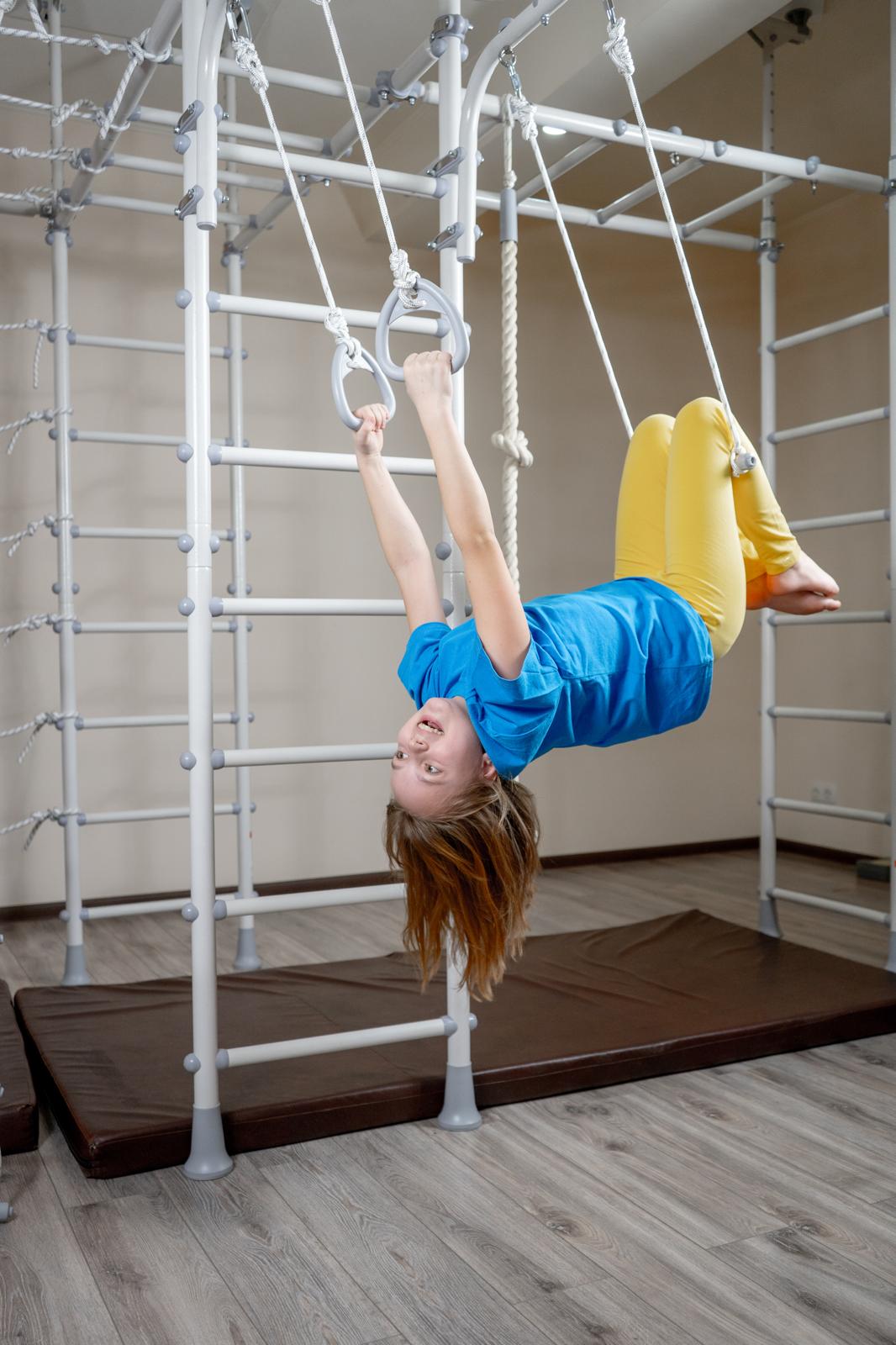
The movement zone is the opposite: always available, zero setup. This is the piece most families under-build. If the body break requires driving somewhere, inflating something, or moving furniture, it will not happen six times a day—and six times a day is the schedule. A corner with a crash mat and a compact climbing frame with a bar, rings, and a swing covers hanging, climbing, brachiating, and swinging in about the footprint of a loveseat. (Our sensory gym at home guide walks through the full build, and homeschool room ideas covers layouts for the whole space.) Safety stays first: mats under everything, gyms are for independent climbing at ages 3 and up, and the seat zone should not share a landing area with the swing's arc.
This is the part of the day we build for. A steel frame in the movement zone means the 9:05 body break is eleven steps from the math book, works in January, and never depends on weather, daylight, or your energy:


Which gym fits your homeschool room? Take the 60-Second Quiz →
And whichever direction you go—a full frame, a doorway bar, or a stack of couch cushions—the design principle survives every budget: the movement zone must be closer and easier than the misbehavior it replaces. If regulation costs less effort than dysregulation, you will get regulation.
Curriculum and program notes (brief, on purpose)
Parents researching an ADHD homeschool curriculum or comparing ADHD homeschool programs usually want the name of The One That Works. We are not going to give you one, for a reason you'll appreciate: no curriculum has been shown to fix the block-length problem, and the block-length problem is most of the problem. Almost any solid curriculum works when it is delivered in 15–25 minute pieces with movement in between; almost none survives being delivered in hour-long sittings. Structure first, materials second.
That said, some features consistently earn their keep with ADHD learners, whatever the brand on the box: short, self-contained lessons (so a block has a natural finish line); mastery-based pacing (move on when it's learned, not when the calendar says); low-clutter pages (one problem per line beats a wall of 40); interest-led units for at least one block a day; and hands-on or movement-integrated formats—spelling jumped on a hopscotch grid, math facts drilled from the top of the climbing net. Whether you assemble this from a boxed program, an online academy, a charter's course list, or a library card is a family-fit question, not a correctness question. Buy the smallest unit a publisher sells before you commit to a year of it, and check your state's homeschool requirements early so recordkeeping never becomes a surprise.
When it's hard (and it will sometimes be hard)
Now the section most guides skip. You are taking the child who exhausts trained professionals in six-hour shifts and keeping them home with you, indefinitely, while also being their parent, cook, and executive function. Some days that will feel like the best decision you ever made. Some days it will feel like you have volunteered for the hardest job in education, unpaid—and if you have ADHD yourself, as many parents of ADHD kids do, you are running someone else's executive function on borrowed working memory. None of that means you chose wrong. It means the job is real.
What actually helps, from families several years in:
Shrink the non-negotiables to three. On a hard day, the win condition is math block, reading block, movement. Everything else is bonus. A three-item day that ends warmly beats a nine-item day that ends in tears—for the child's relationship with learning and for yours with the child.
Let the schedule regulate you too. The block structure is not only for the child. Knowing that the current battle ends in eleven minutes, by design, is what keeps a parent's voice level at minute nine. Take your own body break at 9:05. Hang from the bar yourself; it holds you too, and your kid will find it hilarious.
Borrow other adults on purpose. A weekly co-op, a grandparent who owns the read-aloud, an online class for the one subject that always ends in a fight. Outsourcing your highest-friction subject is not failure; it is staffing.
Watch your own gauge. Parent burnout is the most common reason homeschools fail, and it is cheaper to prevent than repair. If you are white-knuckling by October, that is information—shrink the day, buy more curriculum-with-built-in-teaching, get respite. And a year in a good school-with-supports is not a defeat either; this decision is reversible in both directions, which is precisely what makes it safe to try.
Frequently asked questions
Is homeschooling better for kids with ADHD? There is no blanket answer, and distrust anyone who offers one. What homeschooling reliably offers is structural fit: 1:1 attention, blocks matched to your child's real attention span, and unlimited movement—advantages a preliminary study of homeschooled students with ADHD reflected in roughly doubled academic engagement. What it costs is a parent's daily capacity, and that cost is real. Families who thrive tend to be the ones who built the schedule and the room around regulation, not the ones with the most willpower.
How long should lessons be for a child with ADHD? Most families land between 15 and 25 minutes per block for elementary ages, alternated with roughly 10-minute body breaks, and stretch blocks slowly as the child grows. The better rule than any number: end the block while it is still going well. Attention you didn't drain today is attention you get back tomorrow.
Does exercise help ADHD? The research is encouraging and worth stating precisely: meta-analyses of randomized trials link regular aerobic exercise with improvements in attention, executive function, and hyperactivity symptoms in children with ADHD, and one well-known trial found a single 20-minute bout of moderate exercise was followed by better attention and academic-task performance. Exercise is not a treatment for ADHD and does not replace one—talk to your child's clinician about how movement fits alongside their overall plan.
Can I use HSA/FSA funds or a waiver to buy sensory or gym equipment? Sometimes, with paperwork. Sensory and exercise equipment may be HSA/FSA-eligible when a clinician documents medical need—our guides to play gym HSA/FSA eligibility and the letter of medical necessity walk through exactly how. Depending on your state, disability waiver programs and education savings accounts can also cover sensory equipment or homeschool costs. Rules vary; verify with your plan administrator before buying.
Sources
Cerrillo-Urbina, A.J. et al. (2015). The effects of physical exercise in children with attention deficit hyperactivity disorder: a systematic review and meta-analysis of randomized control trials. Child: Care, Health and Development. · Pontifex, M.B. et al. (2013). Exercise improves behavioral, neurocognitive, and scholastic performance in children with attention-deficit/hyperactivity disorder. The Journal of Pediatrics. · Duvall, S.F., Delquadri, J.C. & Ward, D.L. (2004). A preliminary investigation of the effectiveness of homeschool instructional environments for students with attention-deficit/hyperactivity disorder. School Psychology Review. · Sun, W. et al. (2024). Effect of aerobic exercise on the improvement of executive function in children with attention deficit hyperactivity disorder: a systematic review and meta-analysis. Frontiers in Psychology. · Centers for Disease Control and Prevention. Data on ADHD in children. · Centers for Disease Control and Prevention. Clinical care of ADHD: treatment recommendations.
📚 Keep reading in the Decision Guide
Homeschool PE at Home: The Complete Plan · Homeschool Room Ideas That Actually Work · Homeschool Grants & Funding: What's Available · Sensory Swings for ADHD
Share: