

Updated July 2026 · 10-minute read · by the Brainrich Kids team
Full disclosure up front: we make steel play gyms, so we have a horse in this race. But we also talk to hundreds of families a year who are deciding between the two, and each material genuinely fits different families. Here is the comparison we wish existed, including the cases where wood is the right call.
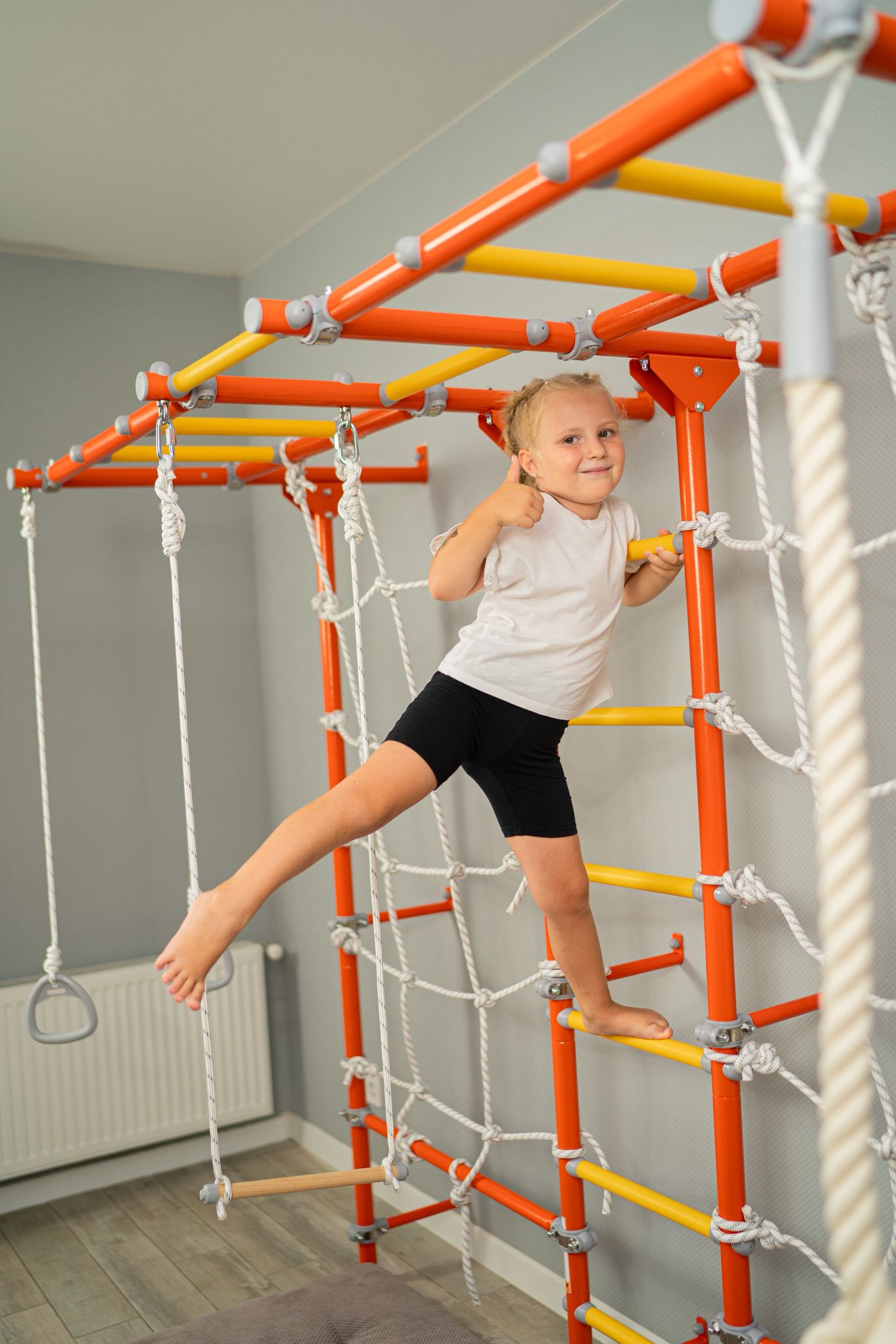
The quick answer: steel climbing gyms are roughly ten times stronger than the softwoods in most wooden climbers (size for size), which is why they hold 220 lb, stay wobble-free for decades, adjust to any age, and expand for multiple kids, in a slimmer profile than an equally strong wooden gym could ever have. Wooden climbers suit the classic Montessori aesthetic and work well for toddlers, but in marketplace reviews they are commonly reported to chip, crack, loosen, and get outgrown around age 6–7. They are fixed structures: not adjustable, not modular, not expandable, and usually not movable either. (Eyeing a $5,000–$30,000 custom playroom instead? Read the cost section before you call the contractor.)
Jump to: Comparison table · Strength · Durability · Adjustable & modular · Placement · Outdoor playsets · Buying wood well · Cost & resale · Owner quotes · Verdict · FAQ
Steel vs. wood at a glance
| Steel gym | Wooden climber | |
|---|---|---|
| Strength (size for size) | ✓ ~10× stronger | Baseline |
| Weight capacity | ✓ 220 lb, kids to adults | Typically 60–130 lb |
| Multiple kids at once | ✓ Built for combined loads | Ratings collapse with 2–3 climbers |
| Lifespan | ✓ Decades | Often outgrown by age 6–7 |
| Adjustable bar heights | ✓ Yes: any age, 3 to 13+ | ✗ No, fixed forever |
| Modular / expandable | ✓ Add sections per kid | ✗ No |
| Placement & moving | ✓ Anywhere in the room; movable, re-buildable | Wall-fixed bars, or a small floor triangle |
| Handles swinging | ✓ Braced, stays rigid | Joints loosen over time |
| Splinter risk | ✓ None | Rises as finish wears |
| Adult use (TRX, ninja, pull-ups) | ✓ Yes | ✗ No |
| Resale value | ✓ 60–75%, active resale market | Limited for worn frames |
| Design language | Modern, minimalist, slim | Classic Montessori warmth |
| Price range | $899–$2,399 | $200–$700 ($150–$400 for a Pikler) |
| Net cost per year (with resale) | ✓ ~$95/yr · 26¢/day | ~$167/yr, little resale |
The strength gap, and why it changes how the gym looks
Structural steel has roughly ten times the strength of pine and similar softwoods in tension and bending for the same cross-section:
STRUCTURAL STEEL
SOFTWOOD (PINE): ~40 MPa
That number isn't trivia: it is the entire design story. Because steel is so much stronger per square inch, a steel gym achieves its 220 lb rating with slim, clean tubes. To match that capacity, a wooden gym would need beams so thick the result would look like furniture from a fortress, which is exactly why wooden climbers are instead rated for toddlers, not teenagers. The material dictates the audience.
Looks: two different design languages
Wood suits families who love the classic Montessori look: warm, natural, familiar. Nothing wrong with that.
That warmth has a real pedigree. Maria Montessori treated movement as inseparable from learning, Hungarian pediatrician Emmi Pikler gave the world the toddler triangle that carries her name, and generations of families following physical therapist Glenn Doman have built wooden brachiation ladders into their homes; we trace that tradition in our brachiation ladder guide. Steel carries a lineage of its own: the wall-bar gymnastics tradition our founder grew up on, which is the 35-year-old gym you will meet below.
But calling steel the "less attractive" option misreads modern design. Slim white or grey lines, minimal visual weight, no bulky planks. A steel gym reads like modern architecture in a room, precisely because its strength lets it stay visually light. Families aren't choosing between "pretty and industrial." They are choosing between farmhouse and minimalist. And only one of the two still looks that way after four years of daily use, because powder-coated steel doesn't chip, dent, or wear the way finished wood does.
Durability: a 35-year data point
Marketplace reviews of wooden climbers repeat a pattern: finishes chip, joints work loose, dowels crack, and the climber that delighted a 2-year-old sits unused by a 7-year-old. That is not one bad brand. It is wood joinery under thousands of hours of dynamic load.
USEFUL LIFESPAN, IN YEARS
Steel gym (our founder's, still standing)
Typical wooden climber (outgrown, per reviews)
"I grew up on one of these steel gyms. It is still standing in my parents' house in Ukraine, close to 35 years old, and still in perfect condition. I have never seen a wooden gym last a third of that. That gym is the reason Brainrich exists."
– YEGOR NADVORNYY, FOUNDER OF BRAINRICH KIDS
And because steel frames don't degrade, refresh economics work in your favor: take a 10-year-old Brainrich, swap a few inexpensive replacement parts (ropes, rungs, a swing) and you have, functionally, a brand-new gym on the original steel.
Adjustable and modular: the two words wood can't say
Adjustable means every bar moves: monkey bars, pull-up bar, and accessories slide up or down in minutes, so the same gym fits a 3-year-old's first climb and a 13-year-old's pull-ups: literally any age. Wooden gyms are built at one fixed height, forever.
AGES SERVED BY ONE PURCHASE
Pikler triangle (9–30 months)
Typical wooden climber (ages ~2–7)
Brainrich steel system (+ parents, up to 220 lb)
← birth · · · age 3 · · · age 7 · · · age 13+ →
Modular means the frame extends: add a section, and a one-kid gym becomes a two-zone playground: one child on the net, another on the monkey bars, no waiting and no fighting. We have yet to see a wooden gym that can do either.
If you have two, three, or more kids, this stops being a preference and becomes physics. Siblings don't take turns; they climb together, and two or three kids at once means 100–200 lb of combined, moving, jumping load, plus double or triple the daily wear. That is routine inside a 220 lb steel rating, and far beyond anything a toddler-rated wooden frame was designed to survive. More kids don't wear a steel gym out; they just use it more. A fixed wooden climber serves one age at one time; a modular steel system serves the whole roster at once and grows new zones as the family does.
One more consequence of that steel strength: while the gym is rated 3+ for independent climbing, the frame accepts nearly any attachment, so families with younger siblings add a toddler swing seat or a wooden board, and the littlest family members grow up alongside the gym (with a parent's hands close by) years before their first solo climb.
Put it anywhere. Move it anytime. Rebuild it when they're bored.
Here is a difference nobody thinks about until after the purchase: where does the gym actually go, and what if you change your mind?
Wooden options give you two answers, both limiting. Wall-bar style wooden gyms are bolted to wall studs: one wall, one spot, forever. The freestanding alternative is the Pikler triangle, a lovely toddler tool, but exactly that: typically $150–$400, rated for the smallest climbers, with a developmental sweet spot of roughly 9 to 30 months.
A pressure-fit steel gym answers differently. It braces between floor and ceiling, so it stands anywhere, and no spot is permanent:
And because the system works like Lego blocks, position isn't the only thing you can change. Kids bored with the current setup after six months? Rebuild it into a different gym: move the monkey bars, re-hang the net, relocate the swings, reshape the whole configuration. A reconfigurable gym manufactures its own novelty, with no new purchase required.
Stability and the pendulum problem
Swinging is the hardest thing a play gym does. A child on a swing or rings creates repeated pendulum loads that pry at every joint, and wooden connections gradually loosen under exactly this force, which is why wobble is one of the most common complaints in wooden-climber reviews. A floor-to-ceiling tension-mounted steel frame is braced against the building itself: it takes swing energy without wobbling and without a single hole drilled in your ceiling. Whichever material you choose, follow the assembly instructions exactly and put impact mats in the landing zones.
The sensory and therapy angle
For families of sensory-seeking, ADHD, or autistic kids, capacity and permanence matter even more: swinging, climbing, and hanging are the vestibular and proprioceptive inputs occupational therapists build into home programs, a framework that traces to occupational therapist A. Jean Ayres, and they need equipment that takes intense, repeated, full-body use every day, including that pendulum motion. This is where steel's headroom earns its keep.
A gym for the whole family, including you

A 220 lb rating turns the kids' gym into family equipment: parents hang a TRX, rock-climbing grip trainers, or ninja-warrior attachments on the same steel frame and get their own workout ten feet from the kids. Try that on a toddler-rated wooden climber. Equipment the adults also use gets maintained, celebrated, and kept, not outgrown.
Which gym fits your family? Take the 60-Second Quiz →
What about an outdoor playset?
Let's say it plainly first: we love outdoor play. Sunshine, vitamin D, grass, scraped knees, the neighborhood: nothing indoors replaces it, and when the weather is good, our advice is simple: go outside. This was never an either/or. But if the actual purchase decision is outdoor wooden playset vs. indoor steel gym, two hard facts belong on the table.
First, weather is brutal on wood. Everything in this article about wooden wear (cracking, warping, loosening, splinters) happens faster outdoors, where rain, UV, frost cycles, and humidity work on the frame year-round. Outdoor wooden playsets need annual re-sealing and re-staining just to slow it down, and their reviews show it.
Second, an outdoor playset is closed exactly when kids need it most. Rain, heat waves, dark winter evenings, mosquito season, pollen season: the outdoor set sits empty during the very hours a bored, buzzing child needs an outlet right now.
That is the whole premise of the at-home gym: it lives where your kids actually spend their time. We build for homeschoolers, for occupational-therapy programs at home, for high-energy, ADHD, and autistic kids whose parents need to offer an outlet in the next thirty seconds, not after shoes, sunscreen, and a drive. And here is the observation we hear from hundreds of families: parents tend to overestimate how much outdoor play their kids really get, because the mental math counts the drive, the packing, the getting-ready, while the actual climbing minutes are fewer than we remember. The gym ten feet from the kitchen gets used before breakfast, between homeschool blocks, and at 8 p.m. in January. The best gym is the one that gets used every day, and the indoor one wins that contest by a mile.
Still leaning wood? Here's how to buy it well.
Completely fair. Here is the part most comparison articles skip. "Wood" is not one material, and the difference between a quality wooden climber and a cheap marketplace listing comes down to two things most shoppers never check.
1. Where the wood grew. Slow-grown northern timber develops tight growth rings and high density: stronger and more stable, but more expensive and harder to work. Fast-grown southern plantation wood is lighter and cheaper, with wide rings and low density, and low-density wood is exactly what cracks, warps, deforms, and in humid rooms can even harbor mold. Two climbers can look identical in photos and behave completely differently by month six.
2. How the surface was finished. A splinter-safe wooden gym requires progressive fine-grit sanding of every surface and edge, followed by multiple coats of a child-safe, non-toxic sealant, typically a water-based lacquer or a natural oil-wax finish. Done properly, this is slow, skilled, expensive work, and it is precisely where budget manufacturers cut corners. The result shows up in reviews with grim regularity: splinters, exactly where small hands grip hardest.
This is why the review sections of cheap wooden climbers keep repeating the same words: cracked, wobbly, splinters, loose bolts. If you go wood, go quality: ask what species the wood is and where it is sourced, read the 6-month-and-later reviews, confirm a multi-coat child-safe finish, and expect to pay accordingly, because dense timber and proper finishing are exactly what the cheap listings left out.
Cost: run the resale math
First, the full price ladder. Wooden climbers typically run $200–$700; steel systems $899–$2,399. And some families explore a third path: the custom-built playroom. Between design, materials, and installation, a custom playroom with built-in wooden monkey bars and climbing features runs $5,000 to $30,000. Some look absolutely stunning. But beautiful and functional are not the same thing: custom builds are often designed around how the room photographs rather than how children move: fixed heights that never adjust, layouts that never change, and zero resale value, because you cannot sell equipment bolted into your walls. Our gyms are engineered the other way around: for play, for function, and for development first, at a fraction of the price, with the resale value intact.
Sticker price says wood. Total cost of ownership says otherwise, because steel gyms have a genuine second life. Inside our 12,500-member owners' community, used Brainrich gyms are resold constantly, typically at 60–75% of their original price, with a 25% discount off retail being a common asking price.
Why so high? Three reasons buyers happily pay it: the steel doesn't degrade and inexpensive replacement parts make a used gym practically new; a used gym comes pre-assembled, saving the buyer an afternoon of setup; and local pickup means no shipping cost and no sales tax on top.
60–75%
typical resale value, even years later
~$95/yr
net cost: $1,899 gym, 8 years, resold at 60%
26¢/day
for a childhood of daily play
NET COST PER YEAR OF OWNERSHIP
$500 wooden climber, outgrown in ~3 years, little resale
$1,899 steel gym, 8 years, resold at 60%
Run the numbers: a $1,899 gym used daily for eight years, resold at 60%, nets out around $760, about $95 per year, or 26 cents a day, for the primary play equipment of an entire childhood, serving every sibling along the way. Sell at the more common 75% and it drops toward 16 cents a day. Financing from about $81.14/month and HSA/FSA eligibility for qualifying families narrow the up-front gap further.
Don't take our word for it
Every quote below is from a verified owner in our private community, unedited and typical of what parents post after the material question has settled itself in daily life:
"Their most used toy by FAR, like by a landslide. They use it every day for hours."
– LEISA L., MOM OF 3
"The only thing we've ever given our children that's gotten played with every day for three years."
– RACHEL W., BRAINRICH OWNER, 3+ YEARS
"My husband rolled his eyes when I said I wanted one. Now he agrees it's the best 'thing' we have ever purchased for our kids."
– JENNIFER A., MOM OF 3
And if you want the unfiltered version, our community of 12,500 parents has hosted long, candid comparison threads over the years, written by parents, not marketers. Come read them before you decide.
So which should you buy?
Here is the bottom line. A wooden gym good enough to avoid the problems above (dense northern timber, properly sanded, sealed in multiple coats) doesn't come cheap either. Once you price quality wood, the cost gap between good wood and steel largely disappears, while the capability gap remains.
Buy wood if you simply love wood: the material itself, the classic Montessori warmth, the way it fits your home. That preference is completely legitimate; just buy dense, properly finished wood from a reputable maker, not the cheapest listing.
Considering a custom playroom? Read the cost section again first: a modular steel system delivers the function designers are trying to build in, at a twentieth of the price, and you can take it with you.
Buy steel for everything else: durability, stability, safety, resale value, modularity, adjustability, placement freedom, multiple kids on one frame, swings that never loosen a joint, and a gym the adults use too.


Ready to see the steel difference in your living room?
Every gym ships in 5–7 days, assembles in an afternoon, and is covered by a 30-day money-back guarantee, even assembled, even used.
Frequently asked questions
How much stronger is steel than wood? Structural steel is roughly ten times stronger than common softwoods in tension and bending for the same cross-section, which is why steel gyms hold 220 lb on slim tubes while wooden climbers top out at toddler ratings.
Can multiple kids use a play gym at the same time? On a steel gym, yes: the 220 lb rating covers siblings climbing together, and modular sections add separate play zones per kid. Wooden climbers are typically rated for one small child at a time, and combined sibling loads are exactly what loosens their joints.
Is an outdoor playset better than an indoor play gym? Outdoor play is wonderful, and when the weather is good kids should be outside. But an outdoor wooden playset weathers faster (rain, UV, frost, requiring annual re-sealing) and is unusable in bad weather, darkness, and mosquito season, exactly when kids most need an outlet. An indoor gym gets used daily year-round, which is why usage-per-dollar strongly favors indoor.
How much does a custom playroom with monkey bars cost? Typically $5,000–$30,000 including design, materials, and installation. They can be beautiful, but heights never adjust, layouts never change, and there is no resale value because the equipment is built into the house. A modular steel gym delivers the daily function at a fraction of the price and keeps 60–75% resale value.
Can you move a tension-mounted play gym? Yes: that is the point of pressure-fit design. It stands anywhere in a room (corner, wall, or center), comes down without a trace, moves to another room or home, and can be rebuilt in a completely different configuration whenever your kids want a new challenge.
Why do wooden climbing gyms splinter? Splinters appear when manufacturers skimp on the two most expensive steps: progressive fine sanding and multiple coats of child-safe, non-toxic sealant (water-based lacquer or oil-wax). As a thin finish wears through with use, the wood grain opens, right where hands grip.
Are wooden climbing gyms adjustable or modular? No: wooden gyms are fixed structures: wall-bar styles bolt to studs, and freestanding Pikler triangles ($150–$400) serve roughly ages 9–30 months. Steel modular systems adjust bar heights in minutes and accept add-on sections, which is how one frame serves multiple kids and ages at once.
What do used steel play gyms sell for? Typically 60–75% of original price. The steel doesn't degrade, replacement parts make a used gym practically new, and buyers get it pre-assembled with local pickup, no shipping, and no sales tax.
Are indoor climbing gyms worth it? Owner data says the deciding factor is daily use: with resale factored in, a steel gym used daily can net out around 26 cents a day across a childhood, less per hour than almost any toy, class, or screen alternative.
📚 Keep reading in the Decision Guide
DIY vs. Buying an Indoor Play Gym · Are Climbing Gyms Safe? The Science of Controlled Risky Play · Brainrich vs. Avenlur · Metal vs Plastic vs Wood Jungle Gyms · The Indoor Jungle Gym Buyer's Guide · Jungle Gym for Adults
Share: