

Updated September 2026 · 9-min read · by Yegor Nadvornyy, founder
Recommendations for sensory swings for autism that are easy to install at home come down to one question: where does the swing hang? Three routes need no drill. A doorway bar wedges across a door frame, a free-standing stand sits on the floor, and a tension-mounted steel frame braces between floor and ceiling. This guide covers what each supports, what each cannot do, live prices and ratings from the makers' own pages, install steps for all three, and the one Brainrich model that is not the no-drill option.
The quick answer: you can hang a sensory swing at home without drilling three ways. A doorway bar (SensoryHarbor's no-screw tension bar, listed at $89.99, rated 600 lb, for doors 27.6 to 37.8 inches wide) is the cheapest and supports linear front-to-back swinging only. A free-standing swing frame (HPSI portable frame, $1,700, 325 lb; Fun and Function HD-120, $2,499, 400 lb) supports every swing type but takes 70 to 110 square feet. A tension-mounted steel play gym such as the Brainrich Model T3 ($899) or Spider V3 ($1,499) braces between the floor and a flat ceiling of 6 ft 9 in to 10 ft 6 in, is rated 220 lb working load (tested to 440), takes one corner, and the swing clips on with a carabiner. Renter-friendly, no holes. The wall-mounted Model W3 bolts into studs, so it is not the no-drill option.
Jump to: The three routes · Doorway bar · Swing stand · Tension-mounted frame · Comparison table · Install steps · FAQ
Why "easy to install" means "no drill"
Most sensory swings ship with a ceiling hook and lag screws and tell you, correctly, to find a wood joist. Fine for a homeowner with a stud finder and a Saturday; not available to renters, concrete-ceiling apartments, or the parent who wants the swing up tonight. The three no-drill routes solve that in different sizes: a doorway, a patch of floor, or a corner.
The swing is the cheap, swappable part; the anchor is the decision. Choose the anchor your home allows, then buy whichever cocoon, pod or seat the child responds to. Our best swings for autistic kids guide covers the swing half.
Route 1: the doorway bar
A steel bar across a door frame, either wedged by tension or held on small brackets. Two live examples. The SensoryHarbor No-Screw Adjustable Doorway Bar is listed at $89.99 (the page also shows $119.99; it was marked sold out when we checked), extends from 28.3 to 36.2 inches for door widths of 27.6 to 37.8 inches, and is rated 600 lb. No screws, no drill. The DreamGYM Doorway Therapy Sensory Swing is $127.97 for a bar, a cotton-blend compression swing and snap links; it fits 26 to 36 inch doors and is rated 220 lb. Its bar rests on metal brackets screwed to the door frame, so it leaves small holes in the trim rather than the ceiling; not drill-free, but far less invasive than a joist hook.
Linear swinging only. The door jambs sit inches from the swing on both sides. Front-to-back motion works; spinning, side-to-side and nest swings do not. For many autistic kids linear is the calming input anyway, so this is a real limit, not a fatal one.
The weight limit is the frame's, not the bar's. A 600 lb bar in a hollow-core door frame with 30-year-old trim is a trim-strength question. Solid wood jambs, tight casing, and a bar seated at least 2 inches inside the frame.
Height. The bar sits at about 6 ft 6 in on a standard door, so cocoons cut for 7.5 to 10 ft ceilings pool on the floor; shorten with a daisy chain.
It blocks a door. Pick a closet or spare-room door, not the route to the bathroom.
Route 2: the free-standing swing stand
A therapy-grade frame with a printed rating and its own swivel. The HPSI Portable Swing Frame with Swivel, sold by Sensory Tool House, is $1,700, 8 ft 6 in square, 7 ft 4 in tall, rated 325 lb, with rubber-tipped feet and a ball-bearing swivel for spinning. Fun and Function's HD-120 Swing Frame with Swivel is $2,499, 11 by 10 ft, 7 ft 2 in tall, rated 400 lb, and supports single- and double-point swings. Both move room to room. The catch is floor: 70 to 110 square feet plus clear air, a dedicated sensory room rather than a bedroom. Every swing type works, and this is the route clinics use.
Route 3: the tension-mounted steel frame
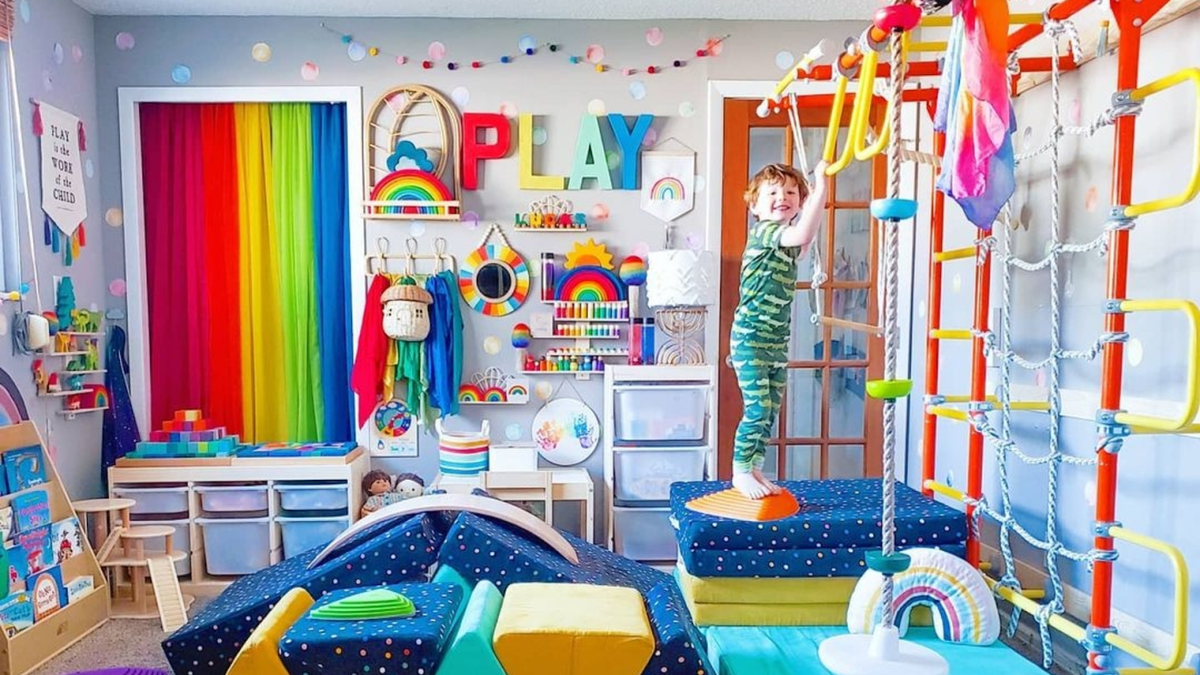
Our route. A Brainrich T3 or Spider V3 is a steel play gym whose vertical poles telescope and lock between the floor and a flat ceiling, the way a shower-curtain rod works but with a structural load. No drilling, no anchors, no marks beyond a rubber foot, which is why renters buy it and why it moves house with you. The frames come in three heights: Basement for ceilings from 6 ft 9 in, Standard from 7 ft 8 in to 9 ft 11 in, and Tall to 10 ft 6 in.
The swing clips on with carabiners to the ring hooks on the V3 pull-up bar, or on the Spider's monkey-bar span. Anything with a carabiner hangs there: the $27 Classic Swing, a Harkla or SensoryHarbor cocoon, a pod swing, the trapeze and rings that ship in the box. Linear swinging and gentle spinning both work because the swing hangs in open air. Working load 220 lb, safety-tested to 440; the tested number is the margin, not the capacity.
Model T3 · $899
One gym ladder, two sets of pull-up bars, rings, rope, trapeze, rope ladder, and the swing point. The bedroom size: a corner the width of a dresser.
Spider V3 · $1,499
Two ladders with the monkey bars built in between, a rope net, and the same accessories. The span hangs a hammock and a seat swing at once, and the climbing is the heavy work that pairs with swinging.
Model W3 · not this one
The wall-mounted W3 ($850) bolts into studs and supports linear swinging only. Great under a slanted ceiling; not the answer to "no drilling."
The trade-off is plain arithmetic: a doorway bar costs a tenth as much. What the frame buys is the rest of the sensory diet in the same footprint, climbing, hanging and rope work, which is why Rebecca P. in our owner community wrote: "Amazing for our daughter to fulfill her sensory needs. We have been able to attach sensory swings and other attachments for her OT." More on building that setup in sensory gym at home.
No-drill sensory swing routes: side by side
| Route / product | Drilling | Published rating | Swing motion | Space needed | Renter-friendly | Price |
|---|---|---|---|---|---|---|
| SensoryHarbor No-Screw Doorway Bar | None (tension) | 600 lb | Linear only | A 27.6 to 37.8 in doorway; blocks it | Yes | $89.99 (bar only) |
| DreamGYM Doorway Therapy Sensory Swing | Bracket screws into door trim | 220 lb | Linear only | A 26 to 36 in doorway; blocks it | Small trim holes | $127.97 (bar and swing) |
| HPSI Portable Swing Frame (Sensory Tool House) | None | 325 lb | Linear and spinning, all swing types | 8 ft 6 in square, 7 ft 4 in tall | Yes | $1,700 (frame only) |
| Fun and Function HD-120 Swing Frame | None | 400 lb | Linear and spinning, single- or double-point | 11 by 10 ft, 7 ft 2 in tall | Yes | $2,499 (frame only) |
| Brainrich Model T3 / Spider V3 (tension-mounted) | None (floor-to-ceiling tension) | 220 lb working, tested to 440 | Linear and gentle spinning; hammock, pod, seat, trapeze | One corner; flat ceiling 6 ft 9 in to 10 ft 6 in | Yes; moves with you | $899 / $1,499 (gym; swing $27) |
| Brainrich Model W3 (wall-mounted) | Yes, into studs | 220 lb working, tested to 440 | Linear only | 9 in off a stud wall | Ask the landlord | $850 |
Prices and ratings were read from each maker's page in September 2026 and will change; source links are at the bottom. A rating on a bar or frame never raises the rating of the swing hanging from it; the lowest number in the chain governs.
Install steps for each route
Doorway bar (15 minutes)
1. Pick a solid-wood door frame you can afford to block. 2. Measure the width and confirm it is inside the bar's range. 3. Extend the bar, seat both ends at least 2 inches inside the jambs, tighten to the maker's torque. 4. Hang your full body weight from it before the child does. 5. Clip the swing on with a rated carabiner; mat below; re-check tension weekly.
Swing stand (1 to 2 hours)
1. Clear the footprint plus 3 feet on every side. 2. Assemble on the floor per the manual, two adults. 3. Check every bolt, then check the swivel spins freely under load. 4. Hang the swing from the swivel with the supplied carabiner. 5. Level the feet; put the mat down; nothing breakable inside the arc.
Tension-mounted frame (a few hours)
1. Measure ceiling height and find a flat patch clear of ducts, beams and fixtures; order Basement, Standard or Tall. 2. Assemble the ladders on the floor, two adults. 3. Stand the frame, extend the telescopic poles to the ceiling, tighten to spec. 4. Push the top of the frame: no sway. 5. Clip the swing to the ring hooks with carabiners; mat under the arc; parent in the same room.
Whichever route, the session is the same: slow, linear, rhythmic motion as the default, spinning only in counted doses if a therapist suggests it. The routine is in sensory swing for ADHD, and the mount comparison in more depth in indoor swing for kids.


A sensory swing up tonight, and no holes when you move out
Steel indoor play gyms for ages 3 to 12+. No drilling, 30-day money-back guarantee.
Frequently asked questions
How do you install a sensory swing at home without drilling? Three ways: a tension doorway bar such as the SensoryHarbor No-Screw bar (600 lb, linear swinging only), a free-standing swing frame such as the HPSI portable frame (325 lb) or Fun and Function HD-120 (400 lb), or a tension-mounted steel play gym such as the Brainrich Model T3 or Spider V3, which braces between floor and ceiling and carries a 220 lb working load. The swing clips to any of them with a carabiner.
Are doorway sensory swings safe? They can be, within their limits. The bar's rating only counts if the door frame is solid wood in good condition and the bar is seated well inside the jambs. Motion is front-to-back only, the bar sits at about 6 ft 6 in, and the doorway is blocked while the swing is up. A parent stays in the same room, as with any swing.
Can a renter put up a sensory swing? Yes. A tension doorway bar and a tension-mounted frame both leave nothing behind but a rubber foot mark. The Brainrich T3 and Spider V3 press between the floor and a flat ceiling from 6 ft 9 in to 10 ft 6 in, disassemble, and move to the next apartment. Wall-mounted gyms and joist hooks need the landlord's yes.
What ceiling height does a tension-mounted play gym need? A flat ceiling between 6 ft 9 in and 10 ft 6 in, clear of ducts, beams and light fixtures where the poles land. Brainrich frames come in Basement, Standard and Tall heights to cover that range. Slanted or cathedral ceilings send you to a wall-mounted model, which does need drilling into studs.
Which is better for an autistic child, a doorway swing or a frame? If linear calming input is the whole goal and the budget is tight, a doorway bar with a cocoon does the job. If the child also seeks climbing, hanging and heavy work, or needs spinning in counted doses, a floor-standing frame gives every input in one corner without blocking a door.
📚 Keep reading in the Decision Guide
Sensory Swing for ADHD · Best Swings for Autistic Kids · Indoor Swing for Kids · Sensory Gym at Home · Sensory Swings Guide
Sources
SensoryHarbor. No-Screw Adjustable Doorway Bar, September 2026. · DreamGYM. Doorway Therapy Sensory Swing, September 2026. · Sensory Tool House. HPSI Portable Swing Frame with Swivel, September 2026. · Fun and Function. HD-120 Swing Frame with Swivel, September 2026. · Harkla. Compression Sensory Swing, joist-mount and ceiling-height guidance, September 2026. · Ayres, A. J. (1972). Sensory Integration and Learning Disorders. · Brainrich Kids engineering specification: frame working load 220 lb, safety-tested to 440 lb; ceiling ranges Basement 6 ft 9 in to 9 ft 1 in, Standard 7 ft 8 in to 9 ft 11 in, Tall 9 ft 4 in to 10 ft 6 in.
Share: