

Published September 2026 · 11-minute read · by Yegor Nadvornyy, founder of Brainrich Kids
Ask a room of autism parents what single purchase earned its keep, and swings come up over and over. Not as a toy: as a regulation tool that works at 7 a.m. before school and at 7 p.m. before the bedtime cliff. But "autism swing" covers half a dozen very different objects, and the difference between the right one and the wrong one is the difference between a daily tool and a closet ornament. This guide matches swing types to sensory profiles, covers the part most guides skip (what you hang it from), and walks through how families actually pay for one.
The quick answer: match the swing to the child's profile. Kids who get overwhelmed tend to do best in enclosing swings (pod, cocoon, compression hammock) moved slowly in a straight line. Sensory seekers tend to want open swings that go big: platform, disc, classic seat, or anything that spins. The mounting question decides everything else: a doorway bar limits you to one small swing, a ceiling mount is permanent and stud-dependent, and a freestanding steel frame holds any swing type plus climbing, with no drilling. Swings for a diagnosed child may be HSA/FSA eligible with a Letter of Medical Necessity, and some state waiver programs fund sensory equipment.
Jump to: Why swings help · Swing types compared · What to hang it from · Safety rules · Funding · FAQ
Why swings work for autistic kids
Swinging feeds the vestibular system, the inner-ear network that senses motion and gravity, and vestibular input is one of the most powerful regulation levers there is. The clinical framework goes back to Dr. A. Jean Ayres's sensory integration work, and the practical version every OT teaches is a two-way dial: slow, rhythmic, linear swinging calms; fast, variable, rotary swinging alerts. That's why the same object can wind a child down before bed and wake a low-energy child up before homework, and why swings appear in nearly every sensory gym and OT clinic on earth. The deeper science is in our vestibular input explainer. Two honest boundaries: responses are individual, and swinging is a support, not a treatment. Watch your child, not the marketing.
Swing types, matched to sensory profiles
| Type | What it does | Best for |
|---|---|---|
| Pod / cocoon | Wraps the child in fabric; combines gentle motion with enclosure and reduced visual input | Kids who overload easily; the after-school decompression chamber; reading and calm-down time |
| Compression / lycra hammock | Stretchy fabric adds deep-pressure squeeze to the motion: vestibular plus proprioceptive at once | Kids who seek pressure and crash into things; often the OT-clinic favorite |
| Platform | Flat deck for lying, sitting, kneeling, or standing; supports two kids and play-on-top games | Therapy-style home setups; kids working on balance and core strength |
| Disc / rope swing | Single point, spins and swings in every direction; strongest input per minute | Confirmed sensory seekers who ask for spinning; needs the most clearance |
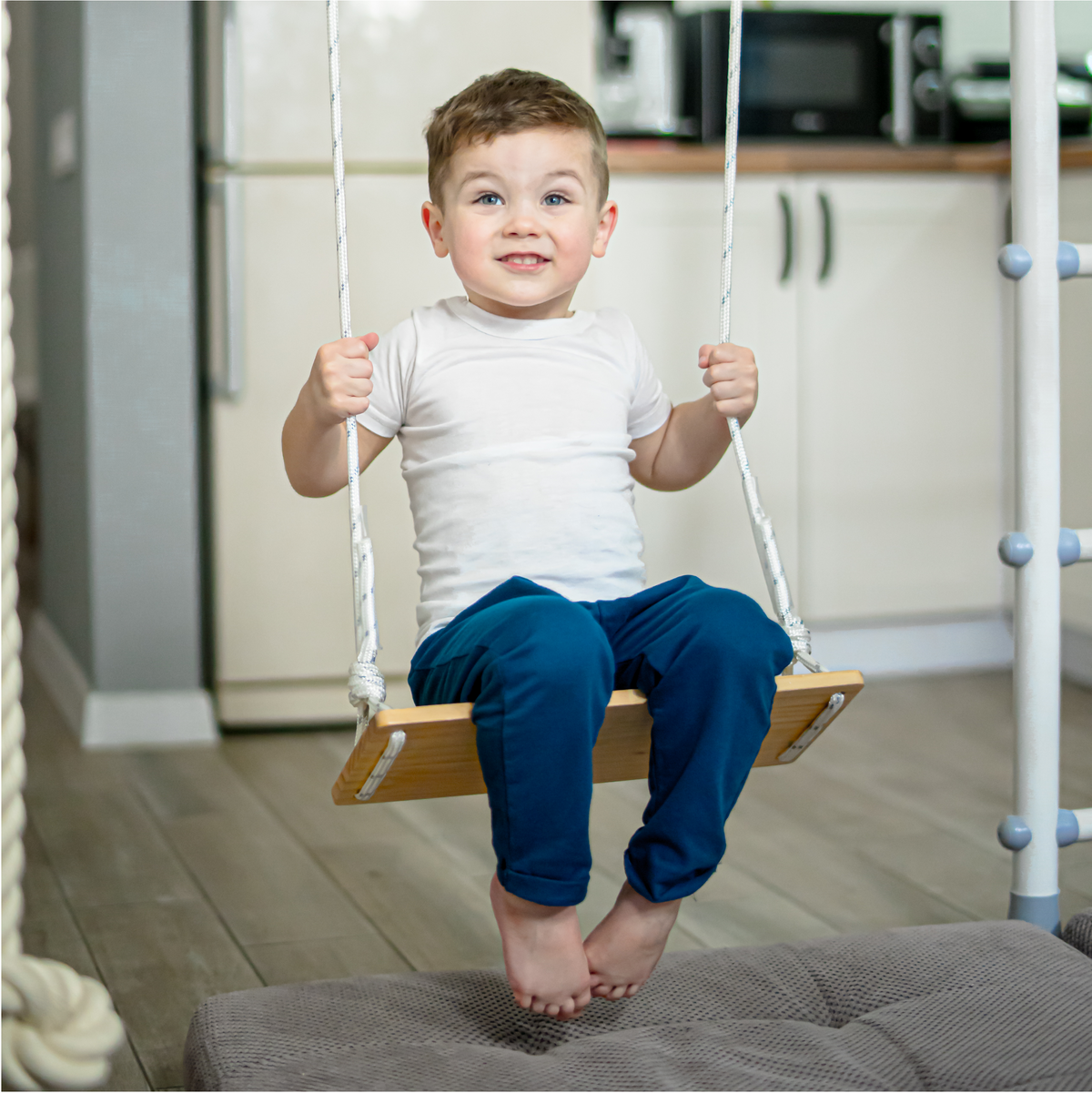
| Classic seat | The playground swing, indoors; clean linear motion, easy on/off, lasts for years | First swing for almost any profile; our Classic Wood Swing is $27 for families with a frame to hang it on |
| Trapeze & rings | Swinging the child powers by hanging: motion plus intense grip-and-shoulder heavy work | Seekers ages 5+; pairs regulation with real strength building |
If you're choosing exactly one: overwhelmed kids get the pod, seekers get the disc or trapeze, and the undecided get the classic seat, because it's the cheapest experiment and every frame accepts more swings later. Full type-by-type detail, including weight limits and fabric care, lives in our Sensory Swings 101 and indoor swing comparison.
The real decision: what you hang it from
Every swing purchase is secretly a mounting purchase. Three options:
- Doorway bar: cheapest entry, no installation beyond the frame, but it limits swing size, motion arc, and the doorway stays occupied. Fine for testing whether swinging helps; usually outgrown fast.
- Ceiling mount: clean and permanent, but it must hit a joist, it's a hole in the ceiling (renters, take note), it's fixed in one spot forever, and rotary swings need a swivel plus serious clearance. If you drill, use rated hardware and follow the manufacturer's load specs exactly.
- Freestanding steel frame: our lane, so the disclosure is on the table. A floor-to-ceiling gym like our Model T3 braces between floor and ceiling with no drilling, holds any swing type from multiple hanging points, and the same frame carries rings, ropes, and climbing, so the swing corner is also the heavy work station. Working load 220 lb, safety-tested to 440, which covers a growing kid, a sibling, and momentum. One routing note: our wall-mounted W3 supports linear swinging only (it sits 9 inches off the wall, so a small hammock fits but nest swings and spinning don't); families who want 360-degree spinning should choose a full-size floor frame.
The safety rules that actually matter
- Respect the weight rating of both the swing and what it hangs from, and remember two kids plus momentum can double the effective load.
- Clearance: a straight-line swing needs free space along its arc; a rotary swing needs a full circle. Walk the arc before the first ride.
- Soft landing zone under and around: a thick mat beats bare floor everywhere a child can exit a swing, planned or not.
- Parent in the room for younger kids and for any new swing until skills are proven; independent use of climbing equipment starts at age 3+.
- Watch the dose. Vestibular input is powerful and can accumulate: if a child comes off spinning flushed, glassy, or wired, that was too much. Slow, brief, and observed beats long and wild, especially at the start. OTs often cap rotary input deliberately.
- Buy rated equipment. A swing that holds a child's life should publish its ratings. Ours do, and whatever you buy should too.
How families fund an autism swing (or the whole gym)
Three routes come up constantly in our inbox, and the language here matters, so we keep it precise: eligibility is decided by plans and programs, not by us.
- HSA/FSA with a Letter of Medical Necessity: when a child has a qualifying diagnosis and a licensed provider writes an LMN, sensory equipment may be eligible for HSA/FSA reimbursement. The process, timing, and December 31 use-it-or-lose-it deadline are in our HSA/FSA guide, and the letter itself is covered in our LMN template guide.
- State disability waiver programs: many states run Medicaid waivers that can fund sensory and adaptive equipment; the state-by-state map is in our waiver program guide.
- Modular buying: our gyms are modular on purpose, so a budget or funding allocation that doesn't cover the full build can cover a starter configuration now, with add-ons like a second swing point or the Monkey Bars purchased separately later, or with the next round of funding.
Need an itemized invoice for your program? That part is on us.
Most funding programs and plan administrators ask for an itemized invoice. Email info@brainrichkids.com with: 1. Your full name · 2. Your address · 3. The model and color you're interested in. We'll calculate shipping, applicable taxes, and the full total, and send the invoice back ready to submit.
One frame, every swing, plus the climbing
Steel floor-to-ceiling frames that hang any swing type with no drilling, and carry rings, ropes, and monkey bars on the same structure. Backed by a 30-day money-back guarantee.
Frequently asked questions
What kind of swing is best for an autistic child? It depends on the sensory profile. Kids who overload easily usually do best in enclosing swings (pod, cocoon, or compression hammock) moved slowly in a straight line, while sensory seekers usually want open swings that deliver big motion: platform, disc, classic seat, or trapeze. If you're unsure, start with a classic seat: it's inexpensive, works for most profiles, and the same hanging point accepts a different swing later.
Do swings really help kids with autism? Swinging delivers vestibular input, one of the strongest sensory regulation levers, and slow linear swinging is widely used by occupational therapists as a calming tool. Responses are individual: many families see a real difference in regulation before school and bed, while other kids respond more to pressure or climbing. Treat a swing as a support that you evaluate on your own child, not a treatment.
Is an autism swing HSA/FSA eligible? It may be. When a child has a qualifying diagnosis and a licensed provider writes a Letter of Medical Necessity, sensory equipment can be eligible for HSA/FSA funds; the plan administrator makes the final call. Most FSA balances expire December 31, which makes fall the practical season to start the paperwork.
What should I hang an indoor swing from? Three options: a doorway bar (cheap but limiting), a ceiling mount into a joist (permanent, one location, renters usually can't), or a freestanding floor-to-ceiling frame that braces without drilling and offers multiple hanging points plus climbing. Whatever you choose, respect the published weight ratings, keep the swing arc clear, and put a mat underneath.
Do you make a swing with a stand? Effectively yes: our steel play gym frames act as the stand. They brace between floor and ceiling without drilling, hold any of our swing types with a 220 lb working load, safety-tested to 440, and the same structure carries rings, ropes, and monkey bars, so the swing stand doubles as the full sensory gym.
📚 Keep reading in the Decision Guide
Sensory Swings 101 · Vestibular Input Explained · Is a Play Gym HSA/FSA Eligible?
New: not sure where the swing should hang? Read Indoor Swing for Kids: Ceiling, Frame, Doorway, or Play Gym?, with pod swing notes and weight limits.
New: need a swing rated for a bigger kid, teen, or adult? See Heavy-Duty Sensory Swing That Supports 150 lb.
New: renting, or no joist to drill into? Read No-Drill Sensory Swing.
Sources
Ayres, A.J. (1972). Sensory Integration and Learning Disorders. Western Psychological Services. · Kranowitz, C. (2005). The Out-of-Sync Child. Perigee. · STAR Institute for Sensory Processing. sensoryhealth.org. · Brainrich Kids engineering specification: frame working load 220 lb, safety-tested to 440 lb.
Share: